
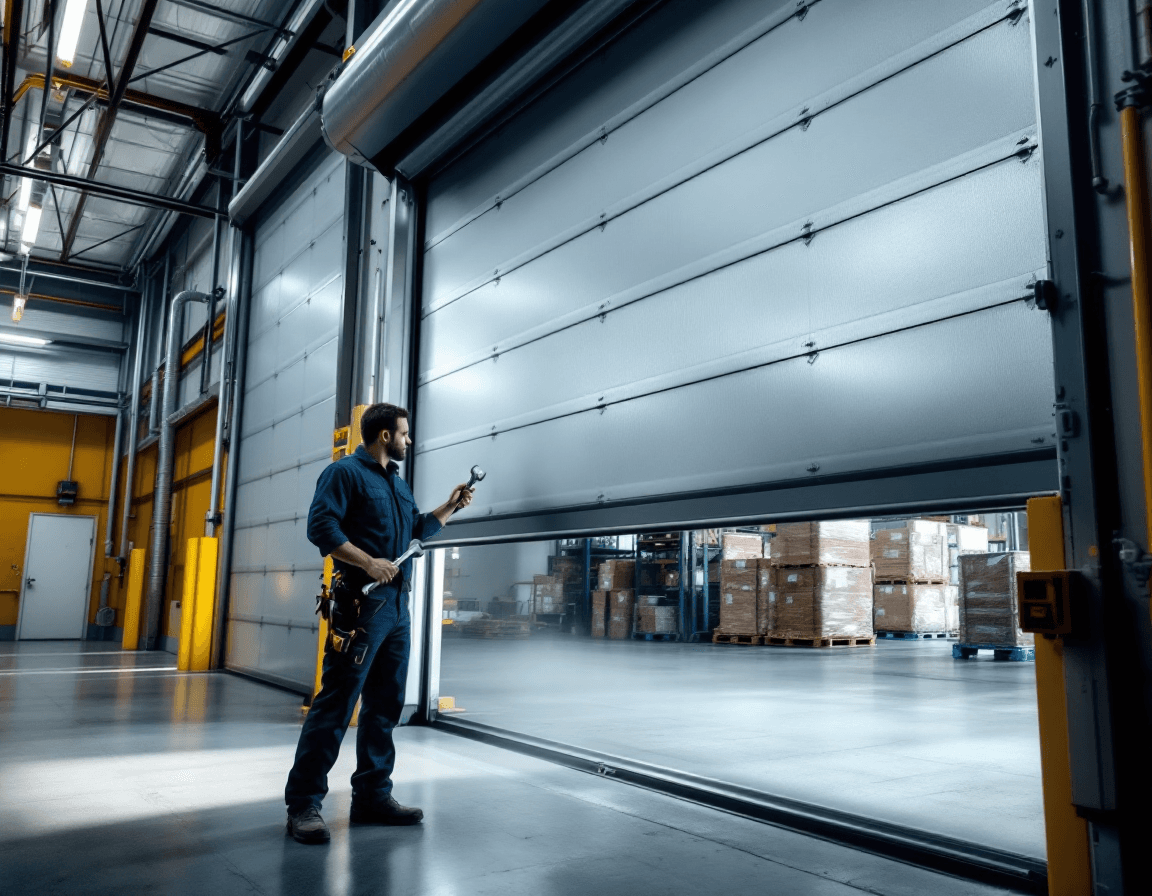
Commercial Overhead Door Repair in Bainbridge Island, WA is a service that business owners on the island usually need on short notice, often when a loading dock door stops mid-shift or a rolling steel door refuses to close at closing time. Bainbridge Island has a mix of storefronts, contractor yards, light manufacturing shops, and service businesses that depend on large doors to move inventory and equipment. When one of those doors fails, the cost is measured in idle crews, delayed deliveries, and customers waiting outside. Our team approaches commercial door work with that reality in mind.
Commercial doors are not simply bigger residential doors. They use heavier panels, larger torsion springs, commercial-grade operators, and track configurations designed for daily cycling rather than occasional use. A sectional door on a warehouse bay might open and close dozens of times in a single morning, while a rolling steel door on a storefront may be the primary security barrier for the entire building overnight. Because the stakes are higher, the diagnosis and repair process has to be organized, documented, and fast. This page explains how we handle those jobs, what symptoms are worth acting on right away, and how preventive planning can keep your doors working through the wet Pacific Northwest seasons.
Every repair starts with a clear understanding of what your business needs the door to do. Some properties need the fastest possible return to service, even if a temporary fix is required before a full component replacement. Others have time to schedule a planned repair during a slower week. We will talk through those tradeoffs with you before any work begins so you can make an informed decision. Our goal is to reduce downtime without cutting corners on the parts and procedures that keep your doors and your people safe.
Why Island Businesses Plan Around Ferry Schedules and Access
Bainbridge Island is reached by Washington State Ferry from Seattle, and that single fact shapes how many local businesses operate. Deliveries, vendor visits, and emergency service calls all have to fit around sailing times and traffic on the island's main roads. When a commercial door fails in the Winslow core, a contractor in an outlying yard may not be able to wait a full day for a replacement part to arrive. Planning ahead for those constraints is one of the most useful things a property manager can do.
Our dispatch process accounts for island logistics. We ask detailed questions about the door type, the manufacturer label if it is visible, the approximate height and width of the opening, and whether the door is currently safe to operate. That information lets us determine whether the job can be handled with parts we already carry, whether a special order is needed, and whether a temporary measure can get the door moving while we wait. We would rather tell you honestly that a part needs to cross on the next ferry than promise a same-day install we cannot deliver.
Access matters too. Many commercial buildings on the island have limited parking near loading docks, shared alleys, or gated yards. We coordinate arrival windows with your site contact, confirm where the vehicle can stage, and identify whether lifts or lift equipment will be needed to reach high spring assemblies or operator mounts. That kind of planning prevents the second-visit delays that cost businesses the most time.
Recognizing Warning Signs Before a Loading Dock Goes Down
Most commercial door failures announce themselves well before the door stops. Operators often strain, panels may hesitate at the same spot on every cycle, or the door may make a grinding or popping sound that was not there last month. Catching those changes early allows a planned repair instead of an emergency call during peak receiving hours. Facility staff who run the doors every day are often the first to notice, so it helps to brief them on what normal operation sounds and looks like.
Several specific symptoms deserve prompt attention. A door that stops partway and then reverses may have a safety sensor issue, a track obstruction, or an operator setting that needs adjustment. Uneven movement, where one side lifts faster than the other, usually points to cable, drum, or spring imbalance. A door that is noticeably slower than it used to be may be signaling a weak operator motor, worn gear components, or binding in the track. Any time a door begins to drop unexpectedly, stop using it and call a technician right away.
- A loading dock door that stops mid-cycle or reverses without an obvious obstruction
- Rolling steel slats that bind, buckle, or sit crooked in the guides
- Operator motors that hum, overheat, or trip the breaker during normal runs
- Visible gaps in weatherstripping at the bottom seal that let in rain, cold air, or pests
- Sections that show dents, cracked hinges, or loose rollers after a bump from equipment
- Unusual vibration or clicking from overhead components when the door is at rest
If you see any of these conditions, document what you observed, including the time of day, the door's approximate position when the problem occurred, and whether anyone was hurt or nearly hurt. That record helps our technicians arrive prepared and shortens the diagnostic phase.
Sectional Doors on Winslow Storefronts and Light Industrial Bays
Sectional overhead doors are common on the island's light industrial and service buildings because they open vertically, leaving the interior ceiling clear and the approach area free for vehicles. These doors are built from insulated or uninsulated panels joined by hinges and guided by tracks on both sides, with torsion springs providing the lift assistance. Commercial sectional doors are typically larger and heavier than residential units, which means their springs, drums, and cables carry significantly more load. That is why these components require licensed handling.
In the Winslow area, sectional doors often serve buildings that receive frequent small deliveries, service vehicles, or walk-in customers during business hours. Repairs in those settings focus on keeping the door reliable under constant cycling. We inspect the track alignment, check roller condition, examine hinges for cracking, and confirm that the bottom weatherseal is not compressed or torn. When a single section is damaged, we can often replace that panel rather than the whole door, provided the replacement matches the existing profile and insulation rating.
Preventive attention to sectional doors pays off quickly. Lubricating rollers and hinge points, tightening hardware that has loosened from vibration, and verifying that the door balances correctly can extend service life and reduce the chance of an unplanned stoppage. Balance testing should always be performed by a licensed technician because it involves high-tension components. Please do not attempt to adjust springs or cables yourself, even if you have experience with lighter residential doors.
Rolling Steel Doors That Jam, Bind, or Leave the Track
Rolling steel doors are a different category of equipment. Instead of panels that pivot along a track, these doors use interlocking horizontal slats wound onto a barrel above the opening. They are popular on storefronts, shops, and buildings that need a robust closure with a compact footprint. Because the slats are fed into guide channels on each side, anything that disrupts those channels, from a bent slat to a debris buildup, can cause the door to jam or slip off track.
On the island, we see rolling steel doors affected by moisture and grit more than almost anything else. Wet conditions can promote corrosion at the guide channels, and sand or leaf debris can collect where the bottom slat meets the sill. When a door begins to bind, the first step is typically to inspect the guides and clear obstructions, then check whether the slats are seated evenly. A door that has come off track may need careful realignment of the guides, the barrel, and the shaft, and that work should be done only after the door is secured against unintended movement.
Our technicians will assess whether a slat can be straightened and reinstalled or whether it needs to be replaced. We also check the counterbalance system and the operator if one is installed. A rolling steel door that is hard to lift by hand or that fails to hold position may have a worn spring assembly, which is another job for a licensed professional. Clean, lubricate, and inspect guides on a regular schedule to reduce how often these issues show up unexpectedly.
Commercial Operators and How Slow Travel Hurts Throughput
Commercial operators are the motorized units that drive the door up and down. They are designed for higher duty cycles than residential openers, and they often include features such as reversing sensors, photo eyes, and adjustable travel limits. When an operator fails, the door may stop completely, travel too slowly, or fail to hold its limit positions. For a busy dock, a sluggish door is almost as disruptive as a dead one because every cycle adds seconds that accumulate across a shift.
Speed issues have several possible causes. The motor may be wearing out, the drive chain or belt may need tensioning, the gear reducer may be low on lubricant or damaged, or the controller may be set to a conservative travel profile. Electrical problems, such as a failing contactor or a loose connection in the control panel, can also cause intermittent slowdowns that are easy to mistake for mechanical wear. We test the operator under load, verify voltage at the supply, and check the limit and safety circuits before recommending a component replacement.
Where throughput is the core concern, we look at the whole system instead of only the operator. A fast motor cannot compensate for a door that binds in its tracks or springs that have lost their rated tension. We can recommend operator upgrades matched to the door weight and cycle frequency, along with adjustments that improve speed without compromising safety. Every change is documented so your facility team knows what was done and why.
Forklift Strikes, Damaged Sections, and Realistic Repair Scope
Forklift impact is one of the most common causes of significant damage on commercial doors. A pallet that catches the bottom panel, a mast that clips a section, or a misjudged approach can crack hinges, bend tracks, and distort the panel profile. Impact damage can look minor from the outside while hiding stress in the hinge knuckles, roller brackets, or spring assemblies. That is why any strike should be reported and inspected, even if the door still appears to function.
After an impact, we start by making the door safe. That may mean locking it in a fixed position, blocking the opening, or disconnecting power to the operator before anyone walks beneath the panels. Next, we assess the extent of the damage. A single panel can often be replaced if the rest of the door is sound and the replacement matches the existing profile, thickness, and insulation. If tracks are bent or the spring system has been stressed, the repair may involve several components at once, and we will explain the sequence and the expected timeline before starting.
Repair scope is not always obvious until the door is open and inspected. We provide a clear written description of recommended work, including whether the repair is temporary or permanent, so you can plan around operations. If a full door replacement would be more economical than piecemeal repairs, we will say so honestly. Our commitment is to recommend the most sensible fix for your building, not the most expensive one.
Pacific Northwest Weather, Salt Air, and Long-Term Wear
Western Washington's climate is mild compared with many parts of the country, but it places steady demands on commercial doors. Frequent rain, damp mornings, and salt-laden marine air can accelerate corrosion on steel components, degrade weatherseals, and cause wood or composite elements to swell and shift. Doors on the waterfront side of the island may experience more exposure, and sheltered alcoves can trap moisture if drainage is poor. Winter condensation inside unheated buildings adds another layer of wear.
These conditions influence which maintenance tasks matter most. Galvanized and coated steel hardware should be inspected for rust at hinge pins, roller brackets, and fasteners. Bottom seals and perimeter gaskets need to remain flexible to keep rain and debris out. Drain paths at the header and sill should be clear so water does not pool behind guides. Lubricants should be chosen for wet conditions, and residue from salt or grit should be wiped away during routine service visits.
- Inspect steel hardware for early corrosion at least twice a year, especially on rolling doors near the sill
- Replace worn bottom seals before they harden and crack in cold snaps
- Keep weep holes and drainage paths at the track base clear of debris
- Check that operator enclosures remain dry and sealed against moisture intrusion
- Confirm that exterior lighting and sensors near the door are not obstructed by vegetation
Seasonal planning helps. Many facilities schedule a preventive review in late summer before the wet season and a second check in early spring after winter stress has had time to show. Doing so catches small problems while they are still inexpensive to fix.
Preventive Maintenance Agreements for Island Operations
A preventive maintenance agreement is a planned service arrangement that schedules regular inspections, adjustments, and minor repairs for your commercial doors. For businesses on Bainbridge Island, this approach can reduce emergency calls, protect nearby equipment and vehicles, and create a documented maintenance history that property managers and insurers may find useful. The specific scope, frequency, and pricing depend on the number of doors, their type, and how heavily each one is used.
A well-structured agreement typically includes a baseline inspection of each door and operator, lubrication of moving parts, testing of safety reversing devices and sensors, verification of limit settings, and a review of wear items such as rollers, hinges, cables, and seals. We provide a written summary after each visit noting what was checked, what was adjusted, and what should be monitored. If we identify a component that is nearing the end of its service life, we flag it early so you can budget for replacement rather than reacting to a breakdown.
Agreements can be tailored. A contractor yard with three large sectional doors and a rolling steel shop door will have different needs than a retail building with a single storefront rolling door and a loading dock. We will recommend a visit frequency based on actual usage and the condition of your equipment, and we will adjust the plan as your operation changes.
How Custom Commercial Quotes Are Built
Commercial pricing is not a flat rate because no two doors are identical. Quotes depend on door size, material, manufacturer, condition, the scope of repair, the availability of parts, the need for lifts or specialized tools, and whether the work must be done outside normal hours. We provide custom commercial quotes instead of generic estimates because a bulk price cannot reflect the details of your building, your schedule, or your risk tolerance.
Our quoting process begins with a site visit or detailed remote review, depending on the job. We document the door type, dimensions, operator model if present, and visible damage. We then outline the recommended repair path, including any options such as a temporary fix to restore operation followed by a planned permanent repair. Each option comes with a clear description of what is included, what is not included, and what conditions could change the scope. You receive the quote in writing so you can compare it with internal budgets or property management approvals.
Turnaround is a priority. For urgent failures, we aim to move quickly from diagnosis to recommendation so you can decide without delay. When parts must be sourced from off-island suppliers, we will tell you the expected timing and whether a rental or temporary solution is available. Our objective is to keep your business moving while making sure the repair is done correctly.
Safety Standards for High-Tension and Automated Systems
Commercial overhead doors involve stored mechanical energy, heavy panels, and automated motion, which is why safety must guide every decision. Torsion springs and cable systems can cause serious injury if they are handled incorrectly, and automated operators must be configured so the door reverses safely when it contacts an obstruction. Facilities should follow applicable manufacturer instructions and recognized industry guidance, and repairs should be performed by trained professionals.
We hold firm on several safety principles. Spring and cable work must be performed by a licensed technician with the right tools and training, never by an untrained person working alone. Doors should be secured and de-energized before technicians work near tensioned components. Entrapment protection and reversing devices must be tested after any adjustment, and any door that fails safety checks is taken out of service until corrected. If you notice a door that is operating unsafely, do not attempt to force it open or closed. Keep people clear of the opening and call for service.
We also encourage facility staff to take part in safety. Training employees to recognize warning signs, to avoid standing beneath doors in motion, and to report impacts immediately can prevent many injuries. Clear signage and marked traffic routes around loading areas support that effort. Good safety habits and professional maintenance work together to protect your people and your property.
Commercial Overhead Door Repair in Bainbridge Island, WA is most effective when it is planned, documented, and performed by people who understand both the mechanical demands of large doors and the practical realities of island business. Whether you need an urgent repair to a stalled loading dock door, a rolling steel door brought back onto its track, an operator tuned for faster cycling, or a preventive maintenance agreement to protect your schedule, we are ready to help. Call Seattle Garage Door Fix at (888) 799-3819 to describe your doors, your access constraints, and your timeline, and we will put together a custom commercial quote with a clear plan for getting your operation moving again.