
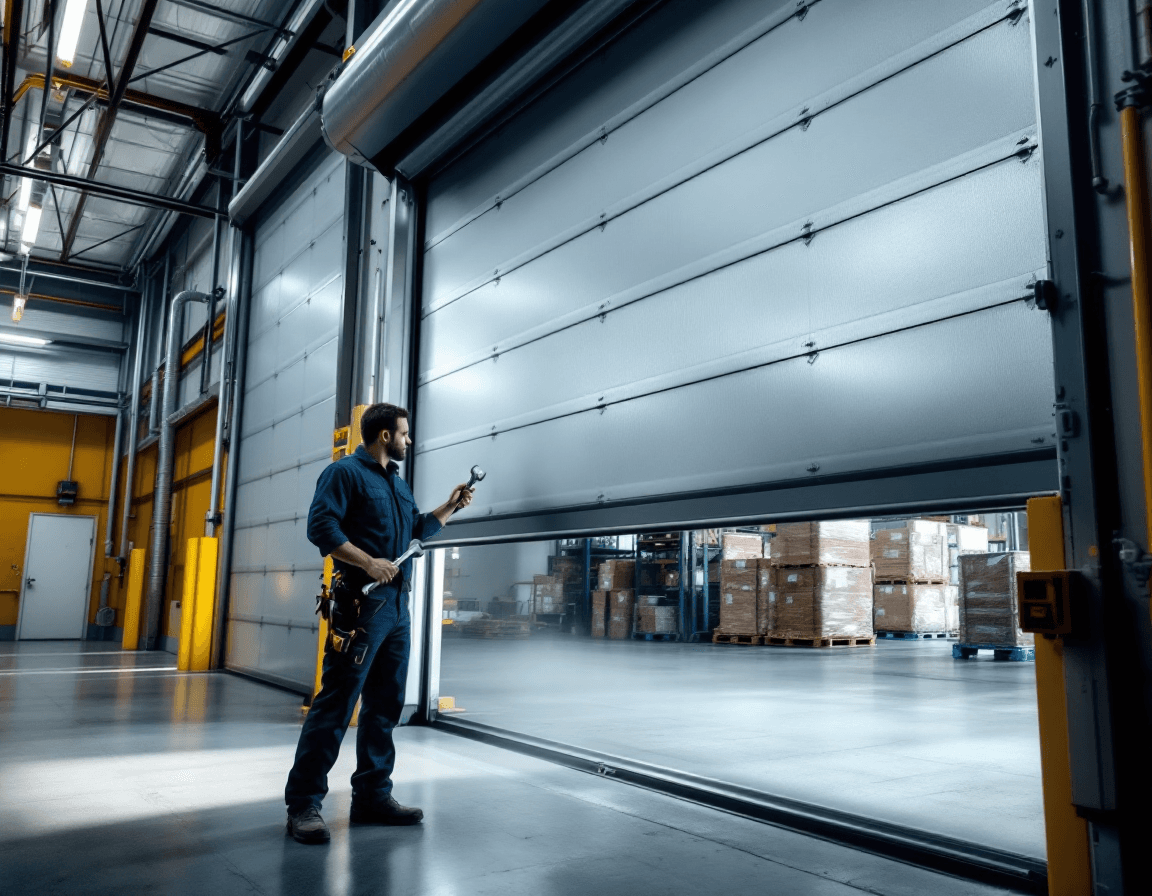
Commercial Overhead Door Repair in Poulsbo, WA keeps warehouses, contractor yards, marine-adjacent shops, and loading docks moving when a heavy door stops doing its job. Poulsbo sits on the shore of Liberty Bay in Kitsap County, and many businesses here depend on large doors that open dozens of times a day for deliveries, equipment, and crews. When a sectional door hangs halfway, a rolling steel curtain jams, or an operator won't respond, the cost is measured in idle staff, delayed freight, and missed pickup windows. Our technicians work on commercial doors across the Poulsbo area, from downtown storefront service bays to light industrial buildings along the Highway 305 corridor.
A commercial door is not simply a bigger residential door. The springs carry more load, the panels are heavier and often insulated, the tracks are engineered for frequent cycling, and the operators are built to run for hours at a time under demanding conditions. That means a repair that might take an hour on a home garage can require a planned service window, a lift, specialized parts, and a careful sequence to keep the door safe during the work. We approach every commercial call with that in mind, asking practical questions about how the door is used before we ever touch a bracket. The goal is to restore reliable operation quickly and to tell you honestly what it will take to keep the door working through the next busy season.
Whether your door is down completely or simply running slower than it should, the first step is a clear diagnosis. We look at the door as a system: the drum and cables or the sectional track geometry, the springs, the operator and its safety sensors, the weather seals, and the wall or header structure that anchors everything. Local conditions matter as well, because the damp, salty air and long wet stretches typical of Kitsap County affect metal and lubricants in ways that show up over time. The sections below walk through the most common commercial door problems we see in Poulsbo and explain what to expect when you call.
When a Loading Dock Door Goes Down in the Middle of the Shift
A loading dock door that won't open is often the first sign that something has been wearing down for weeks. Operators frequently notice a faint grinding, a hesitation at the top of the travel, or a jolt when the door reverses, and those early symptoms are easy to dismiss while the schedule is full. Eventually the door stops entirely, leaving trucks stacked outside and staff working around a closed opening. Our first priority in that situation is to make the door safe and, where possible, restore enough function to keep the dock operating while we plan the permanent repair.
Common causes of a dock door failure include a broken torsion spring, a sheared cable, a failed safety edge or photo eye that keeps the door from closing, a blown control board, or a track that has shifted out of alignment after a bump. Each of these looks similar from the outside, yet the fix and the parts list can differ considerably. We check spring tension and cable condition, confirm that the sensors are aligned and clean, and test the operator's limit settings before recommending anything. When a spring or cable must be replaced, we treat it as the high-tension job it is and never attempt it with improvised tools.
- Door stops mid-travel or will not start at all
- Door reverses unexpectedly or closes with a jerk
- Grinding, popping, or a single loud bang during operation
- Door sags on one side or the sections no longer sit level in the track
- Remote and wall controls respond inconsistently
- Safety sensor light is off, flashing, or the door refuses to close
If any of these appear, avoid forcing the door by hand or repeatedly pressing the button, since that can turn a manageable repair into structural damage. Note when the problem started and whether it followed a particular event, such as a truck backing in or a cold morning. That detail helps the technician narrow down the cause and often shortens the time the dock stays closed.
How Salt Air and Wet Winters Affect Commercial Doors Near Liberty Bay
Poulsbo's position on Liberty Bay means many commercial properties carry a bit more moisture and airborne salt than inland sites farther from the water. Galvanized and painted steel holds up well in most conditions, but the coating can break down at edges, fasteners, and hinge points where water collects and stays damp. Over several wet seasons, that corrosion can seize rollers, weaken bottom brackets, and pit the surfaces where cables and springs make contact. The effect is slow and easy to miss until a component fails during a busy week.
Our technicians pay particular attention to these areas during service visits. We inspect hinge knuckles, roller stems, cable drums, and the lower section brackets for rust bloom or flaking paint, and we look at the bottom seal to see whether standing water is getting under the door. Where the protective finish has failed, we recommend cleaning and touching up with an appropriate coating and switching to lubricants formulated for wet environments. Those small steps are inexpensive compared with replacing a set of rollers or an entire section after corrosion has spread.
Winter brings its own challenges across Kitsap County. Heavy rain can pool at threshold seals, and freezing nights can cause sections to bind if moisture has worked into the track or into door-mounted weather seals. When a door that ran smoothly in October suddenly labors on a cold February morning, we usually start by checking for ice or debris in the track, verifying that weatherstripping is not frozen to the floor, and confirming that the spring system is still balanced for the temperature change. Addressing these conditions early keeps the door dependable through the wet months when reliability matters most.
Sectional Doors and Rolling Steel Doors: Recognizing What You Have
Many Poulsbo businesses operate two very different types of large door, and misidentifying them can slow a repair. Sectional overhead doors are made of horizontal panels hinged together that roll up a curved track and lie flat along the ceiling. They are common on warehouses and dock openings because they offer a large clear opening and excellent insulation options. Rolling steel doors, by contrast, consist of interlocking slats that coil around a barrel above the opening, a design often used on storefronts, service bays, and buildings where space is tight or security is a priority.
Each type fails in its own pattern. Sectional doors tend to show problems in the tracks, rollers, hinges, and balance system, and they often reveal issues through uneven movement or panels that bind in the curve. Rolling steel curtains more commonly jam because a slat has bent or a guide has come loose, and they frequently go off track when the curtain is struck or when one side is pulled harder than the other. The operators, springs, and safety devices also differ, so the technician needs to know which system is installed before beginning work.
Knowing the door type helps you describe the problem accurately when you call. Tell us whether the door is a sectional with panels or a rolling steel curtain, which way it sits when it stops, and whether any sound or motion came before the failure. If you have the manufacturer label, which is usually on the header or on the operator housing, include the model and approximate size. Those details let us arrive with the right parts and tools, which is one of the simplest ways to reduce the time a door remains out of service.
Forklift Strikes and Damaged Panels: Repair, Replace, or Re-Hang
Forklift contact is one of the most common causes of commercial door damage, and it happens in seconds even in well-run facilities. A pallet that catches the lower panel, a tine that clips a track bracket, or a trailer that shifts during loading can bend a section, crack a panel, or knock a rolling steel curtain out of its guides. The first concern after any impact is safety, because a damaged spring or a bent track can release stored energy without warning. We ask that anyone who sees a door struck by equipment keep people clear and avoid operating it until a technician has inspected it.
Once the door is secured, the decision is whether to repair, replace the damaged section, or re-hang the door. A dented panel with intact insulation and undamaged hinges may only need a section swap, which can be done without replacing the full door. A bent track or a misaligned header often means the door must be re-hung so that it runs square and level, and this work requires careful measurement. Rolling steel curtains with a few bent slats can sometimes be straightened and reinstalled, while more severe damage calls for replacement of the affected slats or the whole curtain, depending on cost and remaining service life.
We provide honest recommendations in these situations because an oversized repair can waste money and a minimal one can fail again under load. If the door has sustained repeated impacts, the bottom section, guides, and track supports may be fatigued even where they look fine. Documenting the damage with photos and noting how it occurred can also help with insurance or internal incident reporting. For facilities near busy docks, a bollard, guard rail, or relocated traffic lane is sometimes the best long-term protection, and we are happy to point out where impacts are most likely to occur.
Commercial Operators, Controls, and Safety Sensors
The operator is the motor and control system that drives the door, and on commercial installations it is built for much heavier use than a residential opener. Failures often start with the control board, a worn limit switch, a damaged wire run, or a contactor that is not making clean contact. A single overheated operator can cause a door to stop mid-cycle and refuse to restart until it cools, which can be mistaken for a complete failure. We test the operator under load, verify the limit settings, inspect wiring at junction points, and check the safety sensors that prevent the door from closing onto a vehicle or person.
Safety edges and photo eyes deserve special attention because they protect people and equipment. A sensor that has been knocked out of alignment, coated with dust, or damaged by water may cause the door to refuse to close, or worse, to ignore an obstruction. We never recommend bypassing a safety device to keep a door running, even temporarily, because the risk is too high. If a sensor is failing, we replace it with a compatible unit and re-test the full reversing function before returning the door to service.
Modern commercial operators may include diagnostic indicators, remote monitoring modules, or integration with building access systems. When a control fault appears, the code or light pattern can point toward the source, but it can also be misleading if a sensor has simply gone out of alignment. Our technicians interpret these signals together with a physical inspection of the door and its balance. If you are considering a control upgrade, such as a radio receiver change or an interlock with a dock leveler, tell us about your workflow so we can recommend options that fit how your staff actually operates the building.
- Operator hums or clicks but the door will not move
- Door opens partway and then stops, sometimes restarting after a pause
- Sensors show a fault even when nothing is blocking the opening
- Controls work from one station but not from another
- The door reverses unexpectedly during normal closing
Jammed Rolling Steel Curtains and Getting Them Back on Track
A rolling steel door that jams is one of the more stressful calls we receive, because the curtain may be partly up, partly down, and pinned in the guides. Attempting to force the curtain by pulling on the slats or by hitting the operator can bend the slats further and damage the barrel. Our first step is to stop operation, confirm that the power is off at the disconnect, and assess whether the curtain can be safely lowered or raised by hand under controlled conditions. In some cases, the slats can be eased back into the guides after clearing debris or freeing a stuck bottom bar.
When a curtain goes off track, the cause is usually a combination of misalignment at the bottom, a guide that has loosened, or a slat that has been pushed sideways by an impact. Re-tracking requires lifting the curtain carefully, inspecting the guides for bends or wear, and reseating the slats so that they align with the channel without binding. The barrel and tension system must be checked afterward, since an off-track event can shift the balance and cause the curtain to drift during operation. We do not recommend DIY re-tracking on a curtain under tension, because a sudden release can injure hands or fingers.
Preventing future jams is largely a matter of routine checks. Keeping guides clear of grit, watching for slat deformation, and making sure the bottom bar stays level all reduce the chance of a sudden failure. In coastal-influenced Poulsbo, we also suggest checking guide hardware for corrosion each season, since rust can make the curtain pull unevenly and wear the slats unevenly. A quick inspection at the start of a season is far less expensive than an emergency call during a peak delivery week.
Slow Doors and Throughput: When Speed Becomes a Business Problem
Not every commercial door complaint involves a complete failure. Sometimes a door still works but takes so long to open or close that it slows the operation, creating a bottleneck at the dock or a backup at the shop entrance. A door that once cycled in a few seconds may now take much longer because of worn rollers, a weak operator, an imbalanced spring system, or a track that has accumulated friction. Staff often adapt to a slow door without reporting it, which means the productivity cost grows quietly over months.
To evaluate throughput, we time the door's full cycle, observe how it accelerates and decelerates, and check whether the operator is working harder than it should. A door that hesitates at the start or slows near the top may need spring tuning, while one that is uniformly sluggish may need a lubrication plan, roller replacement, or an operator with a different speed profile. For businesses with high traffic, we discuss options such as faster operators, high-speed doors for specific openings, or sensor placement that reduces unnecessary stops. The right answer depends on how many cycles the door completes each day and what the surrounding workflow requires.
Our goal is never to upgrade for its own sake. A slow door that matches your current needs may only need routine adjustment, while one that is holding back a growing operation may justify a capital project. We provide written options with the expected benefit, the downtime involved, and a realistic timeline so you can make the decision based on your own numbers. Being transparent about these tradeoffs is part of earning long-term trust with the businesses we serve.
How Custom Commercial Quotes Work and Why Turnaround Matters
Commercial door work is priced differently from residential service because every building, door size, and operator configuration is unique. A quote may depend on the door type and dimensions, the condition of the springs and track, the operator and controls involved, whether a lift is needed, and whether the work must happen after hours to avoid disrupting operations. Because of these variables, we provide custom commercial quotes rather than flat rates, and we aim to return them quickly so that downtime is not extended while decisions are made.
When you contact us, it helps to have a few details ready. Describe the door type, approximate opening size, the location and access for the technician, and the current symptoms, including whether the door is completely inoperable or still functioning with limitations. Photos of the door, the operator, and any damaged components can speed up the assessment. If the door is part of a larger facility plan, let us know about upcoming projects, inspection requirements, or insurance deadlines so the quote reflects your timeline.
- Door make, model, or manufacturer label if visible
- Approximate width and height of the opening
- Photos of damage, the operator, and the sensors
- Best days and hours for technician access
- Any prior repairs or recent impact incidents
- Whether a temporary fix is needed to keep the dock running
Once we have the information, we inspect the door, outline the recommended repair or replacement, and explain what is included and what might change if hidden damage is found. Where parts must be ordered, we tell you the expected lead time so you can plan around it. Our aim is a clear written scope that lets your team approve the work with confidence.
Preventive Maintenance Agreements for Busy Poulsbo Facilities
Many commercial door emergencies are preventable. A preventive maintenance agreement schedules regular inspections, lubrication, adjustments, and safety testing so that small issues are corrected before they become shutdowns. For facilities that rely on dock doors every day, this kind of planned care is often more economical than reacting to one failure after another. It also creates a documented service history that can be useful for internal safety audits and insurance conversations.
A typical maintenance visit may include checking spring tension and cable condition, inspecting rollers, hinges, and tracks, testing the operator and reversing sensors, lubricating moving parts with products suited to Kitsap County's damp conditions, and reviewing seals for wear. We also look at fasteners and mounting hardware, because vibration from frequent use can loosen connections over time. The frequency of visits depends on how many cycles the door completes and how harsh the environment is, and we recommend a schedule based on what we observe rather than a one-size-fits-all calendar.
Agreements can be tailored to the way your business operates. Some clients prefer seasonal visits timed before the wet months, while others want more frequent checks during peak production. We can coordinate visits around shift changes and off-hours, and we keep notes on each door so that the technician arriving next time understands previous repairs and recurring issues. If you are unsure whether an agreement fits your facility, the first step is usually a comprehensive inspection that establishes a baseline and identifies any urgent items.
Safety Practices for Crews and Staff Working Around Heavy Doors
Commercial doors store significant energy in their springs and move heavy components at speed, so safety must be part of every service call and every day-to-day operation. Torsion springs and cable drums under tension can cause serious injury if released without control, which is why we insist that only trained, licensed professionals perform spring and cable work. Our technicians use proper winding bars, lockout procedures, and fall protection where required, and we verify that power is disconnected before starting any inspection that involves the operator.
Facility staff also have a role to play. Keep the area around the door clear of pallets, carts, and equipment, especially when the door is in motion. Never stand under a door that is partly open or attempt to free a jammed door by hand while the power is on. Train employees to report unusual noises, slow movement, or sensor faults immediately instead of working around them, and make sure forklift operators understand the door's clearance and approach path. A brief safety reminder at the start of a busy season can prevent many of the impacts we are asked to repair.
Safety devices should never be bypassed or disabled to keep production moving. If a sensor is misbehaving, the correct response is to schedule a repair, not to tape over the eye or tie down a safety edge. We are glad to walk through your facility's door operations and identify any gaps, such as missing signage, unsafe approach paths, or outdated controls, that could put workers at risk. Protecting people and equipment is part of the same commitment that keeps your doors running well.
Need commercial overhead door repair in Poulsbo or anywhere in the surrounding Kitsap County area? Call Seattle Garage Door Fix at (888) 799-3819 to describe your door, your symptoms, and your timeline, and we will arrange a prompt assessment and a clear custom quote so your operation can get back to business.