
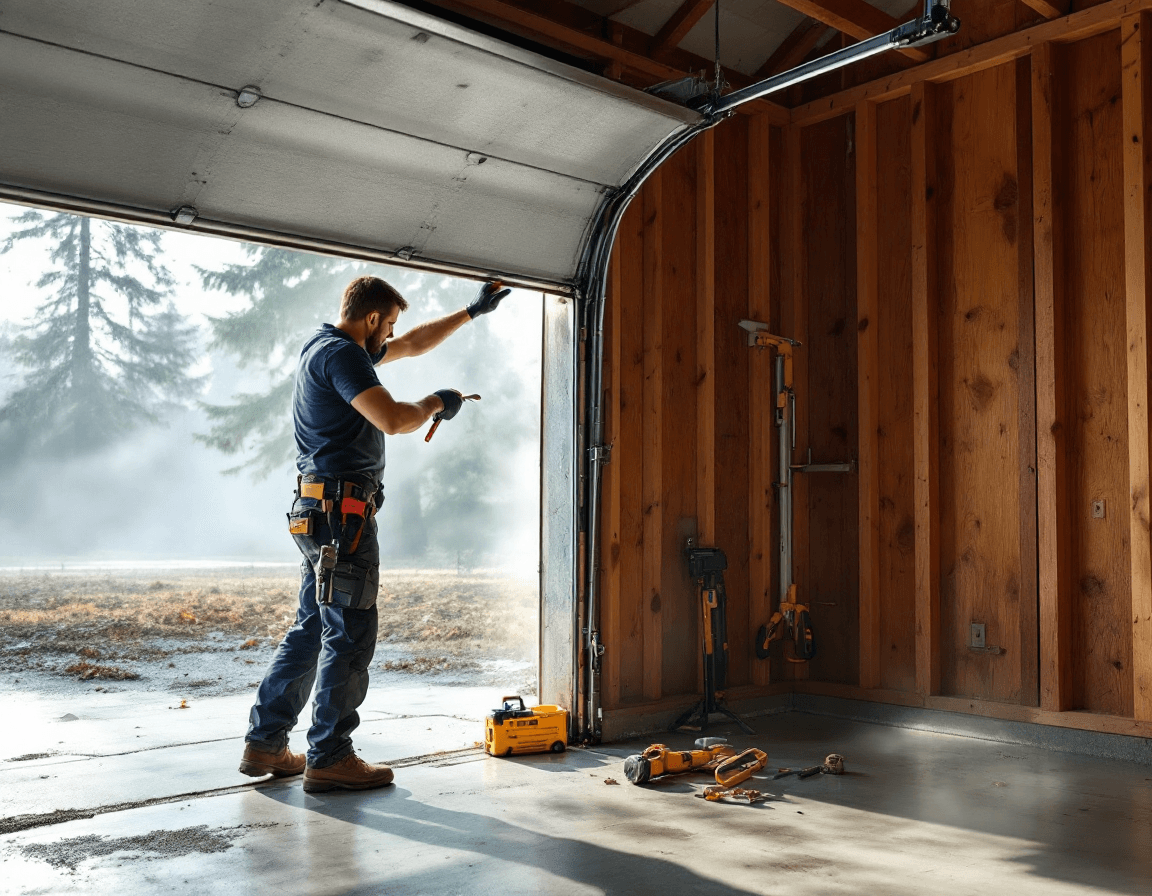
Off-track garage door repair in Poulsbo, WA is one of the most common calls we take from homeowners around Liberty Bay, and it's rarely a problem that fixes itself. When a door slips off one or both tracks, the panels can bind, the rollers can pop loose, and the whole assembly can be pushed out of alignment in a matter of seconds. Some of these failures come from a slow wear pattern that builds over years, while others happen in an instant when a door is forced by hand, hit by a car, or pulled against a stuck section. Either way, the door is no longer moving the way it was engineered to move, and continuing to run it can turn a modest adjustment into a costly parts replacement.
Our technicians work throughout Poulsbo and the surrounding Kitsap County communities, and we see the same handful of causes again and again. Homes near the downtown core often have older one-car or two-car garages with tight clearances, while newer subdivisions on the hillsides tend to have wider doors that carry more weight on longer track runs. Because the door is the largest moving object on most houses, even a small misalignment can change how every roller, hinge, and bracket behaves. This page explains what to look for, what usually causes derailment in this part of Washington, and what a realignment visit typically involves when you call us at (888) 799-3819.
Most off-track problems are fixable without replacing the door itself, and that's good news for your budget. For most realignment and track-straightening jobs, our pricing generally falls between $125 and $400, depending on how much damage is present and how many components need attention. The rest of this guide walks through the details so you can make an informed decision and know when a repair can safely wait and when it should happen right away.
Why Doors Keep Jumping Their Tracks in Western Washington
The Kitsap Peninsula sits in one of the wettest parts of the state, and that moisture works its way into nearly every mechanical system on a house. Garage doors are no exception. Wood frames swell during the long autumn and winter stretches, steel tracks pick up surface oxidation along their mounting brackets, and the vertical sections can drift a few millimeters out of plumb as the framing around them shifts. None of these changes is dramatic on its own, but together they can pull the rollers just far enough off the track radius that a heavy panel starts to ride in the wrong groove.
Temperature swings add another layer. Poulsbo mornings in late fall and early spring can drop well below freezing for a few hours, then warm up by afternoon, and that daily expansion and contraction loosens fasteners over time. A bracket bolt that was snug in September may be a half turn loose by February, and a loose bracket lets the track shift under load. We often find that a door that "suddenly" came off its track had been drifting for months, with the first sign being a rattle or a faint scrape that nobody thought to investigate.
Finally, many local garages were built with limited headroom or side clearance, especially in older neighborhoods where lots are narrow and the house sits close to the driveway. When the door has less room to move, any bump, uneven floor, or slightly bowed track has more effect on the rollers. Good realignment work accounts for these tight conditions, because the fix that works in a spacious three-car garage may not hold in a compact one.
Reading the Warning Signs Before a Door Fully Derails
A derailment rarely starts with the door falling off. Usually there's a series of quieter signals that appear days or weeks beforehand, and catching them early can save you from a jammed door on a rainy morning when you're already running late. Learning to notice these signs is one of the most useful things a homeowner can do, because it turns an emergency into a scheduled appointment.
Pay attention to changes in sound and motion rather than just whether the door opens. A healthy door glides with a steady, even hum, while a drifting door tends to chatter, stutter, or make a grinding noise near the top corners. Watch the door's movement from the inside as well as the outside, looking for a gap that appears along one edge or a panel that seems to sit higher on one side than the other.
- A visible gap between the top or side of the door and the track, especially one that changes as the door travels
- Rollers that look tilted, wobbly, or sitting partly outside the track channel
- Popping, clicking, or scraping sounds at the start or end of the door's travel
- The door pausing or stopping halfway, then continuing after a manual nudge
- Bottom seal that no longer meets the floor evenly on one end
- Opener running longer than usual or reversing for no obvious reason
If you notice any of these, stop running the door until someone has looked at it. Continuing to force a misaligned door can bend the track further and put strain on the opener, which is a much more expensive problem than a simple realignment.
What Happens When a Roller Pops Out of the Track
A roller is a small wheel, usually steel or nylon, that rides inside the track and carries the weight of each door section. When a roller pops out, the section it supports loses its guide, and the door begins to pivot or lean rather than travel in a straight line. That lean can transfer load onto neighboring rollers, hinges, and the track itself, which is why a single popped roller often leads to several additional problems if it isn't addressed.
In most cases, the roller can be reseated with the right tools and a careful hand. The technician supports the door section, lifts it just enough to relieve the tension on the affected roller, guides the roller back into the track lip, and then checks that it turns freely in both directions. We also inspect the roller stem and bearing for cracks, flat spots, or grit that could make it pop out again. A worn roller that won't stay seated usually needs to be replaced, since reseating it would only buy a short period before it fails again.
Rollers also tell us a lot about the rest of the system. If one roller has popped, we check the others on the same track for similar wear, look at the hinge alignment, and measure whether the door is square in its opening. This matters because a roller that came out once often came out because something else was already pulling it off line, and fixing only the one that failed leaves the underlying cause in place.
Bent Track Sections and the Hidden Cost of Waiting
Track damage is one of the most misunderstood parts of an off-track call. Homeowners often assume that a dented track is cosmetic, but even a small bend in the vertical or horizontal section changes the path the rollers must follow. That change can cause repeated derailment, uneven wear on the rollers and hinges, and extra stress on the opener. Left alone, a bent track can gradually twist the door out of square until the panels start binding against the frame.
Realigning a track involves more than just tapping the metal back into shape. The technician loosens the mounting brackets, checks the track with a level and a straightedge, and adjusts each section so the vertical and horizontal runs meet the correct angles. In moderate damage, the track can be carefully straightened and re-secured to the wall and ceiling. Severely crimped or separated sections often need to be replaced, since trying to hammer them back could crack the metal or leave a weak point that fails under load.
Waiting on a bent track tends to increase the final bill. A roller that jumps once a month can wear a groove into the track lip, and that groove makes future alignment harder. Brackets pulled loose by an unbalanced door can tear out of drywall or wood framing, which adds carpentry to the repair. For most homeowners, the cheapest time to fix a track is the first time it's noticed.
Vehicle Strikes and the Damage That Hides Behind a Dent
A vehicle hitting the garage door is one of the fastest ways to knock a door off track, and it's common on driveways that are narrow, sloped, or shared with neighbors. Reversing a car or backing a truck into the bay can strike the lower panels or the track hardware, and the impact can jolt several rollers out of their channels at once. Even a light tap can shift the door enough to cause a binding problem that appears days later.
After any impact, look at the door from both inside and outside the garage. Check whether the panels are still flush, whether the track is still parallel to the wall, and whether the bottom seal still touches the floor evenly. Note any scrapes on the track, because paint transfer or fresh metal marks often show exactly where the contact occurred. Do not attempt to force the door open or closed if it's jammed, since a sudden release can cause the spring system to react unpredictably.
- Stop using the door immediately if it's crooked, jammed, or making new grinding noises
- Photograph the damage from several angles for insurance purposes
- Keep vehicles and people clear of the door path while it's out of alignment
- Call a technician before running the opener again, even if the door looks mostly fine
Vehicle strikes can also crack panels, bend hinges, or stress the spring assembly, so an inspection after impact is worth scheduling even if the door seems to work. We recommend a visit within a day or two so the damage is caught while it's still limited.
Why Springs and Cables Must Stay with a Licensed Professional
Most off-track repairs involve the track, rollers, and hinges, but many homeowners wonder whether they can handle the springs or cables themselves when a door is misaligned. The short answer is no. Torsion springs and extension springs store enormous amounts of energy, and a cable that comes off its drum or a spring that releases unexpectedly can cause serious injury. Garage door work at this level should always be performed by a licensed, bonded, and insured professional who has the proper winding bars, safety equipment, and training.
Cable issues often accompany off-track problems because the cable keeps the door sections tensioned while they move through the track. If a cable has slipped off its drum or frayed, the door can tilt sharply and fall out of its track. Attempting to re-wrap a cable without the correct tension and tools is risky, and it can also damage the drum or the cable itself. A technician will release the tension safely, inspect the components, and set the system back to balance before the door is returned to service.
We take this approach because the stakes are high, not because the work is complicated for its own sake. If you're unsure whether a cable or spring is involved, leave the door in its current position and call us. A short phone call can prevent a dangerous situation and point you toward the safest next step.
What a Realignment Visit Usually Looks Like in a Poulsbo Home
A typical realignment visit begins with a quick walkthrough of the door's history. We'll ask when the problem started, whether there was a noise or impact beforehand, and how the door has behaved in recent weeks. That conversation helps us decide where to focus, since a door that drifted over months may need a different approach than one that jumped off its track after a bump.
Next, the technician inspects the door in both the closed and open positions. We check the track for plumb and level, look at each bracket and fastener, examine the rollers and hinges, and test the door's balance. If the door is out of square, we measure the gap at the top corners and along the bottom seal to see how far the panels have moved. Where a cable or spring is involved, we make sure the system is safe to work on before proceeding.
Once the cause is clear, we realign the track, reseat or replace rollers, tighten the brackets into solid framing where possible, and confirm that the door runs smoothly through its full range of motion. We then test the opener's force settings and safety reversal, since a door that's been off track sometimes triggers safety sensors in unexpected ways. You'll get a clear explanation of what was done and what, if anything, should be watched in the coming weeks.
Realistic Price Expectations for Off-Track Repairs
Homeowners often ask what an off-track repair will cost before the technician arrives, and the honest answer is that it depends on what's damaged. For most realignment and track-straightening jobs, our pricing generally falls between $125 and $400. A straightforward reseating of one or two rollers on an otherwise sound track usually lands at the lower end, while a job that involves straightening multiple track sections, replacing several rollers, and resetting brackets will move toward the upper end.
Several factors influence the final figure. The number of track sections affected matters, as does whether the track is only bent or also separated at a joint. Door size and weight play a role, since heavier steel doors and wider two-car doors require more time and care to balance. Access can also add time, particularly in tight garages where the technician has limited room to work around the door and opener.
We provide the estimate on site, once the technician has examined the door and confirmed the scope of work. That way, you know exactly what's being done before any repairs begin. If a larger component such as a spring, cable, or panel needs replacement, we'll explain the difference and let you decide how to proceed.
Coastal Moisture and Rust Around Liberty Bay
Living near Liberty Bay means dealing with salt-tinged air, damp mornings, and the kind of persistent humidity that finds its way into every metal fitting. Homes close to the water or on lower streets near downtown often see more surface rust on tracks, bracket bolts, and roller hardware than homes further inland. That corrosion can seize a roller in place or weaken a bracket until it fails under the normal weight of the door.
Rust doesn't always announce itself with a bright orange color. It often appears as a dull, flaky film on the track's inner lip or as a crust around bolt heads that makes them look fine from a distance. When a technician reaches for a wrench and the bolt won't turn smoothly, that's usually a sign of corrosion underneath. Corroded hardware can also allow the track to flex, which is why a rust problem can quietly turn into an alignment problem.
Good maintenance in this climate starts with a few simple habits. Keeping the track clean and lightly lubricated with a garage-door-appropriate product helps repel moisture, while periodically checking the bolts for looseness or crusting catches problems early. If you notice heavy corrosion, a technician can replace the most affected hardware during the realignment visit, which is far more efficient than returning later for a second trip.
Practical Habits That Keep Tracks True Between Visits
Preventive care won't eliminate every derailment, but it can reduce how often they happen and make the warning signs easier to spot. A homeowner who does a few quick checks each season will usually notice drift long before the door comes off its track. These habits take only a few minutes and require no specialized tools, though they should never involve touching the springs or cables.
- Look along the track each season for bends, dents, or gaps at joints
- Check that bracket bolts are snug, tightening them only if they're accessible and not overtorqued
- Clear debris, leaves, and gravel from the bottom of the track and the floor where the door rolls
- Watch the door's motion once a month, noting any new sounds or pauses
- Keep the area around the track free of stored items that could be bumped
- Keep the opener's manual release and safety sensors clean and unobstructed
If anything looks off during these checks, stop there and schedule a visit rather than adjusting components yourself. Garage door hardware is precisely calibrated, and a well-meant tweak can create a new problem. Our technicians can confirm whether a small issue needs attention now or can wait for your next routine service.
Choosing a Technician Who Understands Local Garages
A good off-track repair depends on more than just the right tools. It also depends on a technician who understands how doors behave in the specific kinds of garages found around Poulsbo and the rest of the Kitsap Peninsula. Older homes with tight clearances, newer homes with longer track runs, and garages on sloped driveways all present different challenges, and the best technicians adjust their approach accordingly.
When you're comparing options, ask whether the company is licensed, bonded, and insured, and whether the technicians are trained to handle both track alignment and the spring and cable systems that often accompany it. Ask how they'll explain the problem and the proposed fix, and whether they'll give you an estimate before starting work. A clear, unhurried explanation is usually a good sign that the work will be done carefully.
We serve Poulsbo and more than 60 surrounding cities across the greater Seattle and Western Washington area, and we're happy to walk you through what we find. If your door has come off its track, is binding, or has a visible gap, the most useful next step is a short conversation so we can decide together how to proceed.
If your garage door is off track, crooked, jammed, or showing a new gap, don't wait for it to fail completely. Call Seattle Garage Door Fix at (888) 799-3819 to schedule an off-track repair in Poulsbo. Our licensed, bonded, and insured technicians will assess the door, explain what's wrong, and give you a clear estimate before any work begins, with most realignment jobs falling between $125 and $400.