
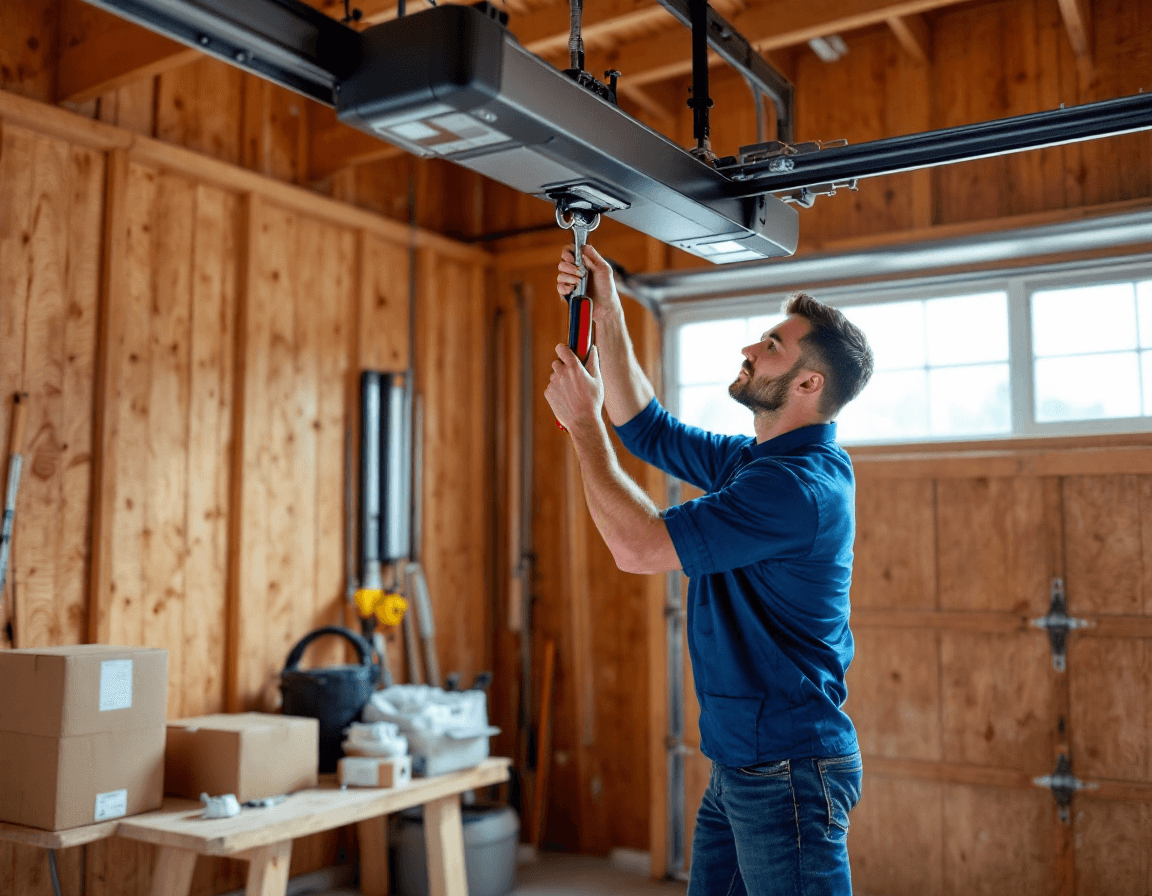
Garage door opener installation and replacement in Poulsbo, WA is one of the most practical upgrades a homeowner on the Kitsap Peninsula can make, and it often pays off in daily convenience long before it shows up in any other way. A garage door opener is a motor, a rail, a logic board, and a set of safety sensors working together, and when one part starts to fail, the whole system feels unreliable. Many Poulsbo households live with a door that grinds, hesitates, or stops halfway for months before deciding it is time to replace the unit. Our technicians see that pattern regularly, and we believe it is worth addressing sooner rather than later.
Poulsbo sits on the shore of Liberty Bay, and that setting shapes how garage equipment ages here. Homes around Downtown Poulsbo, the hillside neighborhoods above the bay, and the newer subdivisions farther out all share a common challenge: long stretches of cool, damp weather punctuated by windstorms that can knock out power for hours at a time. An opener that handled those conditions reasonably well a decade ago may now be showing its age in ways that affect safety, security, and your ability to get in and out of the house during bad weather. This guide walks through what to look for, how to choose the right drive style, and what a replacement typically involves, so you can make a confident decision.
Our service area covers the 98370 ZIP code and the nearby communities we serve across Western Washington. Whether your garage is attached to a house on a quiet residential street or sits in a detached structure at the back of a larger lot, the installation process follows the same core steps: verify the door's balance and hardware, select a compatible opener, mount the rail and power head securely, program the travel limits, and test every safety feature before you walk away. The details differ from home to home, and that is exactly why a site visit matters before anyone commits to a specific model.
Signs Your Current Opener Has Reached the End of Its Useful Life
Most people do not wake up one morning and decide their opener is obsolete. Instead, they notice small changes that slowly add up. The door may take longer to open than it used to, or it may pause partway through its cycle and then continue after a second attempt. A motor that runs much louder than it once did, especially one that rattles or screeches at the start and finish of each cycle, often signals worn gears, a loose carriage, or a motor bearing that is nearing the end of its service life. Intermittent failures are particularly frustrating because they are hard to predict, and a door that works nine times out of ten can still leave you stranded on the one morning you are in a hurry.
Remote controls and keypads offer another useful clue. If you have to press the transmitter several times, stand closer to the door, or hold the button longer than before, the receiver may be failing, the antenna may be damaged, or the unit may be struggling with interference. Wall-mounted keypads that stop responding after a rainy week are a common sign that moisture has found its way into the control board. None of these symptoms guarantees that the opener needs replacing, but together they point to a system that is working harder and delivering less reliability.
Age is also a meaningful factor. Many openers manufactured before the widespread adoption of rolling-code technology lack modern safety and security features, and some older units no longer have parts available from the manufacturer. Below are common warning signs we discuss with homeowners during an evaluation:
- The motor runs noticeably louder or produces grinding, clicking, or squealing that was not present before.
- The door reverses for no apparent reason or fails to close fully without the safety sensors being obstructed.
- Remotes need to be pressed repeatedly, or the opener responds only when you are standing near the door.
- The unit is more than roughly a decade old and the manufacturer no longer supplies replacement components.
- Repair estimates for the drive, logic board, or motor approach half the cost of a new installed opener.
Choosing Between Belt-Drive, Chain-Drive, and Wall-Mount Systems
Selecting the right drive style is one of the most important decisions in any opener replacement, and it depends on how your garage is used and how close the living space sits to the door. Chain-drive openers use a steel chain running along the rail to move the trolley. They are typically the most economical option and are known for strong lifting power, which makes them a sensible choice for heavier wood doors or insulated steel doors that carry extra weight. The tradeoff is noise. Because the chain is metal, it tends to be louder during operation, and that sound travels into the house quickly if the garage shares a wall with a bedroom or home office.
Belt-drive openers use a reinforced rubber belt in place of the chain. The result is a quieter, smoother cycle that many Poulsbo homeowners prefer, particularly in attached garages in the older neighborhoods near downtown where houses sit close together. Belt-drive systems usually cost somewhat more upfront, but the difference in daily comfort is hard to ignore if you come home late or leave early. We generally recommend belt-drive for attached garages with finished rooms overhead or beside the door, and for anyone who has grown tired of hearing the opener run every time a neighbor leaves for work.
Wall-mount openers attach the motor to the side wall rather than the ceiling. They make sense when ceiling space is limited, such as in a garage with a lift, a loft storage platform, or an unusually low header. They also free up overhead room, which helps when the garage doubles as a workshop. Each style has trade-offs in installation complexity, noise transmission, and cost, so the right answer depends on your ceiling clearance, door type, and how much noise you can comfortably live with.
Rolling-Code Security and Why Older Units Leave You Exposed
Older garage door openers often use fixed-code remote systems, meaning the transmitter sends the same signal every time you press the button. That design is convenient but risky, because anyone with a simple radio device can capture and replay the signal to open the door. Rolling-code technology solves that problem by changing the transmitted code with every use, so a captured signal becomes useless almost immediately. If your opener predates this technology, your garage may be more vulnerable than you realize, especially if the door is visible from the street or the driveway is accessible from a side gate.
Security is not only about remotes. Modern openers also tend to include features such as automatic lockout after repeated failed attempts, vacation or lock modes that disable the remote while you are away, and detailed logs showing when the door was opened and closed. Some systems allow you to set schedules that prevent the door from opening overnight, which can offer real peace of mind for households that travel frequently. Upgrading the opener does not replace good habits, such as keeping the door closed when you are not using it and avoiding leaving remotes in the car, but it closes a gap that many older systems simply cannot.
We also check the condition of the existing wall button, keypad, and any wiring that runs to them during an installation. Replacing the opener without addressing a worn keypad or damaged low-voltage wiring can leave a weak point in the system. A thorough installation takes that broader view.
Wi-Fi and myQ Smart Control in a Damp Pacific Northwest Garage
Smart openers have become popular across the Puget Sound region because they let you check the door status and open or close it from your phone, receive alerts when it has been left open, and grant temporary access to family members or service providers. Many models work with ecosystems such as myQ, and a few integrate with voice assistants or home automation platforms. For busy households in Poulsbo, where school schedules, ferry commutes, and weekend projects can pull people in different directions, that flexibility can be genuinely useful.
Connectivity deserves careful planning, however. Garages are often located at the far edge of the house, sometimes detached, and the Wi-Fi signal that reaches the living room may not reach the garage reliably. Thick walls, metal framing, and distance from the router can all weaken the connection. During a site visit, we test signal strength where the opener will be mounted and recommend a range extender or mesh node if needed. Installing a smart opener on a weak connection is frustrating, and it is far better to solve the network question before the unit goes on the wall.
The damp climate matters too. Garages in this part of Washington see high humidity for much of the year, and condensation can form on cold surfaces overnight. Smart controllers and logic boards need to be mounted in a location that keeps them dry and away from direct moisture. We typically position the power head so that its electronics are protected from splashing rain that might blow in during open-door conditions, and we confirm that any outdoor-facing keypad has adequate weather protection. Cabling and connectors receive the same attention, because a corroded connection can cause intermittent faults that look like software problems.
Battery Backup Options for Power Outages and Windy Winters
Power outages are a reality for homeowners across Kitsap County, particularly during winter windstorms that bring down lines and trees. When the power goes out, a standard opener cannot move the door, and many households discover this at the worst possible moment, such as when they need to leave for a medical appointment or return home after dark in heavy rain. A battery backup accessory allows the opener to run for a limited number of cycles during an outage, giving you the ability to open or close the door without a manual release.
Battery backup kits vary in capacity, charging method, and the number of cycles they can provide on a single charge. Some use a standard rechargeable battery that is trickle-charged from the opener's power supply, while others use lithium-based packs with longer service life. The best choice depends on how often you expect to use the door during an outage and how much you want to spend. We discuss realistic expectations with homeowners, because a backup battery is designed to handle a handful of emergency cycles, not to run the household in a long blackout.
A manual release cord remains essential regardless of backup options. Every opener should have a clearly labeled release that lets you disengage the door from the carriage so it can be lifted by hand in an emergency. Batteries eventually lose capacity, and a backup system that has not been tested can fail when it is needed most. We recommend checking the release mechanism and battery condition at least once a year, ideally in the spring when the weather is calmer and the stakes are lower.
What a Typical Installation Visit Covers in Poulsbo
A professional opener installation is more than mounting a motor on the ceiling. It begins with an inspection of the door, the tracks, the rollers, the hinges, and the springs, because a new opener cannot compensate for a door that is out of balance or binding. If the door is hard to lift by hand or moves unevenly, that condition must be addressed before the opener is installed. Spring and cable work involves high tension and serious injury risk, and it should be performed only by a licensed professional with the proper tools and training. Our technicians will tell you plainly when a problem falls into that category, and we will recommend a licensed pro for it rather than improvising.
Once the door is confirmed to be in good operating condition, the installer selects the correct opener for the door weight and size, assembles the rail, mounts the header bracket, and secures the power head to the ceiling joists. Structural attachment matters, because a weak mounting point creates vibration, noise, and long-term stress on the opener. The safety reversal system is then installed and aligned, including photo-eye sensors near the floor on both sides of the opening. The installer sets the travel limits, tests the force settings, and verifies that the door reverses when it contacts an obstruction.
Programming comes last. We pair remotes, set up keypads, connect smart features if you want them, and walk you through how the system works. Many homeowners appreciate a short demonstration of the manual release and the battery backup, along with a clear explanation of what to do if the door behaves unexpectedly. A good installation should leave you feeling confident about the equipment, not just satisfied that the door moves.
Understanding the $275 to $650 Installed Price Range
Our installed pricing for garage door openers in Poulsbo typically falls between $275 and $650, depending on the model selected. That range reflects differences in drive type, horsepower, noise rating, smart features, and battery backup capability. A basic chain-drive unit for a single-car door will generally sit near the lower end, while a quieter belt-drive system with advanced connectivity and backup power will land toward the upper end. The final number depends on the specific opener you choose and whether any additional components, such as a wall-mount kit or extended rail, are needed for your garage layout.
It helps to understand what the price includes. A quoted installed price should cover the opener itself, the mounting hardware, the safety sensors, the programming, and a functional test of the system. It should also account for disposal of the old unit, which is an element homeowners sometimes overlook. We recommend asking for a written breakdown before work begins, so you can compare options side by side and see exactly where your money goes. Price is one factor, but the right opener is the one that fits your door, your garage, and the way your household actually uses it.
Some situations push costs outside the typical range. A door that needs balance adjustment, a damaged track, or replacement of worn rollers may require additional work before the opener can be installed safely. Likewise, a garage with unusual ceiling clearance or a need for a longer rail may increase the scope. When we identify those conditions during an inspection, we explain them clearly and give you the option to proceed or to schedule the additional repair separately.
Liberty Bay Air and Protecting Your Opener Over the Long Haul
Poulsbo's proximity to Liberty Bay brings salt-laden marine air into many neighborhoods, especially those closer to the water. That moisture can accelerate corrosion on exposed metal, including mounting brackets, safety sensor housings, and fasteners. Over time, a surface that looks fine can develop rust that weakens its grip or interferes with electrical contacts. We select hardware with corrosion resistance in mind and recommend stainless or coated fasteners where appropriate, particularly in garages that open toward the bay or receive direct wind off the water.
Regular maintenance helps extend the life of a new opener. Keeping the rail lubricated according to the manufacturer's guidance, checking the tension on the belt or chain, and wiping sensor lenses clean of dust and spider webs will prevent many common problems. Cobwebs and grime on photo-eye sensors are a surprisingly frequent cause of doors that refuse to close, and a quick cleaning can save a service call. In the wetter months, it is also wise to watch for water pooling near the door threshold or seepage through the bottom seal, since standing water can reach electrical components and reduce their lifespan.
We encourage homeowners to schedule a brief inspection once a year. During that visit, a technician can check the opener's force settings, test the reversal system, look for loose hardware, and confirm that the battery backup is holding a charge. Catching a small issue early is almost always cheaper and safer than waiting for the door to fail during a storm.
Repair or Replace: A Practical Look at the Economics
Deciding whether to repair an older opener or replace it comes down to a few straightforward questions. How old is the unit? Are replacement parts still available? How much would the repair cost compared with a new installed opener? And how often has the system already needed service? If a repair quote approaches half the price of a new opener, and the existing unit is more than a decade old, replacement often delivers better value because you also gain modern safety features, improved security, and a warranty on the new equipment.
Repairs can still make sense in some cases. A worn remote, a failed wall button, or a damaged safety sensor can often be replaced for a modest cost without touching the opener itself. If the motor and logic board are in good shape and the main issue is a simple component, repair may be the right call. We always aim to give you an honest assessment rather than steering you toward the most expensive option, and we will tell you when the old opener still has life left in it.
Replacement also gives you a chance to address related wear. Many homeowners find that upgrading the opener prompts a look at the remotes, keypads, and safety sensors, all of which can be updated at the same time. That approach avoids a second visit later and ensures that the whole system works together as intended.
Safety Boundaries: What Stays with a Licensed Professional
Garage doors are heavy, and the springs that counterbalance them store enormous amounts of energy. Attempting to adjust, remove, or replace torsion springs, extension springs, or cables without proper training and equipment can cause severe injury. For that reason, any spring or cable work should be left to a licensed, bonded, and insured garage door professional. Our technicians handle those repairs as part of a complete service, and we would rather explain the danger clearly than watch a homeowner attempt a job that calls for specialized tools and experience.
Opener installation itself also involves electrical connections and mounting to structural framing, so it should be performed by someone who understands both. Even when a homeowner feels comfortable with basic tools, the safety reversal system, the force settings, and the wiring all require careful attention. A mistake in any of those areas can prevent the door from reversing on an obstruction, which creates a real risk for children, pets, and anyone standing in the path of a closing door. If you are ever unsure whether a task belongs to you or to a professional, the safe answer is to call a licensed technician.
We are happy to walk you through what to expect, answer questions about your existing system, and help you decide on the right next step. Our goal is to make the process clear and the outcome reliable, without pressure and without cutting corners on safety.
Whether your current opener is loud, slow, unreliable, or simply past its useful life, a planned replacement can restore smooth, secure, and dependable operation for your Poulsbo home. Call Seattle Garage Door Fix at (888) 799-3819 to schedule an inspection, discuss belt-drive, chain-drive, or wall-mount options, and get a clear installed quote for your garage.