
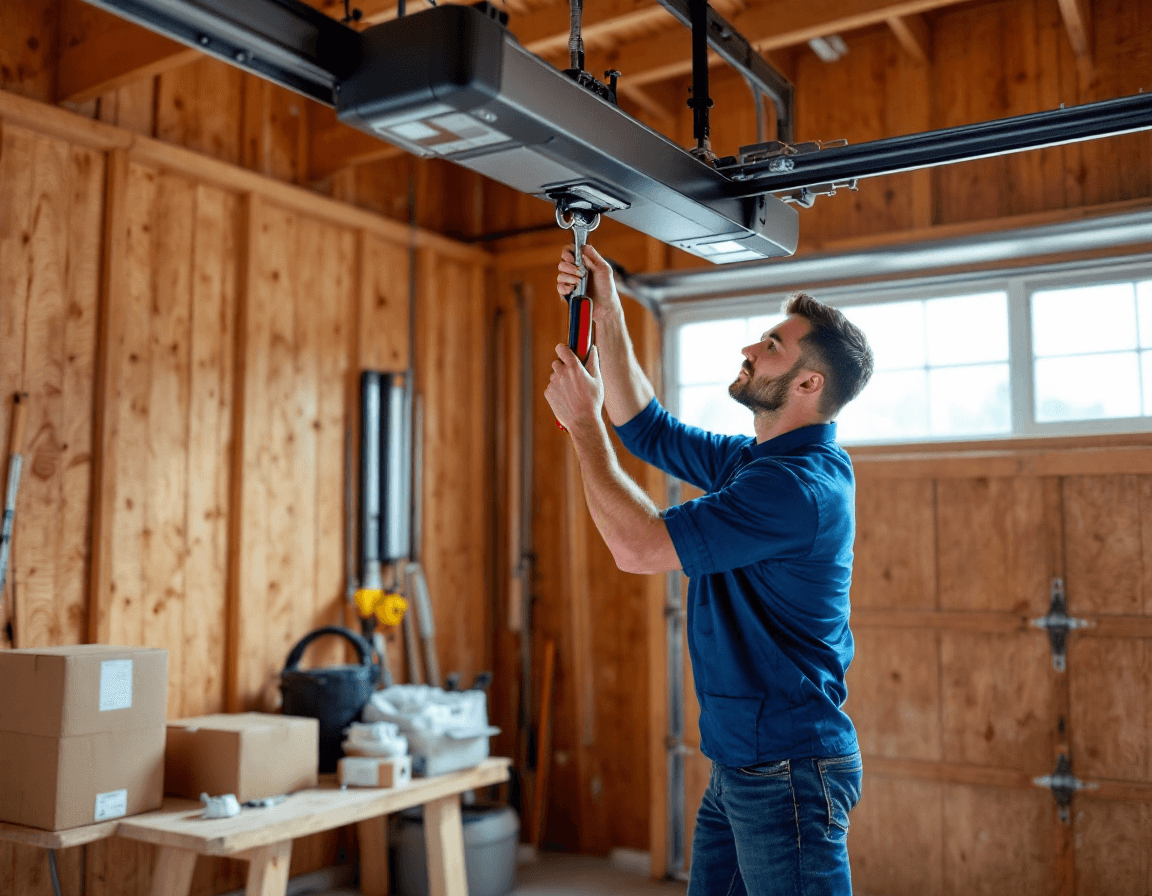
Garage Door Opener Installation & Replacement in Bainbridge Island, WA is one of the most practical upgrades a homeowner on the island can make, especially if your current opener has become loud, slow, or simply unpredictable. Bainbridge sits across Puget Sound from Seattle, and its homes range from older craftsman bungalows near Winslow to newer builds tucked into the wooded slopes above Rolling Bay. Many of those garages were fitted with an opener decades ago, and the damp, salty air that drifts in from the Sound does its own quiet work on motors, rails, and wiring over time.
Replacing an opener is not only about swapping a box on the ceiling. The right unit should match your door's weight, your garage's ceiling height, your daily habits, and the way you want to control the door from your car, your phone, or a wall keypad. A good installer will look at the door itself, the torsion or extension spring setup, the safety sensors, and the track alignment before recommending any particular model. That broader view is what keeps a new opener running smoothly for years instead of becoming another fast-failing part.
This page walks through the decisions Bainbridge homeowners tend to face, from recognizing an opener that has reached the end of its useful life to choosing a drive style, understanding security and smart features, and planning for power outages. It also explains what a typical installation visit involves and how pricing works in our service area. Along the way you will see where we draw firm lines around work that belongs with licensed specialists, because safety matters more than any upgrade.
Why Island Garages Wear Out Openers Faster
Bainbridge Island's weather is gentle by some standards and punishing by others. Winters bring long stretches of rain, and the humidity in a closed garage can linger well past the storm, which encourages surface rust on steel brackets, corrosion on electrical contacts, and swelling in wooden door panels. Salt air carried in from Puget Sound settles on exposed hardware and accelerates oxidation, particularly for homes on the western and northern shorelines. Even inland neighborhoods near Lynwood Center see the same moisture cycle, so the garage environment rarely stays dry for long.
These conditions affect an opener in a few predictable ways. Moisture finds its way into limit switch housings and control boards, and that can cause the door to stop partway, reverse for no obvious reason, or refuse commands from a remote that worked fine last month. Lubricants on chains and screw drives can break down or wash away, leaving the motor to fight friction it was never designed to handle. Over a decade or more, a unit that started out reliable may develop intermittent faults that are hard to diagnose without a close look at the wiring and sensors.
Many island homes also experience sudden wind events and occasional power interruptions. Repeated cycles of outage and restart put stress on the opener's logic board and the door's mechanical components. When you combine that with the moisture load, it is no surprise that openers in our area often fail earlier than the manufacturer's expected life. Choosing a unit with good weather resistance and proper sealing for your specific garage can make a real difference.
Reading the Warning Signs Your Current Opener Is Giving You
Most homeowners do not wake up one morning to a dead opener. Instead, the unit sends signals for weeks or months before it finally quits. A motor that hums louder than it used to, a door that takes noticeably longer to travel, or a rattling sound at the start and end of each cycle are all early indicators. Pay attention to whether the door hesitates at the top or bottom of its travel, because that pause often points to a strained drive system or a limit adjustment that has drifted.
Reliability issues tend to show up in a different way. The door might respond to the wall button but not the remote, or work for three tries and then fail on the fourth. Lights on the opener may flicker, the safety reversal may trigger on a clear path, or the unit may lose its memory of programmed remotes after a power blip. Any of these symptoms is worth taking seriously, since a failing opener can leave you stranded outside or, worse, allow the door to close unpredictably.
Be honest with yourself about the repair math. If the drive gear is stripped, the logic board is failing, or the motor has begun to smell hot after runs, a repair may cost nearly as much as the replacement and still leave an aging unit in place. When a technician tells you the opener is beyond economical repair, that is usually a sign to compare new models instead of sinking money into a machine that will keep generating new problems.
- Louder or grindier operation than the unit produced a few years ago
- Door reversing or stopping mid-travel without an obvious obstruction
- Remotes that work intermittently or have lost their programming
- A burning smell, a warm motor housing, or flickering lights during operation
- Visible rust on brackets, rails, or the drive chain near the ceiling mount
Belt, Chain, or Wall-Mount: Choosing the Drive That Suits Your Home
Opener drive style affects noise, maintenance, and how the unit fits into your garage. Chain-drive openers are typically the most affordable and are sturdy enough for heavy doors, but they produce more sound because metal links run over a metal rail. Belt-drive openers use a reinforced rubber belt, which runs much more quietly and is a strong choice for a garage that shares a wall with a bedroom or home office. Wall-mount openers attach to the side of the garage rather than the ceiling, which can free up overhead space in a cramped garage or one with a high-mounted storage system.
For many Bainbridge homes, the quietness of a belt-drive unit is the deciding factor. Many island houses sit close together on smaller lots, and a late-night garage door cycle can carry through a wall or up into a second floor bedroom. A belt-drive opener will not make the door silent, but the difference is noticeable. Wall-mount models are particularly useful in garages with a flat ceiling that is already crowded with ductwork, bike hoists, or ceiling storage racks.
Your door type also matters. Heavier insulated steel doors, carriage-style doors with decorative hardware, and older wooden doors each place different loads on the drive system. A knowledgeable installer will confirm that the opener's rated horsepower and rail configuration match the door's weight and dimensions. Choosing an opener that is underpowered for your door is one of the most common causes of early failure, so this step deserves careful attention.
Rolling-Code Security and Why an Older Unit Is a Liability
Older openers, particularly those installed before rolling-code technology became standard, often use fixed-code remotes. A fixed code transmits the same signal every time you press the button, which means someone with inexpensive equipment could potentially capture and reuse it. Rolling-code systems change the transmitted code with every use, so a captured signal becomes useless almost immediately. For a home near busy neighborhood streets or a property where you come and go on varied schedules, that difference is meaningful.
Security is not the only reason to upgrade. Many older units lack modern safety features, and their photo-eye sensors and force settings may no longer meet the standards you would expect from a current installation. A new opener brings updated obstruction detection, better auto-reverse behavior, and clearer diagnostics. Those features protect children, pets, and anyone who might be standing in the door's path when it moves.
When we replace an older unit, we typically review the entire control setup, including wall-mounted keypads and exterior keypads if you have them. Keypad codes and remote programming should be reset as part of the job so that old transmitters do not remain active. We also check the safety sensors, mounting brackets, and wiring, because a secure opener is only as good as the components connected to it.
Smart Wi-Fi and myQ Control Without the Guesswork
Smart control has become one of the most requested features on the island. Many homeowners want to confirm that the door closed after they drove off the ferry, or to let a delivery driver or dog walker in without handing over a key. Wi-Fi-enabled openers can connect to smartphone apps, and many systems support myQ-compatible control and integration with common smart home platforms. Notifications about door activity can also help households with teenagers or frequent travelers keep track of the garage at a glance.
Smart features work best when the network underneath them is solid. Garages on Bainbridge are sometimes located far from the main router, and dense construction materials, including concrete foundations and metal framing, can weaken the signal. We often recommend checking the signal strength at the garage before choosing a model, and in some cases a small mesh extender placed in the house can resolve the issue. An opener that drops offline every few days is more frustrating than a basic unit that never loses its connection.
Privacy and account management deserve attention too. Each smart system relies on an online account, and that account should be protected with a strong password and two-factor authentication where available. Share access only with household members or trusted people, and remove access for anyone who no longer needs it. We are happy to walk you through setup during installation so that your phone, your network, and your opener are configured together rather than left for trial and error later.
Battery Backup When the Wind Knocks Out the Power
Windstorms are a familiar part of Pacific Northwest life, and island residents know how quickly a gust off the water can take down lines and leave neighborhoods dark for hours. A standard opener stops working without electricity, which means your car may be locked inside the garage or you may be unable to open the door to get out in an emergency. Battery backup kits and openers with built-in backup features solve this problem by keeping the unit running for a limited number of cycles during an outage.
The practical value of battery backup depends on how you use your garage. If you rely on the garage as your primary entrance, or if you have an electric vehicle that you need to access or charge during an outage, backup power becomes a sensible investment. Battery capacity varies by model, so ask how many cycles the backup will support on a single charge and how long it takes to recharge. A good installer will set expectations clearly so that the backup works as intended when you need it.
Manual release is also worth discussing before any storm arrives. Every opener includes an emergency release cord that disconnects the door from the drive so it can be lifted by hand. Make sure everyone in your household knows where the cord is and how to use it safely. If the door is heavy or the spring system feels unusual, stop and call a professional rather than attempting to force it.
What Installation Looks Like on a Typical Island Visit
A typical replacement starts with a walk through the garage and a review of the existing setup. We check the door's balance, the condition of the tracks and rollers, the position of the ceiling joists, and the available clearance above the door. We also confirm the electrical outlet location, since many modern openers need a dedicated, properly grounded outlet nearby. This assessment helps us recommend the right model and avoid surprises once the old unit is removed.
Next comes removal and installation. The old opener is disconnected, the mounting hardware is inspected, and the new unit is secured to the ceiling or wall according to the manufacturer's requirements. The rail is aligned, the drive is connected, and the limit settings are programmed so the door stops precisely at fully open and fully closed. Safety sensors are mounted and tested, and the auto-reverse function is verified with the door's actual weight and movement.
Finally, we program the remotes and keypads, set up any smart features, and walk you through daily operation. We test the emergency release, confirm the backup system if one was installed, and explain routine maintenance such as occasional lubrication and visual checks. Before we leave, you should feel confident using the new opener and know what to watch for in the months ahead. If anything about the door's spring or cable system looks worn, we will tell you plainly and recommend the appropriate next step.
Price Expectations: The $275 to $650 Range Explained
Installed pricing for garage door openers in our service area generally falls between $275 and $650, depending on the model you choose and the features you need. Entry-level chain-drive units sit at the lower end of that range, while belt-drive, wall-mount, and smart-enabled models with battery backup generally cost more. The final figure reflects the hardware, the installation labor, and any incidental parts needed to complete the job safely, such as new mounting brackets or a replacement safety sensor set.
It helps to understand what can push a project toward the higher end. A quieter belt-drive opener, a model with advanced Wi-Fi capability, or a unit with battery backup will cost more upfront but may suit your household better over the long term. Garages with unusual ceiling heights, heavier custom doors, or wiring that needs minor adjustment can also affect the total. We prefer to give you a clear quote after we have seen your setup rather than guessing from the phone.
Price should never be the only factor, but it is a legitimate consideration. A lower-cost opener that fails within a few years may end up costing more than a well-matched mid-range unit that serves you reliably. We are glad to lay out two or three options side by side, explaining the trade-offs in noise, features, and expected performance so you can choose what makes sense for your budget and your garage.
Scheduling Around Ferry Schedules and Island Logistics
Bainbridge Island's geography shapes how service visits are planned. Because the island is reached by the Washington State Ferries from Seattle and by way of the Agate Pass Bridge from the Kitsap Peninsula, travel times can vary with traffic and ferry sailings. Our technicians build those realities into the scheduling process so that appointments stay on track and you are not left waiting. If you know your household's routine, such as commuting off-island on certain days, let us know when you book so we can plan around it.
Permitting is another local detail to keep in mind. The City of Bainbridge Island oversees building and construction matters within city limits, and some garage projects may require a permit depending on the scope of the work. A straightforward opener replacement is often handled without a major permit review, but it is wise to confirm with the city if you are unsure, especially if the project involves electrical changes or structural modifications. We will tell you if we think a permit question is worth checking before work begins.
Neighborhood access can also matter. Homes in Winslow, near Lynwood Center, and along the roads around Rolling Bay may have narrow driveways, limited street parking, or gated entries. Give us clear directions and a good contact number so the technician can arrive ready to work. A little advance planning helps the visit run efficiently and keeps your day moving.
Safety First: The Parts We Leave to Licensed Specialists
Every garage door involves stored energy, and that energy is where the real danger lies. Torsion springs and extension springs hold tens or even hundreds of pounds of tension, and cables and drums can cause serious injury if they release unexpectedly. For that reason, we always recommend that spring replacement, cable repair, drum work, and any adjustment to torsion systems be handled only by licensed, trained professionals. Homeowners should never attempt these repairs with household tools, no matter how confident they feel.
Opener installation is different in one important way: it is a task many homeowners can understand, but it still involves working near a heavy door, electrical connections, and a mechanical drive that can move suddenly. Even during a straightforward replacement, we handle the door balance check and safety testing with care. If your door shows signs of a broken spring, a frayed cable, or uneven movement, stop using it and call a licensed specialist right away instead of forcing it to operate.
Our team is licensed, bonded, and insured, and we approach every job with the same caution we would want in our own garage. We will explain what we are doing, why it matters, and what you should avoid after we leave. If you ever feel unsure about your door's condition, call us before attempting anything yourself. A short conversation can prevent a serious injury and protect the door you rely on every day.
Replacing an aging opener or upgrading to a quieter, smarter, backup-ready system can make your Bainbridge Island garage more secure, more convenient, and far more dependable through our wet winters and windy storm seasons. If your current opener is loud, slow, unreliable, or beyond repair, call Seattle Garage Door Fix at (888) 799-3819 to schedule an assessment. We will explain your options clearly, give you a firm quote after seeing your setup, and make sure your new opener is installed and tested the right way.