
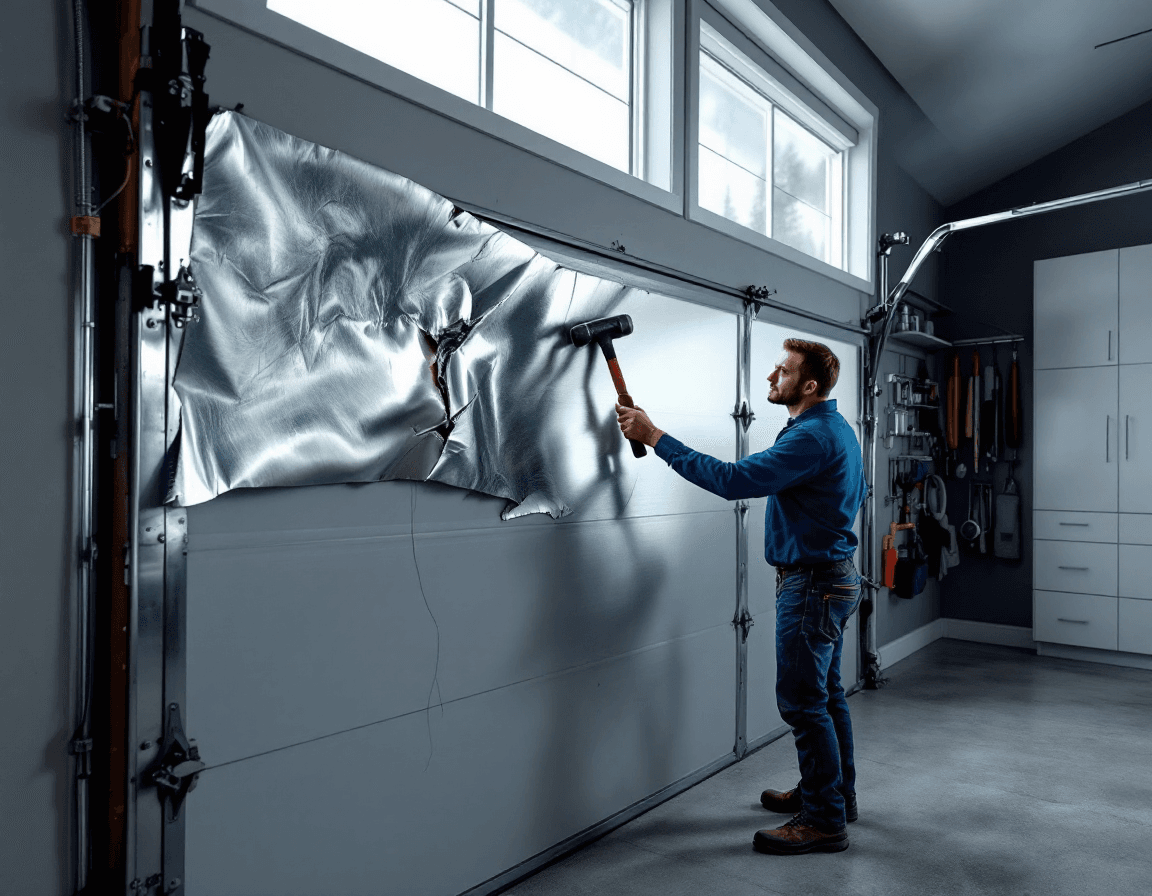
Garage door panel replacement on Bainbridge Island is a common job, and it is often more practical than most homeowners expect. A single dented, cracked, or water-damaged section doesn't always mean the whole door has to go. Our technicians serve Winslow, Lynwood Center, Rolling Bay, and the rest of the island from our local routes, working on everything from older wood-look doors to modern insulated steel. This page explains when a panel swap makes sense, what the work involves, how we approach color matching, and what you can expect to pay.
Most of the calls we get on the island start with something visible: a bulge in the lower section after a delivery truck clipped the door, a hairline crack running across a window insert, or a bottom panel that has gone soft after a winter of wet weather. The door itself may still open and close without complaint, which is why many owners wait longer than they should. A damaged panel left alone can allow moisture into the insulation core, weaken the connection to neighboring sections, and make the next repair more involved. Catching it early usually keeps the job small.
If you are reading this because something on your door looks wrong, you are in the right place. Below, we walk through the specific conditions that show up in Kitsap County, how to tell cosmetic damage from structural damage, and how to decide between replacing a section and replacing the whole door. We also explain where licensed professional help is non-negotiable, because a few parts of this work carry real risk. Read through the sections that match your situation, and call us if you would like someone to take a look in person.
How the Island Climate Wears Down Garage Doors
Bainbridge Island sits in the middle of Puget Sound, and that location shapes almost everything about how garage doors age here. Winters bring long stretches of rain and low, damp air, while summers are mild but can still carry enough marine moisture to keep surfaces wet overnight. Salt spray carried inland by westerly winds settles on exposed metal, especially on homes near the water in areas like Rolling Bay. Over time, that combination encourages corrosion at panel seams, hinge points, and the bottom edges where water sits after rain.
Moss and algae are another local factor that many homeowners don't think about until they notice a dark green band near the base of the door. Shaded driveways under tall Douglas fir and cedar stay damp for days, and organic growth can trap moisture against the lower panel. Wood-look and composite panels absorb that moisture more readily than painted steel, which means rot can begin unseen behind a paint film that still looks fine from across the driveway. We see this most often on older doors that have been repainted but never had the bottom section properly sealed.
Temperature swings also matter. A door that sits in a cold garage overnight and then gets hit by a warm, humid afternoon can experience condensation on the inside of the panels, which slowly degrades insulation foam bonded to the steel skin. None of this happens overnight, but across several seasons it changes how a panel responds to a bump or a hard push. Understanding this background helps explain why a panel that looked solid last year might now flex, crack, or separate from its neighbor.
Reading the Dent: Cosmetic Damage Versus Structural Damage
Not every dent needs a new panel, and not every dent is harmless. The first question we ask is whether the damage affects the panel's ability to hold its shape and transfer load across the door. A shallow dent in the middle of a flat steel panel may only be a cosmetic concern, particularly if the metal is not creased, the paint is intact, and the section still tracks properly in the tracks. A dent that runs across a horizontal stiffening ridge or sits near a hinge is a different matter, because it can change how the door bends when it lifts.
Cracks deserve more attention than dents. A crack in a steel skin can grow with thermal cycling, and a crack in a composite or wood-look panel can open a path for water into the core. We look at whether the crack stops at the edge of the panel or runs into a seam, and whether the surrounding area has begun to bulge or separate. Cracks around glass or acrylic window inserts are common after impacts, and they often mean the insert or its retaining frame needs attention along with the surrounding skin.
A simple check you can do yourself is to close the door slowly and watch the damaged section. If it sways, rubs the track, or sits crooked when it reaches the top, the damage has probably moved beyond cosmetic. Also run your hand along the panel edges looking for sharp burrs or sections that feel loose. Those signs are worth reporting, because a panel that is pulling against its hinges or rollers can strain other parts of the system.
What a Panel Swap Involves on a Sectional Door
Most residential garage doors on Bainbridge Island are sectional doors built from several horizontal panels joined by hinges and rollers. Replacing one section means supporting the door safely, disconnecting the panel from its neighbors, removing the damaged panel, and installing a new one that lines up with the existing hardware. The work is precise. A panel that is even slightly out of square can cause the door to track unevenly, bind in the tracks, or stress the opener.
Before any panel comes out, the door has to be secured and the spring tension has to be addressed correctly. This is one of the areas where we insist on licensed professional handling. Torsion and extension springs store a large amount of energy, and working near them without the proper tools and training is dangerous. Our technicians manage that step as part of the service, and homeowners should never attempt it themselves, even if a video makes it look straightforward.
Once the section is out, the replacement panel is fitted, the hinges and rollers are checked for wear, and the door is cycled several times to confirm smooth operation. We also inspect the neighboring panels for stress marks that suggest the original impact traveled through the door. Sometimes a simple roller or hinge replacement during the same visit prevents a repeat problem, and we will talk through those options before adding any work to your bill.
Matching a Panel When the Original Has Faded or Been Discontinued
Color and texture matching is often the hardest part of a panel replacement, especially on doors that are more than a decade old. Sun exposure on south- and west-facing garages can fade paint and clear coats unevenly, so a new panel can look noticeably different even if the manufacturer's color name is the same. Wood-grain textures and embossed patterns also change over time as manufacturers update their lines. That is why a visual check in daylight matters more than any catalog description.
When an exact match is not available, we look at several options. In some cases a panel from the same manufacturer's current line is close enough, particularly if the door is painted and the difference will be less noticeable from the street. In other cases, a full repaint of the adjacent sections can even out the appearance, though that is a larger job and costs more. If the door is a discontinued model, we will be honest about whether a matching panel exists and what compromise makes sense.
Homeowners sometimes ask whether a mismatched panel is a problem beyond looks. Usually it is not, provided the replacement is the correct size, thickness, and insulation rating for the door. What matters more is that the panel fits the hinge and roller geometry precisely. A panel that matches in color but not in dimension will create far more trouble than a slightly lighter one that tracks perfectly.
Water Damage and the Bottom Section Problem
The bottom panel takes more abuse than any other section on a garage door. It sits closest to the driveway, catches splashing water, collects road grime, and sometimes holds standing water after a heavy rain. On the island, where driveways often slope toward the garage or drain poorly after winter storms, the bottom section can stay wet for longer than homeowners realize. That moisture is the main reason bottom panels soften, rust through, or delaminate.
Water damage often shows up as a swollen or spongy area near the base, a stain line that runs upward from the bottom edge, or paint that bubbles and peels. On insulated doors, moisture can get trapped in the foam core, where it is hard to see and slow to dry. A panel that feels soft when pressed or sounds hollow when tapped is a good candidate for replacement, because the damage will not reverse on its own. Ignoring it can let the problem spread to the bottom weatherseal and the track rollers beside it.
Replacing a water-damaged bottom panel is often the most cost-effective fix when the rest of the door is sound. We usually recommend checking the weatherseal at the same time, since a worn seal can keep the driveway water coming back. We also look at whether drainage around the garage threshold needs attention, because no panel replacement will last long if water keeps pooling at the same spot. Those observations are part of an honest assessment, and we will explain them without pushing unnecessary work.
Backing Accidents and Single-Panel Impacts
A single panel damaged in a backing accident is one of the most common repair scenarios we see. A bumper, a trailer hitch, or a side mirror can dent a section in one moment, and the damage may seem minor at first. On many island properties, driveways are tight, and the garage door sits close to the edge of a turnaround or a narrow approach. Even a slow bump can bend a panel enough to affect how it sits in the track.
The key question after an impact is whether the door was moving at the time. An impact on a closed door usually transfers force into one panel and the adjacent hinges. An impact on a door in motion can twist the section and damage the roller track as well. If you notice grinding, a shift in the door's alignment, or a noise that wasn't there before, stop using the door and call for service. Continuing to run it can bend the track further and turn a single-panel job into a larger one.
Insurance questions sometimes come up after a backing accident, particularly when a vehicle is involved. We can document the damage and provide an itemized description of the repair, though coverage decisions are between you and your insurer. Keeping photos of the damage from several angles, along with the date and a brief description of what happened, makes that conversation easier.
Repair, Replace, or Re-Panel: A Practical Decision Guide
Deciding between repairing a panel and replacing the whole door depends on several factors. The age and condition of the rest of the door matter most. If the springs, rollers, and tracks are in good shape and the damage is limited to one or two sections, a panel replacement usually makes sense. If the door is thirty years old, the springs are near the end of their life, and multiple panels show corrosion, a full door replacement may cost less over the next several years than repeated panel work.
Insulation performance is another consideration. Many older doors were built without insulation, and a replacement panel on an uninsulated door will not change its energy profile. Homeowners who use a garage as a workshop or a space that needs temperature control sometimes find that upgrading to an insulated door offers more comfort than a simple panel swap. We can discuss those trade-offs without assuming a full replacement is necessary.
Here are a few signs that suggest replacing the door instead of a single panel:
- Three or more panels show rust, rot, or cracking in different areas
- The tracks, rollers, or hinges are worn and cannot be restored reliably
- The door's manufacturer no longer makes compatible panels, and no reasonable match exists
- The springs have broken or show advanced wear, and the door is already past its expected service life
- Repairs have been done repeatedly in the same area over a short period
When none of those signs apply, panel replacement is usually the right choice. It keeps the existing door, preserves the existing hardware, and costs far less than a full installation.
What Panel Replacement Typically Costs on Bainbridge
Pricing for garage door panel replacement depends on the door, the panel, and the complexity of the work. For our Bainbridge Island service area, the typical range for a single section is $250 to $800, with the final number determined by the specific door and the panel that needs replacing. Simpler steel panels on common residential doors tend to fall toward the lower end, while wood-look, composite, or window-insert panels and older or specialty doors often land higher.
Several factors shape the final price. The availability of a matching panel can add time and cost if it must be ordered. Doors with a complicated track layout or heavy-duty hardware may require additional labor to remove and reinstall the section safely. If the damage has affected the hinges, rollers, or weatherseal, those parts may be recommended in the same visit, which adds to the total. We aim to explain each line item before any work starts so you know what you are paying for.
Here is what usually goes into a panel replacement estimate:
- The replacement panel itself, matched as closely as possible to your existing door
- Labor to secure the door, remove the damaged section, and install and align the new panel
- Hinge, roller, or weatherseal replacement if worn parts are found during the work
- A post-installation test cycle to confirm smooth operation and proper tracking
Keep in mind that these figures reflect our typical range and are not a guarantee for every door. An on-site inspection gives the most accurate picture.
Safety Limits: What Licensed Technicians Should Handle
Garage door work is one of the more hazardous home maintenance tasks, and panel replacement sits close to several of its dangers. The springs that counterbalance a sectional door hold substantial tension even when the door appears to be at rest. Removing or adjusting them without the correct tools and training can cause serious injury. For that reason, any work that involves springs, cables, drums, or the tension system should be handled by a licensed, bonded, and insured professional.
Homeowners can take some safe steps on their own. You can clean the exterior of the door, check for loose hardware by sight, keep the tracks free of debris, and photograph damage for your records. You can also note any unusual sounds or movement and share those observations when you call. What you should not do is attempt to disconnect a panel from the springs, loosen a torsion bar, or pull a door section out of the track while it is under tension.
Our technicians follow established safety practices on every job. We secure the door before starting, verify that the work area is clear, and confirm the door's movement before leaving the property. If your situation involves cables that have frayed, a spring that has visibly separated, or a drum that appears damaged, please keep everyone away from the door and call us right away. Those conditions need prompt, professional attention.
Scheduling Panel Work Across Bainbridge Island
Getting service on the island takes a little planning, mostly because the ferry schedule and island traffic influence when technicians can reach certain neighborhoods. Our crews plan routes around these realities, grouping visits in areas like Winslow, Lynwood Center, and Rolling Bay where possible. If you can describe the damage clearly when you call, we can often determine whether the job needs a parts order before the visit, which can save a second trip.
When you schedule, it helps to have a few details ready. Knowing the approximate age and brand of the door, the width of the opening, and whether the door is insulated or has windows gives us a head start on identifying a matching panel. Photos of the damage from outside and inside the garage are also useful. If the door is currently inoperable, mention that so we can prioritize the visit appropriately.
If the damaged section is causing the door to stick, sag, or leave the garage partially open, please let us know immediately. Those conditions can be a security concern and sometimes a safety concern, and they may warrant faster scheduling. For less urgent cosmetic or moisture damage, we are happy to set up a convenient appointment that fits your week.
Whether your door has a single dented section after a delivery, a bottom panel softened by winter rain, or a cracked window frame from a backing mishap, we can assess the damage and explain your options clearly. Call Seattle Garage Door Fix at (888) 799-3819 to schedule a licensed technician for your Bainbridge Island home. We will walk you through repair versus replacement, provide transparent pricing before any work begins, and make sure your door is safe and operating smoothly.