
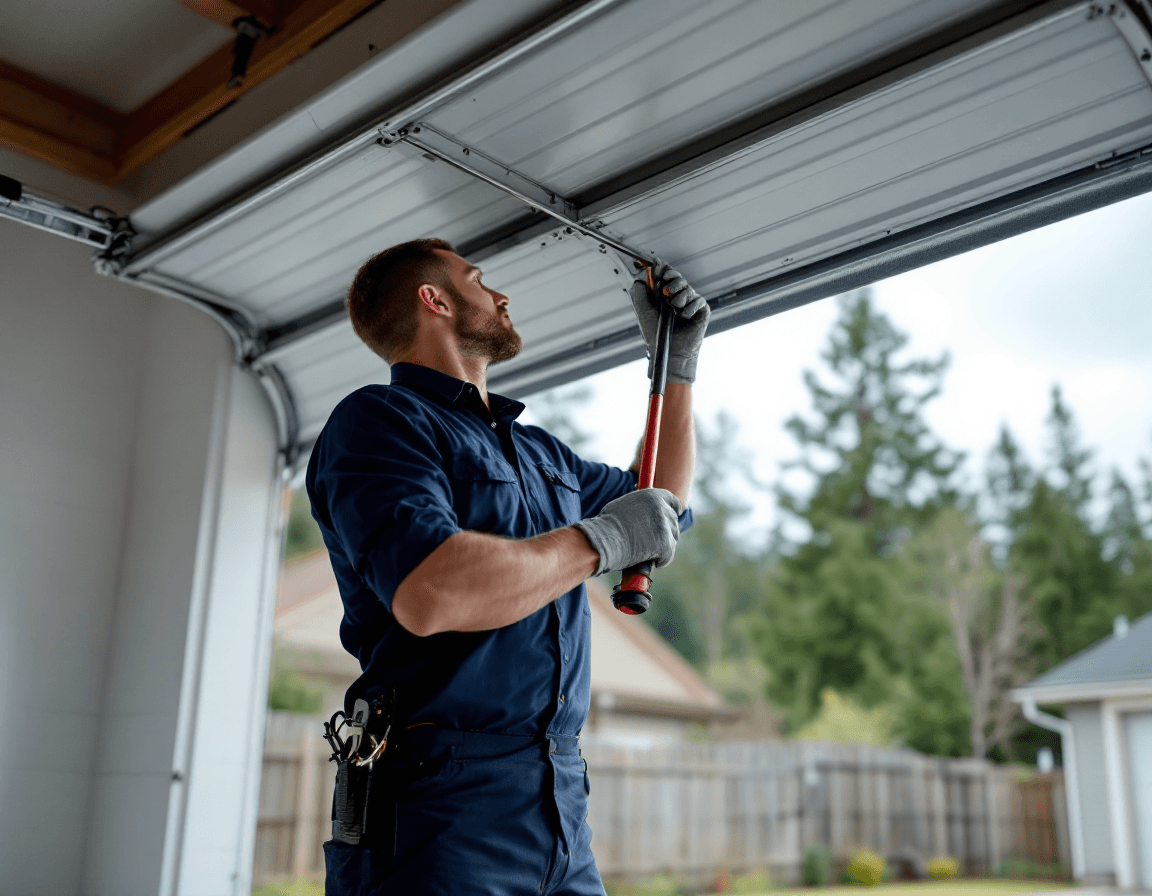
Garage Door Spring Replacement in Bainbridge Island, WA is one of the most common repairs we handle on the island, and it is also one of the most important to get right. The springs carry most of the weight of a garage door, so when one breaks, the door can become nearly impossible to lift by hand and the opener may struggle or stop altogether. Homes from Winslow to the quieter lanes near Rolling Bay see the same pattern: a sudden bang in the early morning, followed by a door that sits half open or refuses to move. This page explains what that failure looks like, why it happens so often here, and what a proper repair involves.
Bainbridge Island has a particular mix of conditions that affects garage hardware. Our winters are wet and mild rather than severely cold, but the moisture rarely lets up for long, and the salt carried in from Puget Sound air settles on steel surfaces across the island. Many garages are also detached or set into sloped lots, which means doors take a lot of daily use and a fair amount of humidity. Springs are made from hardened steel, and steel that lives in damp, salty air gradually loses its temper and its protective coating. Understanding this background helps homeowners know when to call for help and why a spring that seemed fine last year may be nearing the end of its life.
If you are reading this because your door has just failed, the good news is that spring replacement is a well-defined job with predictable steps. A licensed technician can usually diagnose the problem on the first visit, confirm which spring type your door uses, and install the correct replacement with the door properly balanced. Our team is licensed, bonded, and insured, and we treat every spring as the serious piece of equipment it is. If you have a broken spring, call (888) 799-3819 rather than attempting the repair yourself.
Reading the Warning Signs Before a Spring Lets Go
Most torsion and extension springs give some warning before they fail completely. A spring that is wearing out often produces a slight change in how the door behaves, such as a noticeable lurch when it starts to open or a feeling that the door is heavier on one side than the other. Some homeowners notice a faint squeak or grinding noise from the spring area as the coils rub against each other or against the bracket. These signs are easy to dismiss during a busy week, but they usually mean the spring has already lost much of its working tension. Paying attention to them can turn an emergency call into a scheduled appointment.
The most dramatic failure is the loud bang many Bainbridge homeowners describe, often in the early morning or after a cold night. When a spring snaps, it releases its stored energy suddenly, and the sound can be startling enough to wake the whole house. After a break like this, the door typically stays closed or hangs partway open, and the opener may hum or strain without making any real progress. Some people assume the opener has failed, but in most cases the opener is simply being asked to lift a door that no longer has its counterbalance. Treat that sound as a signal to stop using the door until a technician has inspected it.
Look also for a visible gap in a torsion spring. A healthy torsion spring is a continuous, evenly spaced coil wound tightly around the shaft above the door. When a section breaks, you may see a clear space between two coils, sometimes with the ends pulled slightly apart. Even if the door still moves, a gapped torsion spring should be considered broken, because the remaining coils are carrying loads they were never designed to handle. Replacing it promptly protects the opener, the cables, and the door itself.
Why Island Garages Put Extra Strain on Springs
Garage hardware on Bainbridge Island deals with a set of pressures that inland homes sometimes avoid. Salt-laden air drifts off the water and deposits fine mineral residue on exposed metal, and that residue encourages rust, especially on the coil surfaces of older springs. Damp weather also means garage doors spend more time with moisture trapped between panels, tracks, and hardware, which can gradually corrode the anchoring points where cables and brackets attach. Over several seasons, these small effects combine into a steady loss of strength that is hard to see from the outside.
Temperature swings add a second factor. Steel expands and contracts with changes in temperature, and a spring that sits in a cold garage on a frosty morning is under a different level of stress than one that has warmed up through the afternoon. Many island homes also have garages that are not heated, so the springs experience the full range of outdoor conditions. Repeated expansion and contraction, combined with corrosion, can weaken a spring in ways that show up as a sudden failure rather than a slow decline.
Usage patterns matter too. Families who leave for work early and return late often open and close the door several times a day, and a spring rated for a certain number of cycles can wear out sooner than expected. Homes with home offices, rental units, or shared driveways may also run their doors more frequently than the original installer anticipated. When we inspect a door after a spring failure, we consider both the environment and the cycle count, because those two factors together help determine whether a standard spring is enough or whether a higher-cycle option makes more sense.
Torsion or Extension: Knowing Which Spring Your Door Carries
Before any repair begins, a technician needs to identify the type of spring your door uses, because torsion and extension springs work differently and require different procedures. Torsion springs mount on a horizontal steel shaft above the garage opening, and they twist to store energy as the door closes and release it as the door rises. Extension springs run along the horizontal tracks on each side of the door, stretching and contracting as the panels move. Many older doors use extension springs, while most newer residential doors on the island use torsion systems.
Identifying the system is not guesswork. A torsion setup has a single long shaft running across the top of the door, with a central spring cone and winding bars used during installation. An extension setup has springs and cables along the sides of the tracks, often with safety cables threaded through the springs themselves. Some doors combine features, and a few older installations have been modified over the years, so a careful visual inspection is important. Our technicians check the door's label or manufacturer information where available, and they confirm the system before ordering any replacement part.
Each type has its own hazards. Torsion springs store a great deal of energy in their winding, and they are never something a homeowner should adjust with ordinary hand tools. Extension springs can also release stored energy violently if they are removed without the proper safety measures. In both cases, the work belongs with a licensed professional who has the right equipment and training. Attempting to swap a spring without that preparation is one of the most common ways people get hurt during garage repairs.
What a Spring Replacement Typically Costs Here
Pricing for spring replacement depends on several factors, and it is reasonable for homeowners to ask what is included before the work starts. For most spring replacements on Bainbridge Island, our pricing falls in the range of $180 to $450. The final figure depends on the spring type, the door's weight and size, whether one or both springs need replacing, and whether any cables, drums, or bearings also require attention. A single broken spring on a standard residential door will usually fall toward the lower end of that range, while a larger or heavier door, or one that needs extra components, will generally cost more.
It is wise to replace springs in pairs on torsion systems when possible. Both springs on a torsion shaft were manufactured to work together, and if one has failed, the other has usually seen the same wear and is not far behind. Replacing only one can leave the door unbalanced, placing extra stress on the new spring and the opener. Our technicians will explain whether a pair replacement makes sense for your specific door and will give you an itemized view of what each option includes before any work begins, so you can decide with clear information.
Ask about warranty coverage and parts specifications when you receive your estimate. Reputable installers should be able to explain what the spring is rated for, how long the warranty runs, and what is included in the labor. Be cautious of any quote that sounds unusually low without explaining what is being left out, because a rushed or incomplete repair can lead to a second failure. Remember that the price range we quote is for most spring replacements, and your technician will confirm the exact figure after inspecting your door.
Cables, Drums, and the Hidden Damage After a Break
When a spring breaks, the force of the failure does not always stay confined to the spring itself. The lift cables may slip off their drums, become kinked, or fray where they wrap around the drum surface. On torsion systems, the drums sit at each end of the shaft and carry the cables that raise the bottom bracket of the door. A sudden release can pull a cable loose from its anchor point or bend the drum out of alignment, and these problems are easy to overlook when the spring is the obvious culprit.
Homeowners sometimes notice that the door hangs crooked or that one side rises faster than the other after a spring failure. This can be a sign that a cable has come off its drum or that a bracket has shifted. Continuing to operate the door in this condition can damage the tracks, rollers, and opener, and it can create a dangerous situation if the door drops unexpectedly. A thorough inspection after a break should include the cables, drums, bearing plates, and track alignment, not just the spring.
- Check whether the lift cables are still seated on their drums and free of visible kinks or frayed strands.
- Look for bent track sections, loose bolts, or rollers that have popped out of their guides after the break.
- Note whether the door sits level when partly open, since a tilt often signals a cable or drum problem.
- Listen for grinding or scraping during operation, which can indicate a bearing or roller issue.
- Avoid operating the door manually or with the opener until a technician confirms the cables and drums are secure.
Address these issues in the same visit whenever possible. Replacing a spring while ignoring a damaged drum or frayed cable simply sets up the next failure, and it wastes the money you spent on the repair.
High-Cycle Springs and Why Busy Households Upgrade
Standard springs are rated for a particular number of cycles, which is one complete open-and-close movement of the door. Many residential springs are designed for roughly 10,000 cycles, though the exact rating varies by manufacturer and product line, and we always confirm the specification for the specific part we install. A household that uses the door a few times a week may get many years out of a standard spring, but families with heavy daily traffic, home businesses, or multiple drivers may reach the rated limit sooner than they expected.
High-cycle springs are engineered to handle more movement over their service life, typically with thicker wire or different heat-treatment methods. They are a sensible upgrade for busy households, particularly those in homes where the garage is the main entrance and the door opens many times a day. They can also suit homeowners who want to reduce the chance of an unexpected failure during a cold snap, when a stressed spring is most likely to give way. The higher-cycle option usually costs more upfront, but it can be a practical investment when weighed against the inconvenience of a second emergency call.
Choosing a high-cycle option is not appropriate for every door, and it should never be selected simply because it sounds more durable. The door's weight, track configuration, and opener type all influence which spring will balance correctly. A technician should measure and calculate before recommending a particular cycle rating, and the spring must match the door's design. If you are considering an upgrade, ask your technician to explain how the new spring will change the door's balance and whether any other components should be checked at the same time.
Balancing the Door So the Opener Is Not Doing the Lifting
A garage door is designed to be nearly balanced by its springs, so that the opener only needs to guide it rather than muscle it up and down. When springs are properly tensioned, a well-balanced door should stay roughly in place when raised partway and released, rather than dropping or rising on its own. After a spring replacement, the balance must be checked and adjusted, because even a correctly sized spring can leave the door too heavy or too light if the tension is set incorrectly. An unbalanced door places strain on the opener motor, the gears, and the track system.
A common test is to pull the emergency release, lift the door by hand to about waist height, and let go. A balanced door will stay put. If it slides down quickly, the springs are not providing enough lift, and if it rises rapidly, they may be providing too much. Technicians use this kind of check, along with careful measurement of the door's weight and the spring's rating, to confirm the balance before they leave. Our approach focuses on precision, because even a small imbalance can shorten the life of the opener and the new spring.
Balancing also affects how the door closes. A door that closes too fast or crooked may have uneven tension between the two sides, or the cables may be sitting unevenly on their drums. Adjusting the balance and checking the cable routing usually resolves these symptoms. If the door still drifts after balancing, the technician should inspect the rollers, hinges, and track alignment, because the problem may be mechanical rather than spring-related.
Neighborhood Notes: Winslow, Lynwood Center, and Rolling Bay
Bainbridge Island is small enough that most homeowners recognize the differences between its neighborhoods, and those differences can matter for garage hardware. Homes in and around Winslow tend to include a mix of older craftsman-style houses and newer builds, so we see everything from original extension-spring systems to modern torsion setups. Many of these properties have detached garages or driveways that run close to the street, and the doors in these areas often take frequent use. Our technicians are familiar with the layouts and access challenges common to the village core and its surrounding blocks.
Lynwood Center draws a lot of families and neighborhood traffic, and the homes nearby often have attached garages that open directly into living space. For these households, a spring failure is more than an inconvenience, because the door may be the main way in and out of the house. Quick, reliable scheduling is especially valuable here, and we aim to give clear arrival windows so homeowners can plan around school runs and work schedules. When a door is stuck open or closed in a high-traffic household, getting it secured promptly matters for both safety and security.
The Rolling Bay area sits closer to the water, which means the salt-air effects described earlier are often more pronounced. Garage doors and their hardware in this part of the island may show corrosion sooner than those set farther inland, so we pay particular attention to rust on coils, brackets, and anchor points during inspection. Homeowners in Rolling Bay and similar shoreline pockets may benefit from periodic lubrication and cleaning, which we can discuss during a service visit. Wherever you live on the island, a technician who understands local conditions can give you a more realistic picture of what your door needs.
Safety Rules Every Homeowner Should Follow
Garage door springs are among the most hazardous components in a home. The tension stored in a torsion or extension spring is enough to cause serious injury if the spring is released without proper control, and the danger increases when people attempt repairs using improvised tools or without training. Our first recommendation to every homeowner is simple: do not attempt to remove, install, adjust, or wind a spring on your own. The work should always be done by a licensed professional who understands the energy involved and has the equipment to manage it safely.
Even if you are not planning any repair, a few precautions can protect your household while you wait for a technician. Keep children and pets away from the door area, and avoid standing beneath a door that is partly open or hanging unevenly. Do not try to force the door open or closed by hand when the spring has failed, because a sudden release can cause the door to drop or the cables to whip. If the door is stuck, leave it where it is and call for service.
- Never stand directly under a garage door that is unbalanced, partly open, or hanging crooked.
- Do not attempt to wind, unwind, or adjust torsion spring tension yourself under any circumstances.
- Keep children and pets clear of the garage door area while a technician is working.
- Disconnect the opener and avoid using the emergency release on a door that is sagging or uneven until a professional has examined it.
- Call a licensed technician for any spring, cable, or drum problem, regardless of how minor it seems.
Following these rules keeps your household safe and gives the technician the best chance to complete the repair quickly and correctly.
What Happens During a Service Visit
When you schedule a spring replacement, the technician will start by asking about the symptoms you have noticed, such as the bang you heard, the door's behavior, or any unusual noises from the opener. This conversation helps the technician prepare the right parts and tools before arriving. On site, the first step is a visual and functional inspection of the door, springs, cables, drums, tracks, rollers, and opener. The goal is to confirm the cause of the failure and identify any related damage that should be addressed during the same visit.
Once the diagnosis is clear, the technician will explain the recommended repair and provide the estimate. This is the time to ask questions about spring type, cycle rating, warranty, and whether a pair replacement makes sense. After you approve the work, the technician will secure the door, release the tension using proper procedures, install the new spring, and reattach or replace any damaged components. The door is then balanced and tested through several full cycles, with the opener's behavior checked as well.
Before leaving, the technician should walk you through what was done, explain how to recognize early warning signs in the future, and answer any remaining questions. You should feel informed about the repair and confident that your door is operating within safe limits. If something does not seem right after the visit, call us so we can take another look. Reliable spring work depends on careful diagnosis, precise installation, and clear communication, and those are the standards we bring to every Bainbridge Island job.
If your garage door has snapped a spring, shows a visible gap in the coil, won't lift, or closes unevenly, do not wait for it to fail further. Call Seattle Garage Door Fix at (888) 799-3819 to schedule a licensed technician who can inspect the damage, explain your options, and restore safe, balanced operation to your door.