
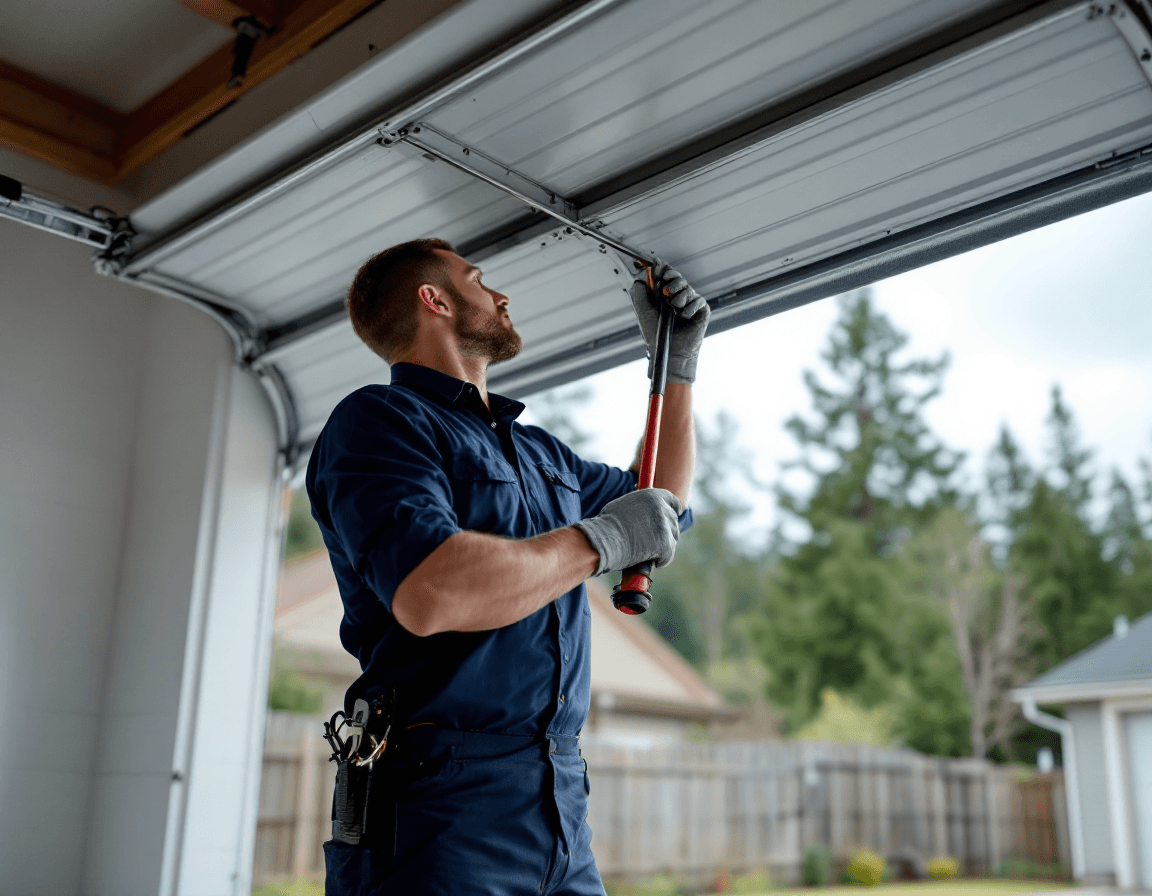
Garage door spring replacement in Port Orchard, WA is one of the most common repairs we handle for homeowners across Kitsap County, and it is also one of the most time-sensitive. The springs above your door carry most of its weight, so when one fails, the door usually stops working at the same moment. Many households first notice the problem with a sharp crack or a loud bang from the garage, while others discover it when the door refuses to lift at all. Either way, the failure tends to arrive without much warning, especially after a long stretch of wet weather or a sudden drop in temperature.
Port Orchard sits on the western side of the Kitsap Peninsula, where marine air, frequent rain, and damp winters are part of everyday life. Homes around downtown Port Orchard, the neighborhoods out toward Manchester, and the newer developments in the McCormick Woods area all face the same basic conditions: moisture, salt-laden breezes off the water, and cold mornings that stiffen metal and lubricant. Those conditions gradually weaken spring steel and dry out the grease that keeps coils moving smoothly. This guide explains what spring failure looks like, why it happens so often in our area, and what a proper repair involves.
Our goal is to give you a clear picture of the problem so you can make a confident decision. You will learn how to recognize the warning signs, what the difference is between torsion and extension springs, and why precise balancing matters after a replacement. We also explain what a typical repair costs, which is generally between $180 and $450 for most spring replacements, depending on the spring type, door size, and whether high-cycle upgrades are part of the job. Spring work carries real risk, so we also explain why it belongs in the hands of a licensed professional.
What a Snapped Spring Sounds Like From Your Driveway
A broken torsion or extension spring rarely goes unnoticed. Most homeowners describe a loud bang, similar to a gunshot or a heavy metal pipe hitting concrete, coming from inside the garage. Sometimes the sound is followed by a sudden jolt in the door, or a slight shift as the panels settle. In a quiet Port Orchard neighborhood on a damp evening, that noise can carry well beyond the garage walls, which is often how neighbors and family members learn something has gone wrong.
The sound happens because the spring is under enormous tension when it is holding the door's weight. When the steel fatigues to the point of failure, the stored energy releases in a fraction of a second. The coil may split, unwind, or separate at a weak point that has been stressed by years of opening and closing. Even when the break is small, the release can be forceful enough to damage nearby hardware, bend tracks, or loosen the cables that connect the spring system to the bottom bracket of the door.
If you hear that sound, the safest move is to stop trying to operate the door. Keep children and pets away from the garage, and avoid standing beneath the door or near the springs. Do not attempt to wind or unwind the spring yourself, since that is where serious injuries happen. The door may still look intact, but the internal load has changed, and running the opener can damage the operator, the rollers, or the track system.
Why Port Orchard Garages Wear Springs Faster Than You Expect
Garage door springs are engineered to last through a set number of open and close cycles, but the real-world life of a spring depends heavily on its environment. In Port Orchard and the surrounding Kitsap communities, humidity and salt-tinged coastal air work steadily against bare steel. Surface rust may start on exposed coils, and that corrosion creates tiny stress points that eventually crack under load. Garages that are not fully insulated also see larger temperature swings between night and day, which causes metal to expand and contract repeatedly.
Cold snaps add another layer of wear. When temperatures drop quickly, the factory lubricant on a spring thickens and loses its ability to protect the coils from friction. A spring that was working fine in October may feel stiff and noisy by January, and that added resistance places more strain on the coil each time the door moves. Homeowners sometimes assume the opener is struggling, when the real problem is a spring that has lost flexibility.
Heavy use also matters. Families who leave for work early and return late, or who run a home business out of the garage, may cycle the door several times each day. Those routines can push a standard spring toward the end of its rated life several years sooner than expected. This is one reason many local homeowners now ask about high-cycle spring options when they replace a failed spring, since a stronger, longer-lasting setup can make sense for a busy household.
Torsion Versus Extension Springs: Knowing What Sits Above Your Door
Before any repair begins, a technician needs to identify which spring system your door uses, because the replacement process and the safety precautions differ. Torsion springs are mounted on a steel shaft above the door opening. They twist to store energy and are typically found on newer and heavier residential doors. Extension springs run along the horizontal tracks on either side of the door and stretch as the door lowers. Many older garages in the Port Orchard area still use extension springs, while many newer installations rely on torsion systems.
Torsion springs are generally the more powerful of the two, and a broken torsion spring can leave a visible gap in the coil or a gap between coils that is easy to spot once you know where to look. A torsion spring that has partially failed may still hold part of the door's weight, which can make the door feel uneven or stuck mid-travel. Extension springs can also break, often near the end hooks or along the coil body, and they may leave the cable slack or the door sagging on one side.
Knowing the spring type helps you describe the problem accurately when you call. It also shapes the scope of the repair. Some homes need both springs replaced at once, since the remaining spring has been under the same stress and is likely near failure. Others need the cables, drums, or bearing plates inspected as well. A proper assessment covers the entire lifting system, not just the component that snapped.
Warning Signs That Point to a Spring Problem Before It Fails Completely
Springs often give warning signals long before they break outright. Catching those early can prevent a sudden failure during a school run or a rainy weekend, and it can reduce the chance of additional damage to the opener and tracks. Many of the symptoms below appear gradually, so it helps to check your door periodically, especially after the first hard frost or a long wet season.
- A loud bang or sharp crack from the garage, often followed by a sudden shift in the door
- A door that feels extremely heavy when lifted by hand, or one that resists the opener without clear reason
- A visible gap in a torsion spring coil, or a coil that looks stretched, separated, or rusty at one spot
- A door that opens a few inches and then stops, or refuses to lift past a certain height
- An opener that strains, hums, or clicks while the door barely moves
- Cables that have come loose, slipped off their drums, or hang unevenly after a spring break
- A door that closes too fast, drops suddenly, or sits crooked in the opening
Any one of these symptoms deserves attention. The combination of two or more usually points to a spring that is failing or has already failed. Do not treat a crooked door or an opener that hums as a minor annoyance, since both can signal that the springs are no longer sharing the load evenly.
The Door That Opens Partway and Stops
Among the most frustrating symptoms is a door that rises a foot or two and then halts. Homeowners often blame the opener or the remote, but the cause is frequently a spring that has lost tension. When the spring cannot supply enough lifting force at higher positions, the opener sends power to the motor and the door simply stalls. In some cases the opener's safety reversal may also engage, which makes the door go back down.
This pattern is common after a spring has partially fatigued, even before it snaps completely. The spring may have stretched or lost elasticity, leaving the door unbalanced. Adjusting the opener force settings may seem tempting, but that approach can mask a serious mechanical issue and can put additional stress on the operator. A door that stops partway should be inspected before anyone pushes the opener harder.
Local weather can make this symptom appear suddenly. A cold morning after a warm week can tip an already weakened spring over the edge, so a door that worked yesterday may fail to lift today. If you notice this behavior, avoid repeated open and close attempts, since each cycle adds strain to the broken or weakened components.
Cables, Drums, and the Hidden Damage After a Break
A spring break rarely stops at the spring itself. The lifting cables are wrapped around drums attached to the bottom bracket, and their tension depends on the spring system working correctly. When a spring snaps, the cable can go slack, jump off the drum, or fray where it rubs against the track or the bracket. Sometimes the drum itself cracks or slips on its shaft, which creates an additional hazard.
Frayed or kinked cables are a serious concern. A cable that has been under sudden load may have broken strands that are not visible from the outside. Replacing the spring without inspecting and, when necessary, replacing the cables and drums can lead to a second failure within weeks. Our technicians check the entire cable path, from drum to pulley to bottom bracket, before returning a door to service.
Other components can also be affected. Bearings and center brackets sometimes crack when a spring lets go, and the shaft may bend if the load was uneven. Those parts are easy to overlook when the broken spring is the only visible problem. A thorough repair considers the full lifting system so that the replacement actually lasts.
High-Cycle Springs and What They Mean for Your Household
When a spring is replaced, homeowners often ask whether a higher-cycle option is worth the additional cost. A standard spring is designed for a particular number of cycles, and that rating reflects how many open and close movements it is expected to handle under normal conditions. High-cycle springs use upgraded wire and processing methods to extend that rated life, which can be helpful for households that use the garage heavily.
Whether a high-cycle upgrade is right for you depends on how often the door moves. A family that opens the door twice a day for commuting, school pickups, and errands may benefit from a longer-lasting spring, while a garage used mainly for storage may not need one. Local conditions also play a role. Coastal humidity and cold snaps can shorten the life of standard springs, so an upgraded option may provide a useful margin in damp areas like ours.
The decision should be based on your actual usage and the condition of the rest of the system. A high-cycle spring on a door with worn rollers or a misaligned track will not perform as expected. Our approach is to evaluate the door as a whole, then recommend options that fit the way you use your garage and the condition of your hardware.
Balancing a Door So the Opener Stops Working Overtime
After a spring replacement, the door must be properly balanced. A balanced door stays in place when it is raised about halfway and released, and it moves smoothly without drifting up or down. When the balance is off, the opener has to work harder, the springs wear unevenly, and the door can close too fast or sit crooked in the opening. Precise balancing is one of the most important parts of a professional spring job, and it is easy to get wrong without the right tools.
Homeowners can perform a basic check, but it should be done with care and never with the spring under tension. Start with the door fully closed and disconnect the opener by pulling the emergency release cord. Lift the door manually to about waist height. A balanced door should stay in place. If it rises or drops on its own, the springs are not supplying the correct lift, and a professional should inspect the system.
Balancing also involves making sure both sides of the door lift together. A door that rises unevenly can bind in the tracks, twist the panels, or put side-to-side stress on the cables. Our technicians measure and adjust the system so that the load is shared correctly, which protects the door and reduces wear on the opener.
What Spring Replacement Typically Costs in Port Orchard
Cost is one of the first questions homeowners ask, and it is a fair one. For most spring replacements in our service area, the typical range is $180 to $450. Where a job falls within that range depends on several factors, including whether you have a torsion or extension system, the size and weight of the door, the spring rating you choose, and whether cables, drums, or other components also need attention.
A straightforward single-spring replacement on a standard residential door will usually cost less than a job that involves replacing both springs, correcting cable damage, or upgrading to a high-cycle option. Larger or heavier doors, such as double-wide garage doors used for vehicles and storage, may require stronger springs and more labor, which can move the price toward the upper end of the range. We recommend asking for a clear explanation of what is included before any work begins, so there are no surprises when the job is complete.
It is also worth remembering that a cheap repair that ignores the rest of the system can cost more over time. Replacing only the broken spring while leaving worn cables or an unbalanced door in place often leads to a second visit within a short period. A complete assessment protects your budget and your safety.
Why Spring Work Belongs in Licensed Hands
Garage door springs store a large amount of energy, and mishandling them is one of the most common ways homeowners get hurt during repairs. Winding a torsion spring with the wrong tools, releasing a tensioned spring incorrectly, or working on a door that is not properly supported can lead to serious injury. For that reason, spring and cable work should always be performed by a licensed professional with the proper training and equipment.
Our company is licensed, bonded, and insured, which means we carry the protections homeowners should expect from a contractor working on high-tension components in their home. We recommend that every homeowner in Port Orchard, Manchester, McCormick Woods, and the surrounding Kitsap communities leave spring replacement to trained technicians. A professional arrives with the correct winding bars, safety clamps, and diagnostic tools, and knows how to verify that the door is balanced before the job is considered complete.
Even if you are comfortable with general home repairs, spring work is not a good project for a weekend. The risks are high and the margin for error is small. A licensed technician protects you, your vehicles, and your property, and gives you a repair that is designed to last through our wet winters and busy seasons.
If your Port Orchard garage door has stopped lifting, makes a loud crack, or shows any of the warning signs described above, call (888) 799-3819 today. Our team can schedule a licensed spring replacement, check the cables and balance, and talk through high-cycle options that fit how your household uses the garage. Please do not wait until a small problem becomes a larger one, and keep the area clear until a technician arrives.