
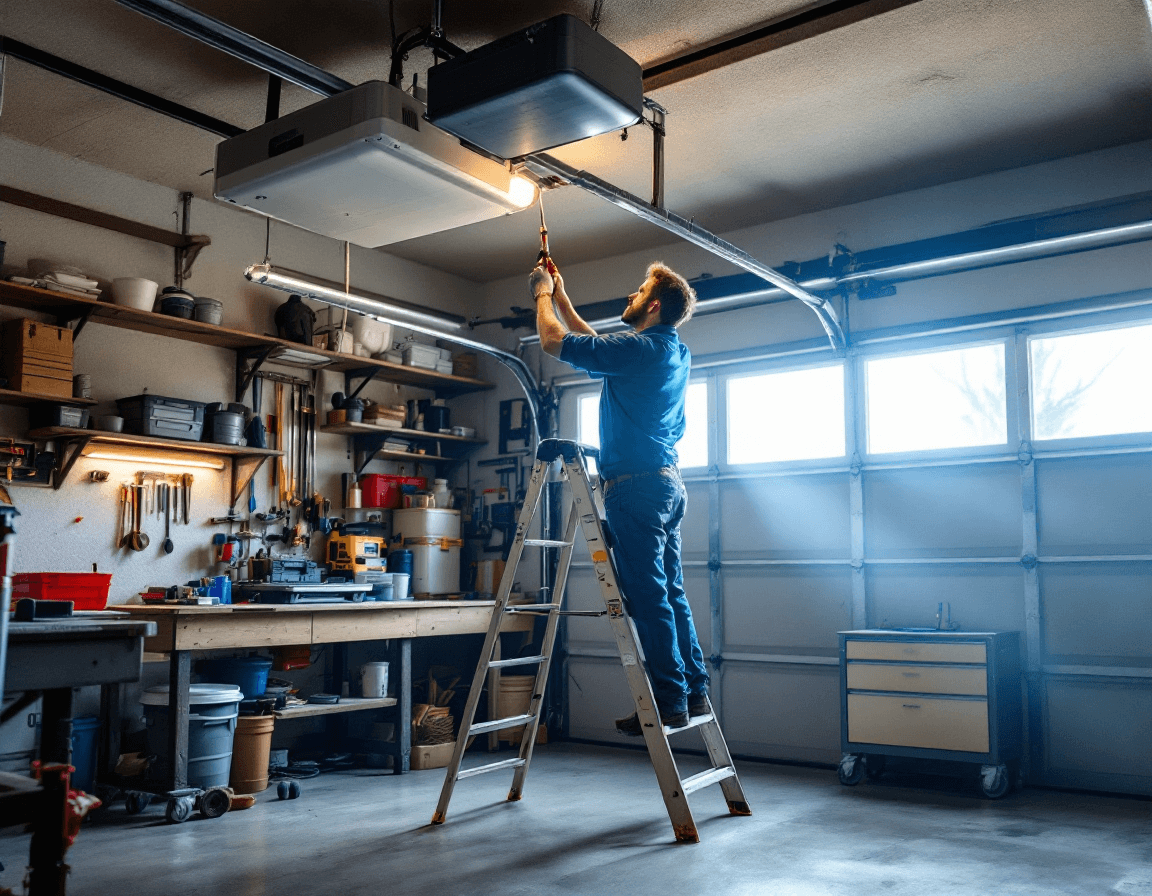
Garage door opener repair in Port Orchard, WA is one of the most common calls we take across Kitsap County, and for good reason. Homes here sit under heavy winter cloud cover, salt air drifts in from Sinclair Inlet and the Sound, and damp weather works its way into wiring, sensors, and metal parts year after year. When an opener stops responding, the cause is often something small and fixable, but it can also point to a worn gear, a failing circuit board, or a travel setting that drifted out of range. A careful diagnosis saves time and money, and it keeps a minor problem from becoming a door that won't close at all.
Our technicians work on every major opener brand, from the belt-drive units common in newer Port Orchard subdivisions to older chain-drive models still running in homes near Downtown and in the older neighborhoods around Manchester. We troubleshoot motors, gear assemblies, logic boards, safety sensors, radio receivers, and travel limits, and we replace parts when repair doesn't make sense. For most opener repairs, pricing falls between $95 and $375, depending on the component involved and the access required. Before we quote anything, we want to understand what the door is doing, or not doing, so the first visit is productive.
This page explains the most frequent problems we see locally, what usually causes them, and what you can safely check before picking up the phone. It also covers where the line sits between a homeowner task and a job for a licensed professional, because some garage door work carries real injury risk. If you are dealing with a door in Port Orchard, the ZIP codes 98366 and 98367, or nearby areas like McCormick Woods, the information below applies directly to your situation.
Reading the Early Warning Signs Before a Full Failure
Most opener failures announce themselves well before the door stops working altogether. A slight hesitation at the start of travel, a door that pauses halfway, or a motor that sounds louder than it used to are all clues that something is changing inside the unit. Catching these early often means a simpler and less expensive repair, because a lubricated or re-adjusted system is far easier to restore than one that has already stripped a gear or burned out a board. Paying attention to how the door sounds and moves over several weeks gives you a useful baseline.
Here are the symptoms our technicians hear about most often from Port Orchard homeowners:
- The opener motor runs, but the door stays closed or open and does not travel.
- The remote and the wall button stop responding, while the keypad may still light up.
- A grinding or clicking sound comes from the opener head during operation.
- The door closes partway and then reverses immediately, or it will not reach the floor.
- The status lights on the opener flash in a repeating pattern.
- The drive chain or belt sags, jumps off the track, or makes a slapping noise.
- The door works one time and fails the next, with no obvious pattern.
If you notice any of these, write down when it happens, what the weather was like, and whether the problem appears from the wall button, the remote, or both. That information helps a technician narrow the cause quickly. It also helps distinguish between a single failing part and a broader system problem, which matters when deciding whether to repair or upgrade.
When the Motor Hums but the Door Refuses to Budge
A motor that clearly runs while the door stays put is one of the more puzzling symptoms, and it usually has a mechanical explanation. The most common cause we find is a disconnected or slipping drive connection, where the trolley has come off the rail or the release cord has been pulled and left the door unlinked from the carriage. In these cases, the motor turns the drive but nothing transfers the motion to the door panel. Sometimes the trolley simply needs to be reengaged, and the door will move normally after that.
Another frequent cause is a stripped gear or worn drive sprocket inside the opener head. When teeth wear down or break, the motor can spin freely while the drive shaft barely turns, which means the door receives little or no force. Local humidity can accelerate wear on lubricants and metal components, so an opener that has seen several damp winters may need attention sooner than the manufacturer's schedule suggests. A technician can check the gear train by hand after disconnecting power, looking for play, flattened teeth, or metal shavings in the housing.
Motor failure itself is less common than people expect, but it does happen, especially in units that have been overworked by heavy doors or by repeated cycling during power fluctuations. A motor that makes a humming noise without turning, or one that cuts out after a second or two, often indicates a failing capacitor, a voltage problem, or a worn motor winding. Because these symptoms can also come from a board fault, we test the electrical side before replacing the motor, which keeps the repair focused and avoids paying for a part you do not need.
Remotes and Wall Buttons That Go Quiet After Wet Weather
Port Orchard's wet seasons are hard on remote controls and wall switches. Moisture can creep into remote housings, corrode battery contacts, and weaken the radio signal, and wall button wiring running through unsealed garage walls can develop shorts over time. A remote that works fine in July and fails every November is a classic pattern in this part of Kitsap County. Before assuming the opener has failed, it is worth checking the simplest possibilities first.
Start by replacing the remote battery and inspecting the contacts for green or white residue, which points to moisture or corrosion. Try the wall button from the same spot, and if it also fails, look at the low-voltage wires running to it, checking for pinched insulation, staple damage, or exposed copper where the wire passes through a wall or ceiling. If the remote works from inside the car but not from the driveway, the problem may be range or interference from a neighboring system rather than the opener itself. Some homes in McCormick Woods and newer parts of town have many wireless devices in close proximity, and that can make a weak signal even weaker.
If the remote has been reprogrammed or replaced recently, check whether the receiver on the opener is still learning the correct code. Some older units require a specific sequence to erase and relearn codes, and a mismatched remote will look exactly like a dead system. Our technicians can test the receiver board, confirm the frequency, and replace the antenna or wiring if needed. A quick test of the wall control and the remote together usually reveals whether the problem lives in the radio, the wiring, or the logic board.
Stripped Gears and the Grinding Sound From the Opener Head
A grinding sound from the opener head is never something to ignore. It usually means the gear teeth are worn, chipped, or stripped, or that the drive has lost alignment and metal parts are rubbing together. Continuing to run the opener in this condition can turn a modest gear replacement into a complete unit replacement, so it is worth stopping use and calling for service once you hear it. A grinding noise that appears only at one point in the door's travel often points to a worn spot on the gear or a misaligned rail.
Gear problems tend to develop gradually, which is why many homeowners notice a change in sound before they notice a change in performance. The sound may start as a faint whine, become a rough grind over several weeks, and finally cause the door to hesitate or stop. In Port Orchard, where garages can be cool and damp for months, lubricant can thicken or wash out, and metal parts may show more wear than expected for their age. Regular lubrication of the rail, hinges, and rollers helps, but the gear assembly itself requires professional inspection because the housing must be opened carefully.
Repair or replacement depends on the extent of the damage and the age of the opener. A worn drive gear can often be replaced as a component, while a stripped worm gear or damaged housing may make a full unit swap more sensible. We will explain the options clearly, including the cost difference, so you can decide what fits your budget and how long you plan to stay in the home. Many of our Port Orchard customers prefer to repair when the motor and board are still healthy, and to replace when the gear damage is extensive.
Travel Limits, Reversing Doors, and Doors That Won't Seal
A door that closes most of the way and then reverses is frustrating, but it is also a built-in safety feature doing its job. Modern openers are required to detect obstructions, and they will reverse when the force on the door exceeds a set threshold. The problem is that the threshold can be triggered by a misaligned sensor, a bent track, a worn spring, or travel limits that have shifted out of adjustment. Before adjusting anything, it helps to know that the reversal may be protecting the door from a real obstruction, such as a toy, a bicycle, or a buildup of debris in the track.
Travel limit settings tell the opener where the door should stop when fully open and fully closed. Over time, the door can settle, the rollers can wear, or a cable can stretch, and the limits may no longer match the physical position of the door. A door that will not reach the floor, or that stops short of the top, often needs its limits reset. Limit adjustment is usually a homeowner-friendly task on many models, but the exact method varies by brand, so consult the manual or call us if the buttons and dials are unfamiliar.
Doors that will not seal at the bottom can cause the same reversing behavior, because the opener senses resistance when the panel meets an uneven slab or a worn weatherstrip. Our technicians check the seal, the threshold, and the sensor alignment together, since all three contribute to the way the door reacts. If the seal is worn, replacing it is inexpensive and often improves both comfort and energy efficiency during the cold, wet months. Adjusting the opener to compensate for an unsealed door is a short-term fix at best, and it can hide a real problem that is getting worse.
Blinking Lights as the Opener's Diagnostic Language
Many openers flash their indicator lights in a pattern that corresponds to a specific fault. A repeating blink sequence might mean the safety sensors are misaligned, the door has been stopped by an obstruction, the travel limits need adjustment, or the logic board has detected an internal error. The exact meaning depends on the manufacturer, so the first step is to look up the code in your owner's manual or on the brand's support materials. Writing down the number of blinks and the pause between sequences makes the lookup faster and more accurate.
The safety sensors mounted near the floor on each side of the door are among the most common sources of blinking lights in our region. Dirt, spider webs, and moisture can disrupt the infrared beam, and a sensor that has been bumped out of alignment will often produce a fault code without any visible damage. Wiping the lenses with a clean cloth and checking that both sensors point directly at each other is a simple step any homeowner can take. If the lights remain on or continue to blink after the sensors are clean and aligned, the wiring or the board may need professional testing.
Some blinking patterns point to a logic board or power problem rather than a sensor issue. Voltage fluctuations during storms or after a power outage can leave a board in an error state, and in some cases the opener needs to be power-cycled to clear the fault. We recommend unplugging the unit for about thirty seconds, plugging it back in, and testing the door before assuming a permanent failure. If the same pattern returns quickly, the board, the power supply, or the wiring needs a closer look.
Chains, Belts, and Why Slack Drives Need Professional Hands
A loose or derailed chain or belt is one of the more common reasons a Port Orchard homeowner calls for service. Chains can stretch over time, and belts can slip if the tension is wrong or if the drive has been stressed by a heavy door. When the chain sags enough to jump off the sprocket, the opener may still run, but it will not move the door in a controlled way, and the chain can bind or tangle. Belt-drive systems have their own failure patterns, including cracking, fraying, and loss of tension after several seasons of temperature swings.
Some tension and alignment adjustments are within reach of a careful homeowner, but any work that involves the springs, the torsion system, the cables, or the drum needs to be handled by a licensed, trained professional. Torsion springs and extension springs store enormous energy, and improper handling can cause serious injury even when the door appears to be sitting still. Cables can snap under tension, and drums can slip if the wrong tool or technique is used. Our technicians are licensed, bonded, and insured, and they treat spring and cable work as a specialized job that requires proper equipment, not improvised fixes.
For opener-related chain or belt issues, the safest first step is to disconnect power to the opener and manually disengage the trolley before touching anything. Do not attempt to tension a chain or belt while the door is partially raised, and never stand under the door during any test. If the chain has come off the sprocket or the track is bent, call for service and keep the door closed until a technician arrives. This approach protects you from unexpected movement and prevents additional damage to the rail and carriage.
Intermittent Faults That Show Up on Damp Winter Mornings
Intermittent operation is one of the more frustrating symptoms because it defies a simple cause. A door may work perfectly for a week and then fail on a cold, wet morning, only to function again later that day. In our experience across Western Washington, intermittent faults often trace back to moisture affecting connectors, sensor wires, or the logic board, or to a weak battery in the remote. Temperature swings can also cause parts to expand and contract, loosening connections that were only marginally secure to begin with.
To investigate an intermittent problem, keep a simple log that records the date, time, weather, and what the door did. Patterns often emerge quickly, such as failures that happen only after heavy rain, only in the early morning, or only when the door is opened from the wall button. Check the sensor wiring for damage where it enters the opener, and inspect the terminal connections at the board for corrosion or looseness. A technician with the right diagnostic tools can often reproduce the fault and identify the failing component far faster than trial-and-error replacement.
Intermittent faults can also come from electrical noise, particularly if the garage shares a circuit with other high-draw equipment such as a freezer, a compressor, or a power tool charger. Voltage dips during startup of those appliances can briefly confuse the opener's logic board. Grounding and outlet condition matter as well, so a loose or damaged receptacle in the garage deserves a check. We test power quality at the opener as part of most intermittent-fault visits, because a stable power supply is essential for reliable operation.
Port Orchard Homes, Older Garages, and Wind Exposure
Port Orchard's housing stock is varied, and the garage door equipment you find reflects that mix. Older homes near Downtown and in established neighborhoods may still have chain-drive openers, older wiring routed through attics or unfinished walls, and tracks that have shifted over decades of use. Newer construction in areas like McCormick Woods often includes belt-drive openers, Wi-Fi-enabled systems, and more complex sensor arrangements, which bring their own troubleshooting considerations. Knowing the age and type of your opener helps set realistic expectations for repair cost and remaining service life.
Wind exposure is a practical concern for many Kitsap County properties, especially homes on open lots or with long driveways facing prevailing winds. Strong gusts can push on the door panel, stress the tracks, and cause the sensors to shift slightly out of alignment. Over time, that movement can loosen hardware and change the balance of the door, which in turn affects how hard the opener has to work. If your door seems to behave differently on windy days, mention that to the technician, because it can point toward mounting, bracing, or track issues rather than an opener fault.
Salt air is another local factor, particularly for homes that sit within a short distance of the water or that get regular onshore breezes. Metal hardware, hinges, and brackets can corrode faster than inland homeowners might expect, and that corrosion can work its way into moving parts. Stainless or galvanized hardware, along with regular cleaning and lubrication, extends the life of the system. When we visit a home with visible corrosion, we note it in our assessment so you understand how the environment is affecting the equipment.
What a Typical Opener Repair Visit Includes
A productive opener repair visit begins with a conversation about the symptoms, followed by a walkthrough of the door, the opener, and the controls. The technician will check power at the outlet, test the remote and wall button, inspect the sensors and their wiring, and look at the travel limit settings. The drive system, including the chain or belt and the trolley, gets examined for wear and alignment. If the door is operating under tension from springs, the technician will assess those components for safety and make sure they are not part of the problem without proper handling.
Once the cause is identified, we explain the repair options in plain language. Many opener repairs fall between $95 and $375, depending on whether the issue is a sensor, a remote, a board, a capacitor, a gear, or a motor. We provide the price before any work begins, and we walk through what each option will and will not fix. If the opener is old and the repair cost approaches the value of a new unit, we will say so, so you can make an informed decision rather than feeling pressured.
Our technicians carry the parts most commonly needed for popular opener brands, which speeds up the repair in many cases. For specialized components or discontinued models, we will tell you what is needed and how long sourcing may take. We are licensed, bonded, and insured, and we follow safe procedures for every job, including lockout steps and careful handling of any spring or cable components. If you have questions about your opener or your door, call us at (888) 799-3819 and we will help you decide the next step.
If your Port Orchard garage door opener is misbehaving, whether it hums without moving, ignores the remote, grinds, reverses, flashes odd lights, or works only some of the time, we are ready to help. Call (888) 799-3819 to schedule an opener repair visit for Port Orchard, Manchester, McCormick Woods, and the surrounding Kitsap County area. Our team will diagnose the problem carefully, explain your options clearly, and get your door moving safely again.