
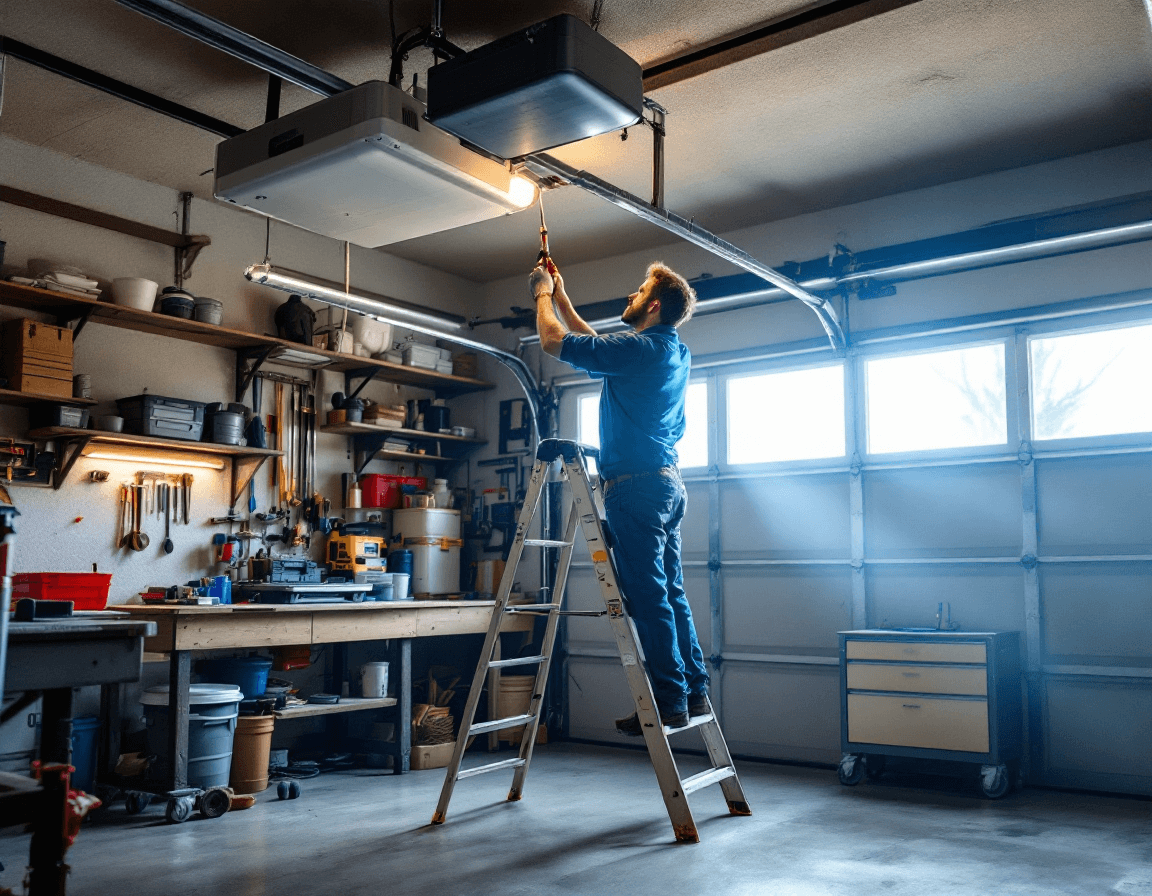
Garage door opener repair in Poulsbo, WA is one of the most common service calls we answer on the Kitsap Peninsula, and most of the time the fix is simpler than homeowners expect. A garage door that suddenly stops responding, grinds, or reverses for no obvious reason usually traces back to one of a handful of causes: a worn gear, a failed limit setting, a tired motor, a dead safety sensor, or a logic board that has started to misbehave. Our technicians troubleshoot motors, gears, circuit boards, and travel limits on every major opener brand, and we work hard to find the actual fault instead of replacing parts you do not need.
Living near downtown Poulsbo and the shoreline of Liberty Bay means your garage sees a particular kind of wear. Damp marine air, long stretches of rain, and the occasional hard freeze all put stress on the metal, wiring, and electronics that keep your door moving. Many of the openers we inspect in town have been running through several wet winters without any real protection, and the symptoms often show up gradually before they become a full failure. Knowing what each symptom is telling you can save you a second service call and a lot of frustration.
This page walks through the most common opener problems we see in the 98370 area, explains what usually causes them, and describes what a practical repair looks like. Repairs for most openers fall in a range of roughly $95 to $375, depending on the part involved and how deep the diagnosis goes. We will also be clear about the tasks that belong in the hands of a licensed professional, because some garage door work carries real risk. If something here matches what your door is doing, read on, and then call us at (888) 799-3819 when you are ready to have it looked at.
Why Poulsbo Garage Openers Wear Differently
Homes around Poulsbo sit in a climate that is mild by national standards but hard on mechanical and electrical equipment. Salt carried inland from Liberty Bay settles on exposed hardware, and the moisture that lingers through the fall and winter can work its way into junction boxes, wall button wiring, and the photo-eye sensors near the floor. Garages in older neighborhoods often have less insulation and ventilation than newer builds, which means condensation forms on steel tracks and sometimes drips onto the opener head itself. Over a few seasons, that moisture can corrode contacts and loosen connections in ways that look like a mysterious opener failure.
The temperature swings matter too. A cold snap that drops the garage well below freezing can thicken lubricant inside the gearbox and make the motor work harder to start the door, especially on heavier insulated doors. When the weather warms again, the same unit may run normally, which is why many customers tell us their opener "only acts up when it is cold." That pattern is worth noting, because it points toward lubrication, electrical connections, or a motor that is already near the end of its useful life.
Finally, many Poulsbo homes use a mix of older belt and chain drive openers alongside newer units that were installed during recent remodels. Each drive type has its own wear points. Chains stretch, belts can glaze or slip, and the rail assembly can shift when fasteners back out from years of vibration. Understanding what kind of opener you have, and how it has been living in a damp coastal garage, gives a technician a head start on finding the problem quickly.
When the Motor Hums but the Door Refuses to Move
One of the more puzzling complaints we hear is that the opener clicks, hums, or runs for a second, yet the door stays where it is. Homeowners often assume the motor has died, but in many cases the motor is working exactly as designed and the load on it is the real issue. A door that has become binding in its tracks, a roller stuck in a dented section of track, or a spring that has lost tension can all cause the opener to strain against weight it cannot lift. Some openers respond to that strain by shutting off after a short run, which can make the problem look intermittent.
Before blaming the opener, it is worth doing a quick visual check. Disconnect the opener by pulling the emergency release cord, which should be done with the door closed to avoid a sudden drop, and then lift the door by hand. If it feels unusually heavy, stiff, or jerky, the problem is likely mechanical rather than electrical. A door that moves freely by hand but still will not respond to the opener points more toward the motor, the drive connection, or the control circuit.
Our technicians check whether the motor is receiving full voltage, whether the drive mechanism is engaging, and whether any safety feature is causing the unit to halt. Repairs in this category sometimes involve replacing a capacitor, reseating a loose wire, or swapping a motor assembly, and the cost varies accordingly. Please do not attempt to adjust or replace torsion or extension springs yourself to compensate for a heavy door. Spring tension is serious business, and that work belongs to a licensed, bonded, and insured technician.
Remote and Wall Button Both Stop Responding
Few things are more frustrating on a rainy Poulsbo morning than pressing the remote three times and getting nothing. When both the handheld transmitter and the wall-mounted button fail at once, the fault usually sits inside the opener head or in the wiring that connects the wall station to it. When only the remote fails, the problem is more often a dead battery, a learned code that has been erased, or interference from a nearby device. Narrowing down which control has quit is the first step toward a fast fix.
Wall button problems are frequently caused by moisture and corrosion. A low-voltage control wire that has been pinched during a remodel, or a wall station mounted on an exterior wall where condensation can collect, may develop an intermittent connection. We have also found cases where a previous installer left slack wire coiled behind drywall, which later shifted and cracked a connection. Checking the wall station for loose screws, discoloration, or a stuck button is a reasonable starting point, but tracing wiring inside the wall should be left to a professional.
Remote issues sometimes come down to the receiver. Opener logic boards can lose their programmed codes after a power surge, a lightning-driven outage, or a board that is beginning to fail. Reprogramming is sometimes enough, but repeated code loss is a warning sign that the circuit board may need replacement. A technician can test the receiver, confirm the radio signal is reaching the board, and recommend the least expensive path that will keep the door reliable.
Grinding Noises and Stripped Gears in the Opener Head
A loud grinding, clacking, or metallic chewing sound from the opener head is one of the clearest signals that something inside the drive has failed. The most common culprit is a stripped gear, often in the drive gear or the worm gear that turns the trolley and moves the door. Gears wear down gradually, but a sudden change in sound usually means teeth have broken off or the gear has slipped on its shaft. Continuing to run the opener in that condition can damage the motor and turn a modest repair into a larger one.
On many residential openers, the gear assembly is a sealed unit that can be replaced without replacing the entire motor. The price depends on the brand, the drive style, and whether the gear is available as a standalone part. Some older units are discontinued, which means the technician may need to source a compatible component or recommend an upgrade. We always explain the options clearly so you can decide whether a repair or replacement makes more financial sense.
If your opener is grinding, we recommend stopping regular use until it has been inspected. Each cycle with a damaged gear can grind away more material and leave metal debris that clogs the housing. That debris can also work its way into the motor bearings. A prompt diagnosis is almost always less expensive than waiting until the entire head seizes.
Doors That Reverse Right Away or Refuse to Seal
Garage doors are designed to reverse when they meet resistance, and that safety feature is important. When a door starts to close and then immediately lifts again, however, the opener may be detecting a false obstruction. Common causes include a misaligned or dirty photo-eye sensor, a sensor bracket that has bent or shifted, a travel limit set too close to the floor, or a door whose bottom seal has become stiff and catches on uneven concrete. In Poulsbo, a thin film of salt residue or spider webs on the sensor lenses can be enough to trigger reversal, so cleaning the sensors is always a good first step.
Check the sensor alignment by looking at the two small lights on the sensor units mounted near the floor on either side of the door. Both lights should be steady, and the sensors should face each other directly. If one light blinks or goes dark, the sensors may be out of alignment or the wiring may be damaged. Please do not bend or force the sensor brackets far beyond their normal range, because a small adjustment can make a big difference.
If the door closes partway and then reverses without any visible obstruction, the travel limit settings may need adjustment. The close limit tells the opener where the door should stop, and if it is set incorrectly the unit may think the door has hit something. Adjusting limits requires care, and different brands use different procedures. Our technicians can calibrate the limits, confirm the force settings meet safety requirements, and test reversal behavior before leaving your home.
Reading the Blinking Pattern on the Opener Light
Many modern openers include a diagnostic light or LED that blinks in a repeating pattern when something is wrong. The blink code is meant to help technicians identify the fault, but it is often confusing to homeowners who do not have the manual handy. A rapid flash may indicate a sensor problem, a repeated slow pulse may point to a limit or travel-setting issue, and a steady light with no movement can suggest a power or board fault. The exact meaning depends entirely on the manufacturer, so reading the code with the model's documentation is important.
We recommend noting the pattern before you call. Count the number of blinks in each group, note how long the pauses last, and check whether the pattern repeats immediately after you press a button or only when the door is in motion. Taking a short phone video can help a technician compare your pattern with the service documentation. This small step often shortens the diagnosis and reduces the chance of unnecessary parts being ordered.
It is also worth checking the basics that blink codes frequently point to. Make sure the sensors are clean and aligned, that nothing is blocking the door path, and that the emergency release is fully reset. If the blinking continues after these checks, the opener likely needs a closer look at its control board or sensor wiring. Do not keep cycling the door repeatedly while a fault code is active, since that can stress the motor and gears.
Loose Chains, Slipping Belts, and Rail Problems
A chain or belt drive that has loosened, jumped its sprocket, or come off its track is a common reason an opener either fails to lift the door or makes a loud slapping noise during operation. Chains stretch over time, especially in humid environments where lubrication breaks down, and belts can glaze, crack, or slip when they age. A loose drive can also cause the trolley to disengage from the rail, leaving the door hanging in an unsafe position. These situations are easy to misread as motor failures when the real issue is a simple mechanical slip.
Before any repair, the power should be disconnected and the door should be secured. Please do not attempt to reattach a chain or belt while the opener is plugged in or while the door is unsupported. A technician will check the tension, inspect the chain or belt for stretching or damage, verify that the rail is straight and securely fastened, and confirm that the trolley is properly engaged. Tightening or replacing a drive is often a straightforward job, but it should be done correctly to prevent future slippage.
Rail problems deserve special attention in Poulsbo garages. Rails can bend or loosen if the opener was mounted to a ceiling joist that has shifted, or if the door has been slammed repeatedly after a stuck cycle. Vibration from a loose drive can gradually back out the fasteners that hold the rail to its bracket. A rail that sags even slightly will put uneven stress on the drive, which is why a complete inspection is useful after any slip or disengagement.
The Intermittent Opener That Works Sometimes
Among the most frustrating problems for homeowners is an opener that works perfectly one day and fails the next. Intermittent operation often points to a loose connection, a failing capacitor, a sensor that is sensitive to temperature or moisture, or a control board that is beginning to fail. Because the symptom comes and goes, it can be difficult to reproduce on demand, and many people end up trying the same few fixes without success. A systematic approach works better than guessing.
Our technicians typically start by checking all the power connections, the outlet supplying the opener, and any extension cords or surge protectors that may be in the circuit. Wiring that runs near the ceiling in a damp garage can develop loose or corroded terminals, and a single poor connection can cause a motor to stall intermittently. We also test the sensors, the wall station, and the radio receiver to rule out components that behave differently in cold or wet conditions. If the fault still will not show up during the visit, we can recommend monitoring steps you can take at home to capture the failure when it happens.
If your opener has been acting unpredictably in cold snaps or after heavy rain, mention that to the technician. Patterns like these are valuable clues. Keeping a simple log of when the problem happens, what the weather was like, and what the opener was doing at the time can shorten diagnosis significantly. Once the root cause is found, we can repair or replace the affected component and verify reliable operation through several full cycles.
Brand Differences, Travel Limits, and Force Settings
Garage door openers come from many manufacturers, and each brand uses its own logic, programming methods, and safety features. A procedure that works on one model may not apply to another, and mixing up instructions can leave the door improperly calibrated. Travel limits and force settings are especially brand-specific, and they are central to both safe operation and reliable closing. Because of these differences, we tailor each repair to the exact model rather than applying a one-size approach.
- Travel limits define where the door stops when opening and closing, and incorrect settings can cause reversing, incomplete closing, or overtravel.
- Force settings determine how much resistance the opener tolerates before reversing, and they must comply with safety requirements for automatic reversal.
- Sensor alignment and wiring affect whether the door can close at all, and small misalignments can mimic a major fault.
- Logic boards store remote codes and programmed settings, so a board failure may require reprogramming every transmitter.
- Gear and drive types differ between chain, belt, and screw openers, and each style wears in its own way.
Calibrating limits and force on a modern opener takes patience. Settings that are too aggressive can make the door reverse unnecessarily, while settings that are too gentle may fail to protect against real obstructions. A technician balances these requirements, tests the door several times, and confirms that the automatic reversal works as intended. If the door has been operating unpredictably, a fresh calibration often resolves the problem without any parts at all.
What a Typical Poulsbo Repair Visit Covers
Homeowners often ask what they get for a repair visit and how the pricing works. Our technicians arrive prepared to inspect the opener head, the rails, the door hardware, the sensors, the wall station, and the power supply. We check the motor, the gear assembly, the drive, and the control board, and we test the door through full open and close cycles. The goal is to identify every fault contributing to the problem, not just the most obvious one, so the repair holds.
For most opener repairs, pricing falls in a range of about $95 to $375. Simpler jobs, such as aligning a sensor, replacing a wall button, or adjusting limits, usually land near the lower end. More involved repairs, such as swapping a motor, replacing a gear assembly, or replacing a logic board, typically fall higher in the range. We will explain the diagnosis and the options before any work begins so you can decide how to proceed.
- A complete inspection of the opener, sensors, wall station, and door hardware
- Testing of motor, gear, drive, and control board performance
- Adjustment of travel limits and force settings to match your door
- Replacement or repair of the affected component when approved
- A test of automatic reversal and safety features before we leave
Our work is backed by our license, bond, and insurance, and we will always tell you what we found in plain language. If a part is needed, we will explain why and what it does. If an issue is minor or can wait, we will say so.
Safety Work You Should Leave to a Professional
Some garage door tasks are dangerous even for experienced homeowners. Torsion springs and extension springs store enormous amounts of energy, and a single mistake during adjustment or replacement can cause serious injury. Cable repairs are equally risky, because a cable under tension can snap and whip with force. For that reason, any work involving springs, cables, drums, or the lifting mechanism should be performed only by a licensed professional with the right tools and training.
Homeowners can safely do a few basic checks, such as cleaning sensor lenses, confirming the power is on, testing the remote batteries, and observing whether the door moves smoothly by hand when the opener is disconnected. Those steps help you describe the problem accurately when you call. Beyond that, please avoid adjusting springs, loosening cable drums, or forcing a binding door. If the door feels unusually heavy or uneven, stop and call for service.
Remember that a damaged opener or door can also create hazards for children and pets. Keep the area clear while the door is moving, and never walk under a door that is opening or closing unexpectedly. If the door falls, stops in a dangerous position, or makes a loud snap or bang, step away and contact a professional. Our team is ready to respond with the right tools and the right safety precautions for your Poulsbo home.
Ready to get your opener working reliably again? Call Seattle Garage Door Fix at (888) 799-3819 to schedule an inspection for your Poulsbo garage door. Our licensed, bonded, and insured technicians will diagnose the fault, explain your options clearly, and get your door moving safely again.