
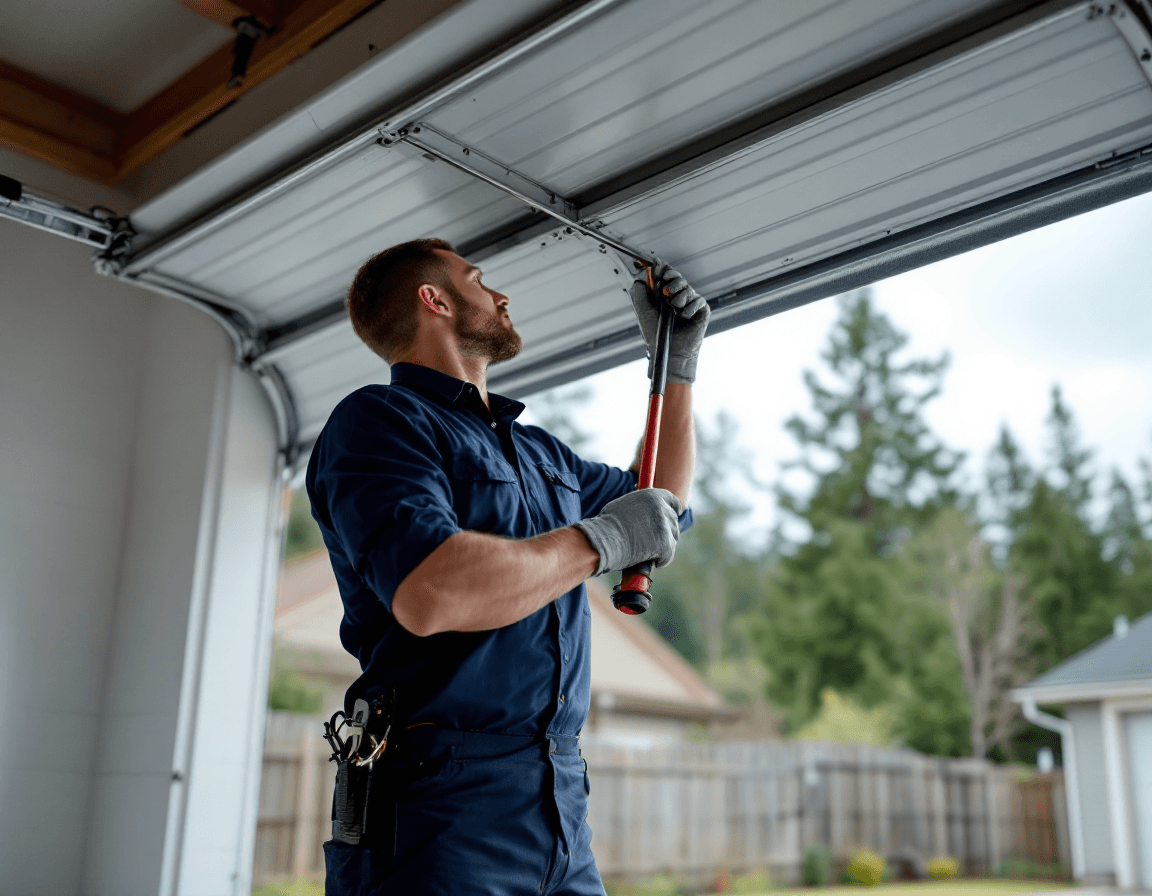
Garage Door Spring Replacement in Poulsbo, WA is one of the most common repairs we handle on the Kitsap Peninsula, and it is also one of the most urgent when it goes wrong. The springs above your garage door carry most of the door's weight, so when one fails, the whole system can stop working in a single moment. Homeowners near downtown and along the shores of Liberty Bay often notice the failure first as a loud crack from the garage, followed by a door that will not budge.
Poulsbo sits in a setting that is easy to love and hard on hardware. Long stretches of drizzle, damp mornings off the water, and salty air drifting in from Puget Sound all work their way into steel. Springs, rollers, and cables rarely fail because of one dramatic event. They weaken gradually through thousands of open-and-close cycles, and the cold, wet months speed up that process more than most people expect.
This page explains what a broken spring looks and sounds like, how the two main spring types differ, what replacement typically costs for local homes, and why balancing and high-cycle options matter. It is written for homeowners who want clear, practical information before they call anyone. If your door is currently stuck or you suspect a spring has already snapped, please keep the door closed, keep people and pets away from it, and call a licensed technician at (888) 799-3819.
Why Kitsap Winters Work Against Garage Door Springs
Western Washington's wet season is long, and the moisture that settles into a garage does not always stay outside the door. Condensation forms on cold metal during the night and then evaporates unevenly as the morning warms up. Over many months, that cycle can leave surface rust on torsion tubes, spring cones, and the hardware that anchors the spring assembly to the wall or header. Rust does not necessarily break a spring on its own, but it adds friction and uneven stress that accelerate fatigue.
Salt air is another factor for homes close to the water. Even when a house is a few blocks from the shoreline, marine air carries fine particles that settle on exposed hardware and bond with moisture. Garages with an open lower vent, an unsealed threshold, or a door that rarely closes fully tend to see more of this exposure. Over time, galvanizing wears thin on spring hardware and corrosion begins at the coil ends.
Temperature swings matter as well. Steel becomes slightly more brittle in deep cold, and a spring that has been quietly stressed all year may give way on the first hard frost of the season. Many of the calls we hear in late autumn and early winter are springs that were already weak and simply reached their limit when the air turned cold. The timing feels random to homeowners, but from a technician's perspective it usually reflects months of accumulated wear.
The Bang From the Garage: What a Snapped Spring Sounds Like
Most homeowners remember the sound of a spring break for the rest of their lives. It is typically a sharp, flat bang, sometimes compared to a gunshot or a heavy metal pipe dropped on concrete. Some people hear it from inside the house and assume a vehicle hit the door or that something fell off a shelf. In many cases, the noise is followed by a faint metallic ringing and a visible shift in the door's position.
After the bang, the door often sits partly open or crooked. You may notice that the door will not lift when you press the opener, or that the opener makes a strained humming noise without moving the door much at all. Some doors drop slightly when the spring releases, which can leave the bottom panel resting unevenly on the floor. Others remain perfectly level but feel impossibly heavy when lifted by hand.
If you hear that bang, the safest response is to avoid the door entirely. Do not stand beneath it, do not try to lift it manually, and do not attempt to inspect the spring up close. Broken springs can carry significant stored energy, and a partially released spring can still move unpredictably. Keep children and pets clear of the garage, use the side entry if you need to get in or out, and schedule a licensed repair visit as soon as possible.
Reading the Warning Signs Before the Door Quits
Springs rarely fail without warning, and the early clues are easy to miss if you do not know what to look for. A visible gap in a torsion spring coil is one of the clearest indicators. Torsion springs are wound tightly as a continuous coil, so a noticeable space between coils, usually near the center, often means the spring has begun to separate or has already broken. Do not touch the spring to test it, but a careful visual check from a safe distance can reveal the problem.
Other warning signs appear in the door's behavior. A door that opens a few inches and then stops is a common symptom, often because one side of the balance has failed and the opener cannot compensate. A door that closes too fast or crooked can mean the springs are no longer holding their share of the weight. Some owners notice that the door feels heavier than usual on manual operation, especially in the first few feet of lift.
Sound also tells a story. Creaking, popping, or grinding that gets worse over time can indicate friction or fatigue within the spring system. Keep these observations in mind when you call, because they help a technician narrow down the cause quickly. Describing what you saw and heard is genuinely useful information, and it often speeds up the diagnosis.
- Visible gap or stretched spacing between torsion spring coils
- Door opens partway and then stops or reverses
- Opener strains or hums without lifting the door
- Door feels unusually heavy when lifted manually
- Door closes too fast, drops, or sits crooked on the track
- Cables that appear loose, frayed, or off the drum
Torsion or Extension: Knowing Which Spring Your Door Carries
Not every garage door uses the same spring design, and knowing which type you have can help you understand what happened. Torsion springs mount on a steel shaft above the door opening. They twist to store energy when the door closes and release it to help lift the door. Most modern residential doors in the Poulsbo area use torsion systems because they are quieter, more balanced, and generally longer lasting when properly maintained.
Extension springs sit along the horizontal tracks on each side of the door, usually running parallel to the ceiling. They stretch as the door lowers and contract to help raise it. Extension systems are often found on older homes or on lighter doors, and they typically come with safety cables routed through the spring to contain the spring if it breaks. A broken extension spring can still be dangerous, but the cable is designed to limit how far it can travel.
The distinction matters for repair because the two systems are not interchangeable. A technician must identify the correct spring type, wire size, inside diameter, length, and cycle rating before ordering parts. Trying to match a spring by eye or pulling a replacement from a hardware shelf without checking specifications is a common reason DIY attempts go wrong. A licensed tech measures your door's weight and dimensions before recommending a replacement, and that step protects both the door and the people who use it.
What a Spring Replacement Costs Around Liberty Bay
For most spring replacements in our service area, pricing falls between $180 and $450. That range covers the common residential jobs we see on standard single-car and double-car doors, and it reflects the cost of the spring itself plus the labor needed to install it safely. The final figure depends on what is being replaced, how many springs are involved, and whether additional components need attention during the same visit.
Several factors push the price within that range. A single torsion spring on a lighter door costs less than a matched pair on a heavier insulated door. Extension springs are often priced differently from torsion systems, and high-cycle upgrades add to the cost but extend the life of the system. If cables, drums, or bearings are worn or damaged, a technician may recommend replacing them at the same time, since they are working under the same tension and can fail soon after a new spring is installed.
A reasonable homeowner question is whether to repair or replace. If a single spring broke but the other is intact and the door is otherwise sound, many people choose to replace both springs together. Springs of similar age tend to wear at similar rates, so replacing only one can mean another failure in a few months. We always explain the options clearly, including what we recommend and why, so you can decide what fits your budget and your home. Please call (888) 799-3819 for a quote tailored to your specific door rather than relying on general estimates.
Inside the Visit: How a Licensed Technician Swaps Springs Safely
A professional spring replacement begins with a complete safety assessment before any tools come out. The technician will check the condition of the door, the tracks, the rollers, the cables, and the opener, because a spring repair is only as reliable as the system around it. If the door is off balance or the hardware is seriously corroded, that gets documented and discussed before the work begins.
The actual replacement involves carefully releasing tension in the old spring, removing damaged components, and installing the new spring to the correct specifications. Torsion springs store a great deal of energy, and they are wound using specialized winding bars in a controlled sequence. Working on them requires training, the right equipment, and a steady method. This is precisely why spring work should never be attempted by homeowners, no matter how handy they are with other projects.
Once the new spring is in place, the technician tests the door through several full cycles. They look for smooth travel, proper tension, and even movement on both sides. Cables are checked for seating on the drums, rollers are inspected for wear, and the safety reversal system is tested to confirm the opener responds correctly. The door is not considered finished until it operates predictably under normal use.
High-Cycle Springs and Why They Suit Busy Kitsap Households
Standard residential springs are typically rated for a set number of cycles, and that number is often lower than homeowners expect. A cycle is one full open and close movement. Households that leave for work each morning, make several trips a day, or use the garage as a main entry can reach their rated cycles faster than they think. High-cycle springs are engineered with a greater rated lifespan, which makes them a practical upgrade for busy homes.
High-cycle options are not necessarily the right choice for every door, and a technician should evaluate your use before recommending one. Factors include the door's weight, the frequency of operation, whether the door is insulated, and whether the opener is adequately sized. A heavier door paired with a high-cycle spring still needs correct balance, so the upgrade should be part of a complete setup rather than an isolated part swap. The goal is to match the spring to the way your household actually uses the door.
For Poulsbo families with active schedules or multiple vehicles, high-cycle springs can offer real peace of mind. They do not eliminate the need for maintenance, but they can extend the period between repairs. We recommend discussing your daily usage honestly during the visit, because that information shapes which spring is the best fit. Our technicians will explain the trade-offs without pressure so you can make an informed choice.
Balancing, Cables, and the Fine Tuning Nobody Sees
Door balance is one of the most important and least visible parts of a spring repair. A properly balanced door should be able to stay roughly in place when partly raised, rather than sliding down or shooting upward. When balance is off, the opener works harder, the springs wear unevenly, and the door can close crookedly or slam into its stops. Even a brand-new spring can cause problems if the tension is not calibrated to the door's actual weight.
Cables play a supporting role in this system. They wind onto drums at each side of the door and work with the springs to lift the panels evenly. If a spring breaks, the cables can slacken, jump off the drum, or tangle in the track. Sometimes a cable that looks fine on the surface has stretched or frayed inside the housing. A technician checks each cable for seating and wear and replaces any component that could compromise the next cycle.
Fine tuning matters because small imbalances become big problems over time. After installation, the tech may make incremental adjustments to tension and check the door through several cycles to confirm that it travels straight and level. This step is easy to skip in a rushed job, and it is one reason we emphasize thorough testing before we consider a repair complete. A door that moves smoothly and quietly is the result of many small details working together.
Protecting Your New Springs Through Kitsap Winters
Once new springs are installed, a few simple habits can help them last. Wipe the spring and shaft lightly with a dry cloth if you notice grime, and avoid spraying harsh solvents or heavy oils on the coils, which can attract dirt and gum up the system. Lubrication should focus on the hinges, rollers, and tracks as recommended by the technician, since over-lubricating springs can make the area messier without improving performance.
Weather protection is especially useful in the Poulsbo area. Check that the garage door seal along the bottom and the weatherstripping along the sides are intact, since gaps let in moisture and cold air that accelerate corrosion. If your garage has a poorly sealed floor or a vent that lets damp air in, addressing those issues can reduce condensation on the hardware. Keeping the garage reasonably dry and ventilated is one of the most effective ways to protect metal components through the long wet season.
Regular visual checks make a difference too. Once a season, look at the springs from a safe distance for signs of rust, gaps, or uneven coil spacing, and listen for new noises during operation. Do not attempt to adjust tension yourself. If anything seems off, schedule a professional inspection so a licensed tech can evaluate the system before a small issue becomes a broken spring on a cold morning.
Acting Early Versus Waiting for the Bang
Many homeowners wait until a spring breaks before calling for help, usually because the door seems to work fine until the moment it does not. That approach is understandable, but it often leads to a more stressful and sometimes more expensive situation. A broken spring can leave you without reliable access to your vehicle or garage, and it may damage related parts such as cables, brackets, or the opener if the door drops unexpectedly.
Acting early has practical advantages. If a technician finds a spring that is weakened but still intact, you have time to plan the repair, compare options, and choose a schedule that suits your household. You also avoid the emergency premium that often comes with a same-day callout after a break. Early inspection gives you a clear picture of the system's health, which is valuable whether your door is 5 years old or 25 years old.
If you are unsure whether your door needs attention, it is reasonable to ask. Describe what you have noticed, including sounds, movements, and any gaps or unevenness you have seen. A licensed technician can tell you whether the issue is urgent or can wait, and what it would cost to address it properly. Call (888) 799-3819 to talk with our team about your Poulsbo garage door and get guidance that fits your home.
Garage door springs are one of the few components that demand professional handling, and the stakes are high enough that cutting corners is never worth it. If your door has already broken, keep the area clear and make the call. If you are simply planning ahead, a timely inspection can save you a frightening morning later. Whatever your situation, our licensed, bonded, and insured technicians are ready to help you restore safe, smooth operation to your garage door at (888) 799-3819.