
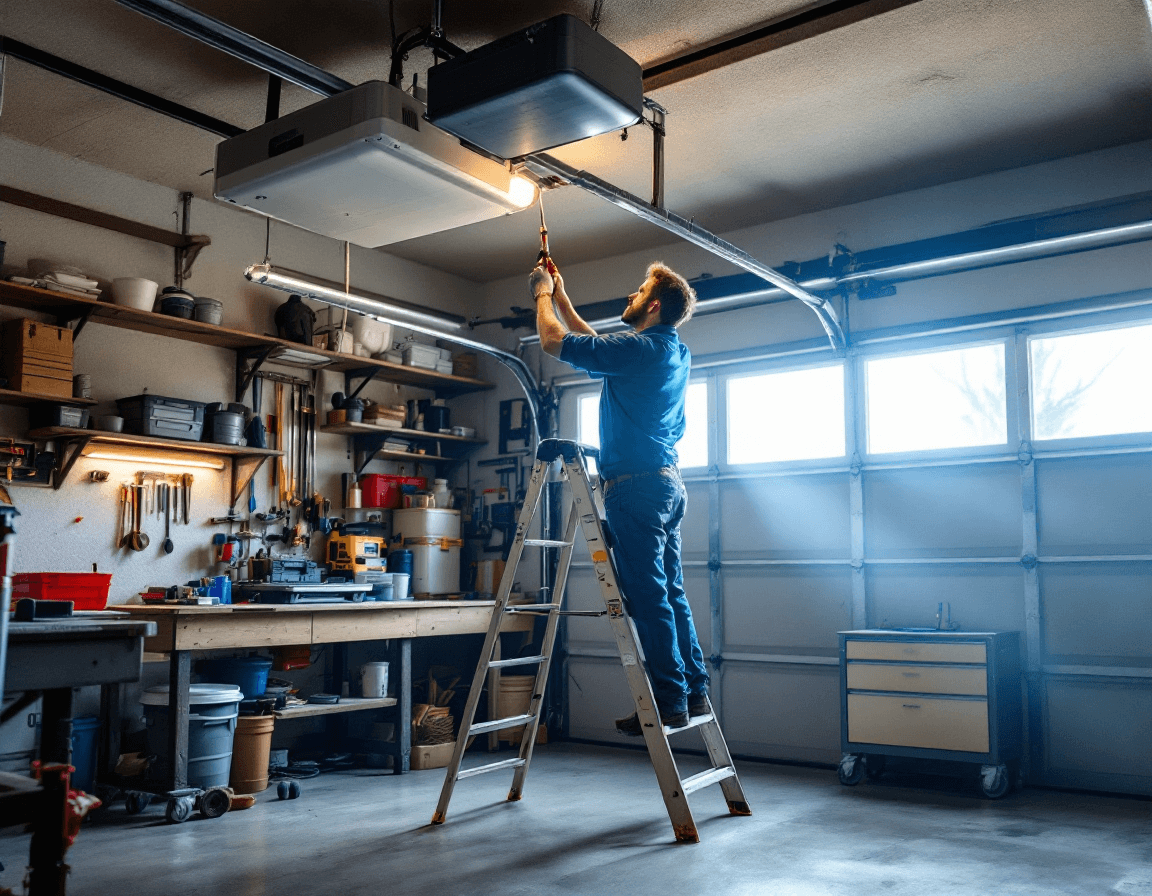
Garage Door Opener Repair in Gig Harbor, WA is a common need for households along the Narrows, from the older homes near Rosedale to newer builds in the Harborview and Gig Harbor North areas. Openers here work hard. They run through damp winters, salty marine air on the lower-elevation streets, and the occasional windstorm that knocks out power and forces a full reset of the system. When one stops responding, the cause is often something simple, but it can also be a worn gear or a failing control board that needs a proper diagnosis.
This page explains how opener problems tend to show up in Pierce County homes and what you can check safely before calling. We cover the symptoms we hear most often, from a motor that hums without moving the door to a remote that works one day and fails the next. We also describe what a typical repair involves and where the boundaries are for do-it-yourself work. Repairs for most common opener faults generally fall in the $95 to $375 range, depending on the part and the brand, though your exact cost depends on what we find when we inspect the unit.
Our technicians work on every major opener brand, including Chamberlain, LiftMaster, Genie, Craftsman, and others you are likely to find in a Gig Harbor garage. Whatever the make, the troubleshooting follows the same logic: confirm power and control signals first, then check the mechanical drive, then verify the door's travel and safety settings. Read on for a walkthrough of the most common issues, and call (888) 799-3819 if you would rather have someone on site.
Why Openers Work Harder Around the Harbor
Gig Harbor's climate is mild by national standards, but it is persistently damp. Long stretches of gray, wet weather keep humidity high inside attached garages, and that moisture finds its way into wiring junctions, sensor connectors, and the metal housings of older openers. Homes closer to the water can also see a faint salt film on exposed hardware, which speeds up rust on rail brackets, bolts, and the springs of the door itself. None of this causes an opener to fail overnight, but it adds stress over years of use.
Seasonal swings matter too. Cold mornings in January can stiffen the door's lubrication and make the opener pull harder than usual, while warm, humid afternoons in late summer can cause condensation to form on electronics that were not designed with much airflow. Many homeowners notice their opener acting up after the first hard cold snap or after a week of heavy rain, which is a useful clue when you are trying to pin down the cause. Keeping a simple log of when the problem happens can help a technician narrow things down quickly.
Power quality is another local factor. Windstorms off the Sound occasionally trigger brief outages or voltage dips, and a surge can damage the logic board or the power supply in the opener head. If your opener began misbehaving right after a storm, mention that when you call. It does not guarantee a surge caused the problem, but it helps us know where to start looking.
When the Motor Hums but the Door Stays Put
One of the most frustrating symptoms is hearing the motor run, feeling it strain, and watching the door sit still or move only an inch. In most cases, the motor itself is not dead. The more likely culprits are a disconnected or slipping drive mechanism, a release handle that has been pulled and left disengaged, or a door that has become unusually difficult to lift because of a balance problem or a frozen roller. Before you assume the worst, check that the trolley is still attached to the door arm and that the emergency release cord has not been yanked into the disengaged position.
Inspect the door by hand with the opener disconnected from power. Lift it slowly and notice whether it feels heavier on one side, whether it binds in the tracks, or whether any roller seems to be stuck. If the door feels balanced and moves freely by hand, the problem is more likely in the opener's drive or control system. If it feels heavy, binds, or drops suddenly, stop there and call a licensed technician, because the spring tension and cable system store a great deal of energy and should never be adjusted by an untrained person.
A motor that hums without turning the drive can also indicate a worn gear set or a failed limit circuit that is cutting power before the door travels. These are diagnostic questions best answered with a meter and a careful look at the internal components. A technician can confirm whether the motor draws normal current, whether the drive is turning, and whether the controller is sending the right signals.
Remotes, Wall Buttons, and the Silent Treatment
When the remote and the wall button both fail to respond, the first question is whether the opener is receiving power at all. Check the outlet, the breaker, and any inline switch that feeds the unit. Then look at the light on the opener head. A steady light or a clicking relay suggests the power is reaching the board, while total darkness points toward a power supply fault, a blown fuse on the board, or a loose connection.
If the opener has power but ignores the remote, the issue may be the battery in the transmitter, a learned code that has been erased, or a receiver antenna that has come loose. Replace the remote battery first, since that is the cheapest and most common fix. If the remote still does nothing, try the wall button, which uses a separate wire. If the wall button works but the remote does not, the problem is almost certainly in the radio side of the system. If neither works, the fault is likely wired deeper in the control board or the safety circuit.
Many openers also refuse to operate when a safety sensor is misaligned or obstructed. The photo-eye sensors at floor level should face each other across the door opening, and their indicator lights should be steady. A sensor knocked out of line by a stray bicycle, a shifting trash can, or a wet spiderweb can block all operation, even when everything else is fine. Wiping the lenses and checking the alignment often solves the problem in minutes.
Reading the Light Blinks Before You Call
Most modern openers include a status light that flashes in a pattern to signal a fault. Those patterns are a useful shorthand, and every major brand publishes a chart that matches blink counts to specific conditions. A repeating pattern usually means the opener has detected something it does not like, such as a sensor fault, a force limit trip, an obstruction, or a problem with the travel limit settings. Writing down the exact number of blinks and how often they repeat gives a technician a head start.
Keep in mind that the same blink count can mean different things on different brands. A pattern that indicates a sensor issue on one model might point to a logic board problem on another. That is why it helps to note the brand and model, which are usually printed on a label inside the door track or on the motor housing. If the label is hard to read because of dust or moisture, a quick photo on your phone works just as well.
Flashing lights are not always a sign of a major failure. Sometimes the opener is simply reporting a recent event, such as a door that was stopped by something in its path. Power-cycling the unit by unplugging it for thirty seconds and plugging it back in can clear a stored fault, but if the pattern returns, the underlying cause is still there. Repeated flashing after a reset is a signal to stop cycling the power and get the system checked properly.
Stripped Gears and That Grinding Head Noise
A grinding, clicking, or chattering sound from the opener head often signals a stripped gear or a worn drive component. Plastic and nylon gears, which many residential openers use to keep noise down, wear over time, and a sudden change in sound after years of quiet operation is worth taking seriously. The noise may come and go, or it may happen only during the first part of the travel. Either way, continuing to run the opener with a stripped gear can damage the motor and the drive shaft, turning a modest repair into a bigger job.
Listen carefully before you decide what the sound means. A rhythmic clicking that speeds up with the motor is often a damaged gear tooth or a worn drive sprocket. A grinding noise that stops when the door is at rest could point to a worn bearing or an unbalanced load. Do not try to disassemble the head yourself, since the motor and gear housing contain components that are easy to misalign and some parts can be under tension. A licensed technician can open the unit, measure the wear, and replace the damaged parts with the correct components.
If the grinding is accompanied by a burning smell or a motor that gets very hot, shut the opener off at the outlet and leave it off until it has been inspected. Continuing to run a motor that is binding can overheat windings and create a fire hazard. This is one of those moments when a quick call is far cheaper than waiting it out.
Doors That Stop Short or Bounce Back
A door that closes most of the way and then reverses immediately is usually telling you that the safety reverse system or the force setting has been triggered. This is a protective feature, and it should not be bypassed. The most common causes include a sensor that is misaligned, an obstruction in the doorway, a door that has developed uneven tension, or a close-force setting that is too sensitive for the current condition of the door. Cold weather can make a stiff door drag harder than it did in summer, and that extra resistance is enough to trigger a reversal on some units.
Start by clearing the path. Remove anything on the floor near the door, make sure no cords or hoses are hanging into the opening, and check that the bottom seal is not catching on a raised threshold. Then look at the photo-eye sensors again. A sensor that is slightly out of line may read the beam as broken and reverse the door even when nothing is in the way. Wiping the lenses, tightening the brackets, and making sure the wires are secure can resolve many of these faults.
If the door reverses only at a certain point, such as the last few inches of travel, the travel limit settings may need adjustment. Some openers allow you to set the closed position and force limits through a set of buttons on the head unit, and the manufacturer's manual explains the process. Resist the urge to crank up the force setting to overcome a mechanical problem. A force setting that is too high can cause injury and does not address the underlying issue. Setting limits correctly is part of the service we perform, and we test the auto-reverse function before leaving the job.
Chains, Belts, and Slack That Walks Off the Track
Openers use either a chain, a belt, or a screw drive to move the door carriage along the rail. Each has its own maintenance needs. Chains can stretch and sag over time, and when the slack becomes too great, the chain may jump off the sprocket or rub against the rail. Belts, which are quieter and common in many newer homes, can loosen or slip, particularly after long periods of humidity or temperature changes. Screw drives are sturdy but need lubrication and periodic checks for wear on the threaded rod.
A chain or belt that has come off the track is a clear sign that the drive needs attention. Do not force the door by hand or run the opener again until the tension and alignment have been checked. Running the opener with a loose chain can damage the sprocket, the rail, and the carriage, and it can also cause the door to drop unexpectedly if the trolley disengages. If you notice slack, a wobble, or unusual movement on the rail, reduce use of the opener and schedule an inspection soon.
Adjusting belt or chain tension is a task that many technicians can handle quickly, but the job requires the right tools and a clear understanding of the drive geometry. Over-tightening can stress the motor and the bearings, while under-tightening invites the chain to jump. A proper check includes verifying that the trolley travels smoothly along the full length of the rail and that the release mechanism still functions when pulled.
Travel Limits and Force Settings Nobody Remembers Setting
Every opener must know where the door should stop when it is fully open and fully closed. These are called travel limits, and they are set during installation. Over time, they can drift because of stretched cables, shifting brackets, a new door panel, or a replacement opener that was not programmed correctly. When travel limits are off, the door may stop a few inches short of closed, creep past the open position, or fail to close at all. Force settings work alongside the limits to decide how much resistance the opener will tolerate before it reverses.
Many homeowners have never adjusted these settings and do not know where to find them. The adjustment controls are usually on the back or side of the motor head, sometimes behind a cover that needs to be removed. Labeled buttons, dials, or small screws are the usual forms. Making changes without the right procedure can leave the door under-protected or over-powered, so it is wise to follow the manual closely or ask a technician to do it.
When we set limits, we check the full range of motion, test the auto-reverse at the floor and at a standard obstruction height, and confirm that the door reverses correctly when the sensors are blocked. This two-step test matters because a door that passes one check can still fail the other. Taking the time to verify both is part of what makes a repair reliable rather than temporary.
Intermittent Faults in Damp Garages Near Rosedale and Harborview
Some of the most difficult opener problems are the ones that come and go. The door opens perfectly on Monday, refuses to respond on Tuesday, and then works again on Thursday. Intermittent faults often trace back to loose wiring, corroded connectors, a failing relay, or a control board that is sensitive to moisture and temperature. In Gig Harbor's damp conditions, a connector that is slightly oxidized can make reliable contact most of the time and fail only when humidity spikes or the garage cools overnight.
Homes in the Rosedale area and other older neighborhoods sometimes have garages that were not originally designed with moisture control in mind. Condensation can collect on overhead rails and motor housings, and the first sign of trouble may be a sluggish response or a door that stops halfway during a rainy evening. Improving ventilation, keeping the garage door sealed against standing water, and storing items away from the opener can reduce these issues, though they do not replace a proper diagnosis.
Diagnosing an intermittent fault requires patience. A technician will typically inspect the wiring, clean and tighten connections, check the sensor circuit, and monitor the system through several operating cycles. If the problem is a failing board or a weak power supply, replacement may be the only lasting fix. We aim to explain clearly what we found, what it will cost, and what options you have, so you can make an informed decision instead of guessing.
What a Gig Harbor Service Visit Usually Covers
When you book an opener repair with us, the visit typically follows a sequence designed to find the root cause rather than just swap a visible part. The technician will ask about the symptoms, check the status lights and any fault codes, and verify power at the outlet and the head unit. We then inspect the door balance, the rail and trolley, the drive mechanism, and the safety sensors before testing the control board and radio receiver. Every visit ends with a functional test of the complete system.
Repairs commonly include replacing a damaged gear set, a worn drive belt or chain, a failed circuit board, a defective sensor pair, or a set of remote controls. Some jobs also involve resetting travel limits, reprogramming remotes, or replacing a burned-out power supply. Most common opener repairs fall between $95 and $375, depending on the parts needed and the complexity of the diagnosis. We will give you the price range before any parts are ordered whenever possible, so there are no surprises.
Here is a short list of what we check on most visits:
- Power supply, outlet, breaker, and any inline switch feeding the opener
- Status light patterns and any stored fault codes on the control board
- Photo-eye sensor alignment, wiring, and lens condition
- Drive type, including chain, belt, or screw tension and wear
- Gear housing condition, noise source, and motor current draw
- Travel limits, force settings, and auto-reverse performance
- Remote, keypad, and wall button operation, including programming
Safety Lines to Hold Before You Touch Anything
Garage door systems store significant energy, and some parts can cause serious injury if handled incorrectly. The torsion springs above the door and the cable drums on either side are under very high tension, even when the door looks still. Spring and cable repairs should only be performed by a licensed, trained technician with the proper tools. Never attempt to wind, unwind, or remove a spring yourself, and never stand under a door that is unsupported while working on it.
For the opener itself, a few simple habits reduce risk. Disconnect power at the outlet before opening the motor cover or working near the drive. Keep hands, hair, and loose clothing away from the moving carriage and the chain or belt. Do not hang anything from the door or the opener rail, and do not use the emergency release while a vehicle or person is in the path of the door. If the door is off its track, leave it alone and call for help.
These guidelines are not meant to discourage you from caring for your garage door. Cleaning sensor lenses, checking the manual release, replacing a remote battery, and visually inspecting the rail are all reasonable steps for a homeowner. Anything beyond that, especially work involving springs, cables, or internal gear housings, belongs in the hands of a licensed professional. Your safety is worth more than a few dollars saved on a repair that could go wrong.
Opener problems rarely fix themselves, and the longer a fault goes unaddressed, the more likely it is to damage other components. If your Gig Harbor garage door opener is humming without moving, ignoring your remote, grinding, reversing, flashing, or behaving unpredictably, call Seattle Garage Door Fix at (888) 799-3819 for a licensed technician to diagnose the problem and walk you through your options.