
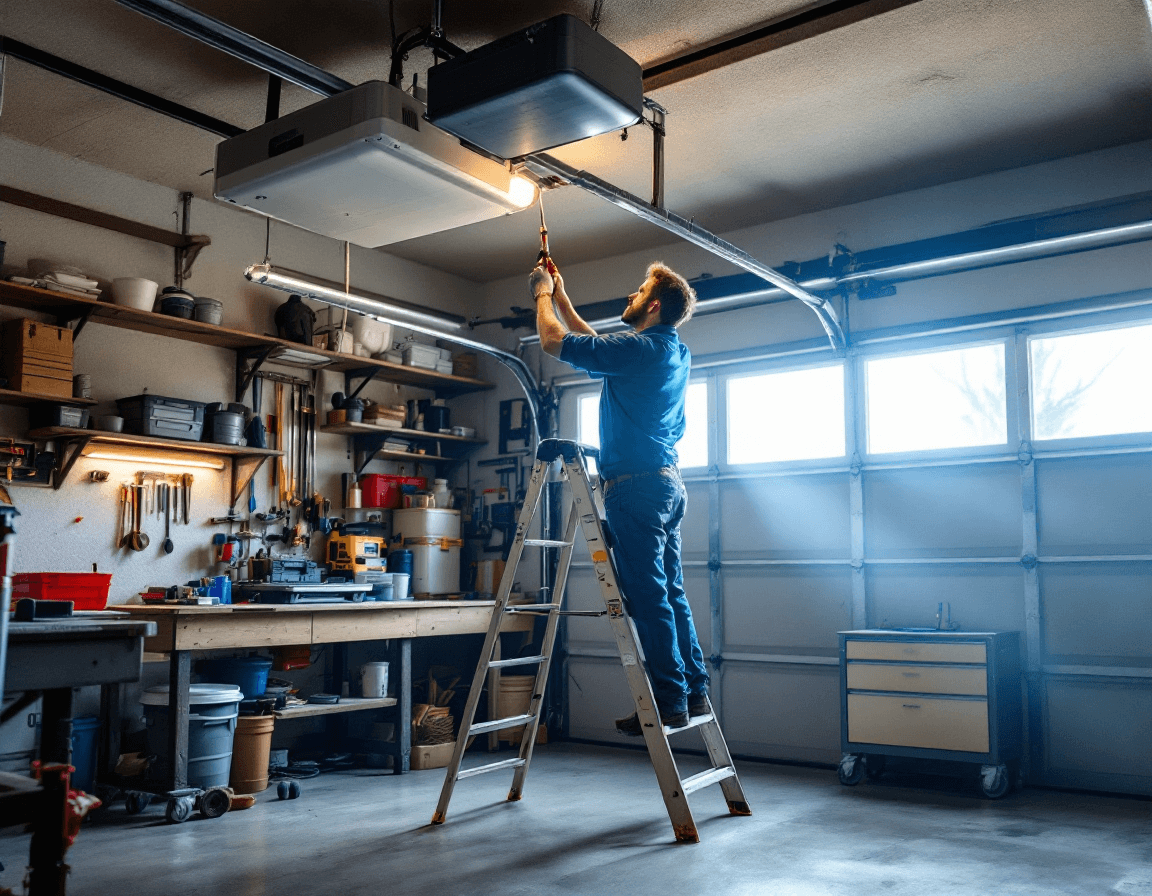
Garage door opener repair in Tacoma, WA is one of the most common calls we take, and for good reason. Tacoma's damp winters, salt-tinged marine air drifting in from Commencement Bay, and long stretches of gray drizzle put steady stress on the electronics and drive components inside a garage door opener. When an opener starts acting up, the cause is often a setting, a worn part, or a sensor that has been knocked out of line, rather than a dead motor. A careful diagnosis usually saves money compared with replacing the whole unit.
This page explains how we approach opener problems across Tacoma neighborhoods, from the older homes near the North End and Proctor to the newer builds on the Hilltop slopes and the townhomes around the Stadium District. We work on every major opener brand, and most repairs we complete fall in the range of $95 to $375, depending on the part and the labor involved. Below, you will find the symptoms we hear about most often, what they usually mean, and where the line sits between a reasonable homeowner check and a job that should be handled by a licensed professional.
Why Tacoma Openers Wear Out Faster Than You'd Expect
Openers in the Tacoma area live a harder life than the manufacturers' brochures sometimes suggest. Wet months mean humidity inside attached garages, and that moisture finds its way into wall-button wiring, outdoor safety sensor connections, and the logic board housed in the motor head. Metal parts such as rails, brackets, and hinge hardware can develop surface rust faster near the water, which then transfers stress to the drive system. Even a garage that feels dry in July can cycle through damp and cold conditions every year.
Temperature swings matter too. On cold, wet mornings, lubricant in the gearbox thickens slightly, and the opener draws more current to start the door. On the handful of genuinely warm days Western Washington gets each summer, that same lubricant thins out and can leave metal surfaces less protected. Over several years, this push and pull accelerates wear on nylon gears and plastic carriers that were never designed for constant moisture.
Older Tacoma homes add their own complications. Many detached and older attached garages have uneven slabs, sagging header boards, or framing that has shifted slightly over decades of settling on clay-heavy soils. When the door and its track are not perfectly square, the opener works harder than it should, and small mechanical problems become noticeable failures sooner. Recognizing this background helps explain why two openers of the same model can have very different service histories.
Reading the Blinking Lights Before You Call
Many homeowners first notice a problem when the opener's indicator lights start blinking in a pattern that seems to mean something. The trouble is that every manufacturer uses its own code, and the sequence that means "obstruction detected" on one brand can mean "logic board fault" on another. Before you assume the worst, check the label on the motor head or the owner's manual and count the flashes carefully. Writing down the exact number and timing will also help a technician who is working from a phone call.
In general, a repeating pattern that clears when the door is moved by hand often points to a safety-sensor issue or an obstruction in the door's path. A pattern that continues regardless of what the door is doing more often points to a control or logic problem, including a wall button that has shorted or a receiver board that is taking in water vapor. Some openers blink rapidly after a power interruption, which can happen during the wind and rain storms that roll through Pierce County from fall through spring. Restoring power and waiting a minute sometimes clears a temporary fault, but a pattern that returns should be investigated rather than ignored.
Sensor lights are another frequent source of confusion. The two small photo-eye units mounted near the floor on either side of the door must be aligned and kept clean, and spider webs, dust, or road grime can break the beam even when the door looks clear. If one lens is tilted, a single bump from a bicycle or a shopping cart can produce the same blinking pattern. Wiping the lenses and checking that both lights are steady is a reasonable first step for any homeowner.
When the Motor Hums but the Door Stays Put
A motor that runs with an audible hum but fails to move the door usually indicates that the drive is disconnected from the door, or that the door is binding in its track. In many residential openers, the trolley or carriage has slipped off the drive, or the release cord has been pulled and the trolley is no longer engaged. Before doing anything else, make sure the door is closed and the emergency release is in the locked position, since a disengaged trolley is one of the most common reasons a door fails to respond.
Binding is the other frequent cause. Rollers that have worn flat, hinges that have loosened, or a track that has been bent slightly can make the door drag hard enough that the opener cannot overcome the resistance. Tacoma's moist air can also cause rollers and track to collect grime that makes them stick, particularly in the lower sections of the door where water tends to settle. Running the opener when the door has been manually lifted halfway, or pushing it by hand while the motor runs, often reveals exactly where it binds.
Do not force the door open or closed when you find binding, and never attempt to adjust the spring tension yourself. Springs store a great deal of energy, and tension work should only be done by a licensed technician with the proper tools. If you can see a cable that looks frayed, or a spring that appears to have gapped or separated, stop and call for service right away.
Remote Silence, Dead Wall Buttons, and Radio Trouble
When the remote stops working, the first suspects are almost always the simplest ones: a battery that has drained, a remote that has been dropped, or a unit whose buttons have worn through to the contacts. Replacing the battery and testing the remote beside the opener, not from across the driveway, will quickly separate a remote problem from a receiver problem. If the wall button also fails to respond, the issue is more likely in the opener's receiver board or in the wiring that runs from the wall station to the motor head.
Wall button wiring deserves special attention in our region. Low-voltage runs that pass through walls near exterior doors can pick up moisture or be pinched by a shifting framing member, and the connection at the wall plate can corrode over time. Intermittent wall-button operation, where the door responds on some presses and not others, is a classic symptom of loose or oxidized contacts. A technician can usually test the circuit quickly, and the repair is often inexpensive once the fault is located.
Radio interference can also play a role, particularly in neighborhoods with dense housing and many garage remotes operating nearby. If your remote works only when you stand very close to the garage, or if the opener responds to codes you did not program, the receiver's learned codes may need to be cleared and reset. Most manufacturers document this process in the manual, but if you have a newer opener with a smart-home module or a Wi-Fi connection, it is worth having a technician confirm the configuration rather than resetting everything yourself.
Stripped Gears and the Grinding Sound Under the Ceiling
A grinding or clicking noise from the opener head is one of the more serious symptoms we see, and it usually means the gear train has begun to strip. Many residential openers use plastic or nylon gears inside the gearbox, and these teeth wear down over time, especially if the door has been heavy, poorly balanced, or forced by a binding track. Once teeth begin to shear off, the grinding noise often gets louder and the door may move unevenly or stop partway through its travel.
Continuing to run an opener with stripped gears can cause the motor to overheat and can damage the drive shaft or carriage. Stripped gears do not usually fix themselves, and attempting to force a door that has been grinding is one way homeowners turn a moderate repair into a costly one. If you hear grinding, shut the opener off at the power switch or unplug it, and keep the door closed until a technician can inspect it. Gear replacement is typically a contained repair that restores smooth operation when the rest of the system is sound.
It is also important to check whether the grinding is coming from the opener or from the door hardware. Worn rollers, dry hinges, and a loose bottom bracket can all produce sounds that seem to come from the ceiling. Listening carefully with the door at different heights can help narrow the source before the technician arrives, and a clear description of when the noise happens often speeds up diagnosis considerably.
Doors That Stop Short or Bounce Back
Doors that refuse to close fully, or that reverse immediately after touching the floor, are usually doing exactly what they were designed to do: protecting people and objects from being trapped. The auto-reverse function depends on the photo-eye sensors and on the force settings programmed into the opener. If either system detects an obstacle, or if the sensors are misaligned, the door will stop and rise again without completing its travel.
The most common causes are small. A sensor lens may be a few degrees out of line, a wire may have been disturbed, or dirt may be blocking the beam at floor level. Leaves, wet grass clippings, and the fine silt that gathers along the threshold after a heavy rain can all interrupt the sensor path, particularly on properties with sloped driveways that drain toward the garage. Clearing the area and gently realigning the sensors is often enough to restore normal closing, provided the lights stay steady and the door closes without obstruction.
If the door still reverses after the sensors are clean and aligned, the force setting may be too sensitive for the door's current weight and balance. An imbalanced door, one where the spring tension has drifted, can make the opener think it has hit something when it has not. Adjusting force settings is sometimes a reasonable homeowner task, but if the door feels heavy when lifted by hand or makes uneven noises, the underlying spring or cable issue needs professional attention.
Loose Chains, Slipping Belts, and Rail Alignment
Chain-drive and belt-drive openers depend on consistent tension to move the trolley smoothly along the rail. A chain that has come loose can jump off the sprocket, and a belt that has stretched can slip under load, producing a jerky movement or a series of clicks. Tacoma's moisture can contribute to rust on chain links and sprockets, and a neglected chain may bind or skip even when it appears to be intact.
Belt openers, which are popular for quieter operation in attached garages, are sensitive to rail alignment and to the condition of the pulley near the motor head. If the rail is bent, the belt can rub against the edge and wear prematurely, and a stretched belt is more likely to slip when the door is heavy or cold. A technician can measure belt tension and check the rail for straightness, then recommend adjustment or replacement based on what they find.
Chain tension should never be adjusted in a way that leaves the opener running on a loose or sagging chain, since a chain that comes off under load can cause the trolley to snap back. If your chain has come off the rail or you see visible slack, unplug the opener, keep people and vehicles clear of the door, and schedule service. A slipping drive is not something to test repeatedly, because each attempt adds stress to the gears and the door's mounting hardware.
Travel Limits: The Hidden Setting Behind Most Mystery Faults
Travel limits tell the opener how far the door should move in each direction before it stops. When these limits drift, the door may stop short of fully closing, or it may keep pushing against the floor and strain the drive. Limit settings can be changed by a power outage, by a battery backup that resets, by a firmware update on a smart opener, or simply by the door slowly settling over several seasons. Many homeowners never realize the limits have moved until the door starts behaving oddly.
Adjusting travel limits is one of the most common tasks in opener service, but the procedure varies a great deal between brands. Some openers use dials on the motor head, while others rely on buttons, screens, or a combination of controls described in the manual. Setting the limits incorrectly can leave the door partly open, cause it to close too hard against the floor, or prevent the auto-reverse feature from working as intended. For that reason, we recommend checking the manual for your exact model and performing the adjustment slowly, one step at a time.
When travel limits are set correctly, the door should close firmly without slamming and should open to a consistent height. If the door looks uneven or leans to one side, the problem may be in the cables, springs, or track rather than in the opener itself. A technician can confirm whether the limit settings are the source of the problem or whether they have been masking a larger mechanical issue.
Intermittent Operation That Comes and Goes With the Weather
Few problems are more frustrating than an opener that works perfectly most days and then fails on a damp morning. Intermittent operation in Western Washington often traces back to moisture, temperature, or loose electrical connections. Water can cause a short in a wall-button circuit or a corroded terminal in the motor head, and the fault may disappear as the connection dries out. Cold snaps can thicken lubricants and slow the motor enough to trigger an error.
Electrical connections deserve careful inspection in this situation. Loose screws on terminal blocks, frayed low-voltage wires, and outlets with weak grounding can all cause the opener to behave unpredictably. Surge-related damage from storms is also a possibility, particularly if the opener is plugged into an outlet that is not protected. A technician can check voltage, inspect connections, and look for signs of heat or corrosion that suggest where the problem is developing.
Because intermittent faults can be hard to reproduce, it helps to keep a simple log. Note the date, time, weather, and what happened when the opener failed, including any light patterns or sounds. This information gives a technician valuable clues and can shorten the time needed to pin down the cause. A repair that addresses the root connection problem will prevent the frustrating cycle of the door working one day and stalling the next.
What a Tacoma Technician Checks During an Opener Visit
When we arrive for an opener repair, the first step is a conversation about the symptoms, including when they began, what the lights are doing, and whether the problem happens with the remote, the wall button, or both. From there, the technician will typically move through a consistent sequence of checks. Starting with the basics keeps the diagnosis efficient and prevents unnecessary parts from being ordered or installed.
- Verify power supply, outlet condition, and any surge protection or battery backup in use
- Inspect the indicator lights, blink codes, and photo-eye alignment and cleanliness
- Test the remote, wall station, and receiver board, including learned codes and wiring
- Check the trolley, drive chain or belt, and release mechanism for wear or disengagement
- Evaluate the gear train for stripped teeth, unusual noise, or motor strain
- Confirm travel limit settings and auto-reverse force settings against manufacturer specifications
- Examine the door's balance, rollers, hinges, and track alignment for binding that affects the opener
Once the diagnosis is complete, we explain the findings in plain language and provide a clear recommendation. Many opener problems can be resolved in a single visit, but some require ordering a specific part or scheduling a follow-up. Our goal is to fix the actual cause, not to replace components that are still working.
Safety Boundaries: What Homeowners Should Leave to Professionals
Garage door openers are safer than they were a few decades ago, but the system still contains heavy springs, high-tension cables, and a door that can weigh several hundred pounds. Some tasks should never be attempted by a homeowner, no matter how handy they are. Spring adjustment, cable replacement, and any work on torsion or extension springs fall squarely in that category, and they require a licensed technician with the correct tools and training.
- Do not attempt to wind, unwind, or adjust torsion springs or extension springs
- Do not disconnect or reroute spring or cable hardware while the door is under tension
- Do not stand under a door that is opening, closing, or being repaired
- Do not bypass safety sensors or the auto-reverse feature to make the door close
- Do not attempt to repair damaged drums, cables, or brackets without professional service
Homeowners can safely perform simple checks such as cleaning sensor lenses, confirming the emergency release is in the correct position, replacing remote batteries, and reviewing the manual's troubleshooting section. Anything beyond that, especially work near springs or cables, should be left to a licensed professional. If you are ever unsure whether a task is within your comfort level, stop and call for help.
Garage door opener repair in Tacoma, WA is most successful when the problem is caught early and handled by someone who understands both the electronics and the mechanical systems working together. If your opener is blinking, grinding, stalling, or refusing to respond, call Seattle Garage Door Fix at (888) 799-3819 for a licensed technician. We serve Tacoma neighborhoods including Downtown, North End, Proctor, Stadium District, and Hilltop, along with surrounding ZIP codes such as 98402, 98404, 98406, and 98409. Our team will diagnose the problem, explain your options clearly, and get your garage door moving safely again.