
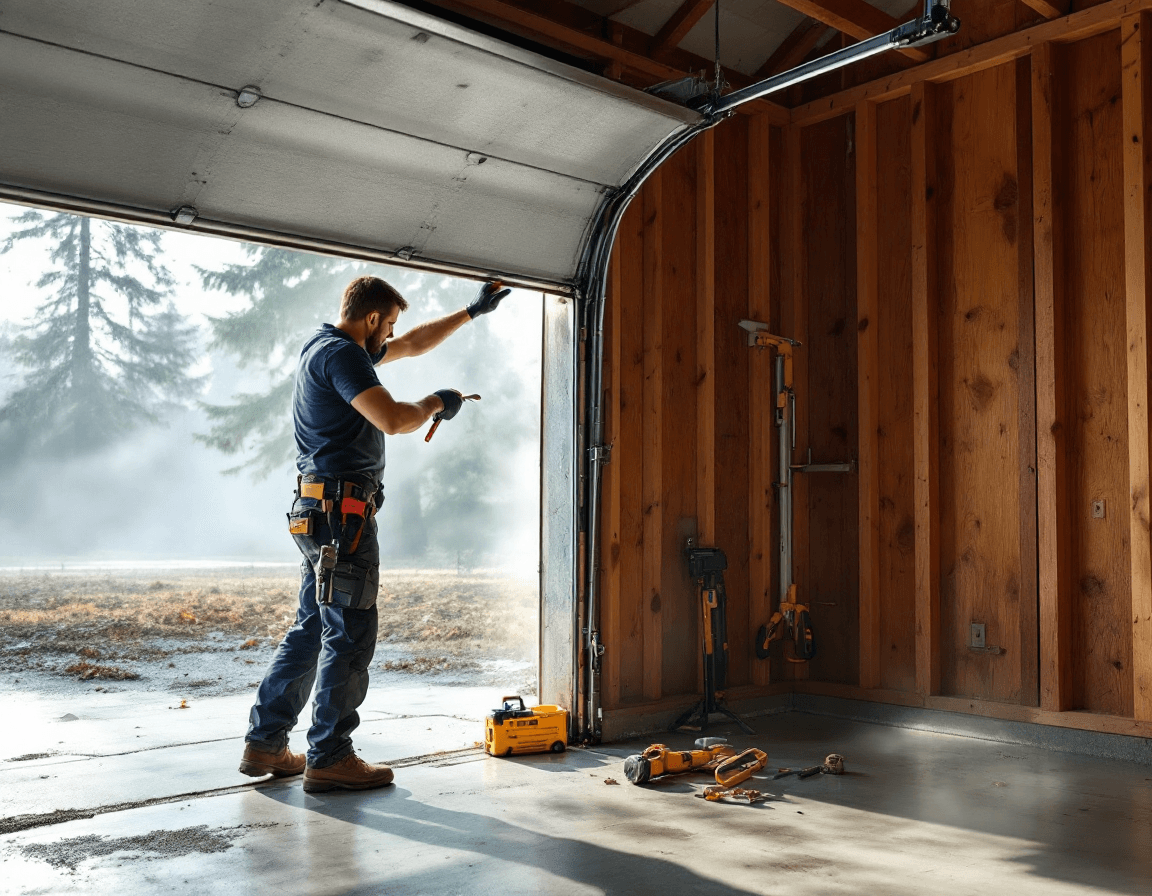
Off-track garage door trouble is one of the most common calls we hear from Tacoma homeowners, and it is also one of the most unnerving. One morning the door runs fine, and the next it sits crooked in its opening, with a gap showing along one side or a roller hanging loose outside the channel. Doors in Tacoma and across Pierce County can leave their tracks for several reasons, including worn hardware, moisture-damaged wood, a minor bump from a car, or a roller that simply wore out of its groove. Our technicians realign crooked and derailed doors, re-seat rollers, and straighten damaged track sections for households throughout the city, and the typical off-track repair falls in the $125 to $400 range depending on what the inspection turns up.
The good news is that a door that has jumped its track is usually fixable without replacing the door or the opener. In most cases the springs and cables are still intact, the panels are sound, and the problem is confined to the rollers, the track alignment, or a bracket that has shifted. The difficulty is that the work is physically risky, because a garage door carries a great deal of stored spring tension and can move unpredictably once it is no longer riding in its track. This page explains what usually causes a door to come off track in our area, how to recognize early warning signs, what to avoid doing yourself, and how a licensed crew approaches the repair.
Whether you live near the waterfront in Downtown Tacoma, in the older blocks of the North End, out near Proctor, along the streets of the Stadium District, or up on the Hilltop, the same principles apply. Our service area also includes the surrounding ZIP codes across Tacoma and Pierce County, including 98402, 98404, 98405, 98406, 98407, 98408, 98409, 98418, 98421, 98422, 98444, 98445, 98465, 98466, and 98467. Read on to understand what is happening inside your door system and when it is time to make a call.
Why Tacoma Doors Keep Slipping Out of Their Tracks
Tacoma sits on the edge of Commencement Bay, and the marine air that drifts in from Puget Sound carries moisture and a fine layer of salt, particularly on homes closer to the water. Over years of damp winters and humid shoulder seasons, steel track can develop surface rust, and the nylon or steel rollers that ride inside it can swell, crack, or lose their smooth profile. A roller that binds slightly in one spot will eventually be pushed out of the channel by the door's own weight during an ordinary open or close cycle. Homes with older wood doors face a related problem, since moisture can warp panels and change the way weight is distributed along the track.
Many Tacoma garages were built decades ago, and the framing around the opening may have settled or shifted slightly over time. When the header, the jamb, or the floor is no longer perfectly level, the track brackets can be pulled out of plumb, and the door starts to ride at a slight angle. That angle puts uneven stress on the rollers at the top corners, where the door has to change direction from vertical to horizontal. Eventually one side pulls harder than the other, and a roller is forced out of the track. Older homes on hillside lots can also experience ground movement that subtly changes the opening, which is worth remembering if you have noticed the door drifting out of square over several seasons.
Vehicles are another common cause, especially in tight driveways and on streets where cars park close to the garage. A bumper that clips the lower panel or a mirror that brushes the track can bend a section of steel just enough to create a bump or a kink. Even a small deformation can catch a roller on the way up or down, and the door may then jump out of its channel. We see this pattern often enough that it is worth checking the track for dents or bends after any minor collision, even if the impact seemed trivial at the time.
Reading the Warning Signs Before the Door Comes Off
A door rarely leaves its track without warning. In most cases, there is a period of several days or weeks when the door makes unusual sounds, moves less smoothly, or looks slightly out of alignment. Catching these signs early can turn an emergency call into a straightforward adjustment, and it can prevent the door from binding in a way that puts extra strain on the opener. Pay attention to changes in how the door sounds and behaves, because your garage is often the first place a developing track problem shows up.
- A grinding, scraping, or popping noise when the door starts or stops, especially on one side
- A door that rides lower on one end than the other when it is closed
- A visible gap between the top or side panels and the weatherstripping along the track
- Rollers that look flattened, cracked, or stuck at an angle when you inspect them from a safe distance
- A door that hesitates or stops partway through its travel and then continues after a manual nudge
- Track sections that look shiny in spots where metal has been rubbed, or that have a visible bend or dent
If you notice any of these symptoms, avoid operating the door repeatedly to test it. Each cycle adds stress to a roller that may already be partially out of its groove. Instead, note what you observed and schedule an inspection before the problem gets worse. Taking a photo of the gap or the track can help the technician understand what changed and how quickly.
What Happens Inside the Track When a Roller Pops Out
To understand the repair, it helps to picture how a sectional garage door moves. Each panel is connected by hinges and carries rollers that travel in a vertical track at the sides, then curve through a horizontal track overhead. The track is not just a guide; it is a precise channel that keeps the door square as it changes direction. When a roller slips out of the channel, the door loses that guidance on one side, and the weight shifts onto the remaining rollers and the hinges. The door may then tilt, wedge against the jamb, or sit at an angle that makes it impossible to open or close smoothly.
The rollers themselves can fail in several ways. Steel rollers can wear flat on one side, nylon rollers can crack, and sealed ball-bearing rollers can lose their lubrication and seize. Each failure changes the path the roller takes through the track, and the door responds by moving slightly out of square. Because the components work together, a single bad roller often reveals a second problem, such as a bracket that has worked loose or a track section that has shifted. A proper inspection looks at the whole path, not just the spot where the roller came out.
Re-seating a roller sounds simple, but it must be done with the door fully supported and the springs and cables handled by a qualified professional. The roller has to be guided back into the track at the correct angle, and the door must then be checked for smooth travel through its full range. If the track itself is bent, simply pushing the roller back in will only create a new derailment later. That is why we treat realignment, roller replacement, and track straightening as a single assessment rather than three separate tasks.
Hands Off: Safety Rules When a Door Is Off Track
Your safety is more important than getting the door moving again. A garage door that has come off its track is carrying significant tension in its springs and cables, even if it looks stable. Attempting to lift, push, or pry the door back into the track can cause it to drop suddenly, shift sideways, or release energy in a way that injures hands, fingers, and backs. Never place any part of your body under a door that is off track, and never try to force the door into position with a bar, a ladder, or a car.
There are a few steps that are generally reasonable for a homeowner to take while waiting for a technician. These steps are about keeping the area safe and preventing additional damage, not about repairing the door. Please keep the following guidelines in mind:
- Keep children, pets, and anyone not needed for the situation away from the garage
- Do not attempt to lift, pull, or push the door manually to get it back on track
- Do not use the automatic opener to try to force the door through a stuck or derailed path
- If you need to disengage the opener to keep the door from moving, use the emergency release cord carefully and only if you can do so without standing under the door
- Do not touch, adjust, or try to remove the torsion springs or cables, which can cause serious injury
- Call a licensed professional and tell them whether the door is fully off track, partly off track, or jammed
Many homeowners want to fix the problem themselves to save money, and that instinct is understandable. But the springs, cables, and drums are the most dangerous parts of the system, and a repair that looks minor from the outside can involve forces that are hard to predict. Licensed and insured technicians have the tools, training, and safety procedures to control the door during realignment. We will always recommend a licensed professional for any spring, cable, or drum work, because the risk to you and your household is simply too high for a do-it-yourself approach.
How Our Technicians Realign a Door Step by Step
When a licensed crew arrives at an off-track call, the first priority is to make the door safe and stable. The technician will assess whether the door can be supported in place, whether the springs are intact, and whether the opener has been disengaged. Only after the door is controlled will the work of realignment begin. Every step is chosen to avoid sudden movement, and the crew will explain what they are doing so you understand the process and the reason for each decision.
Next, the technician inspects the entire track path from the bottom bracket to the top curve and across the horizontal section. They look for bent sections, loose bolts, worn rollers, cracked hinges, and any sign that the opening has shifted out of plumb. Measurements are taken to determine whether the vertical and horizontal tracks are parallel and level, and to check the distance between the track and the door on both sides. If the track is only slightly out of position, it can often be re-aligned and re-secured. If the track has a more serious bend, the crew will recommend straightening or replacing the affected section.
Once the track is ready, the rollers are re-seated carefully and the door is brought back into its channel. The technician then cycles the door slowly, watching for binding, scraping, or uneven travel. Adjustments are made to the brackets, bolts, and roller positions until the door moves smoothly through its full range in both directions. Finally, the crew checks the balance of the door, the condition of the weatherstripping, and the operation of the opener's safety features before handing the door back to you. This final check is important because a door that works well in the driveway may still have an alignment issue that becomes obvious under load.
Bent Track and Vehicle Strikes: Straightening Versus Replacing
Track damage is one of the most frequent reasons a door keeps coming off, and it is also one of the most misunderstood. A slightly bent section can sometimes be straightened in place, especially if the steel has not cracked and the mounting holes are still intact. In other cases, the track has been pulled away from its brackets, the bolts have torn through the bracket plates, or the metal has been creased so severely that it no longer holds a consistent shape. Those situations usually require replacement of the track section rather than straightening.
Vehicle strikes are a particular concern in older Tacoma garages where the driveway is narrow or the garage is set close to the street. A car that taps the lower panel can push the door sideways, and the track on that side may be forced out of its bracket. Even if the door still operates after the impact, the track may have a hidden bend that will cause a derailment months later. If your door or track was involved in a collision, schedule an inspection even if the damage looks cosmetic, because the alignment may have changed in ways that are not visible from the outside.
Our technicians will explain which option makes sense for your situation and why. Straightening is generally faster and less costly when the damage is minor and the track is otherwise sound. Replacement of a track section is more involved but may be necessary for lasting results. We do not recommend straightening a track that has visible cracks, torn mounting holes, or metal fatigue, because those conditions can fail suddenly under the weight of the door. The goal is a repair that keeps the door safe and reliable, not one that simply gets it moving again for a few weeks.
Realistic Cost Expectations Across Pierce County
Most off-track repairs we perform fall in the range of $125 to $400, depending on the nature of the problem and the amount of labor involved. A straightforward realignment with a few re-seated rollers and minor bracket adjustments will generally land at the lower end of that range. Repairs that require straightening or replacing a track section, replacing multiple rollers, or addressing damage from a vehicle impact tend to fall toward the higher end. Every door is different, so the final cost depends on what the inspection reveals, and a technician should explain the scope of work before starting.
Several factors influence the total. The type of door matters, since heavier insulated steel doors and older wood doors can require more time to handle safely. The accessibility of the track and brackets matters too, particularly in garages with limited headroom or tight side clearance. Whether the opener also needs an adjustment, and whether the springs need to be checked for wear, can change the scope of the visit. We always aim to explain these variables clearly so there are no surprises.
It is also worth noting that a quick repair today can prevent a more expensive problem later. A roller that has popped out once may damage the track, the panel, or the hinge if it continues to ride unevenly. An opener that is forced to work against a misaligned door can wear out sooner than it should. Addressing the underlying cause early often keeps the total cost lower than waiting until multiple components have failed.
Neighborhood Notes: Downtown, North End, Proctor, Stadium District, and Hilltop
Tacoma's neighborhoods each have their own character, and that character affects how garage doors behave. In Downtown Tacoma, many homes and townhomes sit close together, with limited space for vehicles and often limited room to maneuver around the garage. Tight parking can increase the chance of a bump against the door or track, so minor impacts are worth checking carefully. Homes near the waterfront may also see more salt and moisture drifting in from the bay, which can speed up corrosion on track hardware.
The North End has many older homes with classic architecture, and some of their garages were built long before modern door systems were common. Older framing can settle or shift over time, which can change the alignment of the opening and place uneven stress on the track. Wood doors in these homes are especially sensitive to seasonal moisture, and warping can change how the door sits in its track. If your North End home has a door that has begun to drift or bind, an alignment inspection is a smart early step.
Proctor is known for its walkable streets and busy commercial blocks, and many homes in the area have driveways that are close to sidewalks and neighboring properties. Garage doors here may take more daily wear from frequent openings and closings, especially in households with several vehicles. Stadium District homes, with their mix of older houses and tree-lined streets, often face similar challenges with moisture and aging hardware. On the Hilltop, steep grades and older garages can place extra strain on tracks and brackets, and a door that is slightly out of square on a sloped driveway can become a derailment risk over time. Wherever you live in the city, our technicians are familiar with the common conditions across these neighborhoods and will look for the patterns that are most likely to affect your home.
Preventing the Next Derailment in Wet Pacific Northwest Weather
Preventive care is the best way to avoid another off-track call. Tacoma's long wet seasons and humid transitions put steady pressure on metal and moving parts, so a little attention each season goes a long way. Start by keeping the track clean and free of debris, leaves, and grit that can build up in the channel and cause rollers to bind. A dry cloth can remove surface dirt, but avoid soaking the track or spraying heavy solvents that can wash away lubrication.
Lubrication matters too, but it should be applied with care. Use a silicone-based lubricant on rollers, hinges, and bearings according to the manufacturer's guidance, and avoid greasing the track itself, since grease can attract dust and grit. Watch for signs of rust on the track and on the roller surfaces, and address them early before they spread. If you notice a roller that looks cracked, flattened, or noisy, replace it before it fails, because a worn roller is one of the most common reasons a door comes off its track.
Finally, pay attention to the door's balance and alignment over time. A door that begins to sit crooked, drift to one side, or leave a gap at the top should be inspected rather than ignored. Weather changes can shift wood panels and settle framing, and a quick professional check each year can catch issues before they become emergencies. Treat the garage door like any other major piece of home equipment, and it will reward you with years of reliable service.
Choosing a Licensed Crew for Off-Track Repairs
Because off-track repair involves stored spring energy and heavy moving parts, choosing the right company matters. A licensed, bonded, and insured technician has been vetted to handle the risks involved and is accountable for the quality of the work. When you call for service, ask about the company's licensing and insurance and confirm that the crew will inspect the full door system rather than simply re-seating a roller and leaving. A good technician will explain what they found, what they fixed, and what they recommend monitoring in the future.
When you speak with a provider, keep the following questions and checks in mind:
- Is the company licensed, bonded, and insured for garage door work in Washington?
- Will the technician inspect the track, brackets, rollers, springs, and opener before recommending a repair?
- Will they explain whether the track needs straightening or replacement, and why?
- Will they give you a clear price range before starting the work?
- Will they test the door through its full range of motion and check the safety reversal features?
- Will they recommend a licensed professional for any spring or cable work, and handle it themselves if it is needed?
Our team at Seattle Garage Door Fix serves Tacoma and the surrounding Pierce County communities with licensed, bonded, and insured off-track repair. We take the time to explain what is happening in your door, why it came off, and how to prevent it from happening again. If your door is crooked, binding, leaving a gap, or sitting partly off its track, do not wait for it to fail completely. Call (888) 799-3819 today to schedule an inspection and get your Tacoma garage door safely back where it belongs.