
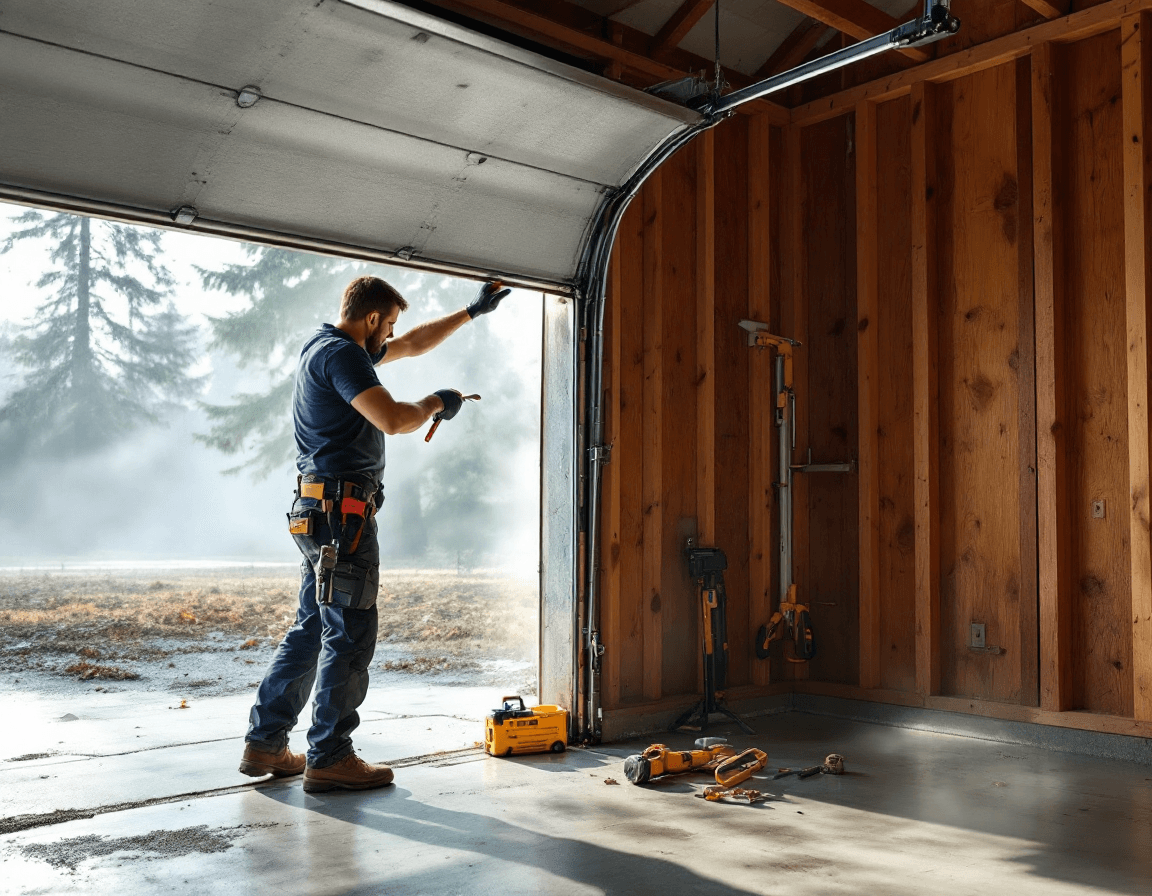
Off-track garage door repair in Puyallup, WA is one of the most common calls we take from homeowners in the Puyallup Valley, and it is also one of the most stressful. A door that has jumped off its tracks can leave a family stuck in the garage, the car trapped inside, or the whole opening sagging at an angle that looks dangerous. The good news is that most derailments are fixable in a single visit when the right technician looks at the whole system instead of just the panel that popped out. This page explains why doors leave their tracks in our area, what the warning signs look like, and what you can reasonably expect from a repair.
Puyallup sits in a part of Pierce County where winter rain is steady and spring stays damp for weeks at a time, and those conditions show up in garage doors more than most homeowners realize. Wood framing, weatherstripping, and even the concrete slab under the door all respond to moisture, and the metal parts that guide the door respond to the temperature swings that come with each season. A door that rolled smoothly in August can bind or lift out of its channel by November without anyone touching it. Understanding those local patterns makes it easier to catch a problem early, before a single roller slips free and the panel is hanging crooked in the opening.
Whether you live in a newer subdivision off the edge of town or in one of the older homes near Downtown Puyallup, the basic mechanics of a sectional door are the same. The panels ride on steel rollers inside vertical and horizontal tracks, and the springs and cables do the heavy lifting. When one of those components fails or shifts out of position, the door can come off a track in a matter of seconds. The rest of this guide walks through the causes, the repairs, and the steps that keep you safe while you wait for help.
Why Doors Keep Jumping Tracks During Puyallup's Wet Seasons
Moisture is the quiet culprit behind many off-track calls we answer in the Puyallup area. Steel tracks can develop surface rust along the seams, especially where the bottom bracket meets the vertical run, and that rust builds slowly until a roller catches on a rough patch and jumps the rail. Wooden door sections, which are still common on older homes, can swell after prolonged dampness and push against the track edges. Even a slight swelling is enough to make a door stick on one side, which pulls the opposite side off its line.
Temperature changes compound the problem. When a morning frost turns to an afternoon drizzle, metal parts expand and contract at slightly different rates, and the fasteners that hold the track brackets to the framing can loosen over time. Homeowners often notice a faint shift in alignment before anything dramatic happens, but they rarely connect it to the weather. Keeping an eye on how the door behaves during the first cold snap and the first long wet stretch of the year gives you an early warning that is hard to ignore.
Floor conditions matter too. A garage slab that has settled or heaved slightly can tilt the bottom of the door out of square, and that strain transfers to the rollers every time the door opens. Because the Pacific Northwest rarely has long dry spells during the rainy months, that stress is repeated over and over, which is why an alignment that seemed fine in summer can give way in winter.
Warning Signs a Door Is Heading Off Its Track
Most derailments do not happen without notice. The door may hesitate before it starts moving, make a grinding or popping sound near the top corners, or stop partway through its travel and then lurch the rest of the way. Any of those symptoms deserves attention while the door is still functioning, because a repair done before a full derailment is usually faster and less expensive. Watching for these signs also helps you describe the problem accurately when you call for service.
Visual cues are just as useful. Look at the gap between the top section of the door and the header, and check whether the gap is even on both sides. Pay attention to the vertical tracks, and note whether one side sits slightly farther from the door edge than the other. If you see a roller sitting at an odd angle in its track or a sliver of daylight where the door should press tightly against the weatherseal, the door is already starting to shift out of line.
- A door that rubs or scrapes along one side of the track when it opens or closes
- Rollers that look bent, flattened, or pulled partly out of their track channel
- A visible gap between the top panel and the track that was not there before
- Popping or banging noises near the top corners as the door reaches the top of its travel
- A door that opens fine but slants noticeably when it is halfway up
If you notice any of those signs, avoid running the opener repeatedly to test the door. Forcing a binding door can bend the track further or put enough strain on the cables and springs to cause a larger failure.
What a Technician Actually Does When a Door Leaves the Track
A proper off-track repair starts with a safety assessment, not with the tools. The technician checks whether the door is held securely, whether the springs are under tension, and whether the cables are intact before anyone places a hand on the panels. In many derailments the door is partly supported by the opener, and that support can disappear the moment the trolley is disengaged, so the first job is to make sure the door cannot drop unexpectedly. Only after that step does the technician begin evaluating the track and rollers.
Once the door is stable, the technician inspects every point where the door meets the track. That includes the track sections themselves, which may be straight but still out of plumb, the roller stems and bearings, and the hinges that connect one panel to the next. Realigning a door is rarely about pushing one panel back into place. It usually means adjusting the track so the rollers can travel freely, replacing any roller that is cracked or has a worn bearing, and confirming that the door balances evenly before the opener is reconnected.
A thorough technician also checks the springs and cables, even when the immediate problem appears to be only the track. Torsion spring systems and extension spring systems store large amounts of energy, and adjusting or replacing them is dangerous work that should only be done by a licensed professional with the proper equipment. If the springs show signs of wear, the technician will explain the options clearly so you can decide how to proceed.
Rollers, Track Sections, and Hinges: The Parts That Usually Fail
Rollers are the most common component to fail in an off-track situation. Nylon rollers can become brittle with age and crack, and steel-stem rollers can lose their smooth travel when the bearing dries out or collects grit. A single damaged roller can cause the adjacent panel to pull sideways, which then strains the next roller and eventually pops the whole section off the rail. Replacing a worn roller is usually inexpensive and quick, but it only solves the problem if the track around it is still straight.
Track sections take more abuse than most homeowners expect. A track bent by a vehicle, dented by a dropped ladder, or pinched by an overly aggressive attempt to force a door open may look only slightly off, but even a small bend can knock rollers out of the channel. Separated track sections, where the joint between two pieces has pulled apart, are a particular concern because the gap can catch a roller at the worst possible moment. Straightening track is a precision task, and a technician will check it with a level and a straightedge rather than relying on eyesight.
Hinges and end caps deserve attention too. A cracked hinge can allow one panel to sag, which changes the angle at which the roller enters the track. End caps that have worn or come loose can let the roller ride off the edge of the track during normal operation. Checking these small parts during a repair visit often prevents the next derailment, which is why a good technician will look at them even when the main complaint seems simple.
When a Vehicle Strike Turns a Routine Door Into an Emergency
Vehicle strikes are among the more dramatic causes of off-track damage, and they are more common than many homeowners expect. A car backing out of a driveway that is slightly too narrow, a truck clipping the corner of a door while parking, or a child's bicycle hitting the lower panel can all bend a track or push a door section out of its channel. Because the impact often happens quickly, the homeowner may not realize the door has been damaged until the next time it is opened.
After a strike, the most important step is to stop using the door until it has been inspected. Continued operation can spread the damage to the opposite track, bend the header bracket, or cause a spring to become overstressed. If the door is hanging crooked, avoid standing directly beneath it, and keep children and pets clear of the opening. Take photos of the damage from several angles, since those images can help a technician estimate what parts are needed before arriving on site.
Driveways in many Puyallup neighborhoods were designed decades ago, and some of them leave limited room for modern vehicles, especially larger trucks and SUVs. If your garage opening is close to a fence, a mailbox post, or a corner of the house, a small misjudgment can cause real damage. Parking with a little extra margin and keeping a clear path near the door can reduce the risk considerably.
Older Homes Near Downtown and Newer Builds Off the Main Corridors
Puyallup has a wide mix of housing, and that mix affects how off-track problems show up. Homes in and around Downtown Puyallup often have older garage structures, sometimes with framing that has shifted over the years, uneven slabs, or track mounting points that were never designed for the weight of a modern insulated door. In these garages, a technician may need to add bracing or adjust the track geometry to keep the door running true, and the work can take a little longer than a straightforward roller replacement.
Newer neighborhoods on the south and east sides of town generally have more consistent framing and slabs, but they also tend to use heavier insulated doors and sometimes more complicated opener setups. A heavier door places greater demand on the rollers and springs, so wear can appear sooner if the system is not balanced correctly. Homeowners in these areas often benefit from a balance check after any track work, because a door that is even slightly out of balance can pull itself off track over time.
Homes on South Hill present their own mix of conditions. The slope of some lots can affect how the garage floor drains and how the foundation settles, and that movement can influence door alignment over the years. When we work on these properties, we pay close attention to the level of the header and the plumb of the vertical track, since a small slope in the structure can make a door look crooked even when the track itself is correct.
What Off-Track Repairs Typically Cost in the Puyallup Area
Most off-track repairs we complete fall in the range of $125 to $400. Where a repair lands in that range depends on how many components are involved, how much track needs straightening or replacement, and whether the door needs to be balanced or the opener adjusted after the realignment. A single re-seated roller with a quick track check usually sits near the lower end, while a door with bent track sections, several damaged rollers, and an alignment problem will sit toward the upper end.
The price discussion is more useful when you know what it typically includes. A repair visit normally covers the inspection, the realignment of the door, re-seating or replacing rollers as needed, and a test of the door's movement through its full range. If a spring or cable needs attention, that work is evaluated separately because it involves higher risk and different parts, and the technician will explain the cost before proceeding. Asking for a clear breakdown before work begins is always a reasonable request.
We recommend keeping in mind that a fast, accurate repair often costs less over time than a temporary fix that leaves the root cause in place. Replacing a cracked roller and straightening the track it runs in is a better outcome than simply forcing the panel back into the channel, which tends to lead to a second derailment within weeks.
Safety Rules for Puyallup Homeowners Before Anyone Touches the Door
Safety should come before every other concern when a door is off its track. Never place your hands or body between a door panel and the track or frame, and never try to lift a hanging door by yourself. Doors are heavy, and a panel that suddenly shifts can crush fingers, hands, or feet. If the door is partially open and not fully supported, keep your distance until a professional has stabilized it.
Springs and cables require special caution. Torsion springs on the header and extension springs along the track hold a great deal of stored energy even when the door appears to be stationary. Attempting to adjust, unwind, or remove a spring without the right training and tools can cause serious injury. The same applies to cables that have frayed, slipped off their drums, or come loose from the bottom bracket. Spring and cable work should always be handled by a licensed, bonded, and insured technician.
- Disconnect the opener by pulling the emergency release cord only when the door is closed, and only if you know how the release works on your model
- Keep children, pets, and vehicles out of the garage opening until the door is secure
- Do not run the opener repeatedly on a door that is binding or hanging crooked
- Do not attempt to bend, hammer, or pry the track yourself
- Call a licensed technician for any issue involving springs, cables, or the header bracket
Simple Monthly Checks That Prevent Future Derailments
Preventing an off-track event is far easier than repairing one. A monthly walk-through of the door takes only a few minutes and can catch problems while they are still small. Start by closing the door and checking that the bottom seal makes even contact with the floor on both sides. Then open the door slowly and watch the rollers as they travel through the curves, listening for any scraping or popping noises that signal a roller is catching.
Keeping the track clean and lightly lubricated also makes a difference, especially in the damp months when grit and moisture accumulate. Use a silicone-based or garage-door-specific lubricant on the rollers and hinges rather than heavy grease, which can attract dirt. Wipe the track free of debris before applying lubricant, and avoid spraying the springs, since the lubricant can make the coils slippery and affect how the components handle tension. Make sure the lubricant goes only on the moving parts that are designed for it.
Finally, look at the fasteners that hold the track brackets to the wall and ceiling. Loose bolts are a common root cause of misalignment, and tightening them during a routine check can prevent a sudden shift. If you find a bracket that has pulled away from the framing or a bolt that spins without tightening, call for service rather than trying to reposition the track yourself. A misaligned bracket can make the door unsafe even if it still appears to work.
How We Serve Puyallup and Surrounding Pierce County ZIP Codes
Seattle Garage Door Fix provides off-track repair across Puyallup and the surrounding communities, including ZIP codes 98371, 98372, 98373, 98374, and 98375. We are licensed, bonded, and insured, and we serve more than 60 cities across the greater Seattle and Western Washington area, which means our technicians are familiar with the housing styles, weather patterns, and driveway layouts you will find throughout the valley. Whether your home is near the fairgrounds, along a quiet street on the edge of town, or tucked into one of the hillside neighborhoods, we plan each visit around the specific conditions at your property.
When you call, it helps to describe what you see and hear. Tell us whether the door came off one track or both, whether any rollers are visibly out of place, and whether the door has been struck or is simply binding. Mention whether the opener is still attempting to run and whether anyone has tried to force the door. That information lets us prepare the right parts and tools and gives you a realistic sense of the visit before a technician arrives.
Our goal is to get your door back on its track safely, correctly, and with an honest explanation of what caused the problem and how to prevent it from returning. We will not recommend work you do not need, and we will tell you clearly when a spring or cable needs attention from a specialist.
If your garage door has come off its track or is hanging crooked in Puyallup, do not wait for it to get worse. Call Seattle Garage Door Fix at (888) 799-3819 to schedule an off-track repair with a licensed, bonded, and insured technician. We will inspect the door, explain the repair in plain terms, and get your garage working safely again.