
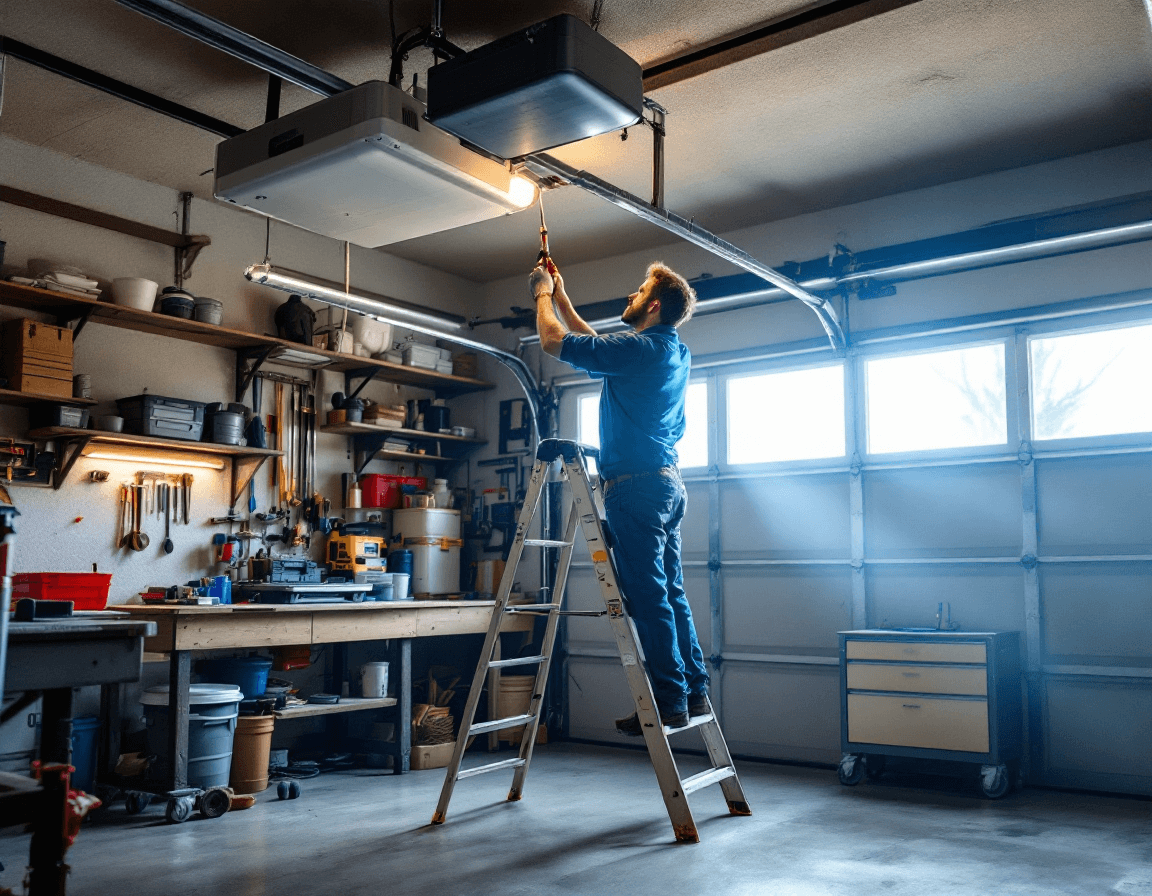
Garage door opener repair in Puyallup, WA is one of the most common calls we take from homeowners between the Puyallup River and the hills of South Hill. The opener is the part of the system that most people only think about when it stops working, and it often gives warning signs for weeks before it fails completely. A door that hesitates, a remote that needs three presses, or a faint new rattle over the garage are all early clues. Catching them early usually means a smaller repair and a more predictable bill.
Puyallup sits in the Puget Sound lowlands, where the cool, damp months from October through April put steady stress on garage door equipment. Moisture finds its way into wall-button wiring, sensor lenses, and control boards, and the temperature swings that come with a typical Pierce County winter cause metal parts to contract and expand. Many local garages are also attached to older homes with long wire runs, shared circuits, or detached structures where the opener depends on a separate power line. Each of these details shapes how an opener behaves, and each one affects how a technician approaches the diagnosis.
This page walks through the most common opener problems we see around Puyallup, what they usually mean, and what a repair visit involves. We cover motors, gears, circuit boards, travel limits, and the signals your opener sends when something is wrong. We also explain what homeowners can safely check on their own, and where the work should stay with a licensed professional. If you are dealing with a door that will not move, will not respond, or will not stay closed, the information below should help you narrow down the cause before you call.
Reading the Early Warnings Your Opener Gives Before It Quits
Most opener failures do not arrive without notice. The motor may start to sound louder during the first second of travel, or the door may pause halfway up as if it were thinking about it. Some homeowners notice that the light on the opener head dims briefly when the door starts, or that the remote works only when they stand directly in front of the garage. These small changes are the opener's way of saying a component is losing strength, alignment, or connection.
In Puyallup, we often hear about these symptoms getting worse after a stretch of wet weather or a cold snap. Moisture can cause a wall button's contacts to corrode slowly, which shows up as a button that works only sometimes. Cold air thickens lubricant in the drive system, so a door that moved smoothly in August may labor in January. Paying attention to when the problem appears, whether it is morning, after rain, or during the first use of the day, gives a technician useful information before the visit even begins.
A practical habit is to keep a short note on your phone each time the door acts strangely. Write the date, the weather, what you pressed, and what the door did. That record makes it easier for a technician to separate a one-time glitch from a developing fault. It also helps you describe the problem clearly when you call, which tends to shorten the diagnostic time.
Why a Motor That Hums But Will Not Lift Points to Torque
When the opener motor runs, you hear a steady hum, and the door still does not move, the cause is usually not the motor itself. The more common culprits are a disconnected or slipping drive component, a broken spring that has left the door too heavy to lift, or a worn gear set that can no longer transfer power to the rail. Many homeowners assume the motor has burned out, but a motor that is spinning under no load is often doing exactly what it was designed to do. The real question is where the force is going.
A technician will typically check whether the release cord has been pulled or whether the trolley has come free from the carriage. They will look for signs that the door's balance has shifted, such as a door that stays closed when you pull the emergency release but feels unusually heavy when lifted by hand. A door that is too heavy for the opener to lift is a sign of a spring problem, and that is one of the areas where a licensed professional must handle the work. Spring tension is stored energy, and attempting to adjust it without the proper tools and training can cause serious injury.
Motor-related repairs we perform include replacing capacitors or relays that have failed, rebuilding or replacing the motor assembly when it is worn beyond service, and correcting power supply issues that cause the motor to run weakly. Each of these fixes depends on what the technician finds during testing. A repair that looks simple on paper may involve several connected components, which is why a proper diagnosis matters more than a quick guess.
Remote Controls, Wall Buttons, and the Puyallup Damp Season
A remote that stops working is one of the most frustrating opener problems, and it is often the easiest to misread. Before assuming the opener itself has failed, check the remote's battery, the receiver's antenna wire, and whether a nearby device is interfering with the signal. Garages in Puyallup frequently share walls with laundry rooms, home offices, or workshops packed with electronics. Wi-Fi routers, security systems, and even some outdoor lighting controllers can cause intermittent interference on the same frequencies.
Wall buttons face a different set of issues. Wiring that runs through an exterior wall or along a garage ceiling can pick up moisture over time, especially where a staple has pinched the insulation or a junction box has collected condensation. A button that works only when pressed firmly, or a button that sends the door into motion only after several tries, often points to corroded contacts or a loose connection at the opener terminal. These are repairs a qualified technician can usually complete quickly once the fault is located.
Circuit board problems can also cause the remote and wall button to behave unpredictably. A board that is starting to fail may accept some commands and ignore others, or it may respond with a delay. In that situation, the fix may be a board replacement or a more thorough inspection of the wiring harness. We recommend letting a technician verify the source of the problem before you buy replacement remotes or parts, since many owners end up replacing components that were never the cause.
Stripped Gears and the Grinding Sound From the Opener Head
A grinding, clicking, or crunching noise from the opener head is one of the sounds homeowners most want to ignore, and it is one of the sounds that should prompt a call. On many chain-drive and belt-drive openers, the gear assembly is responsible for converting the motor's rotation into smooth linear movement along the rail. Over years of use, the teeth on those gears can wear, chip, or strip, especially if the door has been forced by hand or if the opener has been running with a loose chain or misaligned rail.
The grinding often starts intermittently. You may hear it only during the first few seconds of travel, or only when the door is near the top of its track. As the gear wears further, the grinding can become constant, the door may stop partway through its cycle, and the motor may start to strain. Continuing to run an opener with a stripped gear can damage the motor, the drive rail, and the trolley, which turns a moderate repair into a larger one. That is why we generally advise stopping use and scheduling service once the sound appears.
Gear replacement is a common repair in our Puyallup service area, particularly on openers that have served a household for many years. The technician will check the gear, the drive shaft, and the rail alignment, and they will usually lubricate the drive path with the manufacturer-recommended product. In some cases the gear can be replaced alone, while in other cases the opener head needs to be rebuilt or replaced entirely. The right choice depends on the opener's age, the availability of parts, and the cost compared to the unit's expected remaining life.
Doors That Reverse Right Away: Sensors, Force Settings, and Travel Limits
A door that starts to close and then immediately reverses is trying to tell you something about its safety system. Modern openers include photo-eye sensors near the floor on either side of the opening, and these sensors check for obstructions in the door's path. If the beam is blocked, misaligned, or dirty, the opener will reverse the door as a safety measure. Puyallup's dusty summers and muddy winters can coat sensor lenses quickly, especially on garages where vehicles track in debris.
Force settings and travel limits can also cause reversing. Travel limits tell the opener where the door should stop when fully open or fully closed. If those limits drift, the door may reverse before reaching the floor, or it may fail to close completely. Force settings determine how much pressure the opener will tolerate before stopping, and an incorrect setting can cause the door to reverse at the slightest resistance. A technician can adjust these settings safely, but the adjustments must match the door's balance and the opener's specifications, so they should not be guessed at.
Homeowners can safely perform a few basic checks. Wipe the sensor lenses with a soft, dry cloth, confirm that the sensor brackets are aligned and firmly attached, and make sure nothing sits in the door's path. If the door still reverses after these steps, the cause may be a sensor wire that has been damaged, a board fault, or a mismatch in the travel programming. Those issues require a professional, since they often involve the control board and the door's balance together.
Flashing Lights and What the Repeating Pattern Usually Means
Many openers use the indicator light on the motor head to communicate faults. A light that blinks a specific number of times, pauses, and repeats is usually signaling a particular error. The exact meaning varies by brand and model, so the first step is to find the manufacturer's manual or the label inside the opener cover that lists the blink codes. Writing down the pattern before you call saves time, because the technician can start from a narrower list of possibilities.
Common causes for repeating light patterns include a sensor obstruction or misalignment, a travel-limit fault, a motor overload, or a communication problem between the wall button and the opener. Some codes point to a board that is no longer reliable, while others indicate that a safety circuit has been triggered and needs to be reset. A light that flashes continuously without a clear pattern can also indicate an unstable power supply, which is worth noting if your garage lights flicker or your breakers trip during door use.
Do not keep pressing the button repeatedly when you see a flashing code. Repeated attempts can overheat the motor and may cause additional wear on the drive components. Instead, note the pattern, check for obvious obstructions, and schedule a repair visit if the door still will not operate correctly. Clearing a code by unplugging the opener is sometimes possible, but doing so without understanding the cause only postpones the problem.
Loose Chains, Belts, and Hardware After a Hard Season
A chain or belt that is loose, sagging, or has come off the track is a problem that becomes more common as openers age and as the door goes through repeated seasonal stress. Chains stretch over time, and belts can slip if the tension is off or if the pulley has worn. In wet, cold weather, metal parts can also shift slightly, which may pull the chain out of alignment on the rail. A chain that has jumped the sprocket can cause a loud banging sound and can stop the door completely.
Tightening a chain may seem like a simple task, and some owners attempt it. However, chain adjustment interacts with the door's balance and with the opener's travel settings. Overtightening can strain the motor and gear, while undertightening can lead to the chain slipping again. A qualified technician will check the tension, the rail alignment, the trolley, and the mounting brackets, then adjust the system so the door moves smoothly from one end of the track to the other.
Hardware that loosens over time deserves attention too. Bolts holding the opener to the ceiling bracket, the rail to the header, and the door arm to the door can work loose under repeated vibration. A shaking opener head or a visible gap at a mounting point is a warning sign. Tightening hardware is a reasonable task for a homeowner who is comfortable with basic tools, but any work involving the door's spring system or the lifting arm should be left to a licensed professional.
Intermittent Operation in Older South Hill and Downtown Homes
Some of the most puzzling calls we receive involve an opener that works most days but fails unpredictably. The door responds to the remote on Monday, refuses on Tuesday, and works again on Wednesday. This pattern is difficult to diagnose because the failure is not constant, and it often points to a connection problem, a power supply issue, or a component that is beginning to fail under certain conditions. Homes in older parts of South Hill and Downtown Puyallup sometimes have wiring that was added in stages over the years, which can introduce loose terminals or marginal circuits.
Power is a common factor. An opener on a shared circuit with a freezer, a space heater, or a workshop tool may experience brief voltage drops when those devices cycle on. A dedicated outlet and a properly sized circuit can eliminate that issue. Power outages and storm-related voltage fluctuations, which can occur during Pacific Northwest windstorms, can also leave a control board in an unpredictable state until it is reset or repaired. A technician will check the outlet, the breaker, and the opener's power input to see whether electrical conditions are contributing to the problem.
Intermittent faults are also common in the wall button wiring and in the safety sensor connections. A wire that is partially broken may conduct only when it is flexed a certain way, and a connector that is loose may work only when the garage is at a particular temperature. Because these faults can be hard to reproduce, we recommend describing exactly when the door fails and noting any pattern. That information gives the technician a head start when tracing the fault.
What a Puyallup Repair Visit Usually Covers
A typical opener repair visit begins with a conversation about the symptoms and the history of the door. The technician will ask when the problem started, whether it has been getting worse, and whether anything changed recently, such as a power outage, a storm, a new remote, or a recent door adjustment. This is also the time to mention whether the door has been tested with the emergency release, and whether any unusual sounds or smells have been noticed.
From there, the technician will inspect the opener, the rail, the trolley, the door hardware, the sensors, and the wiring. They will test the motor, the gears, and the control board, and they will verify travel limits and force settings. A thorough visit includes checking the door's balance, since an imbalanced door can make a healthy opener appear faulty. Each step helps narrow down the cause so the repair addresses the real problem rather than a symptom.
Once the cause is identified, the technician will explain the options. Some repairs can be completed on the same visit, such as replacing a sensor, tightening a chain, or adjusting travel limits. Others may require ordering parts, which is why we typically confirm the parts list and the cost before proceeding. Repairs we perform for opener issues generally fall in the range of $95 to $375, though the final price depends on the brand, the model, the parts needed, and the complexity of the fault.
Here are a few items homeowners often find helpful to have ready when they call:
- The opener brand and model, usually printed on a label inside the cover or on the motor housing
- The blink pattern of any indicator light, along with the approximate number of blinks
- A short note on when the problem happens, including temperature, time of day, and whether it follows rain
- Whether the remote, the wall button, or both are affected
- Any unusual sounds, such as grinding, banging, or clicking, and when they occur
Repair Versus Replacement: Factors That Matter for Puyallup Homes
Deciding whether to repair or replace an opener depends on several factors, and the right answer is not always obvious. The age of the opener, the availability of replacement parts, the condition of the door, and the frequency of failures all matter. An opener that has served a household for many years and needs multiple repairs may be a good candidate for replacement, especially if newer models offer better safety features or quieter operation. On the other hand, a relatively young opener with a single failed component is usually worth repairing.
Brand matters as well. Many common opener brands have parts that are widely available, which makes repair straightforward. Some older or less common models may require specialty parts that take longer to source, and that can affect both the timeline and the cost. A technician who works across many brands can usually tell you quickly whether a repair makes sense or whether a replacement will serve you better over the long run.
Replacement also gives you a chance to upgrade the features that matter for daily life. Some owners want a quieter belt-drive system for a garage that shares a wall with a bedroom. Others want a battery backup so the door can still operate during a power outage, which can be useful during winter storms. Safety features such as enhanced sensors and auto-reverse performance are worth considering at every replacement. Whatever you decide, ask for a clear explanation of why the recommendation makes sense for your specific door and home.
Safety Lines a Homeowner Should Never Cross
Garage doors are heavy, and they are held in balance by springs under significant tension. Working on the spring system, the cables, the drums, or the bottom brackets can cause severe injury, even when the door appears to be at rest. These components are the reason we recommend a licensed professional for any spring or cable work. Attempting those repairs without the correct tools and training is one of the most common ways homeowners get hurt during garage door maintenance.
Homeowners can and should keep the area around the door clear, test the emergency release periodically, and watch for signs of wear. Disconnect the power to the opener before doing any inspection that requires you to touch the motor head or wiring, and never place your hands inside the door's track while it is moving. If the door is off its track, cracked, or sagging, keep it closed and do not attempt to force it into position. Those conditions can make the door unstable, and a professional should evaluate it before anyone uses the door again.
If you are unsure whether a task is safe for you to do, the answer is to call. A brief conversation with a licensed technician can help you decide what you can handle and what needs professional hands. Garage door repair is one of those areas where a few minutes of caution can prevent a serious injury, and a careful service visit is usually far less costly than the alternative.
Garage door opener problems in Puyallup and the surrounding Pierce County communities are rarely mysterious once a qualified technician has a chance to look at the system. Whether your opener hums without lifting, ignores the remote, grinds from the head, reverses without warning, or flashes an unfamiliar pattern, a careful diagnosis can identify the cause and recommend the right repair. Call Seattle Garage Door Fix at (888) 799-3819 to schedule service for your opener, and we will walk you through the options, explain the costs, and help you get your garage working reliably again.