
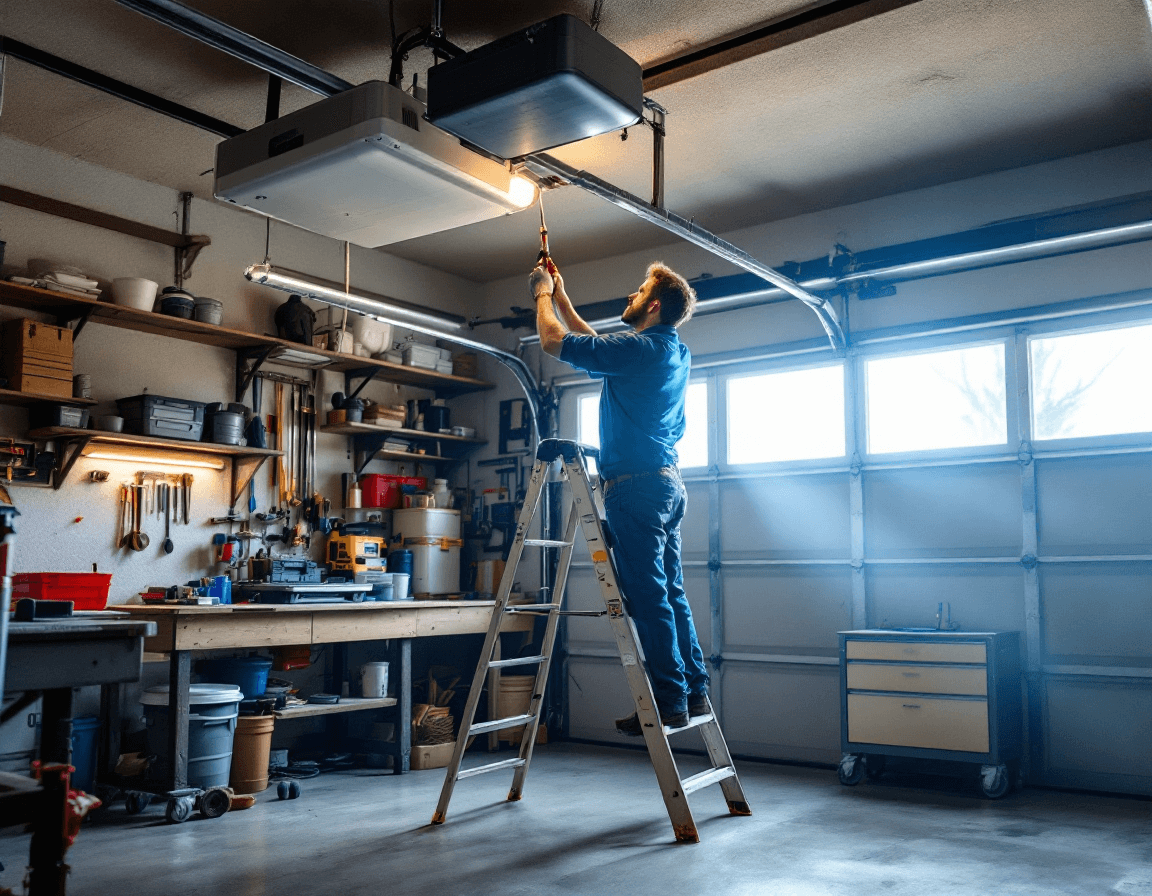
Garage door opener repair in Sumner, WA is one of the most common service calls we handle across Pierce County, and it's usually less mysterious than it looks. A homeowner pushes the remote, hears the motor click or hum, and the door either stays put, stops halfway, or reverses for no obvious reason. Most of the time the cause is a worn part, a misadjusted setting, a sensor that has drifted out of alignment, or a power or signal problem that can be traced with a methodical check. Our technicians work on every major opener brand, and we start by figuring out which system is failing before we replace anything.
Sumner homes come with their own mix of conditions. Older brick-and-frame houses near downtown often have detached or attached garages that have been modified over the decades, while newer homes in areas like Lakeland Hills tend to have longer driveways, larger door sizes, and more electronics packed into the wall and ceiling. Both types of property face the same Pacific Northwest weather, which means long stretches of damp air, cold snaps that stiffen lubricant, and winter storms that knock out power or send water blowing under a door. Those conditions shape the faults we see most often, and they're worth understanding before you decide whether a problem is a quick fix or something that needs a full diagnostic visit.
This page walks through the symptoms we hear about most, explains what each one usually means, and outlines what a professional repair typically involves. Where a task belongs in the hands of a licensed technician, we say so plainly. Opener repairs in the range of $95 to $375 cover a wide span of work, and knowing what you're paying for helps you make a confident decision. If you're dealing with a door that won't cooperate right now, the phone number at the end of this page connects you directly to our scheduling team.
Why Pacific Northwest Weather Shows Up Inside Your Opener
Moisture is the quiet troublemaker for garage door openers in Western Washington. Humid winter air condenses on cold metal surfaces, and that moisture finds its way into the opener head, the limit switch housing, and the wiring junctions that connect the motor to the wall control. Over time, corrosion builds on terminal screws and small contacts, which can turn a reliable signal into an intermittent one. Many Sumner homeowners notice their opener behaves perfectly in July and then starts acting up after the first few weeks of steady November rain.
Temperature swings matter too. When a cold morning follows a mild afternoon, the lubricant on the rollers, hinges, and drive components thickens, and the motor has to work harder to start the door. That extra load can expose a weak capacitor, a tired motor winding, or a force setting that was marginal to begin with. The door may open slowly, make a labored sound, or stop and reverse as the opener senses resistance it wouldn't have triggered in warmer months.
Wind and power interruptions are another local factor. Storms that roll through the South Sound can cause brief outages, and some openers reset their position or lose their programmed limits when power returns. A door that opens fine after a reset but starts drifting out of range a few days later often has an underlying limit or sensor issue that the storm simply revealed. Pay attention to when the problem started, because it often points directly at the cause.
When the Motor Runs but the Door Refuses to Budge
This symptom is one of the more alarming ones for homeowners because the opener clearly has power. You press the button, the light comes on, you hear the motor engage, and yet the door sits motionless or moves only a fraction of an inch. The most common cause is a disconnected or slipping drive component, such as a chain or belt that has come off the carriage or a trolley that has detached from the door's bottom bracket. Less commonly, the motor's internal clutch or gear set may be spinning without transferring force to the carrier.
Another frequent culprit is the emergency release. If the release cord was pulled at some point, perhaps by a child or during a previous attempt to free a stuck door, the trolley may still be disengaged. The door will feel loose when you lift it by hand, and the opener motor will whir without moving anything. Before calling anyone, look at the release cord and the trolley arm. If the arm is hanging free and the cord is dangling, the door may simply need to be reconnected, which is a task we handle carefully because a door under spring tension can cause injury if handled incorrectly.
A third possibility is that the opener has lost its position memory and is trying to run to limits it no longer recognizes. On certain models this produces a short run, a pause, and a second attempt that goes nowhere. This is where a technician's diagnostic process matters. We check the travel-limit settings, verify the drive components, measure the motor's response, and determine whether the fault is mechanical, electrical, or a combination of both. Replacing the motor when the real problem is a disconnected trolley wastes money and time.
Remote and Wall Button Failures Across Sumner Garages
When the remote stops working, the first thing most homeowners suspect is the battery. That's a reasonable starting point, but batteries are only part of the picture. Remotes exposed to humidity in a car visor or a jacket pocket can corrode internally, and the rolling-code receiver on the opener head can lose synchronization after a power glitch or a reprogramming attempt. Wall buttons fail for different reasons, usually because of damaged low-voltage wiring, a loose terminal at the wall plate, or a button that has simply worn out after years of use.
Local conditions influence signal problems too. Many newer homes in the Lakeland Hills area are built with dense framing, metal-backed insulation, and nearby neighboring structures that can weaken radio signals. A remote that works from the driveway but fails inside the house may be dealing with interference or a receiver antenna that has been disturbed. Older Sumner homes can present their own challenges, with wiring runs that have been spliced or repurposed over the years, creating intermittent connections that come and go with temperature changes.
Here are the checks we suggest before scheduling a visit, along with the situations where a technician should take over:
- Replace the remote battery and test the remote within a few feet of the opener head to rule out simple range issues.
- Check whether the wall button works in the same way on each attempt, and look for loose screws at the wall plate or visible wire damage.
- Confirm the opener's light and motor respond to the wall button, since that tells you the problem is likely in the transmitter or the wall control rather than the motor.
- Avoid reprogramming the remote or wall unit repeatedly without a plan, because that can change codes and complicate later diagnosis.
- Call a technician if the opener does not respond to any control, if you notice a burning smell, or if you suspect a wiring problem inside the wall.
Grinding From the Opener Head and the Stripped Gear Problem
A grinding or clicking sound coming from the opener head is one of the clearest signals that something inside needs attention. On many residential openers, the drive gear is made of nylon or a similar composite material meant to wear gradually and quietly. When teeth strip, the motor may still turn but the door moves unevenly, shudders, or stops, and the sound becomes harsh enough that neighbors may notice it. Continuing to run the door in this state can damage the motor mount and the rail assembly, turning a moderate repair into a larger one.
Stripped gears often develop after years of heavy use, after a door has been forced manually, or after the door has been out of balance for a while and the opener has been compensating. In Sumner's damp climate, lubrication can also break down faster than homeowners expect, leaving metal-on-metal contact where the drive system should run smoothly. We inspect the gear, the sprocket or belt pulley, the rail alignment, and the trolley travel to determine whether the gear alone needs replacement or whether a larger component is involved.
Replacing the gear assembly is a common repair in this category, and it's usually within the range of most opener repairs we quote. However, the job should not be treated as a simple lubrication task. Once a gear has stripped, the surrounding parts have been under strain, and a technician should verify the entire drive path. If the door is unusually heavy or the spring system appears to be failing, that is a separate issue that requires a licensed spring technician rather than a standard opener visit.
Doors That Stop Short, Reverse, or Won't Fully Close
Few things frustrate a homeowner more than a door that starts closing and then reverses without warning. Modern openers are designed with safety reversal systems that trigger when they sense an obstruction, a sudden change in resistance, or a sensor beam that has been broken. In practice, the reversal is often caused by something much more ordinary, such as a photo eye that has been knocked out of alignment, a sensor lens clouded by dust and spider silk, or a wire that has been pinched during a previous repair.
Force settings and travel limits create the other half of this problem. If the close limit has drifted, the door may stop a few inches above the floor and then reverse as the opener tries to find the seal. Sumner garages with uneven concrete or thresholds that have settled over time can make this worse, since the door's bottom edge may not land on the same surface every time. A technician adjusts the limits and force settings, cleans and realigns the sensors, and confirms that the door closes firmly without damaging the weatherstrip or the bottom seal.
It's important not to adjust force settings aggressively to force a door down. A door that reverses may be warning you about a real obstruction, a bent track, or an imbalance in the springs. Overpowering the sensor can create a safety hazard, especially with children or pets nearby. A proper repair restores reliable reversal and correct travel rather than defeating the safety system.
Blinking Lights on the Opener Head and What the Pattern Means
Many openers include a diagnostic light, and when it begins flashing in a repeating pattern, it's trying to tell you something. The exact meaning varies by brand and model, which is why we always recommend checking the manufacturer's labeling on the opener housing or the owner's manual before assuming a specific fault. Common meanings include a sensor that is not detecting the door, a stuck or misaligned limit switch, an overheated motor, or a control board that has detected an internal error.
Flash codes are especially useful in the Pacific Northwest because they can separate weather-related problems from mechanical ones. A repeating pattern that starts after heavy rain may point toward a sensor or wiring junction that has taken on moisture. A pattern that appears after the door has been struggling to open in cold weather may suggest a motor or force issue. We record the exact sequence, compare it to the brand's documentation, and test each suspected component rather than guessing from the light alone.
If the light flashes while the door is moving, note whether the door stops, reverses, or continues normally. That detail helps narrow the cause quickly. Please avoid repeatedly pressing the button while a fault pattern is active, since rapid cycling can stress the motor and make the underlying problem harder to isolate.
Loose Chains, Slipping Belts, and Trolleys Coming Off the Track
Chain-drive and belt-drive openers are both common in Sumner homes, and both can develop slack or separate from the carrier over time. A loose chain may sag, rattle, or jump a tooth on the sprocket, while a belt can stretch, fray, or slip off the pulley. In either case the opener may run without moving the door smoothly, or it may make a repeated clacking noise. Sometimes the first sign is a door that stops partway up the track and then tries again.
Trolleys and carriages can also come off the rail when the door is operated by hand or when the release has been pulled. Once the trolley leaves the track, the opener cannot move the door until it is re-engaged and aligned correctly. Re-seating a trolley seems simple, but it involves handling a heavy door, checking alignment, and making sure no part of the drive system is damaged. We treat this as a careful, hands-on repair and never recommend a homeowner forcing a door back onto the rail while the springs are under tension.
Routine tension adjustment on a chain or belt is part of many opener service visits. Over-tightening can damage bearings and the motor, while under-tightening lets the chain or belt ride unevenly. Our technicians check tension, lubrication where appropriate, and rail alignment before closing out the job. If the chain or belt is badly worn or the rail is bent, replacement is the more reliable path.
Intermittent Operation: The Hardest Faults to Chase Down
The most frustrating opener problems are the ones that come and go. A door might work perfectly for a week, fail on a rainy Tuesday, and then start again without any action on your part. Intermittent faults are hard to diagnose because the conditions that trigger them may not be present during a short visit. Loose wiring, corroded contacts, a failing logic board, and marginal sensor alignment can all produce this pattern, and each one behaves differently under heat, cold, moisture, and vibration.
Our approach to intermittent faults is to document the timing and conditions. Ask yourself whether the failures happen in the morning, after rain, during temperature changes, or when a particular device such as a car remote is used. Note whether the door fails completely or merely hesitates, and whether the opener light behaves differently when it happens. Those details give a technician a far better starting point than a general complaint that the door is "acting up."
Once the basics are checked, a systematic inspection can reveal the root cause. That may include tightening and cleaning terminals, replacing damaged low-voltage wire, testing the logic board, verifying safety sensor circuits, and confirming the motor is drawing expected current. In some cases, a control board or motor replacement is the most cost-effective route, but we prefer to confirm the fault before recommending parts. Intermittent problems that seem minor often grow more serious, so it's wise to address them before the door fails completely.
Brand-Aware Troubleshooting for Every Major Opener
Because we service every major opener brand, we understand that the same symptom can have different causes depending on the manufacturer. Some openers use rolling-code receivers with particular programming steps, while others rely on different limit-setting methods or have distinct flash-code systems. A homeowner who searches online for a fix may find instructions that work for one brand and create problems on another. That is one reason we encourage a professional diagnosis rather than trial and error.
Brand awareness also affects parts availability and repair strategy. Some older openers are still serviceable with common components, while certain models may be better served by a replacement unit when the cost of repair approaches the value of a newer, more reliable system. Our technicians will explain the options honestly, including what can be repaired, what is likely to fail again soon, and what a replacement would involve. We aim to give Sumner homeowners a clear picture rather than a sales pitch.
If you're not sure which brand or model you have, the label is usually on the side or back of the motor housing, often near the light cover or inside the rail near the drive unit. Having that information ready when you call helps the scheduling team prepare, and it can shorten the time needed for diagnosis on the day of the visit.
What a Sumner Opener Repair Visit Usually Covers
A typical opener repair visit begins with a conversation about the symptoms, followed by a walk-through of the door and opener. The technician checks the power supply, the wall control, the remote receiver, the safety sensors, the travel limits, the force settings, and the drive components. We also look at the door's balance and the condition of the rail, because many opener complaints are actually caused by problems elsewhere in the system. Once the cause is identified, we explain the repair and the parts involved before doing any work.
Most opener repairs we perform fall in the range of $95 to $375, depending on the complexity of the fault and the parts required. Simple adjustments, sensor realignment, or remote programming usually land at the lower end of that range, while motor, gear, circuit board, or drive assembly replacements tend to be higher. Costs can vary with the brand, model, and accessibility of the components, so the final quote will reflect the specific work needed. We recommend asking for a clear explanation of the diagnosis and parts before authorizing the repair.
Some work is outside the scope of an opener visit and requires a different kind of expertise. Spring replacement, cable repair, and door balancing involve high tension and can cause serious injury if mishandled. Those tasks must be performed by a licensed professional with the right tools and training. If your technician finds a spring or cable issue during an opener visit, they should stop, explain the risk, and recommend the appropriate service rather than attempting the repair as part of the opener job.
Safe Checks You Can Make Before Someone Arrives
There are a few things a homeowner can check safely while waiting for a technician. Start by making sure the door is fully closed and that nothing is blocking the path of the door or the safety sensors. Clean the sensor lenses with a soft dry cloth, and look for obvious damage to the wires running to the sensors. If the opener has a battery backup, confirm it is charged and properly connected, since a dead backup can make a power outage problem look like a mechanical fault.
Never attempt to lift, pry, or manually force a door that feels heavy, binds, or seems out of balance. Avoid standing under the door while it is moving, and keep children and pets away from the opener and track during any test. If you need to use the emergency release, pull the cord gently and only when the door is closed, then do not try to operate the door by hand until a professional has confirmed it is safe. Remember that spring tension is always present, even when the door looks still.
Keep a simple record of what you observed, including the time, weather conditions, the remote or button used, and any flash codes or sounds. That information can speed up diagnosis and help the technician avoid repeating steps you have already tried. If the door shows signs of serious damage, such as a cracked panel, a bent track, or a broken spring, leave it closed, keep people clear, and call a licensed professional right away.
Garage door opener problems rarely fix themselves, and small symptoms often grow into larger failures during the rainy months when the door gets the most use. If your Sumner opener is refusing to run, grinding, reversing, flashing codes, or working only some of the time, call (888) 799-3819 to schedule a diagnostic visit. Our licensed, bonded, and insured technicians serve Sumner and the surrounding Pierce County communities, including the downtown area and the Lakeland Hills neighborhood, with clear explanations and straightforward pricing before any work begins.