
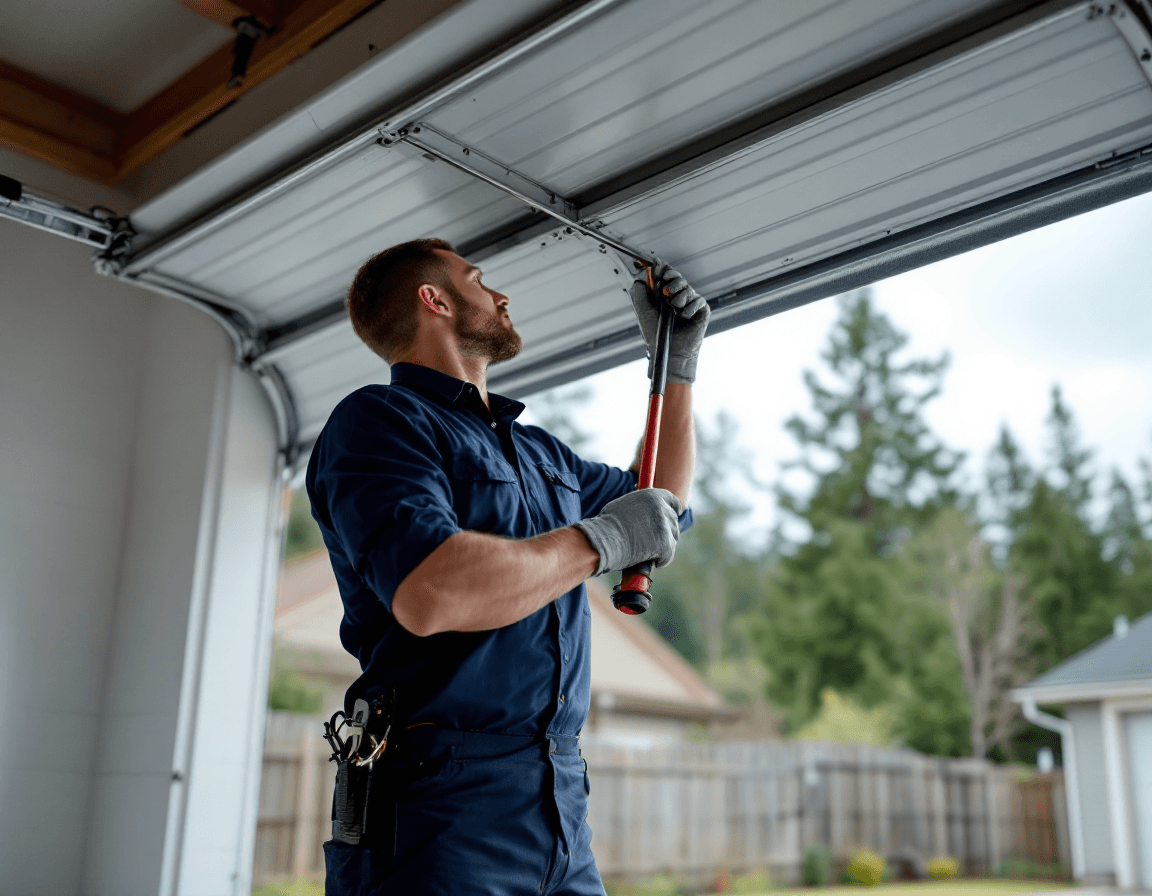
Garage door spring replacement in Sumner, WA is one of the most common repairs we handle, and for good reason. The springs carry most of the weight of a typical garage door, and they wear out through repeated use rather than on a set date. Homes around downtown Sumner and the newer subdivisions up the hill in Lakeland Hills see daily openings for school runs, work commutes, and weekend projects, so the springs cycle more often than many homeowners realize. When one fails, the door often stops working entirely, and the sudden break can be startling.
Most of the calls we take start the same way: a homeowner walks out to the driveway, presses the wall button, and hears the opener strain without any movement, or the door rises a few inches and then stops. Sometimes the first sign is a loud crack that sounds like a gunshot from inside the garage. Whatever the case, a broken spring is not a problem to wait out or troubleshoot with a screwdriver. This guide explains what causes spring failure in our part of Pierce County, how to recognize the warning signs, what replacement involves, and why the work should always go to a licensed technician.
Our service area includes Sumner and the surrounding neighborhoods within ZIP codes 98390 and 98391, and our technicians are familiar with the housing styles you find here. Many garages were built with older single-wide or double-wide doors, while newer homes often feature insulated steel or wood-look panels that weigh considerably more. Matching the correct spring to the door's actual weight, track setup, and cycle demand is the foundation of a lasting repair.
How the Pacific Northwest Climate Wears Down Garage Door Springs
Western Washington winters bring long stretches of damp air, frequent rain, and temperature swings that move between cold mornings and mild afternoons. Moisture is the quiet enemy of steel. A torsion spring that sits in a garage without much ventilation can develop surface rust over several seasons, and rust weakens the metal where the coils flex most. Once corrosion starts pitting the wire, the spring has less capacity to hold its tension, and it can fail without much warning on a cold morning.
Temperature also plays a role. Steel contracts when the air gets cold, and the tension in a spring changes slightly as it does. Homeowners sometimes notice that the door feels heavier on the first frosty day of the year than it did in August. That change is normal, but it can push a tired spring past its limit. A door that already has worn springs may work fine through summer and then fail during the first hard cold snap of November or December.
Humidity from the Puyallup River valley and from the many wooded lots around the area can seep into garages that lack proper sealing. We frequently see doors where the bottom seal is cracked, the weatherstripping has pulled away, and dampness has settled onto the hardware. Addressing those conditions does not replace a spring, but it does slow down the corrosion that shortens spring life. Keeping the garage reasonably dry and checking seals each fall gives the hardware a better chance of reaching its rated cycle count.
Warning Signs That a Spring Is Nearing the End
Springs rarely fail all at once without any history. Before a full break, most doors show a pattern of small symptoms that a careful homeowner can notice. The door may open more slowly than it used to, or it may start to lurch at the beginning of its travel. You might hear a faint popping or ticking sound when the door moves, which often comes from coils rubbing against each other or from a loosening bracket. These clues are worth paying attention to because they give you time to schedule a repair on your own terms instead of an emergency visit.
Visual inspection can help too, but it should be done carefully and from a safe distance. Look at the spring from the side without touching it. Gaps between coils, rust that appears flaky or orange, and coils that look stretched or spaced unevenly all suggest the spring has lost its strength. Extension springs, which run along the sides of the door above the track, may show elongated loops or a visible stretch in one section compared to the other side. Comparing the two sides of the door can reveal a difference that is easy to miss when you only look at one.
- Door opens unevenly, with one side rising faster than the other
- Popping or ticking noises during the first few feet of travel
- Visible rust, flaking, or coils spaced farther apart than their neighbors
- The door seems to drop suddenly when released from the opener
- The auto-reverse feature triggers more often than usual, sometimes because the door is harder to lift
If you notice any of these signs, avoid operating the door repeatedly until a technician can inspect it. Continued use of a weakened spring can cause a second spring to fail, and it can stress the opener motor, the cables, and the drum assembly.
What a Snapped Spring Sounds Like and Why It Feels So Alarming
A torsion spring that breaks usually produces a loud bang that can be heard throughout the house. Many homeowners describe it as a gunshot or a heavy metal object dropping onto the concrete floor. The noise happens because the energy stored in the wound coil releases in an instant. In some cases, one half of the spring flies apart and the sound carries through the walls, which is why a snapped spring often brings a neighbor to the window to check on the house.
After the bang, the door typically looks normal from the outside but refuses to open. You may see a gap in the center of the spring when you look up from a safe spot, or you may notice that the door sags slightly on one side. Sometimes the door opens a few inches and stops because the remaining spring cannot lift the full weight. Extension spring failures can be quieter, sounding more like a sharp snap, but the door will usually drop or hang at an angle afterward.
These symptoms can be unnerving, but the safest response is the same every time. Keep children and pets away from the door, do not attempt to lift it by hand, and disconnect the opener if you can do so without touching the door. Then call a licensed technician, who will carry the correct replacement parts, verify the spring size, and handle the removal of the damaged components with the proper tools. Even a seemingly stable door can shift when the broken pieces are disturbed, so professional handling matters.
Torsion Versus Extension Springs: Knowing Which Type You Have
Garage doors in Sumner typically use one of two spring systems. Torsion springs mount on a steel shaft above the door opening, usually just above the header. They wind and unwind to provide lifting force, and they are the most common setup on modern residential doors. Extension springs run parallel to the horizontal tracks along each side of the door, stretching and contracting as the door moves. Older homes and some lighter doors use extension springs, and they are often less expensive to replace, though they carry their own safety considerations.
Knowing which system you have helps you understand the repair. Torsion spring replacement requires precise measurement of the wire diameter, inside diameter, length, and cycle rating, all of which must match the door's weight and dimensions. Extension spring replacement depends on the door's height, track configuration, and safety cable setup. In both cases, a technician will confirm the existing spring specifications before ordering parts, because installing a spring of the wrong strength can make the door dangerous to operate.
Some homeowners try to identify their springs by looking at the cones on the ends of the torsion shaft or by counting the number of coils. These are useful clues, but they do not replace a proper measurement. Two springs that look nearly identical can have different tensions, and a spring installed for a lighter door will not hold a heavier one. A trained technician will check the door's weight, the shaft diameter, and the mounting hardware before recommending a specific replacement.
Understanding the $180–$450 Range for Most Spring Replacements
For most residential spring replacements in the Sumner area, our pricing falls in the range of $180 to $450. That range reflects the common combinations of parts and labor we see on standard single-car and double-car doors. The final amount depends on the type of spring, the size and weight of the door, whether the job includes both springs, and how much related hardware needs attention.
Several factors push the cost toward the higher end of the range. A heavier insulated door, a double-wide door, or a door with a larger glass section usually requires a stronger spring set. High-cycle springs, which are discussed below, cost more upfront but can last longer under heavy use. If the drum, cables, or bearings have also been damaged, the repair may include those components as well, which adjusts the total. Conversely, a straightforward swap of a single extension spring on a lighter door will usually land near the lower end.
We always recommend asking for a clear explanation of what is included before approving work. A good quote should list the spring type, the cycle rating, whether both springs are being replaced, the status of cables and hardware, and the balance adjustment. Be cautious of anyone who offers a dramatically low price without inspecting the door, because replacing a spring with the wrong size or skipping the balance check can create safety problems that cost far more to fix later.
High-Cycle Springs for Busy Sumner Households
Standard springs are rated for a set number of cycles, meaning one full open and close counts as one cycle. Many standard residential springs are designed for a typical household use pattern, but homes with multiple drivers, frequent deliveries, or teenagers coming and going can wear through them faster than expected. High-cycle springs are manufactured from wire and coil designs intended to handle a greater number of cycles, which makes them a practical upgrade for busy households.
Choosing high-cycle springs is not always necessary, but it is worth discussing if your door opens many times each day. Families with home businesses, landscapers who store equipment in the garage, and households with frequent weekend activity often benefit from the extra durability. The added cost is usually modest compared with a second replacement a few years down the road, and it spares you the inconvenience of another unexpected failure during a busy week.
High-cycle springs still require the same professional handling as standard springs. Their stronger design does not make them safer to adjust or install without training. Any spring tension work should be performed by a technician who understands the winding procedure, the correct equipment, and the safety precautions that protect both the homeowner and the installer.
Balancing the Door So It Opens Smoothly
After a new spring goes in, the door must be balanced. Balance refers to how evenly the spring tension supports the door's weight so that it stays put when partially open and moves smoothly through its full range. A well-balanced door should stay in place when you lift it by hand to about waist height and release it, assuming the opener is disconnected. If the door drifts up or down on its own, the balance is off and needs adjustment.
Balance problems often show up as a door that closes too fast, crooked movement, or uneven strain on the opener. A door that is too heavy at the top can lift slowly and stress the motor, while a door that is too light can slam shut and become a safety issue. Crooked operation sometimes points to spring tension that differs between two sides, a problem that may require replacing both springs at the same time so they carry equal loads.
Balance is one of the most important parts of spring replacement, and it is often overlooked by people who attempt DIY repairs. Adjusting tension without proper tools and experience can result in an unsafe door that looks fine until it fails. A licensed technician will test the balance after installation, check the cable tension, verify the track alignment, and confirm that the auto-reverse system responds correctly before leaving the property.
Cables, Drums, and the Damage a Broken Spring Can Leave Behind
When a torsion spring breaks, the lifting cables attached to the drums can become slack or come loose from the drum. The drums are the cone-shaped or grooved components at each end of the shaft that wind the cable as the door lifts. A broken spring can cause the cable to jump out of its groove, bunch up, or fray where it rubs against the track. If the cable separates from the drum entirely, the door may hang at an angle, and any attempt to force it can make the situation worse.
Inspecting cables and drums is part of every complete spring replacement. Frayed strands, kinks, rust, and cable ends that have pulled out of their fittings all need attention. Drums may be cracked or misaligned, and bearings on the shaft can be damaged if the door was operated after the break. Replacing these parts at the same time as the spring prevents a second failure that could otherwise happen within weeks.
Homeowners often ask whether it is safe to reattach a loose cable themselves. The answer is no. Cables are under significant tension even when they look slack, and reattaching them without the proper procedure can cause them to snap back with force. A licensed technician uses the right clamps, measurements, and sequencing to restore the cable system correctly.
Safety Rules for Every Sumner Homeowner
Garage door springs store a large amount of energy, and that energy can cause serious injury if mishandled. Torsion springs in particular should never be adjusted, wound, or removed by anyone without specialized training and equipment. Winding bars, which are often used during spring work, can slip and strike the operator if the technician does not follow the correct procedure. For this reason, spring and cable work belongs to licensed professionals who carry the right tools and insurance.
Homeowners can take sensible precautions while waiting for a technician. Do not stand under a door that is out of balance or that appears to be sagging. Keep children, pets, and vehicles clear of the door's travel path. If the door is stuck partway open, avoid pushing or pulling it hard, and consider disconnecting the opener only if you can do so safely without lifting the door. Use the manual release only when the door is fully closed, because releasing the trolley on a door that is up can allow it to drop suddenly.
It is also wise to avoid trying to test the springs yourself by loosening set screws or by moving the winding cones. These components look simple but are under substantial tension. A safe approach is to document the problem with a few photos from a distance, note the symptoms, and then call a licensed technician who can evaluate the door and recommend the right repair.
What Happens During a Spring Visit in Sumner and Lakeland Hills
When you contact us for spring replacement in Sumner, a technician will typically begin by asking about the symptoms and the door's history. Be ready to describe what happened, whether you heard a bang, whether the door moves at all, and whether anyone has tried to repair it previously. Give the technician access to the garage, the opener, and the door sections so they can inspect the full system before any parts are ordered.
The technician will measure the existing spring or springs, check the cable and drum condition, examine the track alignment, and test the opener's response. Based on those findings, they will explain the recommended repair, provide an estimate in the range that applies to your door, and describe whether high-cycle springs or additional parts make sense. Once you approve the work, the replacement is performed with the necessary safety procedures, followed by balance testing and a final check of the door's operation, including the safety reversal system.
Whether your home sits near downtown Sumner's older streets or in the newer neighborhoods around Lakeland Hills, the process stays consistent. We aim to restore reliable, balanced operation that matches your door's weight and your household's daily use. If you have questions about the work or the options, a technician can walk you through them before any decisions are made.
Simple Habits That Extend Spring Life in a Wet Climate
While springs eventually wear out, a few regular habits can help them last longer. Lubricating the moving parts of the door with a silicone-based or lithium-based garage door lubricant reduces friction on rollers, hinges, and bearings, which in turn reduces the strain on the springs. Avoid petroleum-based products on rubber seals and nylon rollers, since they can break down those components over time. Wiping down the tracks and removing debris keeps the rollers moving smoothly.
Visual checks every few months are also valuable. Look for rust on the springs, fraying on cables, and loose bolts on brackets. Watch the door's movement for changes in speed or sound. If you notice that the door seems heavier or that one side lags behind the other, schedule an inspection rather than waiting for a failure.
Finally, consider the environment inside the garage. Good ventilation, a working weatherstrip, and a bottom seal that fits snugly all help limit moisture, which is one of the biggest contributors to spring corrosion in Western Washington. Keeping the space reasonably dry and free of standing water protects not only the springs but also the opener, the track, and the sections of the door itself.
If your garage door has stopped working, shows signs of a broken spring, or has been making unusual noises, do not wait for the problem to get worse. Call Seattle Garage Door Fix at (888) 799-3819 to schedule a licensed technician who can inspect the door, explain your options, and restore safe, balanced operation.