
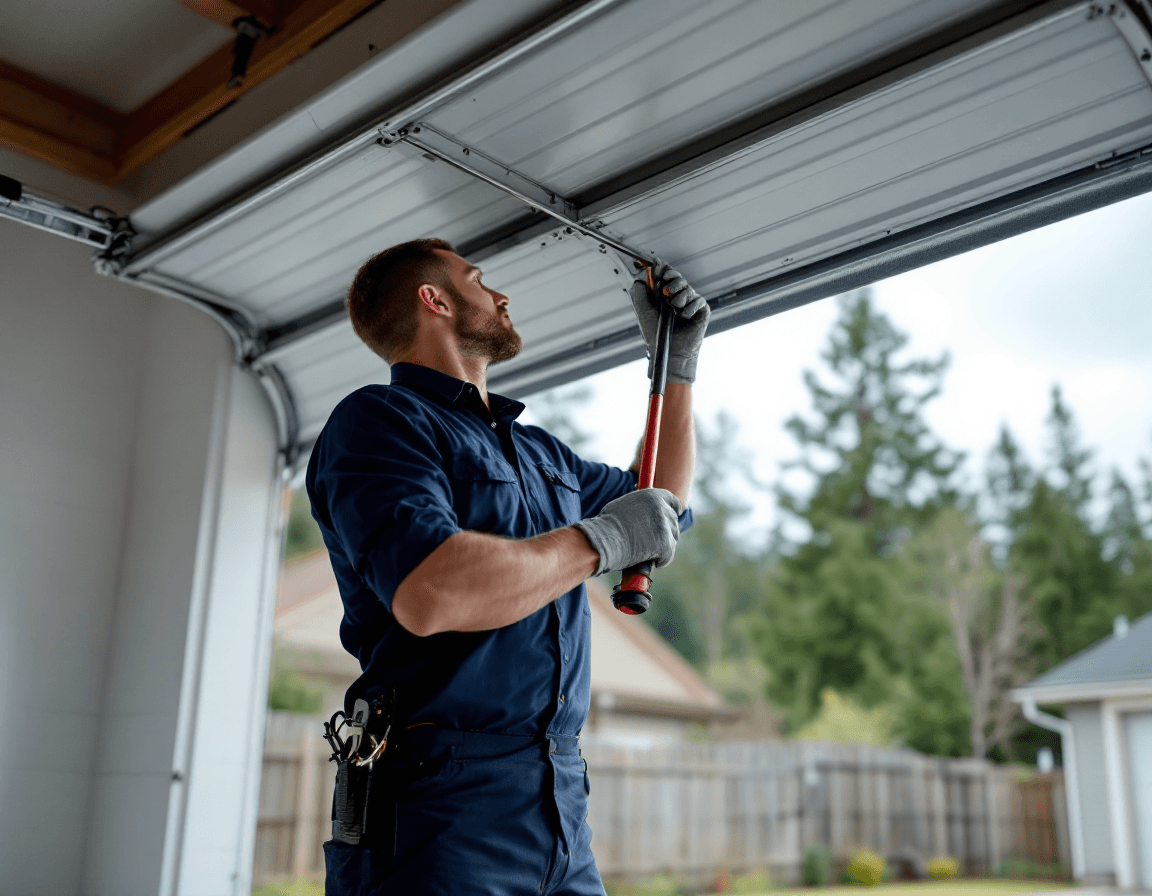
Garage door spring replacement in Pacific, WA is one of the most common repairs we handle, and it is also one of the most urgent. A torsion or extension spring carries most of the weight of a heavy steel door, so when one fails, the door often stops working entirely. Pacific sits in the lowlands south of Auburn, where wet winters, damp air, and sudden cold snaps all put extra stress on the hardware that keeps your door balanced. Homeowners around Pacific City Park and across the 98047 area usually notice the problem the same way: a sharp bang in the garage, then a door that won't budge.
This page explains what a broken spring looks like, why the Pacific climate contributes to early failure, and how the replacement process works from start to finish. We also cover the signs that point to a spring problem rather than an opener problem, how to choose a high-cycle spring that fits your household, and what drives the typical $180 to $450 price range for most jobs. Spring work carries real risk of injury, so we explain where the line sits between a safe homeowner check and a job that belongs with a licensed technician.
If your door is stuck, sagging, or making noises you haven't heard before, you don't need to guess. Read through the sections below to narrow down what happened, then call us so a technician can inspect the springs, cables, and balance in person. Our team is licensed, bonded, and insured, and we work across Pacific and more than 60 nearby cities in Western Washington.
Reading the Bang: What a Snapped Spring Sounds Like in a Pacific Garage
Most homeowners remember the moment a spring breaks. It usually happens while the door is closed or partway through a lift, and the sound resembles a gunshot or a heavy metal pipe dropped on concrete. Some people describe it as a loud crack followed by a rattling that continues for a second or two as the broken wire settles. If you heard that sound and then saw the door sag or refuse to move, a spring failure is the most likely cause.
Pay attention to where the sound came from, because that tells you a lot. A break in a torsion spring typically sounds like it came from above the door, on the header bracket near the center of the opening. An extension spring break tends to be louder at the sides of the door, close to the track, where the spring sits along the horizontal rails. In many Pacific homes the garage is attached to a house with shared walls, so the noise can seem to come from somewhere else entirely, and checking the door itself is the fastest way to confirm.
After a snap, do not try to lift the door by hand or force the opener to work it. The stored energy in the remaining spring can still shift, and the door may fall unexpectedly if the cables are under uneven tension. Close the door if it is open, unplug the opener or pull the emergency release cord, and keep children and pets away from the bay. Then call a technician, who can secure the door safely and confirm which spring failed.
Torsion Versus Extension: Knowing Which Spring Your Door Is Carrying
Before any repair, it helps to know which type of spring your door uses, because the two systems behave differently when they fail. A torsion system mounts one or two long steel springs on a bar above the opening, and it twists to store energy when the door closes. Torsion springs are common on newer residential doors and are generally considered more balanced and longer-lasting when properly installed. A single broken torsion spring on a two-spring system often leaves the door stuck halfway, because the remaining spring cannot lift the full weight alone.
Extension springs run along the horizontal tracks on each side of the door, and they stretch as the door lowers and contract as it rises. You will often see them on older garages or on lighter doors, and they usually come with safety cables routed through the coils to contain the spring if it breaks. A broken extension spring can still be dangerous even with a safety cable, so it should never be handled as a casual fix. Extension springs also tend to show their wear through sagging or uneven movement before they snap.
Knowing the system matters for quoting, parts, and safety. Torsion work requires winding tools and careful measurement of the spring's turns and wire size, while extension work focuses on proper length, hook style, and cable routing. A technician who arrives with the correct spring spec for your door saves you a second visit. If you aren't sure which system you have, look above the door first; if there is a long bar with cones at each end, you have torsion springs, and if the springs are along the tracks, you have extension springs.
Why Western Washington Humidity and Wet Winters Wear Springs Down Early
Springs are made of tempered steel, and steel responds to moisture over time. Pacific's damp winters, combined with the humid air that settles into lowland garages, create the conditions for surface rust on coils and cable hardware. Rust does not always break a spring right away, but it pits the metal and weakens the wire, which can lead to a sudden failure after a cold morning. Many Pacific garages also hold a lot of moisture from cars coming in wet from the road, which adds to the problem.
Temperature swings add another layer of stress. When the weather drops into the freezing range for a few nights and then warms again, the metal contracts and expands, and the lubricant on the coils can thicken and then loosen. A spring that had enough life left in the fall may simply give out during the first hard cold snap in January. This is why spring failures in the Seattle area often cluster in the coldest months, even though the springs were wearing down long before.
Good routine care helps slow this process. Wipe down the springs and cables a few times a year with a dry cloth, then apply a light lubricant designed for garage door hardware to the coils and moving parts. Avoid spraying lubricant on the door's rollers or tracks in a way that drips onto the floor or the spring itself, because excess product can attract dirt. Keeping the garage ventilated, especially after washing cars or hanging wet gear, also reduces the moisture that feeds rust.
Five Warning Signs That Your Door Is Telling You Something
Spring problems rarely arrive without warning. Often the door gives you clues for weeks before the break, and recognizing them can turn an emergency into a scheduled repair. The signs below are common in Pacific homes, and any of them justifies a professional look at the springs, even if the door still works.
- A visible gap in the coil of a torsion spring, or a coil that looks stretched or separated from its neighbors
- A door that feels noticeably heavier to lift by hand than it did last year, especially on one side
- A clicking, popping, or grinding sound from the spring area during opening or closing
- Rust-colored flaking or dark pitting on the coils, the cone brackets, or the cable drums
- A door that closes faster than normal or slams down against the floor instead of settling gently
Any one of these signs can have other causes, such as a worn roller, a bent track, or a loose bracket. That is why a technician should test the balance and inspect the hardware instead of guessing. Still, a visible gap in a torsion coil is almost always a sign that the spring has failed or is about to, and it should be replaced rather than monitored. Treat that gap as a sign to schedule service soon, not as a cosmetic issue.
The Door That Lifts Two Feet and Quits: Diagnosing a Partial Failure
A door that opens a few inches and then stops is one of the most confusing symptoms. Many homeowners assume the opener is failing, but in most cases the springs are the cause. When a torsion spring weakens or breaks on one side of a two-spring system, the door may rise partway before the remaining tension can no longer carry the weight. The door can also hang crooked, with one side higher than the other, which is a telltale sign of uneven spring output.
Extension springs can produce the same effect when one spring stretches more than its partner. The door may travel a few feet, then stop with a jolt or a hard shudder as the opener strains against the imbalance. Continuing to run the opener in this state can damage the gear, the trolley, or the rail, which turns a moderate spring repair into a larger bill. If the door has stopped partway, shut off the opener and avoid repeated attempts.
A technician will check the balance by disconnecting the opener, lifting the door by hand to a midpoint, and observing whether it stays put. A balanced door should hold at roughly halfway without drifting up or down. A door that falls or rises on its own needs spring work, cable inspection, or both, and this test is one of the first steps we take when diagnosing a partial failure.
Opener Strain Without Movement: Why the Motor Is Not Always the Culprit
When an opener hums, clicks, or strains but the door barely moves, it is natural to blame the motor. Yet an opener is designed to assist the springs, not to replace them. If the springs have lost most of their tension, the opener is forced to lift almost the full weight of the door, and the motor responds by drawing extra current, overheating, or stalling. The noise you hear may be the motor struggling against a door that the springs no longer balance.
Listen carefully to what the opener does. A steady hum with little or no door movement often points to lost spring tension, while a rapid clicking may indicate that the motor is trying to start repeatedly. A grinding sound from the rail usually means the chain or belt is also under load, and continuing to operate the door in this condition can strip gears or stretch the drive. Stopping the opener early protects both the motor and the rest of the system.
If the opener is more than a decade old, it may also need service, but replacing it first will not fix a spring problem. A proper diagnosis starts with the springs and the balance, then moves to the opener once the door moves freely by hand. Many repeat calls come from homeowners who replaced an opener only to find the springs were the real issue, so checking springs first can save money.
Loose Cables and Crooked Travel After a Break
A spring break does more than stop the door. The cables that wind around the drums on each side are under heavy tension, and when a spring fails, they can go slack, jump off the drum, or wrap unevenly. In some cases the cable slips out of its groove and hangs loose inside the track. Pacific garages with lower ceilings or tight clearances may show cable damage more quickly, because the cable rubs against hardware that is not perfectly aligned.
Crooked travel is another common consequence. If one cable is looser than the other, the door may rise at an angle, bind against the track, or lean sideways in the opening. Continuing to operate a door with a loose cable can bend the track, damage the bottom seal, or fray the cable further. Some homeowners try to reseat a cable themselves, but a cable under uneven tension can snap back with force, so this step belongs with a technician.
When we replace springs, we also inspect the cables, drums, and bearing plates for wear. A cable that shows broken strands, kinks, or a flattened section should be replaced along with the spring, because it was loaded during the failure and may not hold again. Checking these parts at the same visit prevents a second service call a few weeks later.
Picking High-Cycle Springs Without Overbuying
Most standard residential springs are rated for a typical cycle count that works well for an average household, but many Pacific families use their garage far more often than that. Busy households with teenagers, home businesses, or frequent trips for work may open and close the door several times a day. High-cycle springs are built with heavier wire or higher-grade steel to handle that repetition, and they can be a sound upgrade when your usage justifies the cost.
Choosing a cycle rating should be based on how often the door actually moves, not on a guess. Think about daily trips, weekend projects, and any time the door stays open for long periods. A technician can help match the spring to your door's weight, height, and track type, because a spring that is too strong can make the door unsafe to operate and can accelerate wear on the opener. Upgrading just for appearance or without reviewing the door's specifications is rarely a good investment.
We also consider the door itself when recommending a spring. A heavier insulated steel door or a wood carriage-style door may need a different spring setup than a lightweight single-layer door, and that affects both cost and performance. Asking for a written breakdown of the spring options, including the wire size and expected cycle rating, helps you compare choices fairly.
What the Repair Visit Covers, and What Drives the $180 to $450 Range
For most residential spring replacements, the typical price falls between $180 and $450. The final cost depends on several factors, including whether you have torsion or extension springs, how many springs need replacement, the weight and size of the door, and whether cables, drums, or bearings also need attention. A single extension spring on a light door will usually land near the lower end of the range, while a pair of heavy torsion springs with cable replacement will be closer to the top.
A complete visit typically includes removing the damaged spring safely, installing the correct replacement, rebalancing the door, testing the opener's travel and reverse function, and checking the cables, rollers, and hinges. Balancing is not optional. A new spring that is not properly set will put uneven stress on the door and the opener, and it can shorten the life of the new hardware. Ask the technician to walk you through the balance test so you can see the result for yourself.
Be cautious of estimates far below this range that skip the balance check or use mismatched springs, and of quotes that push large add-ons without explaining why they are needed. A clear, itemized estimate that lists the spring type, the cycle rating, and any cable or drum work gives you the information to decide with confidence.
Safety Rules We Keep on Every Spring Job
Spring work is one of the few garage door tasks that can cause serious injury, and it should always be handled by a licensed professional. Torsion springs store enormous energy, and improper winding or removal can cause the spring, the winding bar, or the cone to release with force. Extension springs can also snap and recoil dangerously, even when a safety cable is installed. Homeowners who attempt these repairs with improvised tools, or without understanding how the stored tension works, put themselves and their families at serious risk.
Here are the basic rules we follow on every spring job, and that any homeowner should respect even when only observing:
- Never stand in line with a torsion spring or its winding bars, and keep hands clear of the coils during any adjustment.
- Do not attempt to remove or install a spring without the correct tools, the correct spring specification, and training in the procedure.
- Keep the opener disconnected and the door secured with locking pliers or clamps before working on cables or drums.
- Leave the door closed and locked until a technician has confirmed that the tension is safely relieved.
- Replace the full set of springs when one has failed on an older door, because the remaining spring has been under the same load and is often close to failure.
These rules are not a suggestion; they are the reason a professional visit is the right choice for spring replacement in Pacific. A licensed, bonded, and insured technician carries the training and coverage to handle the job safely, and that protection matters when a mistake could mean a serious injury.
Keeping New Springs Healthy Through a Pacific Winter
Once new springs are installed, a little routine attention goes a long way toward extending their life. Schedule a visual check at least twice a year, ideally before the wet season begins and again in late spring. Look for rust forming on the coils, cable fraying, and any change in how the door moves, and note anything unusual so you can mention it at your next service visit.
Keep the garage as dry as you reasonably can. Use a dehumidifier if the space stays damp, store wet items outside the bay, and avoid parking freshly washed or rain-soaked vehicles inside for long stretches. Lubricate the moving parts with a product made for garage door hardware, and avoid heavy greases that collect dust and grit. These simple habits reduce the rust and friction that wear springs down faster in our climate.
Finally, plan for the unexpected by keeping your technician's number handy and by not waiting until a break forces an emergency call. A spring replaced on a planned schedule costs less, avoids the inconvenience of a stuck door, and keeps your household safer. If it has been several years since your springs were checked, or if any of the warning signs above sound familiar, now is a good time to schedule an inspection.
Your garage door should move smoothly, quietly, and safely through every Pacific season. If your door has gone silent after a loud bang, sits stuck partway, or moves crookedly, call Seattle Garage Door Fix at (888) 799-3819 to schedule a licensed technician. We will inspect the springs, cables, and balance, explain your options clearly, and get your door back to reliable operation.