
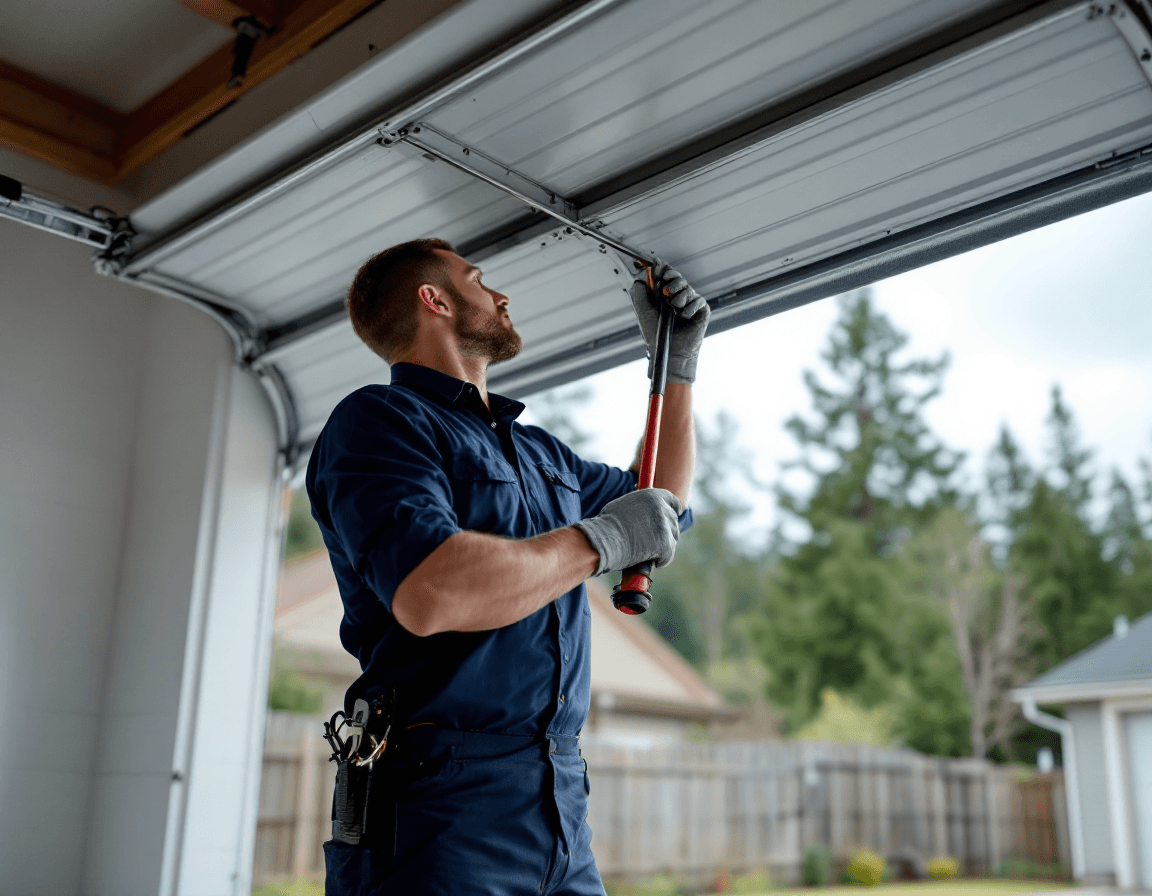
Garage Door Spring Replacement in Auburn, WA is one of the most common repairs we handle, and it is also one of the easiest to misjudge from the driveway. A garage door that suddenly refuses to lift can look like a motor problem, a sensor problem, or a stuck track, when the real culprit is a fatigued spring that has finally given up. Auburn homeowners deal with the same mix of wet winters, damp air, and daily open-and-close cycles as the rest of Western Washington, and those conditions wear springs down steadily until one of them fails.
This page explains how springs fail, what the symptoms look like in real homes, and what a proper replacement involves from start to finish. We cover the difference between torsion and extension systems, why high-cycle springs are worth considering, how door balancing affects the life of the new hardware, and what a fair price looks like for most jobs. Our goal is to give you enough detail to recognize the problem early, make an informed decision, and understand why spring work belongs with a licensed professional.
If you are reading this because your door is currently stuck, do not try to force it open or start unwinding anything. Spring tension stored in a door can be substantial, and the rest of this page explains why. Keep the door closed, keep people and pets away from the door, and call us at (888) 799-3819 so a technician can assess the situation safely.
Why Auburn Garages Wear Springs Faster Than You Might Expect
Auburn sits in the Green River valley, and that low, river-influenced geography means damp air tends to linger in the lower neighborhoods for long stretches during fall and winter. Moisture is the enemy of steel, and garage door springs are steel under constant tension. Even when a spring is protected by a factory coating, repeated exposure to humidity, condensation, and the occasional splash of road water from wet driveways gradually breaks down that protection. Once surface rust forms in the coils, it creates tiny stress points that concentrate load every time the door moves.
Temperature swings add another layer of stress. A cold snap that drops temperatures well below freezing overnight can make a spring feel noticeably tighter the next morning, and the metal responds by holding more tension than it did the day before. Homeowners on the higher ground of Lea Hill sometimes notice that their doors feel stiffer after a hard freeze, while homes lower in the valley may notice more corrosion on hinges and rollers. These differences are subtle, but over years they add up, and they explain why a spring in one Auburn neighborhood may outlast another that looks identical on paper.
Daily use matters just as much as weather. A household that leaves for work and returns in the evening may cycle the door twice a day, which adds up quickly over a decade. Families with teenagers, home businesses that receive frequent deliveries, or households with two working vehicles often put far more cycles on their springs than the original builder anticipated. When people ask why their springs failed "early," the honest answer is usually that the springs were rated for a certain number of cycles, and the household simply used them more than that.
Reading the Warning Signs Before a Spring Lets Go
Most spring failures do not happen without warning. Springs usually weaken gradually, and the door sends signals long before the metal actually breaks. Learning to recognize those signals gives you time to schedule a repair on your terms instead of discovering the problem at six in the morning when you need to leave for work. Many of the signs are easy to notice if you pay attention to how the door sounds and feels during normal operation.
Common early warning signs include:
- The door begins to close faster than usual or slams down when released.
- One side of the door rises noticeably higher than the other during opening or closing.
- The opener motor sounds strained, hums loudly, or seems to labor without moving the door much.
- A visible gap or separation appears in a torsion spring coil when you look at the header area above the door.
- Rust-colored flakes or a light orange dust collect on the floor beneath the spring.
A louder problem is a sudden loud bang, which usually means a spring has snapped completely. Many homeowners describe it as sounding like a gunshot or a heavy object dropped inside the garage. If the bang happened and the door now sits partly open, closed unevenly, or refuses to move, the spring has very likely failed, and the door should be treated as unsafe until a technician inspects it.
Do not ignore the early signs just because the door still technically works. A spring that is clearly fatigued is still under load, and it will eventually fail. Scheduling a repair while the door is still operational is almost always less stressful, less expensive, and safer than waiting for a sudden break that may damage cables, brackets, or the opener along with the spring itself.
Torsion Versus Extension Springs: What Your Door Actually Uses
Understanding which type of spring your door uses helps you make better decisions about repair and replacement. Torsion springs are mounted horizontally on a steel shaft above the door opening, and they twist to store energy as the door closes. They are the most common system on modern residential doors because they are generally smoother, quieter, and safer in the event of a break, since the tension is contained on the shaft rather than stretched along the sides of the door. Most newer homes in the Lakeland Hills area, as well as many older homes around downtown Auburn that have had their doors upgraded, use torsion systems.
Extension springs run parallel to the horizontal tracks on each side of the door, often one above the other along the length of the track. They stretch as the door lowers and pull back as it rises. Extension systems are typically found on older doors or on certain budget installations, and they carry a different risk profile because the springs and their safety cables are placed close to the household. When an extension spring breaks, the energy released can be dangerous, which is why safety cables are critical and should never be removed or disabled.
The distinction also affects cost and scope. Torsion spring jobs often involve replacing a matched pair of springs, adjusting winding tension, checking the shaft and drums, and confirming balance. Extension spring jobs may involve replacing a pair of springs and cables, inspecting the track, and making sure each side is set correctly. Either way, a licensed technician should identify the system first, because using the wrong replacement part or the wrong winding method is one of the most common ways DIY attempts go badly.
What Happens During a Professional Spring Swap
A professional spring replacement begins with a thorough inspection rather than an immediate parts swap. The technician checks the door panels, hinges, rollers, tracks, cables, drums, and the opener's connection to the door. This matters because a broken spring is often accompanied by other wear, and replacing only the spring while ignoring a bent track or frayed cable leads to repeat calls. In many Auburn homes, the inspection also reveals whether the door was originally sized for a different spring rating, which affects how the replacement should be specified.
Next, the technician secures the door and releases residual tension using the correct tools and methods. This step is where most injuries happen when people attempt the job themselves, so it is never something to rush or improvise. Once the old spring is removed, the replacement is sized for the door's weight, height, and track configuration, and the new spring is installed with the proper winding procedure. Torsion springs are wound with specialized bars under controlled conditions, and the number of turns must match the spring specification exactly.
After installation, the technician reconnects cables, verifies drum alignment, tests the door through several full cycles, and checks that the safety reversal system works correctly. A reversal test confirms that the opener stops and reverses if the door encounters an obstruction, which is a critical safety feature. The job is not complete until the door operates smoothly, stops where it should, and passes safety checks, and a good technician will walk you through what they did and why.
High-Cycle Springs and When They Make Sense
Standard springs are designed for a typical residential cycle count, and for many households they perform well for years. High-cycle springs are engineered with heavier wire or different alloys that allow them to handle more opening and closing cycles before fatigue sets in. They are not a universal upgrade, but they can be a smart choice for homes with heavy daily use, households with multiple drivers, or families that frequently use the garage as their main entry point.
Choosing a high-cycle spring usually starts with an honest look at how the door is used. If your garage door opens fifteen or twenty times on a typical weekday because children are coming and going, delivery vehicles are frequent, or you run a small business from the property, a high-cycle option may offer more long-term value than a standard spring. The added cost is generally modest compared with the inconvenience of a second breakdown in just a few years, and the spring must still be correctly sized for the door's weight.
It is important to avoid the idea that a high-cycle spring can compensate for a poorly balanced door or damaged hardware. A spring of any rating will wear faster if the door is heavy, the rollers are worn, or the track is out of alignment. That is why we pair spring replacement with an evaluation of the full system, and why we explain the reasoning behind any upgrade recommendation so you can decide what fits your household.
Balancing the Door After the New Spring Goes In
Balance is one of the most overlooked parts of spring work, and it is one of the reasons a professional installation outperforms a quick fix. A balanced door stays in place when you lift it partway by hand and then let go. It opens and closes at a steady pace, and the opener does not have to fight an uneven load. An unbalanced door places strain on the opener, wears rollers and tracks unevenly, and can cause the door to drift or bind.
Balancing begins with confirming that both sides of the door have equal spring tension and that the cables are winding evenly on their drums. If one side is tighter than the other, the door will rise crookedly, and the lower panels may rub against the track. Technicians adjust the setup carefully rather than simply adding turns to one side, because small changes can have large effects on how the door behaves through its full travel. The goal is a door that feels effortless and stays stable at any point in its range.
After balancing, you should notice a difference in how the door moves. It should lift without jerking, close without slamming, and stop where you expect it to stop. If you notice uneven movement weeks after a repair, it is worth calling for a follow-up rather than assuming the new spring is faulty. Many balance issues are caught early when a technician checks the setup again, and a simple adjustment can prevent a larger failure later.
Cables, Drums, and the Hidden Damage a Broken Spring Leaves Behind
When a torsion or extension spring breaks, the energy released often reaches beyond the spring itself. Cables may come loose from their drums, snap, or jump off their grooves. Drums can crack or slip on the shaft. Brackets can bend, and the door can drop unevenly, stressing the track and rollers. For this reason, a broken spring should always be treated as a system problem, and a professional should inspect everything connected to it before the door is returned to service.
Several components deserve particular attention after a spring failure:
- Lift cables that show fraying, kinks, or flattened sections should be replaced rather than reused.
- Cable drums should be checked for cracks, stripped set screws, or signs of slipping on the shaft.
- Track sections should be inspected for bends, especially near the top where the door transitions from vertical to horizontal.
- Rollers with cracked stems or worn bearings should be replaced so the door does not bind during its next cycles.
- Safety cables, where present, should be confirmed intact and correctly routed through the spring assembly.
Homes with heavier doors, such as double-wide garage doors common in larger Auburn residences, may show more stress on these components after a break. The weight of the door is distributed across several points, and when one point fails, the others are asked to carry more load than they were designed for. Taking the time to check each component is what separates a repair that holds from one that leads to another emergency visit.
Realistic Costs for Spring Replacement Around Auburn
Pricing for spring replacement depends on the spring type, the size and weight of the door, whether the job also includes cables or drums, and how much balancing and testing is required. For most spring replacements, our pricing falls in the range of $180 to $450. The lower end typically reflects a straightforward single-spring or matched-pair replacement on a standard door with no additional damage, while the higher end may involve high-cycle components, larger doors, or related repairs discovered during the inspection.
It helps to understand what the price includes. A fair quote should cover the spring itself, the labor required to release tension and install the replacement safely, winding and balancing, cable inspection, and a functional test of the door and opener safety features. If your door also needs roller replacement, track adjustment, or cable work, those items should be listed separately so you can see exactly what you are paying for. Be cautious of any quote that seems dramatically lower than the range for the same work, since corners are often cut on safety checks, balance, or part quality in those situations.
Cost should not be the only consideration, but it is a practical one for most homeowners. Replacing a spring promptly can prevent secondary damage to cables, drums, and openers that would add to the total bill. For households weighing a high-cycle upgrade, the difference in price is usually modest compared with the expense and disruption of repeating the job in a few years. We are happy to explain the options in plain language so you can choose what fits your home and budget.
Safety Rules Homeowners Should Never Break
Garage door springs store a significant amount of energy, and that is why spring work is one of the few residential repairs we strongly recommend leaving to licensed professionals. Under tension, a torsion spring can cause serious injury if the winding bar slips or the spring is released unexpectedly. Extension springs and their cables can whip with force when they fail. Even experienced DIY enthusiasts can underestimate the risk, and the consequences of a mistake are often severe.
There are several rules every homeowner should follow. Never attempt to wind, unwind, or adjust a torsion spring without proper training and tools. Never remove or disable safety cables that run through extension springs. Keep children, pets, and bystanders well clear of the door while a repair is underway. Do not stand directly beneath a door that is under spring tension, and do not attempt to lift a stuck door by hand when you suspect a spring has broken. If the door is partly open and not moving, keep the opener disconnected and call for service.
Also remember that the opener is not a safety substitute for a sound spring system. A door that is struggling to lift can overload the opener, and a door that has lost balance can behave unpredictably. Keeping the reversal system tested, the photo eyes clean, and the door properly balanced reduces risk for everyone who uses the garage. When in doubt, the safest decision is always to stop, step back, and call a professional.
Keeping a New Spring Healthy Through Auburn Winters
Once a new spring is installed, a few simple habits can extend its life and keep the door running smoothly through Auburn's wet, cool seasons. Start with a visual check every few months. Look for rust, flaking, or unusual gaps in the coils, and wipe away any moisture or grime that has collected on the shaft. Lubricating the moving parts of the door, including hinges, rollers, and the spring itself, helps reduce friction, though spring coils should be lubricated lightly and with products recommended for garage door use rather than heavy greases that attract dirt.
Pay attention to how the door behaves after cold snaps and heavy rain. If the door seems stiffer on cold mornings, that is normal to a degree, but a sudden change in movement is worth investigating. Watch for water pooling near the bottom of the door, since moisture trapped against weatherstripping can encourage rust on lower hardware. Keeping the garage ventilated and avoiding long periods of standing water near the door threshold helps protect the entire system.
Finally, schedule periodic professional inspections, especially if your household uses the door heavily or if your springs are approaching the age where wear becomes likely. A brief check can catch fatigue, loose hardware, or early balance problems before they turn into an emergency. Whether your home is near the downtown core, tucked into the Lakeland Hills neighborhoods, or perched on Lea Hill with its wider views of the valley, a little preventive attention goes a long way toward keeping your door reliable for years.
If your garage door is making a loud bang, refusing to lift, sitting partly open, or behaving unevenly, do not wait for the next cycle to find out how serious it is. Call Seattle Garage Door Fix at (888) 799-3819 for licensed, bonded, and insured spring replacement serving Auburn and the surrounding communities, including the 98001, 98002, and 98092 ZIP codes. We will inspect the system, explain your options clearly, and get your door moving safely again.