
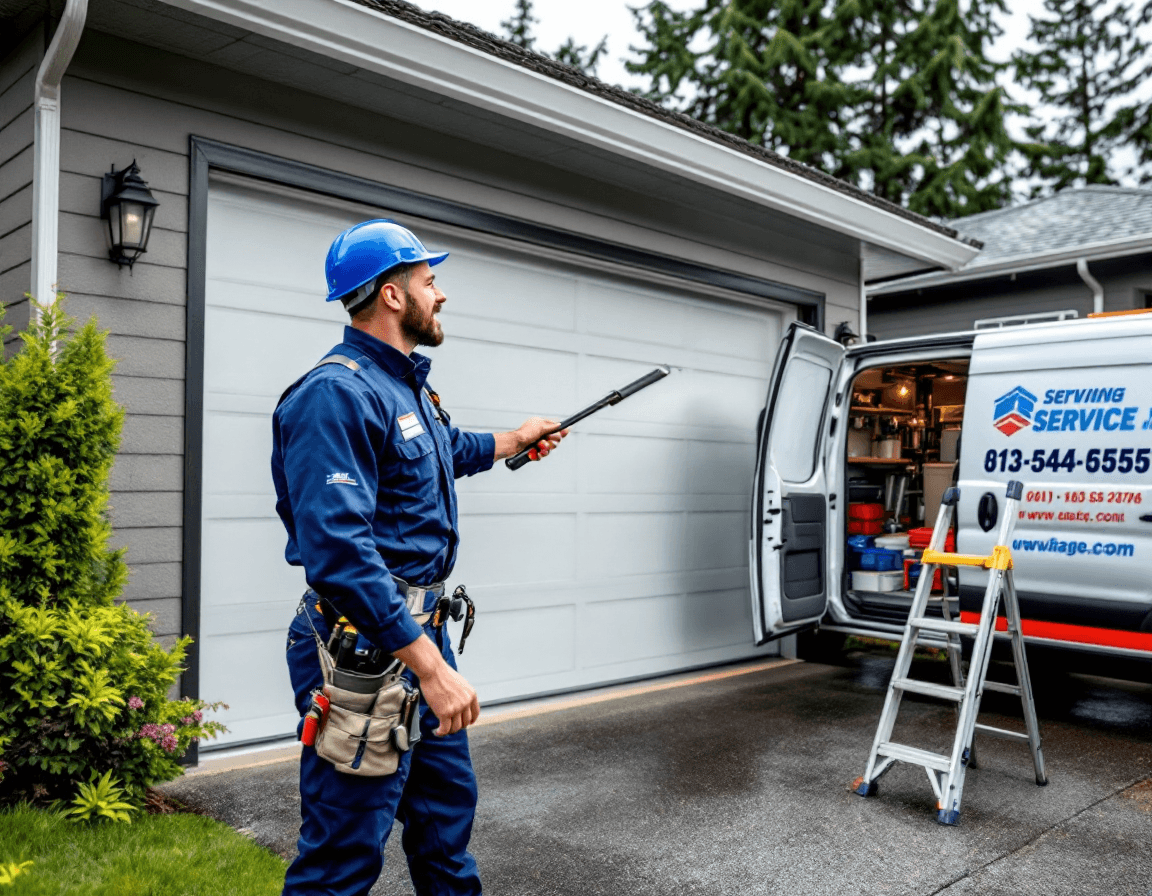
Garage door trouble in Auburn rarely waits for a convenient day. A door that stops halfway up on a wet Tuesday morning turns a quick commute into a scramble through the side entrance, and a door that won't close at night leaves the car and everything stored inside exposed. Auburn sits in the Green River valley, with the hills rising toward Lea Hill and Lakeland Hills on the east side, so local homes deal with valley dampness, clay soils that shift after heavy rain, and long gray stretches that slowly wear on hardware. Our technicians see the same handful of problems again and again, and most of them start as small changes that homeowners notice and then set aside.
This page is written for Auburn homeowners who want to understand what their door is telling them before they pick up the phone. We cover the symptoms that come up most often: a door that won't open or close, one that reverses before reaching the floor, loud grinding or banging, uneven or crooked travel, a door stuck halfway, remote or wall button failures, doors that drop too quickly, and visible sagging or a panel knocked off its track. For each one, we explain the usual causes and what a repair typically involves. Most residential repairs in our service area fall between $95 and $450, with the final number depending on the parts needed and the labor involved.
Nothing here is meant to turn you into a do-it-yourself spring technician. Torsion springs and lift cables store enough force to cause serious injury, and they belong in the hands of a licensed professional. Where a simple check is safe, such as clearing an obstruction or confirming the opener has power, we point it out. If you are unsure what you are seeing or hearing, call (888) 799-3819 and describe the symptoms, and we will help you decide what needs attention first.
Valley Damp, Hill Wind, and What the Weather Does to Steel
Auburn's climate is mild by most national standards, but it is persistent. From late fall into early spring, the valley often sees steady drizzle and low cloud, and humidity hangs around even on days when the rain pauses. Moisture finds its way into every metal joint on a garage door, and once it does, the damage is slow but steady. Rollers, hinge pivots, and bearing plates tend to suffer first, especially on doors that sit close to the driveway where spray and runoff collect.
Temperature swings matter too. Cool mornings followed by milder afternoons cause metal to contract and expand, which subtly changes how snugly a door fits its tracks. Summer brings its own issues: a panel that has baked in the sun can run differently from one in the shade, and a lubricant that worked fine in February can turn sticky by August. Homes on the slopes near Lea Hill and Lakeland Hills can also catch more wind off the hills, and that steady pressure on tall panels can loosen track brackets over the years.
The practical takeaway is that most weather-related problems respond well to routine attention. Wipe down tracks a couple of times a year, check rollers after a particularly wet season, and inspect the bottom weatherstripping for cracks or flattening. If you notice rust blooming along hinges or a musty smell near the door bottom, schedule an inspection instead of waiting for the door to make the problem obvious.
Early Warnings: The Small Changes That Come Before a Breakdown
Most garage doors do not fail without notice. They give off subtle signals for weeks or months, such as a slightly slower opening speed, a new hitch at the midpoint of travel, or a faint squeak that shows up only on cold mornings. Households tend to adjust to these changes without realizing the door is changing with them. That adaptation is exactly why a minor issue can turn into an emergency call when the door finally sticks open before a school run.
Pay close attention to the opener as well. If the motor runs noticeably longer than usual before the door begins to move, the door may be binding or the drive system may be struggling. A light that flickers when the door starts, or a remote that needs several presses before it responds, can point toward electrical or signal problems rather than mechanical ones. Both categories are easier to fix when they are caught early.
Here are a few changes worth noting before they escalate:
- The door pauses or jerks at the same spot each time it opens or closes
- The motor hums but the door moves slowly, or barely moves at all
- Light leaks around the bottom seal when the door is fully closed
- One panel sits slightly out of line with its neighbors when viewed from the driveway
Catching these early usually means a simpler, lower-cost repair. A roller swap or a track adjustment is far less disruptive than a rushed visit when the door is stuck open and the car is trapped inside. Keep a short note of what you notice and when it happens, because details like "only on cold mornings" or "only when the car is parked close" help a technician narrow the cause much faster.
When the Door Turns Around Before It Reaches the Floor
Reversing before the door touches the ground is one of the most common complaints we hear, and it is almost always a safety feature doing its job. Most openers use photo-eye sensors mounted a few inches above the floor on either side of the opening. If the beam between them is interrupted or misaligned, the opener assumes something is in the path and sends the door back up. These sensors are sensitive, which is good for safety but frustrating when the cause is a dusty lens or a bracket knocked out of position.
Start with the simplest checks. Look for a steady light on each sensor, wipe the lenses with a soft dry cloth, and make sure nothing is stored along the floor line that could block the beam. Sun glare through a side window or a low-angle afternoon light can also confuse the sensors in some layouts, so check whether the reversing happens only at certain times of day. Wiring staples that have loosened and pinched a sensor wire are another frequent culprit, particularly in older Auburn garages where cables have been moved over the years.
If the sensors look clean and aligned, the door itself may be creating resistance that the opener reads as an obstruction. A door that feels heavy, a track that has shifted, or a balance that has drifted can all trigger force-based reversing. Avoid forcing the door manually or repeatedly pressing the button to override it, since that can strain the opener and make the underlying problem harder to diagnose. A technician can test both the sensor function and the force settings to find the real source.
Grinding, Squealing, and Banging: Decoding the Noise
Every sound your garage door makes is a clue, though it can take some practice to tell them apart. A high-pitched squeal usually comes from metal parts running without enough lubrication, such as hinge pivots or steel rollers. Deep grinding tends to originate from the opener head itself, often pointing to worn gears or a trolley that has lost its smooth travel. Banging is typically a sign of something loose, like a track bolt, a stop bracket, or a panel that is striking the track with each cycle.
Here are the noises we hear most often and what they commonly indicate:
- High-pitched squeal during travel: dry or worn rollers, or friction at the hinge points
- Deep grinding from the opener head: worn drive components or a trolley needing service
- Sharp bang at the top or bottom of travel: loose track bolts or worn door stops
- Rattling that changes with wind or with the door's speed: loose brackets or track braces
Do not start tightening random bolts while you are unsure what is happening. Some fasteners sit close to components under tension, and a careless adjustment can make things worse. If the noise comes with a visibly frayed cable, a gap in a spring coil, or a door that suddenly drops, stop using the door and keep everyone clear of the opening. A calm inspection is far safer than trying to find the source of a loud bang while the door is still in motion.
Crooked Travel, Sagging Panels, and a Door Knocked Off Track
A door that rises unevenly often has a problem on one side that the other side does not share. Common causes include a roller that has worn unevenly, a track that has drifted out of plumb, or a cable that has slipped on one drum. Homes built on clay soils, which are common in parts of King County, can experience gradual settling that leaves a garage floor slightly out of level. Over time, that change can pull a track slightly off its intended path, and the door begins to lean or lag.
Sagging panels and visible gaps are another category worth paying attention to. When a section hinge loosens or cracks, one panel can drop lower than the rest and leave a strip of daylight along the top or bottom edge. Gaps can also form when the door frame has shifted or the weatherstripping has pulled away from the panels. Both situations affect insulation, pest exclusion, and security, and they often worsen quietly until the difference becomes obvious from the street.
A door that has come completely off its track is a different situation altogether. This can happen after a vehicle bump, a roller that jumps out of its channel, or a cable that slips from its drum. Do not try to pry the door back into place by hand or lift it with the opener while it is off track. The weight and tension involved can cause serious injury, and forcing the door can damage the track, the rollers, or the opener. Keep the door closed if possible, keep people and pets away from it, and call a licensed technician to realign it safely.
Remote and Wall Button Failures: Checking the Signal Chain
When the remote or wall button does nothing, the first question is which component has stopped talking to the opener. A remote that works from the driveway but not from inside the garage may simply need a fresh battery, since many remotes lose range gradually before they fail entirely. A wall button that works while a remote does not usually points to a signal or programming issue. If both fail, the opener itself or its power supply deserves a closer look.
After a power outage, some openers can lose synchronization with their remotes, particularly systems that use rolling codes. Check the opener's indicator lights and the power switch on the unit before assuming the worst. Make sure the wall control wire is not pinched or damaged where it runs along the wall or ceiling. Many homeowners forget that a garage door opener typically has a learn or program button on the motor housing, and a brief re-sync can fix problems that look severe.
Here are the simplest steps to try before calling for service:
- Replace the remote battery and test it while standing close to the opener
- Test the wall button to determine whether the problem is the remote or the opener
- Check the opener's lights after any recent power interruption
- Make sure the wall button wire has not been damaged or disconnected behind the wall plate
Electronic issues can be fiddly, and some of them are not worth troubleshooting for hours. If a control board has failed or the opener is very old, replacement may be more practical than repair. A technician can compare the cost of a control or board repair against the cost of a newer opener and walk you through both options honestly.
Why a Door Slams Shut Too Fast
A door that drops quickly and hits the floor with a jolt is alarming, and it deserves prompt attention. The usual causes include a problem with the spring tension, a cable that is not properly balanced, or down-limit and force settings on the opener that have drifted from their original position. Some of these issues are adjustments an informed homeowner can make by following the opener manual, while others involve high-tension components that should never be handled without professional training.
Worn or broken springs are a particularly important cause. A door that has lost its balance may fall rapidly, lean to one side, or refuse to stay in place when partly raised. A technician will typically