
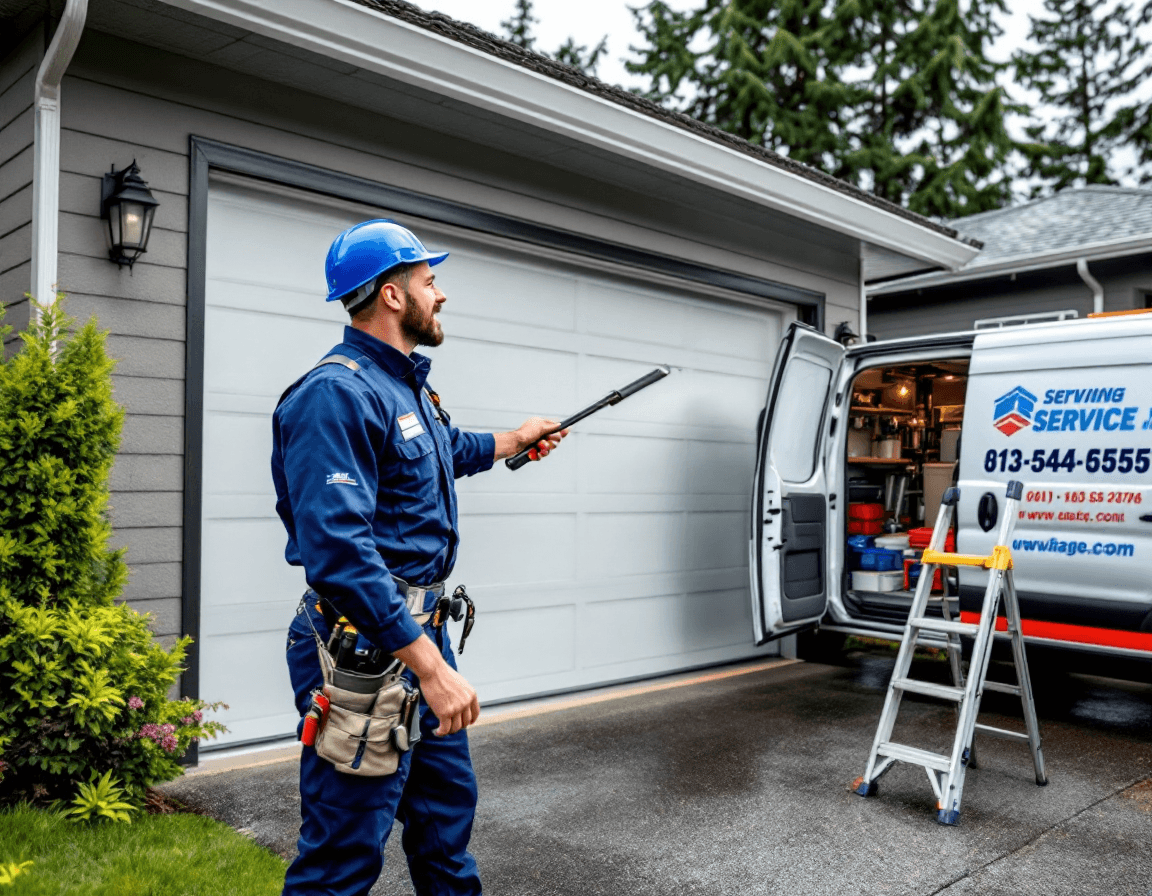
Garage door repair in Algona, WA is rarely a convenience problem. When the door sticks halfway up with the car inside, or the remote quits the morning you need to leave for work, the garage becomes the only entrance that matters. Algona sits in the Green River valley, where damp winters, cool nights, and the occasional hard frost put steady stress on the mechanical parts that lift your door. Our technicians serve homes across the city and the surrounding King County neighborhoods, and we respond quickly when a door won't open, won't close, or won't move smoothly.
This page explains what tends to go wrong with residential doors in and around Algona, how to tell a simple fix from a serious safety issue, and what a typical repair visit looks like. Most residential repairs we handle fall within a range of $95 to $450, depending on the part involved and the amount of labor. The exact figure depends on your door's make, size, and condition, and we give you a clear explanation before any work begins. You should never have to guess what a visit will cost.
Whether your door is a twelve-year-old steel sectional or a newer insulated model, the principles are the same. Panels, rollers, tracks, openers, and safety sensors all have to work together. When one piece fails, the others often show signs of strain first. Reading those signs early can save you a larger bill later, and it can also keep you away from the most dangerous part of the system, the spring assembly.
Why Algona Doors Feel the Pacific Northwest Climate
Western Washington's wet season is hard on steel and wood alike. Rain, fog, and high humidity from October through April seep into hinges, roller bearings, and the bottom seal, and that moisture accelerates rust on exposed hardware. Algona's cooler evenings also cause metal to expand and contract during daily temperature swings, which can loosen fasteners that were tight in July. Over several seasons, these small movements shift tracks out of alignment by fractions of an inch, and that is often enough to make a door bind or run crooked.
The valley floor also means some properties hold moisture longer than homes on higher ground. Garages with poor ventilation can develop condensation on the inside of the door panels, and that trapped moisture rots wood frames and corrodes the bottom brackets. If you notice white crust on the tracks or a musty smell when the door opens, the humidity inside the garage is probably working against your hardware. Adding a dehumidifier or improving airflow can slow this down considerably.
Summer brings its own issues. Long dry stretches followed by warm afternoons can make weatherstripping brittle, and the rubber bottom seal may crack or pull away from the panel. A cracked seal rarely stops the door from working, but it lets cold air, leaves, and pests under the door, and it can throw off the close-and-reverse sensing if debris builds up on the photo-eye sensors near the floor.
Door Reverses Before It Reaches the Floor
One of the most common calls we receive is a door that goes down, makes it most of the way, and then springs back up. This behavior is intentional. Modern openers are built with a safety reversal system that stops and reverses the door when it detects an obstruction, and that system has two main triggers: the photo-eye sensors mounted about six inches off the floor on either side of the opening, and the force sensing built into the opener itself.
When the reversal happens for no visible reason, the most likely culprit is a sensor problem. Sensors that have been knocked out of alignment by a bumped trash can, a misplaced bike, or a shifted bracket will stop seeing each other, and the opener reads that as an obstacle. Check that both sensor lenses are clean and that the small indicator lights on each unit are steady rather than blinking. Wiring damaged by rodents is also a frequent problem in older Algona garages, especially where cables run along the wall near stored bags of feed, pet food, or firewood.
If the sensors look fine but the door still reverses, the opener's down-force setting may be too sensitive, or the door may be binding somewhere along its travel. A door that drags on one side or sits unevenly on its rollers can trigger the same reversal, even when nothing is in the path. Do not keep forcing the door through repeated attempts, because that strain can damage the opener's gearbox or bend the track. A technician can test the sensors, adjust the force settings, and check for binding in about the same time it takes to explain the problem.
Loud Grinding, Squealing, and Banging
Noise is the way a garage door tells you something is wearing out. A high-pitched squeal usually points to dry or worn rollers and hinges. Grinding often means the opener's drive gear or chain is worn, or that a roller has a damaged bearing. A loud bang when the door reaches the top or bottom of its travel can come from a loose bracket, a worn stop, or a track that has shifted and no longer sits flush against the rollers.
Homeowners sometimes assume that a spray lubricant will cure everything. Silicone-based lubricant suits rollers and hinges well, but it should be applied sparingly, and the track itself should never be greased heavily. Thick grease collects dirt and grit, which then grinds against the rollers and makes the noise worse. Wipe the track clean, apply a light coat to the rollers, and avoid spraying the opener's chain or belt unless the manufacturer's instructions call for it.
Banging deserves attention rather than a quick fix. A door that thumps when it closes may have a worn bottom bracket or a roller that has come partway off its track, and continued operation can crack a panel or pull a bracket free. If you hear a sharp crack from the top of the door, stop using it and call for service. A hairline fracture in a spring or a sudden shift in the door's weight is not something to test by repeatedly opening and closing the door.
Door Moves Unevenly, Looks Crooked, or Sits Off Track
A door that rises at an angle or stops with one side higher than the other is telling you that the lifting force is not balanced. In most residential systems, the torsion or extension springs, the cables, and the drums must all share the load evenly. When one cable slips off its drum, one spring loses tension, or a roller has seized, the door will lean. Left alone, the uneven load can bend the track, strip the opener, or cause the door to fall suddenly.
Here is a quick way to check for basic unevenness without touching any spring or cable. Close the door and look at the bottom edge from inside the garage. If the gap at one end is noticeably larger than the other, or if the top section sits lower than the rest, the door may be out of square. Watch the tracks as the door travels. Any visible bowing, gaps where the track meets the wall, or rollers pulling away from the track are signs that the hardware needs professional alignment.
The fix for a crooked door almost always involves the springs and cables, which is precisely why it should be left to a licensed technician. Torsion springs store enormous energy even when they look still, and a cable under tension can cause serious injury if it snaps or unwinds during adjustment. A certified service technician can measure the spring tension, replace a broken component, and re-level the door with the proper tools and safety procedures.
Stuck Halfway, Jammed, or Refusing to Move
A door that stops halfway and will not move in either direction is a frustrating situation, especially when you need to get a car out. Before calling, check for an obvious obstruction along the track, such as a loose item stored on a shelf that has slid into the door's path, or a bicycle hanging from a hook that touches the panels. If the path is clear, the cause is usually mechanical. The opener may have lost power, the release cord may have been pulled, a cable may have come off its drum, or the springs may have broken.
Many Algona homeowners pull the emergency release cord to open the door manually, and that is a reasonable step if the door is otherwise intact. Pull the red cord once and carefully lift the door by hand. Then stop. Lift the door only as high as it will go easily and never try to force a door that feels heavy or uneven. A door that will not budge by hand, or that drops sharply when you release it, likely has a broken spring or a damaged cable, and both situations call for a technician.
Broken springs are one of the most common reasons a door becomes stuck, and they are also among the most hazardous repair jobs in the home. A residential spring can hold hundreds of pounds of force, and it can release that energy with a loud bang and enough violence to cause serious injury. For this reason, we always recommend licensed, bonded, and insured professionals handle spring replacement, cable repair, and any work involving tension. Please do not attempt to remove or adjust a spring yourself, no matter how many videos you have watched.
Remote or Wall Button Does Nothing
When the remote and the wall button both fail, the problem is often simpler than it looks. Start with the remote itself. Replace the battery, then press the button while standing near the opener, not at the far end of the driveway. Check whether the opener's indicator light flashes when you press the button. If it does, the remote is sending a signal, and the issue may be a programming problem or a worn antenna wire.
Wall buttons have their own failure points. The wiring that runs from the button to the opener can be pinched, chewed, or cut, especially in garages where cables run along exposed framing. Look for the small lock or safety symbol on the wall control, since some openers disable the button when a lock feature is switched on. If the button and remote both fail but the opener's light still works, the problem may be in the logic board or the power supply, and that requires a technician with the right diagnostic equipment.
Power is the other part of the puzzle. Confirm that the opener is plugged in securely and that the outlet has power, and check the breaker panel if the garage circuit has tripped. Some Algona homes use GFCI outlets in the garage, which can trip after moisture exposure during a wet week. Resetting the GFCI may restore function immediately, but repeated tripping suggests a fault that should be investigated before it becomes a hazard.
Door Slams Shut Too Fast
A door that drops quickly and hits the floor with a hard thud is more than an annoyance. It stresses the bottom seal, the rollers, and the opener, and it can injure a child, a pet, or a person who is walking under the door. Fast closing usually comes from a force or speed setting that has drifted out of range, a worn or damaged drive component, or a spring that has lost tension and no longer counterbalances the door's weight the way it should.
Most openers include adjustable close-force and close-speed controls. These settings are typically found on the opener's control panel or in the wall control's programming menu, and the manual will show the correct procedure for your model. Adjust the force in small increments and test the door after each change, because a setting that is too strong can keep the sensors from detecting an obstruction at all. If you are unsure of the right setting, a technician can calibrate it and verify that the reversal system responds correctly.
A door that drops suddenly after moving smoothly for years may have a weakened spring, which is a job for a licensed professional. A door that feels heavy when you lift it by hand, or that sags at the top of its travel, is also a sign of spring fatigue. Because spring work carries serious risk, please leave any tension adjustment or replacement to a certified technician.
Visible Gaps, Sagging Panels, and Weather Damage
Gaps around a garage door are more than an aesthetic issue. They let water, cold air, and pests into the garage, and they can make the space above the door harder to heat and dry. Gaps often appear at the bottom, where the seal has hardened or torn, and along the sides, where the stop molding or weatherstripping has pulled loose. A door that sags visibly in the middle may have a panel that has bent or a section that has separated from its neighbors, and that deserves prompt attention.
Check the bottom seal from inside the garage on a dry day, looking for light coming through the gap and for cracks or flat spots in the rubber. Run your hand along the side seals as well. If the seal is intact but still leaves a gap, the door may be out of level, and fixing the seal alone will not solve the problem. Persistent gaps can also reflect worn hinges or rollers that have let the panels drift apart.
Sagging and panel damage often start after a bump from a vehicle, a fallen branch during a windstorm, or the gradual loss of spring tension over many years. Panel replacement is possible for many models, though matching older panels can be difficult, and some manufacturers no longer produce the exact profile. A technician can assess whether a single panel can be replaced or whether the door has reached the point where a full replacement is more practical.
Door Off Its Tracks
When a door comes off its tracks, the first step is to stop operating it. Do not try to push the door back in place while it is still under tension, and do not attempt to lift a door that has come partway off its track by yourself. A door off track can shift unexpectedly and cause crushing injuries, and the springs may still be loaded. Keep children and pets clear of the area and call for service.
Off-track situations usually come from one of a few causes. A roller may have worn out and split, a track bracket may have loosened from the wall, the track may have been bent by a vehicle or by repeated impact, or the cable may have slipped from the drum. In every case, the repair requires the technician to release the tension safely, reposition the door, replace damaged parts, and re-test the balance before normal use resumes.
Prevention helps. Once a year, inspect the track for dents, check that the bolts holding it to the wall and ceiling are tight, and look at the rollers for cracks or flat spots. Listen for new sounds during operation and watch the door's movement for any tilt or hesitation. Catching a loose bracket early keeps a small repair from becoming a much more expensive one.
Local Repair Scenarios We See Around Algona
Repair needs in Algona often follow the rhythm of daily life in the Pacific Algona corridor. Commuters heading toward the highway and nearby employment centers depend on their garages to start the day, so a door that jams at 6:30 in the morning becomes an urgent call. Families with teenagers who come and go at odd hours tend to run their doors more often, which wears out rollers and openers faster than a typical single-car household. Homes near busy roads may also see more vibration, and that vibration can loosen brackets over time.
Many Algona homes have detached or semi-attached garages, older door styles, or openers installed during an earlier decade that may lack newer safety features. Older openers sometimes require a retrofit to meet current safety expectations, and a technician can explain whether an upgrade is practical. If your home has a steel door with a wood frame, the frame may need attention alongside the door itself, especially if moisture has crept into the header or side jambs during wet seasons.
Our technicians work throughout Algona and the surrounding area, including ZIP codes 98001 and 98047. Whether your door is near Algona Blvd or tucked into a quieter neighborhood, we aim to arrive prepared with common parts and the diagnostic tools needed to resolve most residential issues on the first visit. If a part must be ordered, we will tell you what to expect before scheduling the return visit.
What a Professional Repair Visit Looks Like
A good service visit begins with questions. We will ask when the problem started, whether it happens every time or only sometimes, and whether you have noticed noise, gaps, or changes in how the door moves. We then inspect the door, the tracks, the springs, the cables, the rollers, the hinges, the opener, the sensors, and the wiring. This full-system look prevents us from fixing one symptom while missing the real cause.
Once the problem is identified, we explain the options in plain language. For most residential repairs, the total falls between $95 and $450, depending on the parts required and the labor involved. Simple sensor realignments, roller replacements, and opener adjustments tend to sit at the lower end of that range, while spring replacements, cable repairs, panel replacements, and opener component swaps usually land higher. We will confirm the cost before any work begins, and you are free to ask questions or take time to decide.
Safety runs through every step. Our technicians are licensed, bonded, and insured, and they follow proper procedures when working with springs and cables. We recommend that all spring and cable work be handled by a licensed professional rather than attempted by homeowners, because the stored energy in these components can cause serious injury even when the door appears to be at rest. After the repair, the technician will test the door through several full cycles and verify that the safety reversal system works correctly.
Protecting Your Garage Door Between Service Calls
Routine care reduces the number of emergency calls you will need. Keep the tracks and rollers clean, wipe away debris from the bottom of the door, and check that the sensor lenses are free of dust and cobwebs. Test the auto-reverse feature every month by placing a flat object, such as a piece of wood, in the door's path and confirming that the door stops and reverses. Replace the remote batteries annually, and keep spare batteries in a drawer where you will remember them.
Seasonal habits matter in the Pacific Northwest. In late fall, check the bottom seal and weatherstripping before the wettest months arrive, and improve garage ventilation if condensation is a recurring problem. In spring, look over the tracks and brackets after the damp season, since winter moisture can loosen fasteners. In summer, clear away anything stored near the door that could be knocked into the path or that could trap heat and humidity.
Finally, pay attention to changes. A door that once ran quietly and now sounds rough, a door that takes longer to close, or a door that pauses partway through its travel is giving you early warning. Scheduling a inspection when you first notice these signs usually costs less than waiting for a breakdown. Our team is glad to take a look and give you an honest assessment.
If your garage door won't open, won't close, reverses on its own, makes grinding or banging noises, sits crooked, or has come off its tracks, call Seattle Garage Door Fix today at (888) 799-3819. Our licensed, bonded, and insured technicians serve Algona and the surrounding King County communities, and we will explain your options clearly before any work begins. Please avoid working on springs or cables yourself, and let a professional restore your door safely and reliably.