
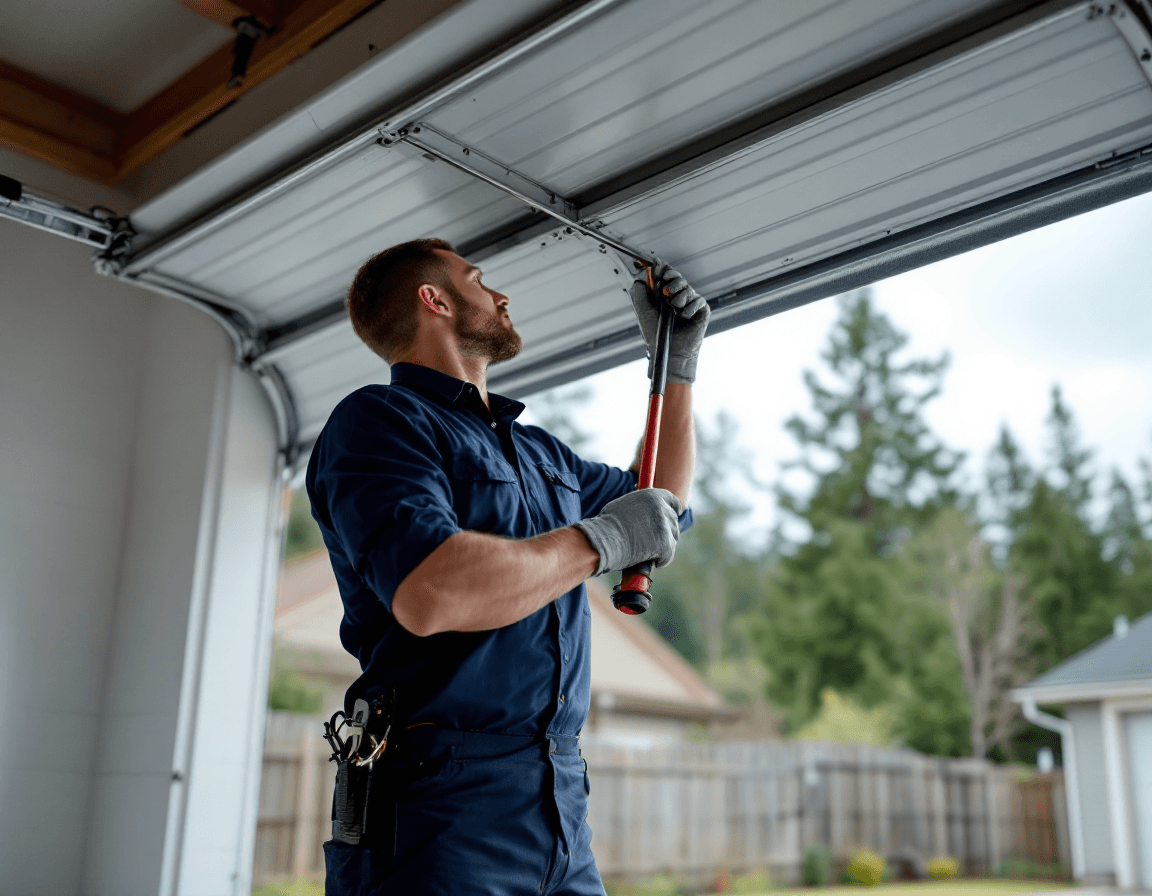
Garage Door Spring Replacement in Algona, WA is one of the most common repairs we handle for homeowners along Algona Boulevard and the Pacific Algona corridor, and it is also one of the most dangerous jobs to attempt yourself. The springs carry most of the weight of your door, often between 100 and 150 pounds on a typical residential panel, so when one fails it can change the door's behavior in seconds. Many Algona households first notice the problem when the door suddenly will not lift, or when a loud crack echoes through the house in the early morning. Understanding what the spring does and why it fails will help you decide what to do next.
Algona sits in the Green River valley, where damp winters and mild summers are the norm rather than the exception. Garages here often hold more than cars: bikes, tools, recycling bins, and sometimes a second refrigerator all add load to the same aging hardware. Many homes in the area have garage doors that have been in place for fifteen or twenty years, and the springs on those doors have quietly completed thousands of open-and-close cycles. Our technicians see that wear pattern regularly, and it is why a spring that held for years can suddenly give out on a cold morning. The sections below explain what to watch for, how the repair is handled, and what separates a quality spring replacement from a rushed one.
Why Algona Garages Put Springs Under Real Pressure
The springs on your garage door exist to counterbalance the door's weight, which means they do the heavy lifting so your opener does not have to. Algona homes tend to have a mix of single-car and double-car doors, and many were built with heavier steel or insulated panels that add considerable mass. Over time, the metal inside each spring fatigues from repeated tension and release, and that fatigue is accelerated by temperature swings. A spring that has been exposed to cold mornings and warm afternoons flexes more than one kept in a stable environment.
Moisture is the second major factor in our region. Pacific Northwest winters bring long stretches of drizzle, and garages that are not fully sealed at the floor or along the sides let humidity settle on the hardware. Surface rust on a torsion spring may look harmless, but it creates tiny stress points that can grow into cracks over successive cycles. We often find that springs in damp, poorly ventilated garages fail sooner than similar springs on drier properties.
Usage matters too. A household that leaves for work and returns in the evening may cycle the door four to six times a day, which adds up quickly. Standard springs are commonly rated for around 10,000 cycles, and a busy family can reach that number within a handful of years. Knowing how often your door moves helps explain why a spring that seemed fine last winter may be nearing the end of its useful life now.
Reading the Warning Signs Before a Spring Lets Go
Springs rarely fail without giving some indication first, and the earliest clues are often subtle. Homeowners sometimes write off a slightly noisy door or a jerky start as normal aging, when in fact the spring is losing its ability to hold tension evenly. Paying attention to how the door behaves at the start and end of its travel can reveal a lot. A door that struggles only at the very beginning of its lift, for example, often points to a spring that has lost some of its strength.
Several symptoms are worth taking seriously. If you notice any of the following, schedule an inspection before the spring breaks completely:
- The door feels noticeably heavier when lifted by hand, or the opener seems to labor more than it used to
- A visible gap or separation appears in the coils of a torsion spring, often near the center of the shaft
- The door opens a few inches, stops, and then needs a push or a second attempt to continue
- The opener strains or hums loudly, but the door barely moves or does not move at all
- The door closes faster than normal, drops hard onto the floor, or sits crooked in its track
Any one of these signs deserves attention, and some combinations are especially urgent. A door that is crooked and closes unevenly may have a spring that is no longer matched to its partner, which places stress on the cables and drums. A door that refuses to lift at all after a loud event should be treated as a potential safety issue, and the area beneath it should be kept clear until a technician arrives.
The Loud Bang and What It Usually Means
Many Algona homeowners describe the same moment: a sharp bang from the garage that sounds like a gunshot or a heavy piece of metal dropping. That sound is typically a torsion spring breaking under tension, and it often happens when the door is closed or during the first movement of the day. The noise can be startling enough that people assume something has crashed into the door from outside. Once you hear that sound, the best thing to do is stay clear of the door, keep children and pets away, and avoid trying to open it manually.
After a break, the door may still look intact, but it no longer has the balance it needs. The opener might move the door partway, or the door may refuse to move entirely because the remaining spring cannot overcome the weight alone. Some homeowners attempt to lift the door by hand and find it suddenly heavy or unpredictable, which is exactly why this situation calls for professional help. The broken spring stores tension that can release unexpectedly, and the cables may also be under strain.
It is also common to find a broken spring with a visible gap in the coil, sometimes with the two ends pulled apart by several inches. Sometimes a second spring on the same shaft has been carrying extra load and is also weakened, which is why we recommend replacing springs in pairs in most cases. Replacing only the broken one can leave the door unbalanced, and the surviving spring may fail within months. A thorough inspection after a break protects both your investment and your household.
Torsion Versus Extension Springs: Matching the Right System
Garage doors in Algona use one of two main spring systems, and identifying which one you have shapes the entire repair. Torsion springs are mounted on a metal shaft above the door opening, usually just above the header. They wind and unwind around that shaft and deliver lifting force through a drum and cable arrangement. Torsion systems are generally considered the safer and more durable option for residential doors, and they are common on newer installations throughout the region.
Extension springs run along the horizontal tracks on either side of the door, stretching and contracting as the door moves. You can often spot them by the long metal tubes or cables running parallel to the track above the door. Extension systems are typically found on older homes and on some lighter doors, and they carry their own safety considerations because the springs can fly if they break. When an extension spring fails, the sudden release of tension can be forceful, so these repairs require careful handling and the right safety cables.
Replacing a spring with the wrong type is not an option, and the two systems are not interchangeable. Our technicians measure the door's weight, height, track configuration, and existing hardware before recommending a replacement. That assessment prevents mismatches that could leave your door under-powered or overstressed. It also determines whether the job is a straightforward swap or one that needs additional hardware, such as new drums, cables, or bearings.
High-Cycle Springs and When They Pay Off
Standard springs serve most households well, but high-cycle springs offer a meaningful upgrade for families who use their garage door heavily. These springs are manufactured with materials and winding processes designed to tolerate more cycles before fatigue sets in, and they are commonly rated for substantially higher cycle counts than standard options. For a household with teenagers coming and going, a home business that uses the garage daily, or a property where the door opens several times an hour, a high-cycle setup can extend the time between replacements considerably.
The tradeoff is cost. High-cycle springs carry a higher upfront price, so the decision should reflect how your household actually uses the door. If you open the door a few times a week and rarely use it at night, a standard spring may be a perfectly sensible choice. If your door is a daily workhorse, or if you have already replaced springs more than once in a short period, a high-cycle upgrade can reduce long-term disruption and expense.
When we discuss options, we look at your usage patterns, the weight of the door, and the condition of the rest of the hardware. A high-cycle spring on a door with worn rollers or a damaged track will not perform as intended, so we often address those components at the same visit. Our goal is to recommend what makes sense for your home, not to push the most expensive option regardless of need.
What a Professional Spring Replacement Actually Involves
A proper spring replacement is more than swapping one coil for another. The technician begins by securing the door so it cannot move unexpectedly, then inspects the entire assembly, including the cables, drums, bearings, end brackets, and the opener's connection. Each of those parts affects how the spring performs, and a worn drum or frayed cable can make a brand-new spring feel wrong. Before any tension is touched, the technician confirms the exact spring size and winding specifications needed for your door.
Torsion spring work requires specialized winding bars and careful control of the tension at every step. Winding a spring to the correct number of turns is not a task for guesswork, and an error can lead to injury or a door that will not operate safely. Extension springs require attention to their safety cables and the correct installation of their brackets. In both cases, the technician verifies the work by testing the door's movement through a full cycle and checking that all hardware is seated properly.
Once the springs are installed, the technician reviews the repair with the homeowner, explains what was replaced, and notes any components that may need attention soon. This is also the point where we discuss maintenance, such as lubricating the springs and checking the hardware periodically. Transparency about what was done helps you understand your door and plan for its future care.
Balancing the Door So It Moves Smoothly Again
Balance is the quiet detail that separates a satisfying repair from a frustrating one. A door that is properly balanced will stay roughly in place when you lift it partway, without sliding up or drifting down. When the balance is off, the opener works harder than it should, the door may slam or stall, and the cables can wear unevenly. Even a correctly sized spring can produce poor performance if the tension is not set to match the door's real weight.
Our technicians test balance after installation by disengaging the opener and lifting the door manually to a midway point. If the door holds its position, the balance is good. If it rises or falls on its own, the spring tension is adjusted until the door is neutral. This step matters most on doors that have been repaired after a break, because the surviving spring and the new spring must work together.
Balancing is one of the reasons we strongly advise against attempting spring work yourself. The adjustment requires precision and an understanding of how the door's hardware interacts, and a mistake can put the door in motion without warning. A door that is correctly balanced protects your opener, prolongs the life of your cables, and makes everyday use quieter and safer for the whole household.
Cables, Drums, and the Damage a Break Can Leave Behind
When a torsion spring breaks, the cables attached to the drums often absorb a significant amount of shock. A cable may fray, unwind from its drum, or develop a kink that prevents it from seating correctly. In some cases, the drum itself cracks or loosens on the shaft. These secondary problems are easy to miss if you only look at the spring, and they can cause the new spring to underperform or wear out sooner than expected.
Loose cables are one of the most telling signs of a recent break. If you see cable slack hanging near the drum, or if the cable appears to have come off its groove, the door should not be operated until a technician inspects it. Attempting to reseat a cable yourself can cause the drum to unwind suddenly, which is a serious hazard. Our practice is to check every cable and drum during a spring replacement and replace any component that shows wear or damage.
Some homeowners ask whether they can save money by replacing only the spring. In many cases, a spring replacement is the right time to address worn cables or drums, because the labor overlaps and the door is already partially disassembled. Ignoring these parts can lead to a second failure within a short period, so a thorough inspection is a sensible investment.
Understanding the Cost Range for Spring Replacement
For most spring replacements, pricing in the range of $180 to $450 is typical, though the final figure depends on the details of your door. The type of spring, whether it is standard or high-cycle, the number of springs being replaced, and the condition of the cables and drums all influence the total. A single extension spring on a light door will fall at a different point than a pair of heavy torsion springs on a double-car door with worn hardware. We provide a clear estimate after inspection so you know what to expect before work begins.
Several factors commonly affect the final quote. Homeowners who want to upgrade to high-cycle springs should expect a higher price than standard replacements. Doors that require additional hardware, such as new drums, cables, or bearings, will also cost more. Access and layout can play a role as well, since some garages make it more involved to reach the shaft or the track. We aim to explain each line item so the estimate is easy to understand.
- Spring type: standard torsion, high-cycle torsion, or extension
- Number of springs replaced, often in pairs for balance
- Door size and weight, including insulated or heavy steel panels
- Condition of cables, drums, bearings, and brackets
- Whether a balance adjustment and full system test are included
Keeping this list in mind when you request a quote can help you compare estimates fairly. A lower price that omits balancing or hardware inspection may not deliver the same result. Ask what is included, and make sure the estimate reflects a complete, safe repair.
Protecting Your Springs Through Seasonal Changes
Caring for your springs does not require expensive equipment, but it does require attention. Once or twice a year, inspect the springs for visible rust, gaps, or flaking, and wipe away grime with a dry cloth. A light lubricant designed for garage door springs can reduce friction and help protect the metal, but avoid spraying it on the door's electrical components or the opener. Never attempt to adjust the tension or loosen any spring hardware, since stored tension can cause serious injury.
Pacific Northwest weather makes seasonal habits especially useful. Keeping the garage ventilated and reducing standing moisture on the floor can slow corrosion on the hardware. If your garage is unheated, consider whether the door's weatherstripping and bottom seal are doing their job, because water intrusion accelerates rust. A door that is kept dry and clean tends to age more gracefully than one left to the elements.
Pay attention to changes in how the door sounds and moves over time. A new squeak, a slight hitch at the start of the lift, or a door that seems to close more quickly are all reasons to schedule an inspection. Catching a developing problem early often means a simpler and less expensive repair than waiting for a break.
Why Spring Work Belongs in Licensed, Insured Hands
Spring replacement is one of the few garage door tasks where the risks are serious enough to justify professional work every time. The tension stored in a torsion or extension spring is substantial, and an improperly handled spring can cause injury even when the door appears to be at rest. Our technicians are licensed, bonded, and insured, and they follow established safety procedures on every call. We do not recommend that homeowners attempt winding, unwinding, or tension adjustments on their own.
Choosing a qualified company also means getting an honest assessment. A good technician will explain what failed, what needs replacing, and what can wait, rather than pressuring you into unnecessary upgrades. We believe homeowners deserve clear information and a repair that holds up over time. If you are dealing with a broken spring, a door that will not lift, or cables that have come loose, call Seattle Garage Door Fix at (888) 799-3819 to arrange a visit, and we will help you get your Algona garage door moving safely again.