
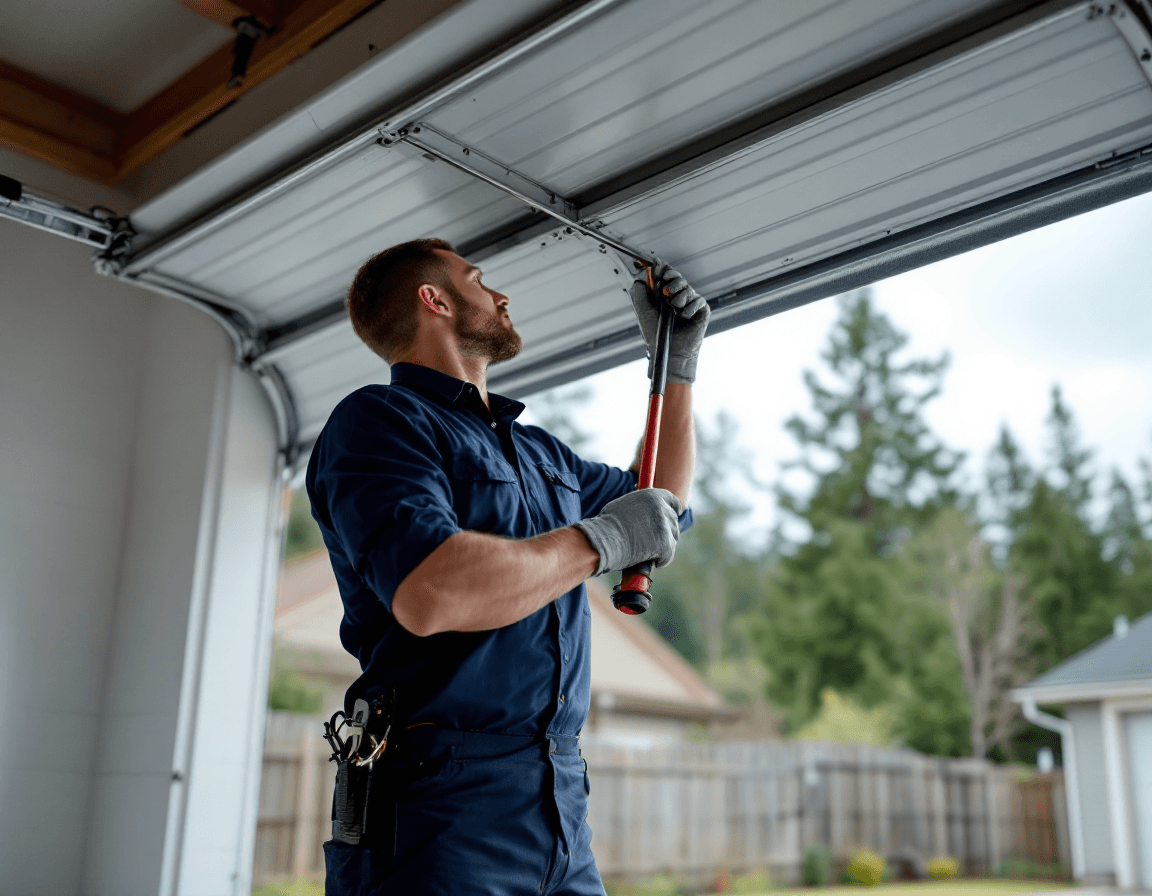
Garage door spring replacement in Milton, WA is one of the most common repairs we handle for homeowners across Pierce County, and it's also one of the most time-sensitive. A spring that has failed leaves a heavy door that can't be lifted safely by hand, and an opener that keeps trying to pull it up can strain itself in the process. Milton's mix of older single-family homes, detached garages, and wet winters means springs here often reach the end of their life without much warning. If your door is stuck, crooked, or making an alarming noise, this page explains what is probably happening and what a proper repair involves.
Spring work is not a do-it-yourself job, and that is the first thing to understand. Torsion springs hold thousands of pounds of tension in a coiled steel bar, and when they release suddenly they can cause serious injury. Extension springs are less dramatic but still store enough energy to cause harm if a cable or safety cable snaps. A licensed, bonded, and insured technician has the right winding bars, tools, and training to release that tension safely, which is why every spring job we perform in Milton is handled by a trained professional.
The information below is written the way a local technician would explain it at your driveway: what the warning signs mean, why the Pacific Northwest climate matters, how spring types differ, what higher-cycle options offer, and what a fair repair cost looks like. Use it to understand your situation before you call, and if anything here sounds like what your garage is doing, call (888) 799-3819 for a visit.
Reading the Warning Signs Your Milton Garage Gives Before a Spring Breaks
Most springs do not fail completely without giving some indication first. Over months or years, the steel loses flexibility, the coils begin to stretch or unwind unevenly, and the door starts to feel heavier on one side than the other. Homeowners often notice that the door takes a little longer to rise, or that the opener seems louder than it used to be. These are early hints, and catching them lets you schedule a repair on your own terms instead of waiting for an emergency.
A common pattern in Milton is a door that rises normally at first and then gets noticeably harder to lift as the day warms or the humidity climbs. That change happens because the metal and lubricant respond to temperature and moisture, which can reveal weakness that was already there. Another early sign is a door that closes faster than it used to, slamming shut with more force than you remember. When you see that behavior, the spring is no longer carrying its share of the load evenly.
Pay attention to the cables as well. Lift cables should wind neatly onto the drum and remain taut when the door is closed. If you see slack, fraying, or a cable that has jumped off its drum, the springs may be struggling to hold tension at all. Any of these signs warrants a closer look, because continued use under a weakened spring can damage the opener, the rollers, and the door panels.
Why Pacific Northwest Winters and Damp Air Wear Springs Down Faster
Western Washington is famous for its drizzle, and that moisture has real consequences for garage hardware. Springs are made of tempered steel that is coated or lubricated to resist rust, but a garage that sits near damp soil, gets wet from driveway runoff, or stays cold and humid through much of the year can see corrosion develop on the coils and winding cones. Rust reduces the effective cross-section of the wire and creates weak points where fatigue can start. Over time, those weak points are where springs commonly fail.
Temperature swings add another layer of stress. A cold January morning can make steel stiffer and more brittle, and a sudden thaw can change how the door moves against its tracks and rollers. Many Milton homes have older garages with uninsulated walls and doors that were never designed for the number of open-and-close cycles a busy family puts on them. Put those factors together and you get a spring that works hard every day in conditions that are hard on metal.
Because of this, we often recommend that Milton homeowners inspect their springs at least once a year, ideally before the wettest months arrive. A technician can check for surface rust, measure the gap between coils, examine the cones and bearing plates, and confirm that the lubrication is still doing its job. A preventive visit costs far less than an emergency call after a snapped spring has damaged the door or the opener.
Telling Apart the Bang, the Gap, and the Stall in Your Own Garage
Each common spring symptom points to a slightly different problem, and understanding them helps you describe the issue accurately when you call. A loud bang from the garage, often compared to a gunshot or a heavy bolt dropping on concrete, usually means a spring has broken and released its tension. The door may still be in place, but it will no longer be balanced, and it can be dangerous to operate.
A visible gap in the torsion spring coil is a strong sign the spring has failed even if the door still moves. Look along the bar above the door when it is closed, and check for a space where the coils should be tightly stacked. If you find one, the spring has separated and should not be used. Do not try to adjust or tighten it yourself.
A door that opens a few inches and then stops is often caused by a broken spring, a cable that has come loose, or an imbalance that has pushed the opener past its limits. Some homeowners hear the opener strain or hum without the door moving much at all. That noise is the opener working hard against a load it cannot lift, and continued attempts can burn out the motor or strip gears. Cables that have come loose after a spring break need to be re-seated and inspected, because the drum and cable may have been damaged in the event.
Torsion Versus Extension Springs: Knowing Which One Your Door Uses
Most residential garage doors in the Milton area use either torsion springs or extension springs, and knowing which type you have affects the repair. Torsion springs mount on a steel bar above the door opening and wind up to create lifting force. They are generally considered the safer and smoother system for most homes, and they tend to last longer when properly maintained. Extension springs run along the horizontal tracks on each side of the door and stretch as the door opens. They are common on older doors and on lighter doors that do not need as much force.
Identifying your spring type is straightforward. If there is a single long bar across the top of the door with cones on each end, you have torsion springs. If there are springs stretched along the horizontal tracks with cables running beside them, you have extension springs. Some doors have a mix, and older installations sometimes have a configuration that was adapted over the years, so a technician should confirm the setup before any parts are ordered.
It matters because the replacement must match the original design, the door weight, and the cycle rating. Installing the wrong spring can leave the door out of balance, overload the opener, or create a hazard. That is why we measure, identify the specifications, and confirm the fit before replacing anything, rather than guessing from the size of the broken part alone.
High-Cycle Springs and What the Upgrade Actually Buys You
Springs are rated by cycles, meaning one full open and close counts as one cycle. Standard residential torsion springs are commonly rated for around 10,000 cycles, which works out to many years for a household that uses the garage a few times a day. High-cycle springs are built with heavier wire or specialized processing and are commonly offered with ratings well above the standard figure. For households that open the door frequently, run a home business from the garage, or simply want more margin before the next failure, that extra rating can be worth considering.
It is important to understand what a high-cycle spring does and does not do. It does not make a door lighter, and it does not fix a door that is out of balance or has worn rollers, hinges, or cables. It simply offers a longer service life under repeated use. A high-cycle spring installed on a door with other problems will still struggle, which is why we evaluate the whole system before recommending an upgrade.
Costs vary depending on the spring type, door weight, and the rating you choose. For most standard torsion spring replacements, our range is $180 to $450, and high-cycle options generally fall at the upper end of that range or above it depending on the parts involved. We will explain the difference during the visit and let you decide, rather than pressuring you toward the most expensive option. Our goal is a repair that is safe, correct, and sized to how your household actually uses the door.
Balance Work: Why Replacing a Spring Is Rarely the Whole Job
A spring replacement does more than swap a broken part. The springs are sized to counterbalance the weight of the door, and when that balance is restored, the door should feel smooth and controlled in both directions. A correctly balanced door should stay roughly in place when you lift it partway by hand and should not slam down or float upward when released. That quality of movement is the real goal of the repair, and it protects the opener and the hardware for years to come.
Balance work usually involves checking the winding tension, inspecting the cables and drums, examining the bearing plates and center bracket, and testing the door's behavior through its full travel. If one side is carrying more load than the other, a technician will adjust the setup so that the door tracks evenly. Crooked closing is a classic symptom of imbalance, and it can also be caused by worn rollers or a bent track, so the technician must look at the entire system instead of assuming the spring alone is responsible.
We treat balance as part of the installation rather than an optional extra. A door that is not balanced puts uneven stress on every component it touches, and the cost of ignoring it often shows up later as a second service call. When you hire us in Milton, you can expect the technician to test the door thoroughly before leaving, confirm the cables are seated correctly, and explain anything that still needs attention.
Safety Rules Every Milton Homeowner Should Follow Around Springs
Spring safety is not optional, and the most important rule is simple: do not attempt to wind, unwind, adjust, or remove a spring yourself. Winding bars can slip, the spring can release suddenly, and the force involved can cause severe injury. Even a spring that looks like it has only a small problem can hold enough tension to be dangerous. Hire a licensed, bonded, and insured professional who has the proper tools and training for the work.
There are also practical steps you can take while waiting for a technician. Keep children and pets away from the garage door area, and avoid standing directly beneath a door that is damaged or hanging unevenly. If the door is stuck, disconnect the opener by pulling the emergency release cord, but only if the door is closed and you can do it without leaning under the door. Do not try to force the door open by hand, because a sudden drop can cause injury or further damage.
- Never attempt to wind or unwind torsion springs with improvised tools.
- Do not stand under a door that is hanging unevenly or has a visible gap in the spring.
- Keep the opener disconnected until a technician confirms the door is safe to use.
- Call a licensed professional for any spring, cable, or drum repair, no matter how small it seems.
Planning a Spring Visit Around Milton's Streets, Driveways, and Older Homes
Milton has a mix of housing types, and many properties have detached garages, narrow driveways, or older access routes that make scheduling and parking worth planning ahead. Homes near the Milton City Hall district and along the surrounding residential streets often have tighter turning radii and limited curb space, so letting us know where the vehicle can park helps the technician arrive prepared. If your garage sits behind a gate or on a shared access path, mention it when you call so we can plan accordingly.
Commute patterns also influence when a visit is most convenient. Traffic on the main corridors connecting Milton to Fife, Federal Way, and nearby communities can slow arrival times at certain hours, so we encourage homeowners to share a preferred time window rather than a single exact slot. Giving us details such as the door width, whether the door has a single or double configuration, and whether the opener is connected will help the technician bring the right materials on the first visit.
Before the technician arrives, clear a path to the garage and move vehicles or stored items away from the door. If the door is currently stuck open or closed, leave it in that position and do not attempt to operate it. A short bit of preparation makes the visit faster, safer, and more accurate, especially for older garages where the framing, header, and wall condition may need to be checked during the job.
Questions Milton Homeowners Ask Before Scheduling a Spring Repair
Many homeowners wonder whether a broken spring means they need a whole new door. In most cases it does not. Springs are a replaceable component, and a door that is structurally sound, with solid panels, intact hinges, and reasonable track alignment, can usually be restored to safe operation with a proper spring replacement and balance adjustment. If the panels are cracked, the track is badly bent, or the opener is failing, we will tell you so and explain your options clearly.
Another common question is whether springs can be replaced in pairs. For torsion systems, we often recommend replacing both springs together, because they age at similar rates and a worn spring paired with a new one can create an imbalance. Replacing the matching spring at the same visit is usually more cost-effective than returning later for a second failure. We will discuss this with you on site and explain the reasoning based on what we find.
Homeowners also ask how long a repair takes. The answer depends on the door type, the number of components involved, and the condition of the cables and drums. A straightforward torsion spring replacement is often completed in a single visit, while jobs that uncover additional damage may take longer. Our technicians will give you an honest estimate once they have looked at the door, rather than promising a time that does not fit the actual work.
If your Milton garage door is showing any of the signs described here, the safest step is to stop operating it and call for a professional inspection. Our licensed, bonded, and insured technicians can diagnose the problem, explain your options in plain language, and restore your door to balanced, dependable operation. Call Seattle Garage Door Fix at (888) 799-3819 to schedule your spring replacement in Milton today.