
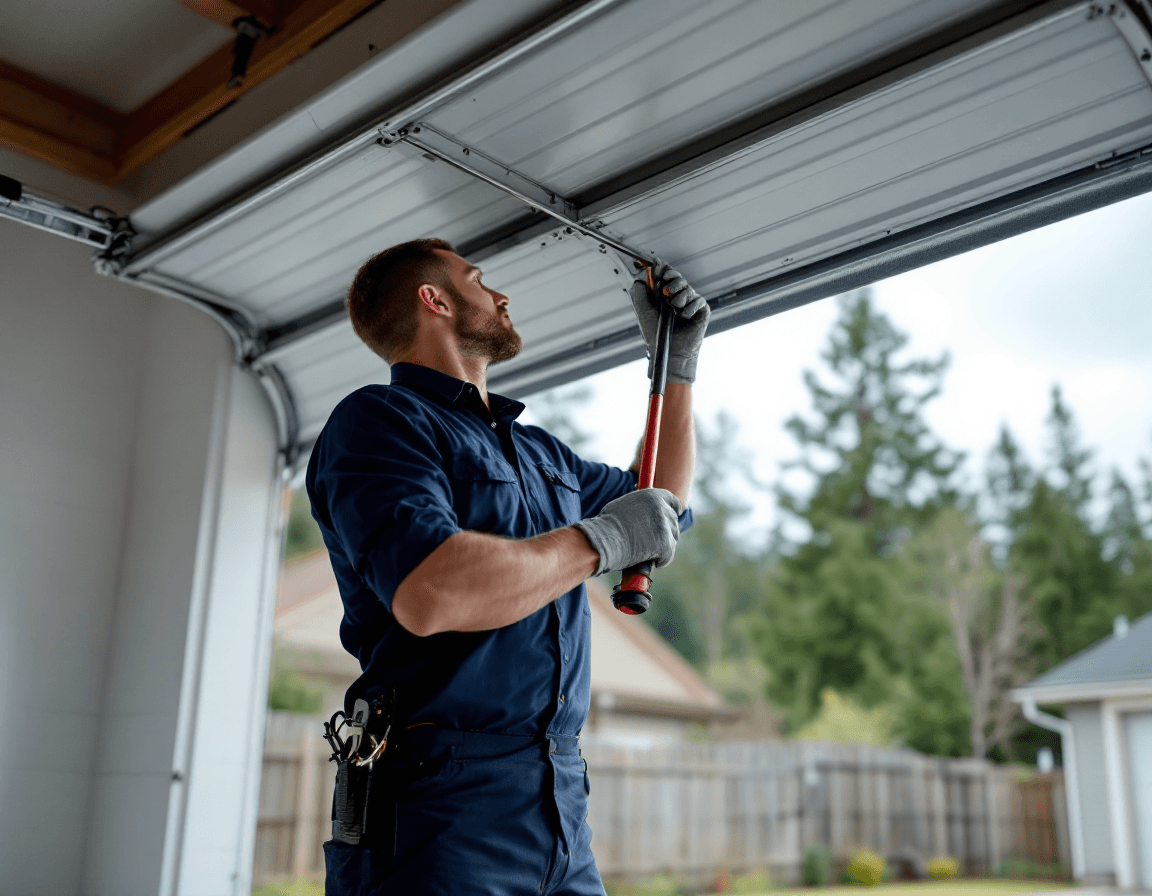
Garage Door Spring Replacement in Fife, WA is one of the most common repairs we handle for homeowners along the Pierce County line, and it is also one of the most urgent. The springs that counterbalance your door's weight are under constant tension, and when one fails, the door can go from working normally to dead in a single cycle. Fife's mix of older residential garages, heavy daily use from commuters heading toward I-5 and SR 167, and the wet, temperature-swinging climate of the South Sound all push springs toward the end of their rated life. Understanding what those springs do, and what to watch for, can save you a tow-truck bill, a damaged opener, or worse.
Fife sits in a very practical spot. Many households here share a garage with a second vehicle, a workbench, and a freezer, and the door may open several times a day for school runs, shift changes, and deliveries headed to the Port of Tacoma corridor. Each open and close cycle loads the springs, so a door that looks fine from the driveway may have already used a large share of its life. The rest of this page explains how springs fail, how to recognize the early signs, why balancing matters as much as swapping parts, and how to choose someone who will do the work safely.
Why Fife Garage Doors Put Extra Stress on Springs
Pacific Northwest weather is hard on steel. Fife gets long stretches of drizzle and damp air, and the cold snaps that come through in winter can cause metal to contract just enough to change how a spring holds its tension. Moisture that settles into a garage over months can start surface corrosion on the spring coils, especially where the coil meets the center bearing plate or the stationary cone. A spring that has picked up rust may look intact but lose strength faster than one kept dry.
Industrial proximity matters too. Properties near the Fife industrial area and the tideflats edge of the Port of Tacoma can see more airborne grit and, in some spots, a faint salt influence carried on the wind. Garage doors in those areas often collect fine dust on tracks and rollers, which increases friction and forces the springs to work harder to lift the same weight. We regularly see springs that failed early on doors with grimy, poorly lubricated tracks, which means the spring was doing the job of a neglected system.
Usage patterns in the city add to the wear. A household that opens the door four or five times a day across years will reach a high cycle count faster than a weekend-use garage. Standard springs are commonly rated for a set number of cycles, and once that number is reached, metal fatigue becomes the main concern. Fife homeowners who run a small business from a garage, store a boat, or cycle through frequent trips should keep this in mind when planning replacements.
Reading the Warning Signs Before a Spring Lets Go
Springs rarely fail without warning, although the warning is often subtle. Many homeowners only notice a problem after the door has stopped working, but a closer look usually reveals earlier clues. The most common early indicators include a door that feels noticeably heavier when lifted by hand, a door that begins to rise unevenly, or an opener that seems to labor more than it used to. Each of these suggests the springs are losing their ability to offset the door's weight.
Some warning signs are visible if you know where to look. A torsion spring that has begun to develop a gap between coils, or a stretched extension spring that sits looser than its neighbor, is worth reporting to a professional right away. Here are symptoms that should prompt a service call without delay:
- A loud bang from the garage, often described as a gunshot or a heavy metal clap, which usually means a spring has snapped
- A door that won't lift at all, or feels extremely heavy when you try to raise it by hand
- A visible gap in the torsion spring coil, where the wire has separated
- A door that opens a few inches and then stops or reverses
- An opener that strains, hums, or clicks while the door barely moves
- Cables that have come loose, slacked, or jumped off the drum after a spring break
- A door that closes too fast, drops unevenly, or sits crooked in the opening
If you notice any of these, avoid repeatedly forcing the door to test it. Continued operation on a damaged spring can stress the opener motor, bend tracks, and turn a manageable repair into a larger one.
Torsion Springs and Extension Springs: Knowing What Your Door Uses
Most garage doors in the Fife area use one of two spring systems, and the difference matters for both safety and cost. Torsion springs mount on a steel shaft above the door opening, usually just above the header, and they wind and unwind as the door moves. They generally last longer than extension springs and provide smoother, more balanced lift, which is why many newer residential doors use them. Their winding is high-tension work, and the process should only be done with the proper tools and training.
Extension springs run along the horizontal tracks on either side of the door, and they stretch as the door opens. They are common on older garage doors and on some lighter residential installations. Extension springs are often sold with safety cables running through the coil, which is a good feature because it contains the spring if it breaks, but it does not eliminate the danger of a sudden release. Whichever type your door uses, a broken spring can release stored energy quickly, so identifying the system is the first step in any repair plan.
Identifying the system is easier than many people expect. Look above the door for a long steel tube with cones at each end, which indicates a torsion setup, or look along the horizontal tracks for coils attached to pulleys and cables, which indicates extension springs. If you are unsure, take a photo and have a technician confirm it before ordering parts, since installing the wrong spring type can create a serious hazard.
What the Bang in the Garage Usually Means
A sudden loud bang is almost always a spring breaking, and it often startles people who have never heard one before. The sound can seem to come from the middle of the house or from the far wall of the garage, depending on how the metal flexed. Many Fife homeowners first assume a vehicle hit the door or that something fell off a shelf, only to find the door sitting partly open or hanging at an odd angle. If the bang happened while the door was closed, the door may still look normal, but it is no longer carrying its proper load.
After a break, the door becomes unsafe to operate because the remaining spring cannot balance its full weight. Lifting the door manually or running the opener in this state can cause the door to drop, bend, or pull free from its tracks. Keep children and pets away from the door area, avoid standing directly under a partially raised door, and do not attempt to wind or unwind a torsion spring yourself. A snapped spring is not a repair you can safely complete with household tools, and attempting it is one of the most common ways homeowners get hurt.
Once a spring breaks, the best response is to disconnect the opener by pulling the emergency release cord, then secure the door with clamps or by having a technician brace it until service arrives. Keep the garage closed as much as possible to limit exposure to rain, and do not leave the door partially open overnight. A prompt call to a licensed technician prevents secondary damage to cables, drums, and the opener itself.
Cables, Drums, and the Hidden Damage After a Break
When a torsion spring breaks, the lift cables attached to the bottom brackets and wrapped around the drums often go slack or come off their grooves. Many homeowners focus only on the spring and forget that the cables and drums can be damaged in the same event. A cable that has jumped off a drum may be frayed where it rubbed against the track or crimped where it caught on hardware. Even if the cable looks intact, it may have stretched or kinked in ways that make the door unstable.
Drums deserve careful inspection because they carry the lift load directly. Check for cracks, for loose set screws, and for any sign that the drum has slipped on the shaft. On extension spring systems, the pulleys and safety cables should also be examined for wear, since a damaged cable can fail to hold the spring if it breaks again. A technician who replaces only the spring and ignores these parts may leave the door in an unsafe condition that worsens over the next few weeks.
Because these components interact, the replacement is usually a system-level job rather than a single part swap. Good service includes inspecting every cable, checking the tension and alignment of the drums, and confirming that the bottom brackets are secure. This is also where a homeowner can ask pointed questions about what was replaced and what was simply inspected, which helps separate a thorough repair from a rushed one.
High-Cycle Springs and Whether They Fit Your Household
High-cycle springs are engineered to last longer under repeated use than standard springs, and they are a popular option for Fife households that open the door many times a day. They use heavier wire or different heat treatment to resist fatigue, which can extend service life considerably for active families, home-based businesses, and anyone who uses the garage as a primary entrance. The added durability usually comes at a higher price, so the decision should match how the door is actually used.
Not every household needs a high-cycle upgrade. A garage that sees light use, such as one mostly for storage with occasional vehicle access, may be well served by a standard spring that meets the manufacturer's specifications. On the other hand, a family that uses the garage daily, has a heavy door, or lives in a high-wear situation near industrial traffic may find the upgrade worthwhile. A technician should measure the door weight, check the existing spring specifications, and recommend an option that fits the actual load.
High-cycle springs also work best when balanced correctly. Installing a stronger spring on a door that is out of balance does not solve the underlying issue and can place uneven stress on the opener and the track. The upgrade should be part of a complete evaluation that includes lubrication, hardware inspection, and balance testing.
Balancing the Door: The Step Quick Fixes Often Skip
Balance is the quiet center of a good spring replacement. A properly balanced door should stay in place when raised manually to about halfway, and it should rise and fall smoothly without the opener doing most of the lifting. When a door is out of balance, it may drift down, climb too fast, or put unusual strain on the opener. Balancing involves adjusting the spring tension so the spring's force matches the door's weight, which is why the job cannot be judged by looking at the spring alone.
After a new spring is installed, a technician should test the door through several open and close cycles and observe how it behaves at different heights. Adjustments may be needed at the spring tension, the cable alignment, or the drum setup. Doors that were already sagging or misaligned before the break often need additional track or hinge adjustments to achieve proper balance. Skipping this step is one of the main reasons a door that seems fixed starts giving trouble again within weeks.
Balancing is also a safety issue. An unbalanced door can drop unexpectedly on a person or vehicle, and it can place extra load on the opener's gearbox and chain or belt. A technician who checks balance as part of the replacement is protecting both the door and the people who use it every day.
What Spring Replacement Costs in Fife and What Shapes the Quote
For most spring replacements, our pricing falls in the range of $180 to $450, depending on the details of the job. The spread reflects real differences in the work rather than a loose estimate. A standard extension spring on a lighter door is generally at the lower end, while a high-cycle torsion replacement on a heavier or larger door, with cable and drum work included, sits at the higher end. Exact pricing depends on what your door needs once the technician sees it.
Several factors influence the final quote. The spring type, the wire size, the door weight, and whether the cables and drums also need replacement all matter. Access can change the price too, particularly in garages with limited headroom or in homes where the door has been modified. Here are the factors that most often affect what you will pay:
- The spring type, whether torsion or extension, and whether the job calls for standard or high-cycle parts
- The size and weight of the door, including whether it is a single or double panel
- Whether cables, drums, or bottom brackets also need replacement after the break
- The condition of the tracks, rollers, and hinges, which can affect balance and safety
- Any additional balancing, lubrication, or opener adjustments needed to finish the repair
If a quote seems far outside this range, ask the technician to explain what is included. A clear estimate should list the parts, the labor, and the testing or balancing steps that are part of the job.
Safety Rules for Anyone Standing Near a Spring
Spring work is one of the few garage door tasks that should always be handled by a licensed professional. Torsion springs store large amounts of energy under tension, and improper winding or handling can cause the spring to release suddenly, with enough force to cause serious injury. Extension springs are less intense in some respects but can still recoil violently if a safety cable is missing or if the spring is released incorrectly. Homeowners should never attempt to remove, wind, or adjust these springs without training and the right equipment.
Simple precautions reduce risk while you wait for service. Keep hands, tools, and pets clear of the door area, do not stand beneath a door that is partially open or unsupported, and disconnect the opener so the door cannot move unexpectedly. If you need to move a vehicle, do so carefully and avoid using the door as a support or lever. Clear the area around the door track so nothing obstructs the tracks or the cables.
A licensed technician will follow established safety procedures, including locking the door in place, using proper winding bars and tools, and confirming that the spring is secured before removing or installing components. They will also check for signs of additional damage that could pose hazards. Choosing a professional is not an extra cost on top of the repair; it is the safest way to complete it.
Choosing a Technician for Spring Work in Pierce County
Selecting the right company for a spring replacement comes down to clear answers and visible professionalism. Ask whether the company is licensed, bonded, and insured, and request that information in writing if you need it for your records. Ask how they will assess your door, what parts they recommend, and whether they will test and balance the door after installation. A reputable technician will explain the options without pressure and will not dismiss your questions.
Local knowledge also helps. A technician familiar with Fife and the wider Pierce County area will understand the common door types in neighborhoods near the industrial corridor, the typical wear patterns from our climate, and the access challenges in older garages. That experience shows up in faster diagnosis and fewer surprises during the job. Be wary of anyone who wants to complete spring work without inspecting the entire door, or who insists on an immediate decision without explaining the risks.
Finally, look for transparency about scope. Good companies tell you what they will replace, what they will only inspect, and what will be left for future maintenance. That clarity makes it easier to budget and to trust the work once it is finished.
Get Your Fife Garage Door Spring Replaced by Seattle Garage Door Fix
If your garage door has gone quiet, won't lift, or sits crooked after a bang, do not wait to see whether it resolves on its own. Seattle Garage Door Fix provides licensed, bonded, and insured spring replacement for Fife homeowners, with torsion and extension spring options, high-cycle upgrades where they make sense, and careful balancing so your door runs smoothly. Call (888) 799-3819 today to schedule an inspection and get a clear, itemized estimate before any work begins.