
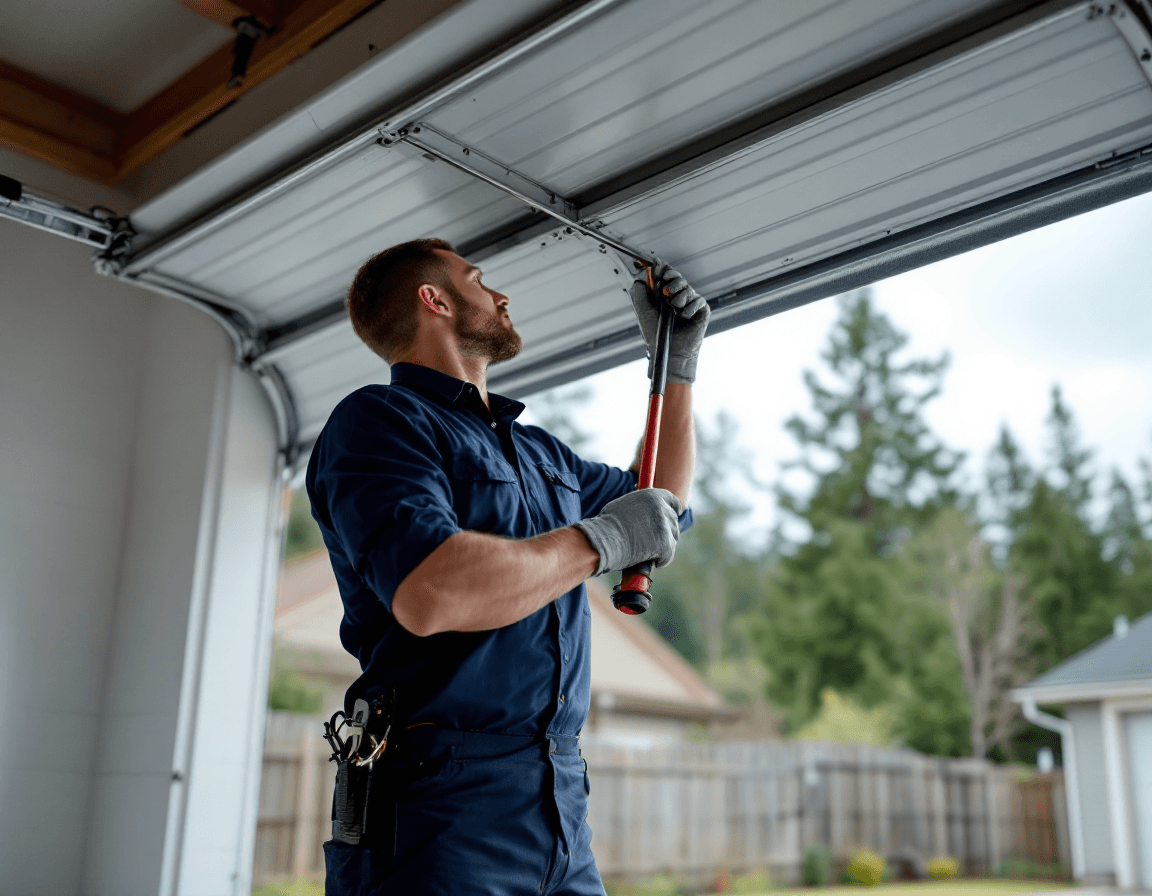
Garage door spring replacement in Tacoma, WA is one of the most time-sensitive repairs a homeowner can face, because a broken spring usually means the door cannot be lifted safely at all. Whether your door sits in a 1920s garage off a North End side street or a newer attached bay in a Hilltop subdivision, the spring is what carries most of the door's weight. When it fails, the opener is suddenly asked to do a job it was never designed to handle. Our technicians work across Tacoma and the rest of Pierce County, and we treat every spring call as a safety issue first and a repair second.
Tacoma's damp, marine-influenced climate puts extra demands on garage door hardware. Rain tends to settle in from October through April, and the salt-tinged air that drifts in from Commencement Bay and the Puget Sound corridor can accelerate surface rust on exposed steel. Those conditions do not cause every spring to fail, but they shorten the margin that springs already have. This guide explains what spring failure looks like, what drives the cost, how high-cycle options fit local households, and what to expect from a proper balance check after the new spring is installed.
If you are reading this with a door that will not move, keep the garage door closed if it is still closed, disconnect nothing, and do not try to lift it by hand. The sections below will help you recognize the signs, understand your options, and decide when to call. For a licensed technician to come out, call (888) 799-3819.
Why a Snapped Spring Sounds Like a Gunshot
Homeowners often describe a broken spring as a loud crack or bang that seems to come from the garage ceiling or from behind the door. In many Tacoma homes, especially those with a detached garage or a shared wall with a bedroom, that sound carries through the whole house. The energy released when a tightly wound torsion spring lets go is considerable, and the sudden shock can also shift the door off its tracks. Some owners first notice the damage when they go to open the car and find the door hanging crooked or refusing to rise.
After a break, the door usually stays where it was when the spring failed. If it was closed, it will often remain closed, which is actually the safest state. If it was partly open, the remaining weight can sag or drop slowly, and that is why you should keep people and pets clear of the door opening. The lifting force that the spring used to supply is now gone, so the opener motor alone is not designed to raise a door of that weight. Trying to force it can burn out the opener or strip the drive gear.
Many Tacoma homeowners assume a loud noise always means a catastrophic failure, but sometimes the only sign is a sharp pop followed by a door that opens only a foot or two. Treat either event the same way: assume the spring is compromised, stop operating the door, and schedule an inspection. A technician can check the spring, the cable drums, the lift cables, and the track alignment in one visit, which avoids paying for multiple trips.
Reading the Coil: Torsion Versus Extension Springs
Before any replacement, a technician needs to identify which type of spring the door uses. Torsion springs are mounted on a steel shaft above the door opening, and they wind and unwind to lift the door through a set of cables and drums. Extension springs run along the horizontal tracks on either side of the door and stretch as the door opens. Many residential doors in older Tacoma neighborhoods, particularly those built before the widespread adoption of torsion systems, still use extension springs, while newer installations are more often torsion.
A torsion spring failure often shows up as a visible gap in the coil. If you can see daylight between two adjacent coils, or if the coils look stretched and uneven, the spring has likely broken and cannot be trusted. Extension springs frequently show a different pattern: a stretched, elongated look, a loose cable, or a spring that hangs with a visible kink. Neither type should be inspected by an untrained homeowner, because the stored energy in a torsion spring is substantial even when it appears to be at rest.
Knowing your spring type matters for two reasons. First, it determines the replacement parts and the labor involved, which affects the quote. Second, it tells you what the system is capable of. Extension springs are usually replaced in pairs along with cables and sometimes safety cables, while torsion springs are often replaced as a matched pair on the same shaft. A reputable technician will explain which configuration your door has and why, rather than simply quoting a single number without context.
Hilltop and North End Driveways: How Slope and Older Hardware Change the Job
Tacoma's topography is one of the features that makes local garage door work distinctive. Hilltop and parts of the North End sit on grades where driveways slope noticeably toward the street, and some garages were built into hillsides with a rear or side entry. Slope itself does not cause spring failure, but it can complicate balancing, because the door's weight and the opener's travel are measured on a level plane. A door that balances well on flat ground may need minor adjustment on a steep approach or where the header sits at an unusual height.
Older homes add another layer. Many Stadium District and North End houses have garages with original framing, uneven floors, and header heights that were never standardized. Replacing a spring in such a garage often means checking that the shaft bearings, end plates, and cable drums are sound, because a worn bearing can make a new spring wear faster. Older doors also sometimes have sections that have warped slightly over decades, which can make the lift feel uneven even after a fresh spring goes in.
Downtown Tacoma and Proctor present their own situations, from detached garages behind multi-unit buildings to attached garages in older bungalows that have been remodeled several times. Access can be tight, and the working space for installing a torsion spring safely is sometimes limited. Good technicians plan for these constraints in advance, confirm the door's dimensions and weight class, and bring the right winding bars and safety equipment. If your garage feels cramped, mention it when you call so the crew arrives prepared.
Marine Air, Rain, and What Puget Sound Does to Steel
Springs are made from high-carbon steel that is coated or treated to resist corrosion, but the coating is only as good as its condition over time. In the Pacific Northwest, persistent moisture combined with airborne salt in coastal-influenced areas can work into small scratches and hairline cracks in the finish. Once corrosion begins, it weakens the cross-section of the wire, and that accelerates fatigue. Homeowners rarely see this process directly, which is why it is easy to underestimate.
Rain-soaked garages add their own problems. Water pooling along the threshold, dripping from roof edges, or tracking in on shoes can rust the bottom brackets, track ends, and drum shafts. A spring that has been exposed to repeated wet-dry cycles may show surface flaking or a dull, pitted appearance before it breaks. Detached garages in shaded lots tend to stay damp longer, which is a reason to inspect them more often even if the door appears to work normally.
Maintenance can slow these effects. Wiping springs with a dry cloth, keeping the garage ventilated, and applying a light lubricant to moving parts (but never to the spring coils themselves) all help. Ask your technician during a tune-up whether the springs show early surface rust, because that is often the moment to plan a replacement rather than wait for a break. A planned replacement during a dry spell is far less stressful than an emergency call during a December storm.
Symptoms That Point to a Spring Problem Early
Most spring failures give some warning, though the warning is easy to dismiss. Catching these signs early lets you schedule a repair on your timeline instead of on the day the door stops working. Watch for the following indicators:
- The door feels much heavier than usual when you lift it manually, or it resists opening even with the opener running.
- The opener motor hums, strains, or cycles off after a few seconds without moving the door much.
- The door opens a few inches, then stops, or it rises unevenly with one side lagging behind the other.
- The door closes faster than normal or drops suddenly near the bottom of its travel.
- One or more lift cables appear loose, frayed, or have slipped off the cable drum.
Any one of these symptoms is worth a professional look, and two or more together strongly suggest a spring problem. Do not assume the opener is the culprit until a technician has checked the spring tension, because replacing an opener when the real issue is a worn spring wastes money and leaves the underlying hazard in place. Keep a short note of when each symptom started, since that detail helps the technician diagnose the failure faster.
What a Spring Replacement Costs and What Shapes the Quote
Most spring replacements in our service area fall in the range of $180 to $450. That range reflects the typical scope for the majority of residential jobs, but the final figure depends on several factors. The spring type and size, the number of springs being replaced, the condition of the cables and drums, and the need for any bearing or track adjustment all influence the total. Doors with heavier construction or larger dimensions usually require springs with higher lift ratings, which can move the price toward the upper end.
Labor is the other major component. Replacing a torsion spring involves releasing tension in a controlled way, removing the broken spring, installing the replacement, and rebalancing the door. Extension spring work can be simpler per spring but often involves replacing cables and safety cables at the same time. When a technician finds additional wear, such as a frayed cable or a damaged drum, the scope may grow, and a good provider will explain the change before doing the work.
Ask for an itemized estimate that lists the springs, cables, labor, and any optional upgrades. A written quote protects you and makes it easier to compare providers. Be cautious of any offer that seems dramatically lower than the range above without explanation, because hardware quality and safety practices vary. As a licensed, bonded, and insured company, we will walk you through what is included before the work begins, so there are no surprises when the invoice arrives.
High-Cycle Springs and Why Local Households Ask About Them
Standard residential springs are commonly rated for roughly 10,000 cycles, where one cycle is one full open and close. For a household that uses the garage a few times a day, that rating can translate into years of service, but families with teenagers, home businesses, or frequent trips may reach the limit sooner. High-cycle springs are manufactured from the same general material family but are designed and tested for a higher number of cycles, which makes them a popular upgrade when a homeowner wants longer life from a single replacement.
High-cycle options are especially relevant for Tacoma households with multiple drivers, shared garages, or workshop use. A garage that serves as a daily entry point for a family of four will open and close far more often than one used only for weekend storage. Choosing a higher cycle rating can spare you from repeating the repair within a few seasons. The additional cost is modest compared with the expense and disruption of a second failure.
Not every door needs a high-cycle spring, and an honest technician will tell you when a standard spring is sufficient. Factors such as door weight, age of the opener, and how often the door is used all matter. We recommend discussing your actual usage pattern during the estimate so the spring you buy matches the way your household lives. If the door is lightly used and the existing hardware is sound, a standard spring may be the most sensible choice.
Precision Balancing After the New Spring Goes In
Replacing the spring is only half the job. A door that has been re-springed must be balanced so that it holds its position when partly open and moves smoothly through its full travel. A properly balanced door should stay put when you release the opener at roughly halfway up, without drifting up or down. An imbalanced door puts uneven stress on the opener, the cables, and the track rollers, and it can cause the same symptoms that led you to call in the first place.
Precision balancing involves adjusting the spring tension in small increments, testing the door at several heights, and confirming that cable tension is even on both sides. Technicians typically check the door manually with the opener disconnected, then reconnect and run a full cycle to confirm the opener's force settings. Track alignment and roller condition are checked at the same time, because a door that is out of square can appear to be unbalanced even when the springs are correct. Small adjustments made carefully produce a smoother, quieter door that is easier on every component.
Balancing is also where experience matters most. The difference between a door that operates quietly for years and one that binds or slams often comes down to the final few turns of tension. Ask whether the technician performs a balance test after installation and whether they will demonstrate it before leaving. A good crew will be glad to show you the door's behavior at multiple heights.
Safety Steps Homeowners Should Never Attempt Alone
Garage door springs store enormous energy, and the risks of a home repair gone wrong are serious. Injuries from winding bars slipping, springs releasing unexpectedly, or doors falling after cables are disconnected are well documented across the industry. For that reason, spring and cable work should be performed only by a licensed professional with the proper tools and training. Even experienced do-it-yourselfers should step back from this category of repair.
The following tasks belong to a trained technician and should never be attempted by a homeowner:
- Winding or unwinding a torsion spring, including adjusting the winding cones or setscrews.
- Removing a broken spring, a spring cone, or a cable drum from the shaft.
- Disconnecting or reconnecting lift cables while the door is under load.
- Adjusting extension spring tension or removing the safety cable.
There are safe things you can do while you wait for service. Keep the door closed if possible, disconnect the opener only if a technician instructs you to, and keep children, pets, and vehicles clear of the opening. Do not stand under a door that is partly open and unsupported. If the door is closed and you need access, use the side door or another entry rather than attempting to lift it manually.
Booking a Visit Across Pierce County and Beyond
We provide garage door spring service throughout Tacoma and across more than 60 cities in the greater Seattle and Western Washington area. Within Tacoma, we regularly serve homes in Downtown Tacoma, the North End, Proctor, the Stadium District, and Hilltop, along with surrounding communities. Our service area covers the following Tacoma and Pierce County ZIP codes: 98402, 98404, 98405, 98406, 98407, 98408, 98409, 98418, 98421, 98422, 98444, 98445, 98465, 98466, and 98467. If your home falls in one of these ZIPs, you are within our standard coverage.
When you call, be ready to describe the symptoms, the door's approximate size, whether it is attached or detached, and whether you have seen a visible gap in the coil or a loose cable. Knowing your spring type helps us prepare, though it is not required to schedule a visit. Tell us whether the door is currently closed or partly open, since that affects how we approach the first step. We will confirm the appointment window and the estimated scope before we arrive.
Every technician we send is licensed, bonded, and insured, and the work is performed with safety as the first priority. We can explain your options, including standard and high-cycle springs, and we will balance the door before we leave. For a broken spring, a door that will not lift, or any of the warning signs described above, call (888) 799-3819 to schedule your spring replacement in Tacoma, WA today.