
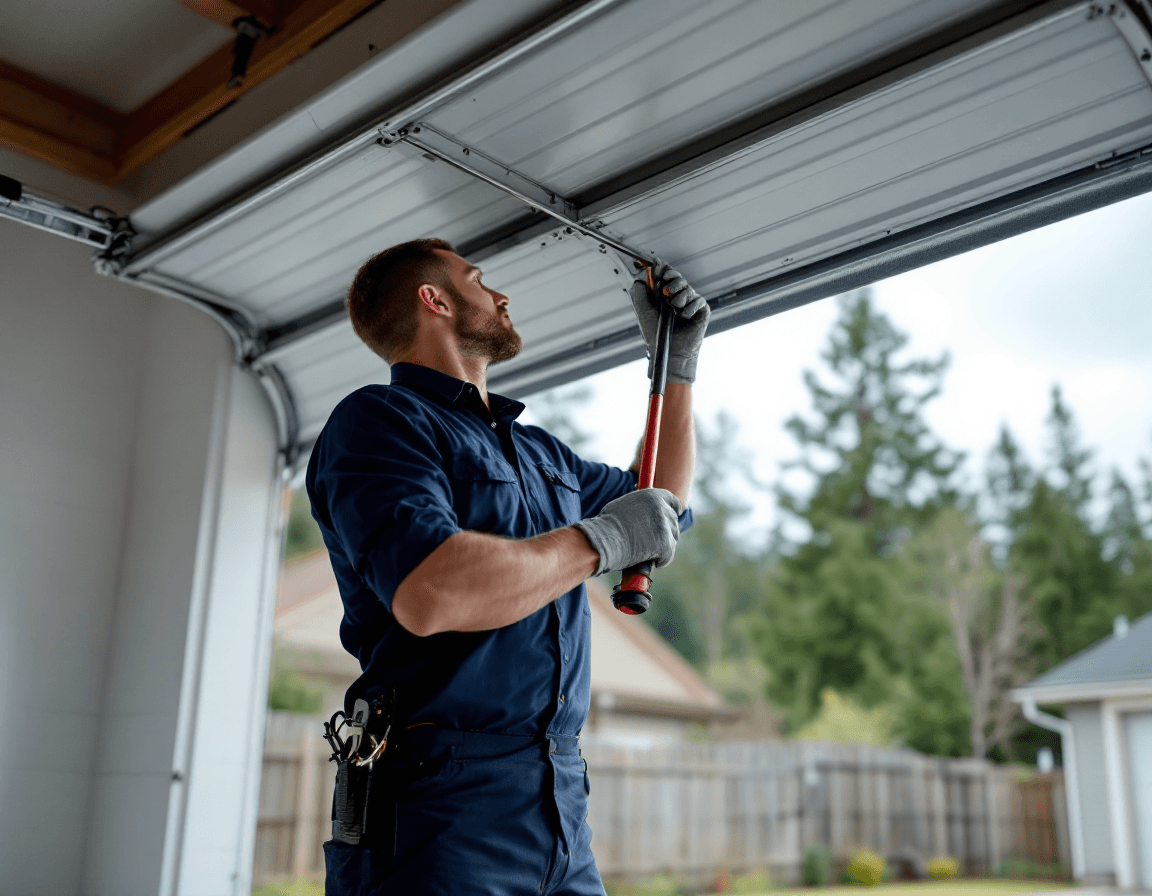
Garage door spring replacement in Ruston, WA is one of the most common repairs we see on the north end of Tacoma, and it is also one of the most important to handle correctly. The springs carry most of your door's weight, so when one fails, the door can go from smooth to nearly immovable in a single morning. Ruston's compact shoreline neighborhoods, many of them with older detached garages and long driveways that take a beating from wet weather, make that failure both more likely and more noticeable.
This page explains what tends to go wrong with garage door springs in and around Ruston, how to recognize the warning signs before a spring lets go, and what a professional repair involves. We cover the difference between torsion and extension springs, why cables can come loose after a break, and why a door that closes too fast or crooked usually points back to balance. We also describe high-cycle spring options and what homeowners can reasonably expect to pay.
Throughout, we keep one principle front and center: spring work is dangerous. Garage door springs are under very high tension even when the door looks still, and a mistake during removal or adjustment can cause serious injury. Treat everything below as background so you can describe the problem accurately to a licensed technician, not as a step-by-step guide to doing the repair yourself.
Why Ruston Garage Doors Work Harder Than You Might Expect
Ruston sits on the Commencement Bay shoreline, and that location shapes how garage hardware ages. Salt-laden air moves inland from the water, and the damp, cool months that define a Pacific Northwest winter keep metal surfaces wet for long stretches. Over time, that moisture finds its way into the steel coils of torsion springs and the galvanized surfaces of cables and drums, leading to surface rust that gradually weakens the metal from the outside in.
The climate also creates a rhythm of expansion and contraction that stresses springs in ways homeowners rarely notice. A cold morning after a damp night can leave a spring noticeably stiffer than it was the evening before, and a sudden warm afternoon can change its behavior again. Metal fatigue accumulates with each of these swings, which is why a spring that performed fine for years can suddenly give out during a cold snap in January rather than failing gradually.
Many homes in the area also have garages that double as storage, workshops, or the main entry point for daily traffic. A door that opens and closes several times a day, especially for a busy household with teenagers, commuters, or a home business, reaches the end of a spring's rated cycle much sooner than a door that is used a few times a week. Understanding this background helps explain why two similar doors on neighboring streets can need spring work at very different times.
Reading the Warning Signs Before a Spring Lets Go
Springs rarely fail without warning, though the warnings are easy to dismiss. Most homeowners notice that something feels different about the door long before it stops working altogether. Paying attention to these early signals can turn an emergency visit into a scheduled repair, and it can keep a worn spring from taking a cable or opener with it when it finally breaks.
Look for the following signs that a spring may be nearing the end of its life:
- The door feels noticeably heavier when lifted by hand, or the opener seems to labor more than it used to.
- You see a gap or visible space between coils on a torsion spring, or the coils look unevenly spaced along the shaft.
- Rust, flaking paint, or a dull orange film appears on the spring coils, particularly near the center bracket.
- The door makes a new popping, creaking, or grinding noise as it moves through the lower portion of its travel.
- The door appears to rise slightly unevenly, with one side lagging the other by a few inches.
Any one of these signs can have other causes, such as worn rollers, a bent track, or a failing opener. That is exactly why a technician should inspect the system rather than guessing. A professional can measure spring condition, check the balance of the door, and tell you whether the problem is the spring itself or something connected to it.
The Bang in the Night: What a Snapped Spring Sounds Like and Does
A broken garage door spring is loud, and most people who hear it never forget it. The sound is typically a sharp crack or a heavy bang, often followed by a rattling as loose parts settle. Because the noise can come from inside a closed garage at any hour, many Ruston homeowners first realize something is wrong when they come out to the car in the morning and find the door sagging or resting unevenly on the floor.
After a spring breaks, the door loses most of its counterbalance. The door may still look closed and secure, but it is no longer properly supported. Attempting to open it with the opener can strain the motor, damage the gears, or cause the door to lurch unpredictably. For this reason, the safest first move after a loud bang is to stop using the door, keep children and pets away from the area, and avoid manually trying to lift or move it.
It is also worth checking whether the door is still resting securely on its track and whether any cables are hanging loose. A broken spring can sometimes lead to a cable jumping off its drum, which creates a separate hazard. Describe exactly what you heard and saw when you call for service, because that information helps a technician arrive prepared with the right replacement parts for your specific door.
Torsion Versus Extension: Which Spring Your Door Carries
Garage doors typically use one of two spring systems, and identifying which one your door has matters for both diagnosis and repair. Torsion springs are mounted in a long coil above the door opening, usually on a steel shaft that runs across the width of the garage. They twist to store energy and turn the drums that wind the lifting cables. Torsion systems are common on newer residential doors and are generally preferred for their smoother operation and improved safety when properly maintained.
Extension springs run along the horizontal tracks on either side of the door, or sometimes along the top section of the tracks. They stretch as the door is lowered and pull back as the door rises. Extension systems are often found on older homes and on lighter residential doors. They tend to fail in different ways, and a broken extension spring often shows up as a sagging door or a single side that refuses to lift.
Knowing which system you have helps you describe the problem clearly. If you see a long coil over the door, you have torsion springs. If the springs sit along the sides of the track, you likely have extension springs. A technician can confirm this in a few minutes and explain which replacement option makes the most sense for your door's weight, size, and cycle expectations.
Why a Door Stops Halfway Up and What That Tells a Technician
One of the most frustrating symptoms is a door that opens a few inches and then stops, or that rises partway and sits there while the opener hums. This pattern usually indicates an imbalance caused by a weakened or broken spring, sometimes combined with a cable or drum issue. The opener is trying to lift a door that no longer has enough counterbalance, so it stalls or strains as soon as the load shifts.
The location of the stop can be a useful clue. A door that stops low may have a failing spring that cannot carry the weight through the bottom of its travel. A door that stops at a consistent height may have a problem at a specific point in the drum or cable. A door that lifts unevenly, with one side higher than the other, often points toward a single broken spring on a dual-spring setup, or toward a cable that has slipped or stretched unevenly.
Do not try to force the door open or repeatedly press the opener button to see if it will eventually move. Repeated strain can damage the opener's gear train and the door's hinges, turning a spring repair into a larger job. A licensed technician can measure the forces involved, confirm where the balance has been lost, and recommend whether the springs, cables, or the opener itself need attention.
High-Cycle Springs and Why Waterfront Households Ask About Them
Standard springs are rated for a certain number of cycles, meaning a complete open and close counts as one cycle. Many residential springs are designed around a typical household use pattern, but busy homes often exceed that pattern. High-cycle springs are engineered with a longer expected service life, which can make sense for households that use the garage door many times each day, operate a home business from the garage, or simply want a longer interval between replacements.
High-cycle options are available for both torsion and extension systems, though the right choice depends on the door's weight, its dimensions, and how it is used. Heavier doors, such as insulated models or doors with glass panels or decorative hardware, may need springs with a different wire gauge or winding specification. Pairing the correct high-cycle spring with a properly balanced door is what delivers the longer life, so the replacement should never be treated as a parts-only swap.
Some households near the waterfront and the park-side neighborhoods ask whether high-cycle springs are worth the additional cost. The answer depends on use patterns and on how much the homeowner values the longer interval. A technician can review the door, talk through the expected cycle count, and explain the tradeoffs without pressure. The goal is a repair that fits your household, not the most expensive option on the quote.
Cables That Jumped the Drum After a Break
When a torsion or extension spring breaks, the cables that connect the spring to the door can become slack, tangled, or pulled off the drum. A cable that has jumped the drum is a serious safety concern, because the tension in the system can shift suddenly during handling. The cable may also be frayed or kinked, which means it should be replaced rather than reused.
Homeowners often notice loose cables after a spring has snapped, sometimes seeing them dangling near the track or wrapped loosely around the drum. The temptation is to pull them back into place or tighten them by hand. That is one of the most dangerous things a homeowner can do, because the drum and cable are part of a tensioned system, and the wrong movement can cause the drum to spin or the cable to whip. Leave cable work to a professional who has the right tools and training.
A proper repair normally includes inspecting both cables, checking the drums for damage or wear, and confirming that the cables are seated correctly. If a cable has stretched, frayed, or been overstressed, replacing it alongside the spring is usually the most reliable approach. Replacing only the spring and reusing an older cable can create a second failure soon after the first.
Balance, Closing Speed, and Crooked Travel
A garage door should feel nearly weightless when it is properly balanced, and it should close at a controlled speed without slamming or drifting. When the door closes too fast, drops unevenly, or travels in a slight diagonal, the issue is often spring balance, not the door itself. A spring that has lost tension on one side, or a pair of springs that were installed with different winding, can create this effect.
Crooked travel is especially common after a single spring has been replaced without rebalancing the system. The new spring may provide a different amount of force than the old one, or the remaining spring may now carry more load than intended. Over time, this imbalance can wear out rollers, bend tracks, and strain the opener. Balancing the door is an essential part of the job, not an optional extra.
Balance adjustments require the correct tools and an understanding of how the spring winding affects the door's movement. A technician will typically test the door at several points in its travel, checking whether it stays in place when lifted partway. If the door drifts, the balance needs correction. Homeowners who notice these symptoms should schedule service rather than attempting to adjust the springs or the tension of the system on their own.
What a Ruston Spring Replacement Typically Involves
Every door is different, but a professional spring replacement in the Ruston area generally follows a predictable process. Understanding the steps helps you know what to expect and why the work takes the time it does. Here is a general overview of what a licensed technician typically handles:
- An initial inspection of the door, springs, cables, drums, rollers, hinges, and track to identify the cause of the failure.
- Measuring the door's weight and dimensions to select a replacement spring with the correct specification.
- Safely releasing the tension in the damaged spring using specialized tools and a controlled procedure.
- Removing the broken spring and any damaged cables, drums, or brackets that need replacement.
- Installing the new spring and cables, then confirming that everything is seated and secured.
- Balancing the door, testing its travel, and checking the opener's performance under the corrected load.
- Walking the homeowner through the results and discussing any related parts that show wear.
Each step carries risk if done improperly, which is why this work belongs in the hands of trained professionals. A complete service also includes testing the door's safety reversal features, since the opener must stop and reverse when it encounters an obstruction. Ask your technician to demonstrate these features before the visit ends.
Pricing Expectations Between $180 and $450
Homeowners often want a clear idea of cost before scheduling spring work. For most garage door spring replacements, pricing typically falls in the range of $180 to $450, depending on the type of spring, the size and weight of the door, the number of springs involved, and whether related components such as cables, drums, or bearings also need replacement. Higher-cycle springs and heavier doors generally fall toward the upper end of that range, while standard replacements on lighter residential doors often land near the lower end.
Several factors influence the final quote. Replacing both torsion springs at the same time is common and often recommended, because the second spring is usually near the end of its life when the first one fails. Additional work such as replacing worn cables, repairing a damaged drum, or addressing a failing opener will change the total. A reputable technician should explain what is included in the price and what would be an optional upgrade.
Be cautious of any quote that seems dramatically lower than the typical range without a clear explanation, or any provider who refuses to describe the parts and labor involved. A fair estimate should match the door's actual needs, and the technician should be willing to explain each line item. When you call, describe the symptoms and the door's size and type so the estimate reflects your situation rather than a generic average.
Staying Safe Around Tensioned Springs
Safety deserves its own section because the most serious garage door injuries happen when homeowners try to handle springs themselves. Torsion and extension springs store a large amount of energy, and that energy can release suddenly if a spring, cable, or winding bar slips. Even a spring that appears broken may still hold residual tension in part of its length, which is why casual inspection by an untrained person can be hazardous.
Keep these basic precautions in mind while you wait for service. Keep children, pets, and visitors out of the garage. Do not stand directly beneath a door that is sagging, cracked, or hanging unevenly. Avoid using the opener repeatedly on a damaged door, and disconnect power to the opener if the door is unstable or the cables look loose. If the door must be moved for any reason, have a professional do it.
Never attempt to remove, wind, or adjust a spring with household tools. Winding bars, pliers, and makeshift supports are not a substitute for proper equipment, and many injuries occur when a bar slips or a spring releases unexpectedly. Licensed and insured technicians carry the tools, training, and liability coverage needed to perform this work safely, and that protection matters for your household as well as for the crew working on your door.
Garage door spring replacement is a repair that rewards careful attention to detail, honest diagnosis, and respect for the forces involved. If your Ruston garage door is showing any of the warning signs described above, or if a spring has already broken, we are ready to help. Call Seattle Garage Door Fix at (888) 799-3819 to schedule a licensed technician who can inspect your door, explain your options, and restore safe, balanced operation before the next cold, wet week arrives.