
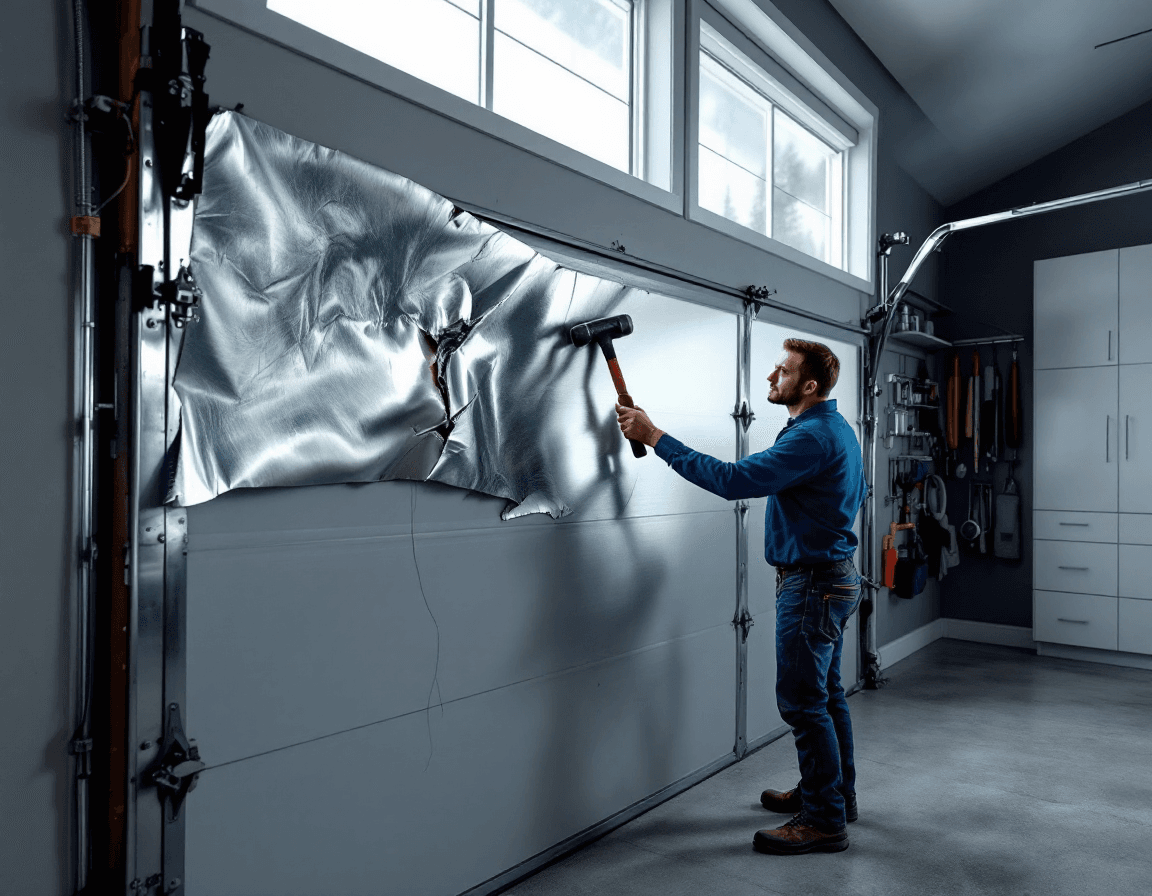
Garage Door Panel Replacement in Ruston, WA is one of the most common repairs we handle for homeowners in this small town tucked against the north end of Tacoma. A garage door can run smoothly for years and still carry a bent, cracked, or rotted section that spoils its looks and weakens its structure. Because the door moves mechanically without trouble, many owners put off the fix, assuming a dent is cosmetic. In reality, a damaged panel can change how the whole door flexes, seals, and handles wind.
Ruston homes span a range of door ages and styles, from original steel sectional doors on older lots to newer insulated models installed during recent remodels. Each door has its own panel width, thickness, and profile, so a replacement is never just a matter of ordering "a panel." The right piece has to match the door's manufacturer, series, and hardware layout, and it has to fit the existing track and spring balance. That is why panel work deserves a careful assessment before anyone reaches for a tape measure.
This guide walks through how we evaluate damaged sections, what the Pacific Northwest climate does to garage door skins over time, how to decide between repairing and replacing, and what homeowners in Ruston can realistically expect for pricing. Our typical range for a single section runs from $250 to $800, with the final figure depending on the door's construction, the panel's insulation, and how much disassembly the job requires. Read through the sections that fit your situation, and call us at (888) 799-3819 if you would like a technician to look at your door in person.
Reading the Dent Before Deciding Anything
A dent looks like a dent, but the way metal has deformed tells a technician a great deal about what happened. A shallow, broad dimple across the middle of a panel often comes from a stray lawn mower, a thrown rock, or a ball that hit the door at an angle. A sharp crease that runs across the panel's embossed ribbing usually points to a heavier impact that stressed the steel beyond its ability to spring back. When the metal has fractured along a seam, the panel has lost its structural integrity even if it still looks mostly straight from the driveway.
We check whether the damage has bent the panel's edges where it joins the next section. Edge distortion can cause adjacent panels to pull unevenly through the track rollers, which produces grinding, rattling, or a door that sits slightly out of level. Running a hand along the bottom edge of the damaged section often reveals a lip that no longer lines up with the panel below it. These small misalignments are easy to miss from the outside but can wear hinges and rollers faster than normal use would.
Before we recommend a replacement, we also look at the inside of the panel where it is accessible. Insulated doors sometimes hide foam that has been compressed or torn by an impact, which reduces the thermal barrier and can let in a draft or moisture. Light patches, flaking paint, or a gap between the skin and the core are signs that the panel's protection has already been compromised. Noting these details helps us explain whether the section can be straightened and sealed or needs to come out entirely.
Salt Air, Rain, and the Slow Rot Along the Water
Ruston sits close enough to Commencement Bay and the Puget Sound shoreline that many garage doors experience a steady dose of salt-laden air, especially on lots that face the water or sit in the path of prevailing winds. Salt does not stay on the surface for long. It settles onto painted steel, works into small scratches, and accelerates corrosion that starts underneath the finish. Homeowners often notice the first sign as a bubbling or flaking patch along the bottom panel, where splashing and standing moisture collect.
Western Washington's long wet season adds another layer of wear. Rain and drizzle can persist for weeks at a time from late autumn into spring, and the damp air rarely dries completely between storms. Wood-core doors, which some older Ruston homes still use, are especially vulnerable when water gets behind the facing and softens the frame. Even steel doors can trap moisture in the bottom seal area, where the lowest panel stays wet longest and the paint film is most likely to crack.
When rot or rust has spread through a panel, replacement is usually the most reliable path. Surface rust that has not yet perforated the metal can sometimes be cleaned, treated, and repainted, but once the steel is thin or pitted, the section will keep degrading and may eventually fail under wind load. We inspect the bottom two panels closely during every visit to this area, because water damage tends to concentrate there. A quick check with a screwdriver tip pressed gently against suspect areas can reveal soft spots that look sound at a glance.
When a Backing Accident Leaves One Panel Crushed
A single panel damaged by a backing accident is one of the most common calls we receive in Ruston. A car bumper, a truck tailgate, or a trailer hitch can strike the lower section at a slow speed and still cause a deep crease or a split along the ribbing. The surrounding panels may look fine, which is exactly why homeowners sometimes assume there is nothing else to address. The impact can still shift the door's alignment, so we always check tracks, rollers, and hinges after an accident.
If the impact was strong enough to push the door out of its tracks or bend a track section, the work becomes more involved than a simple panel swap. Track damage has to be corrected before a new panel is installed, or the replacement will bind and wear prematurely. We also check the door's spring system and opener connection, since a hard hit can shift tension or loosen fasteners that were set correctly before the accident. Those checks protect the rest of the system and make the new panel perform the way it should.
Insurance is sometimes part of the conversation after an accident involving a vehicle. We can document the damage with photographs and a written description of the affected section and any related components, which helps homeowners work through their own claim process. We cannot make claim decisions for an insurer, but clear documentation is useful to everyone involved. Calling for an inspection soon after the incident also prevents a small misalignment from becoming a larger repair.
Matching Color and Profile After Years of Sun
Matching a replacement panel to a faded door is harder than most homeowners expect. Garage doors on sunny exposures lose their color gradually, while the shaded sections keep their original finish, and the difference can become obvious within a few years. Pacific Northwest sun is not as intense as it is in drier regions, but a south-facing door on a Ruston driveway still receives enough ultraviolet exposure to fade the topcoat over time.
We start every match by identifying the door's manufacturer, series, and the year it was likely built, usually from a label on the inside of a panel or from the model plate near the opener rail. Many manufacturers have changed their color names, embossing patterns, and panel thickness over the years, so a specification that worked in one decade may not fit a door built in another. When an exact match is not available, we can often find a close alternative in profile and then discuss whether a slight color difference is acceptable or whether repainting the full door would produce a better result.
Repainting adds cost but can be the right call when a door is several sections in poor condition or when the color difference would be too visible to live with. A full repaint should use a product rated for exterior steel and suited to coastal humidity, and the surface must be properly prepared to avoid peeling. We will explain the tradeoffs honestly, because a single new panel on an otherwise faded door is not always the best value. The goal is a result you will be comfortable with for the next several years.
Repair or Replace: A Practical Decision Path
Deciding between a repair and a full panel replacement comes down to how the damage affects structure, sealing, and appearance. A panel that is straightened, sealed, and still holds its shape can be a sound repair for some homeowners, especially when the damage is cosmetic and the metal is intact. A panel with creases through the ribbing, torn insulation, or corrosion that has eaten through the skin usually needs replacement. Doors with several damaged sections may be better candidates for a broader discussion about age, condition, and long-term value.
Here is the general checklist we walk through with homeowners during an evaluation:
- The panel is dented but not creased, and the metal has no tears or split seams.
- The door still closes, seals, and tracks without grinding or binding.
- Surface rust is limited and has not penetrated the steel.
- The panel can be matched to a current or near-current replacement at reasonable cost.
- The door is otherwise in good mechanical condition and the damage is contained to one section.
If several of those points do not fit, replacement is often the more durable answer. A panel that has been repaired poorly can continue to crack along the same line, and repeated fixes can cost more over time than a clean swap. We would rather tell you honestly that a repair will not hold than sell a temporary patch that leads to another visit in six months.
What a Panel Swap Typically Costs in Ruston
Our typical pricing for garage door panel replacement falls between $250 and $800 per section. Where a specific job lands in that range depends on several factors. A standard steel panel on a common residential door is usually at the lower end, while insulated panels, decorative glass or windowed sections, and less common manufacturers tend to push the cost upward. The amount of labor needed to safely access the panel, realign the door, and test operation also affects the final figure.
Some situations increase the scope. If the damaged section sits in the middle of the door, we may need to lower the door, support it, and remove adjacent sections to reach the fasteners. If the panel is near a spring or the opener drive, additional care and time are required. A door with a damaged track or worn rollers may need those components addressed in the same visit, which we would quote separately so you can decide what fits your budget.
We provide written estimates after an inspection, and we explain what is included before any work begins. Our goal is to give you a clear number based on your actual door rather than a generic guess. If the quote is higher than you expected, we will walk through the reasons and discuss whether a repair, a partial replacement, or a later date would make sense for your situation.
How Panels Come Off and Go Back On Safely
Replacing a panel involves removing hardware, separating the section from its neighbors, and working around parts of the door system that carry serious tension. Torsion springs and extension springs store enormous energy, and mishandling them can cause severe injury. For that reason, panel replacement should always be performed by a licensed, bonded, and insured technician who has the equipment and training to manage spring tension safely. A homeowner should never attempt to disconnect or adjust springs, cables, or the lift system to reach a damaged panel.
During the job, we secure the door, relieve or account for tension in the appropriate way, and carefully remove the damaged section. The new panel is then fitted, hinges and rollers are aligned, and fasteners are torqued to the manufacturer's guidance. We cycle the door several times to confirm smooth travel and check that the seal along the bottom and sides meets the adjacent panels evenly. A panel that fits but leaves a gap or an uneven reveal will let in light, water, and drafts, so we take the time to get the spacing right.
Once the work is complete, we walk through what we did and what to watch for in the coming weeks. Homeowners should listen for new noises, look for uneven gaps, and report any sluggish movement promptly. Early attention to small changes often prevents a larger service call later in the year.
Insulated Panels and Keeping Heat and Moisture Out
Many newer garage doors in Ruston feature insulated panels with a foam core, and replacing one of these sections requires more attention than a basic steel panel. The insulation has to be correctly matched to the door's thickness, and the new section must maintain the same thermal performance across the entire door. A mismatched panel can create a cold line or a thermal bridge that makes an attached garage noticeably colder in winter.
Moisture is a particular concern with insulated panels. If the outer skin is breached, water can enter the foam and remain trapped, reducing effectiveness and encouraging corrosion on the inner skin. We check the perimeter seals and weatherstripping whenever we replace an insulated section, because a damaged seal can allow the same moisture problem to start again. Replacing worn weatherstripping at the same time is often a sensible, inexpensive addition that protects the new panel.
Homeowners who use their garage as a workshop or who keep a freezer or water heater inside should pay particular attention to insulation. A well-sealed panel helps maintain steadier temperatures and reduces the strain on heating equipment in the adjacent space. We are happy to discuss the trade-offs between a standard and insulated replacement if your current section is an older, non-insulated design.
Checking the Door Yourself Before the Technician Arrives
There are several checks a homeowner can safely perform before calling for service. Start by walking around the outside of the door in good daylight and noting every dent, crack, or discolored patch. Take photographs from a few angles, including close-ups of the damaged area and wide shots that show the panel's position relative to the tracks and the floor. Those images help us prepare the right parts and give you a useful record for your files.
Next, operate the door manually only if it is disconnected from the opener and it is safe to do so. Watch for rubbing, unusual sounds, or sections that do not move together. Do not force the door, and do not attempt to adjust any spring or cable. If the door is heavy, sticks, or drops suddenly, stop and leave the work to a professional.
Finally, make a short list of recent events, such as a backing incident, a storm with flying debris, or a period of heavy rain that seemed to leave water pooled at the base. Share that information when you schedule your appointment. The more context a technician has, the faster we can pinpoint the cause and recommend the right repair. If you are unsure whether a panel is worth replacing, we can help you sort through the options on-site.
Scheduling a panel replacement in Ruston is straightforward once we have assessed the damage. Our technicians can discuss matching options, explain the repair-versus-replace decision for your specific door, and provide a written estimate before any work begins. For a licensed, bonded, and insured technician to examine your garage door and help you choose the right path, call Seattle Garage Door Fix at (888) 799-3819 today.