
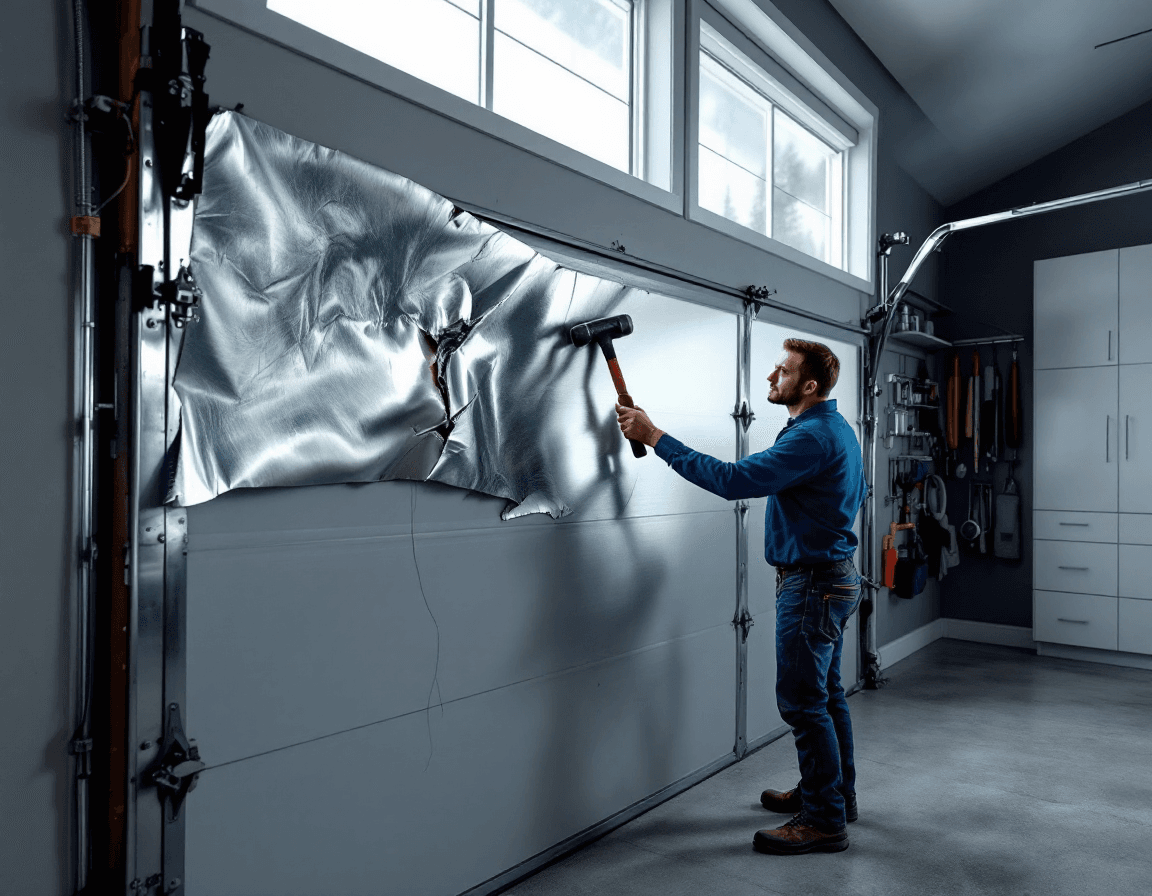
Garage Door Panel Replacement in Tacoma, WA is often the smartest fix for a door that still opens and closes smoothly but has a dented, cracked, or water-damaged section. Tacoma homeowners deal with a particular mix of wet winters, salt-tinged air drifting in from Commencement Bay, and wind that funnels through the valleys between the hills. Those conditions wear on the outer skin of a garage door faster than many people expect. A single ruined panel can make the whole door look neglected, even when the springs, rollers, and opener are in good shape.
Replacing a panel rather than the entire door can save a significant amount of money, and it lets you keep a door you already know works. The key questions are whether the damage is limited to one or two sections, whether the replacement can be matched well enough to look right from the street, and whether the rest of the door is sound enough to justify the investment. Our technicians answer those questions on every visit, and we explain the tradeoffs before any work begins. This page walks through how panel damage happens in Tacoma, how to tell when a swap makes sense, what the work involves, and what you can expect to pay.
If you live in the North End, Proctor, Downtown, the Stadium District, Hilltop, or anywhere else in the city, the guidance below applies to you. We also serve surrounding Pierce County communities, so if your home sits just outside city limits, you will still get the same straightforward assessment. Call (888) 799-3819 whenever a dent, crack, or soft spot appears, because early attention often keeps a small repair from becoming a larger one.
How Tacoma's Weather Works Against Garage Door Panels
Tacoma's winters are long, gray, and damp, and that moisture does not always stay on the outside of the door. Rain soaks the bottom edge of a door every time a car pulls in with wet tires or when wind pushes water under the seal. Over a season, that repeated wetting can soften the bottom section, especially on older wood-core or foam-filled doors where the panel is not fully sealed at the seams. Steel doors can trap condensation between the layers, which then works its way into hinges and fasteners.
The city's proximity to saltwater adds another layer of concern. Salt-laden air settles on exposed metal and accelerates corrosion around scratches, chips in the paint, and fastener holes. Homes near the waterfront and in lower-lying areas near the Thea Foss Waterway often show rust earlier than homes on the higher slopes, although wind-driven spray can reach surprisingly far inland. Ignoring a small rust spot in February often means finding a perforated panel by the following autumn.
Wind matters too. Gusts that roll off the Sound and funnel through Tacoma's streets can push a parked car's door against a garage door, or send a stray branch or trash bin into the panel. Many panel problems we see are not caused by weather alone but by a combination of wind, debris, and a lightweight steel skin that was never designed to absorb a hard knock. Understanding these local pressures helps you decide when to repair, when to replace, and which upgrade will hold up best.
Recognizing When a Single Panel Is the Real Problem
Not every ugly garage door needs a new panel. The first step is to walk out to the driveway, stand about twenty feet back, and look at the door in daylight. Note whether the damage is confined to one section or spreads across several, and whether the dent is a shallow ripple or a sharp crease that breaks the paint. Pay attention to whether the door still tracks evenly, closes fully, and seals against the floor when it reaches the bottom.
A door that is mechanically sound but cosmetically damaged is a good candidate for panel replacement. If the springs are new, the track is straight, and the opener runs without strain, the only real issue is the skin of the door. That is exactly the situation where replacing one or two sections restores both the look and the protection without the expense of a complete new door. Swapping panels also keeps the door's existing weight balance and hardware in place, which avoids unnecessary rebalancing.
Some warning signs point toward a broader problem that a panel swap alone will not solve. If the door binds, pulls to one side, or sits unevenly, the cause may lie in the springs, cables, or track rather than the panel. Those components carry serious tension, and any work on them should be left to a licensed, bonded, and insured technician. We can inspect the full system during a panel visit so you know whether a simple panel replacement is enough.
Dents, Creases, and When Hammering It Out Is Not Enough
A shallow dent in a steel panel sometimes looks like a candidate for DIY straightening, but the reality is more complicated. Steel panels on modern doors are usually insulated sandwich construction, with a thin outer skin bonded to foam. When that skin is pushed in, the foam beneath can crack, separate, or lose its insulating value, and hammering from the outside often stretches the metal further. A dent that looks cosmetic can hide compromised insulation that affects comfort in an unheated garage.
Creases are harder still. A sharp fold in the metal weakens the panel at that line, and it will keep showing through the paint no matter how carefully it is pushed back. Cracks in vinyl or composite panels are even less forgiving, since the material does not reshape well and tends to spread along the grain or stress line. In these cases, attempting a patch often creates a messy result that draws more attention than the original damage.
Replacing the panel is typically the cleanest path when the metal is creased, when insulation is visibly compromised, or when the crack runs through a stress point. A technician can remove the damaged section, inspect the adjoining hinges and rollers, and install a matching replacement without disturbing the rest of the door. We do not recommend prying or loading springs or cables yourself as part of this work, because those components store enough energy to cause serious injury. A licensed professional handles the tension system safely while the panel is swapped.
Bottom Sections, Water Damage, and Hidden Rot
The bottom section of a garage door takes the worst of Tacoma's weather. Water pools against it, splashes up from the driveway, and seeps in through a worn bottom seal. Over time, that moisture can swell the edges of a wood or composite panel, rot the core, and cause the paint to blister or peel. Many homeowners notice the problem only when the door starts to sag or when a child or pet finds a soft spot along the edge.
Impact damage at the bottom is also common. A backing vehicle, a lawn tractor, or a snowblower pushed too hard against the door can crumple the lowest panel and bend the adjoining hinge. The bottom panel often carries more weight than people realize, since it supports the flex of the entire door during opening and closing. A cracked bottom section can shift the balance of the door and put extra strain on the opener.
When rot or water damage extends into the framing or the bottom bracket, a panel replacement may need to be paired with hardware repair. We inspect for these issues at the same visit so the quote reflects the real scope of work. If the damage is limited to the panel itself, replacing that single section is usually the most economical fix and keeps the rest of the door in service.
Rust on Steel Panels and What to Do About It
Rust on a steel garage door rarely announces itself gracefully. It often starts at a small chip in the paint, a scratch from a bicycle handle, or a fastener hole where moisture has been sitting. Around Tacoma's coastal-influenced air, those tiny flaws can bloom into orange patches within a single wet season. Once rust has eaten through the outer skin, it can spread beneath the paint and undermine the surrounding metal.
Surface rust caught early can sometimes be treated by cleaning the area, removing loose material, priming, and repainting. However, once a panel is perforated, flaking, or soft to the touch, the metal has lost too much integrity to hold a finish reliably. Replacing that section gives you a fresh, factory-finished panel, which is more durable than a touch-up over compromised steel. It also prevents rust from migrating to the adjoining panels through shared seams.
Prevention matters just as much as repair. Rinsing the door periodically, especially after winter storms, helps remove salt and grime that accumulate on lower sections. Touching up chips promptly keeps moisture from reaching bare metal, and checking the bottom seal each fall helps prevent standing water from sitting against the panel. These habits are inexpensive compared to the cost of letting rust take hold.
Finding a Match for a Panel That Has Faded Out of Production
Matching a replacement panel is one of the trickier parts of the job. Garage door manufacturers update their profiles, colors, and textures over time, and a model installed fifteen or twenty years ago may no longer be sold in the same style. Even when the design is still listed, sun exposure over many years may have faded the existing finish so that a brand-new panel looks noticeably different beside its neighbors. This is especially visible on the south- and west-facing doors common in some Tacoma neighborhoods.
Start by identifying the manufacturer, model, and series if you can. The label is often printed on the inside of the door near the bottom or on the back of the panel edge. If you cannot find a label, bring a photo that shows the full door face, the panel pattern, and any windows or decorative hardware, and a technician can usually identify the closest match. Keep in mind that paint color, panel thickness, and embossing all affect how a replacement will look in daylight.
When an exact match is impossible, we discuss the options openly. Sometimes the best choice is to replace the damaged section with the closest available panel and to plan for a full re-finish if you want uniform appearance. In other cases, a complete door replacement may be the better long-term decision, particularly if the panel style is discontinued and multiple sections have aged unevenly. We will tell you honestly which path makes sense rather than pushing an expensive option.
A Practical Path for Deciding Between Repair and Replacement
Making the call between repairing a panel and replacing it is easier when you break the decision into a few clear questions. A technician can usually answer them during a single visit, and we encourage homeowners to ask. The goal is to avoid spending money on a fix that will not last, and also to avoid replacing a door that still has years of life left.
- Is the damage limited to one or two panels, with the rest of the door in good condition?
- Does the door track evenly, close fully, and seal at the bottom without binding?
- Is the metal creased, cracked, perforated, or soft, rather than just scratched or dented?
- Can a matching or close-match panel still be sourced for your door model?
- Are the springs, cables, and opener in serviceable condition for the years ahead?
- Do the replacement costs for the affected sections approach the price of a new door, and does the existing door still have useful life?
If most of these answers point toward a contained problem, panel replacement is usually the right choice. If the answers reveal widespread rust, structural fatigue, or mismatched sections that will never look right, a full door replacement may deliver better value over the next decade. We are happy to walk through the numbers either way.
What a Panel Replacement Visit Typically Involves
A panel replacement is a focused job, but it still requires care and the right equipment. The technician begins by inspecting the door from both sides, checking the panel seams, hinges, rollers, and bottom seal, and confirming the model and dimensions. Before any work begins, the tension system is documented and left alone, because springs and cables should only be adjusted or released by licensed professionals using proper winding bars and safety procedures.
Next, the damaged section is carefully disconnected from its neighbors. This usually means removing the hinge fasteners, backing out screws along the rail edges, and separating the panel without bending the adjoining sections. The replacement panel is then fitted, aligned with the track, and secured with new hardware where needed. The door is cycled several times to confirm smooth travel, proper seal contact at the floor, and even balance.
Finally, the technician tests the opener and safety reversal system to confirm the door responds correctly. We clean up debris, check the finish against neighboring sections, and explain any maintenance that will keep the new panel performing well. Homeowners should never attempt to replace panels that remain under spring tension, and we strongly recommend scheduling this work with a licensed professional who carries proper insurance and bonding.
Understanding What Panel Work Costs in Tacoma
Panel replacement pricing generally falls between $250 and $800 per section, depending on the door. The range reflects several factors, including the type of material, whether the panel is insulated, how easily the profile can be sourced, and how much labor is needed to separate and reinstall the section. A flat, basic steel panel on a common residential model generally sits near the lower end, while a custom wood-look panel, a glass insert section, or a discontinued profile can push the cost higher.
Several local considerations influence the final number. Older homes in the North End and Stadium District sometimes have carriage-style or specialty doors that require more time to match, and Hilltop homes with steep driveways may need extra care when staging the door. Access also matters, because a tight single-car garage tucked near a property line can slow the job compared to an open driveway with plenty of room. We provide a clear, itemized estimate after inspection so there are no surprises.
It is worth comparing the cost of panel replacement against the value of the door as a whole. If one section costs a few hundred dollars and the rest of the door is sound, you are paying to restore appearance and protection without replacing hardware that still works. If several sections need work, the total can approach the cost of a new door, and that is the point where a broader conversation about replacement makes sense. We will never recommend work the door does not need.
Neighborhood Notes from Tacoma's Hills, Flats, and Historic Streets
Tacoma's neighborhoods each bring their own garage door character. Downtown and the Stadium District feature many older homes, some with detached garages or alley access, where wood and early steel doors have seen decades of weather. The historic character of these blocks means homeowners often prefer panel repairs that preserve the original look, and matching work is especially important here. Near Wright Park and along the streets that climb toward the Stadium High School area, shaded lots can keep doors damp longer, which encourages rot on lower sections.
The North End and Proctor areas blend older bungalows with more recent additions, and many garages sit close to the street where backing accidents and runaway trash bins are more common. Proctor's shops and busy corridors along Sixth Avenue see plenty of foot traffic, and some homeowners on those blocks have reported bumps from delivery vehicles and bicycles near their garage entries. Replacing a single dented panel quickly often prevents the surrounding sections from developing stress cracks. These are the sorts of local patterns our technicians see again and again.
Hilltop presents its own challenges. Steep grades, exposed lots, and strong winds coming off the higher ground can rack a garage door, loosen fasteners, and drive debris into the lower panels. Homes near the Hilltop core and along the slopes often benefit from periodic inspections, since small impacts from wind-blown items can crack panels that look fine at first glance. Whether you are in the flats or on the hill, a short check-up after a major storm is a smart habit.
Serving Tacoma and Pierce County ZIP Codes
Our technicians provide garage door panel replacement across Tacoma and the surrounding Pierce County communities, including the following ZIP codes:
- 98402, 98404, 98405, 98406, 98407, 98408, 98409
- 98418, 98421, 98422
- 98444, 98445
- 98465, 98466, 98467
We regularly travel between downtown Tacoma, the North End, Proctor, the Stadium District, Hilltop, and the broader county, so scheduling is usually flexible. When you call, mention your ZIP code and a brief description of the damage, and we will confirm availability and whether a photo can help us prepare. Being specific about the panel location, the door model, and any visible water or rust makes the first visit more productive.
Every visit begins with a clear explanation of what we see, what we recommend, and what it will cost. Our technicians are licensed, bonded, and insured, and we treat every spring, cable, and tension component as a job for trained professionals only. If your Tacoma garage door has a damaged panel, do not wait for a small dent or soft spot to become a full replacement. Call (888) 799-3819 today to schedule an inspection and get honest guidance on whether a panel swap is the right fix for your home.