
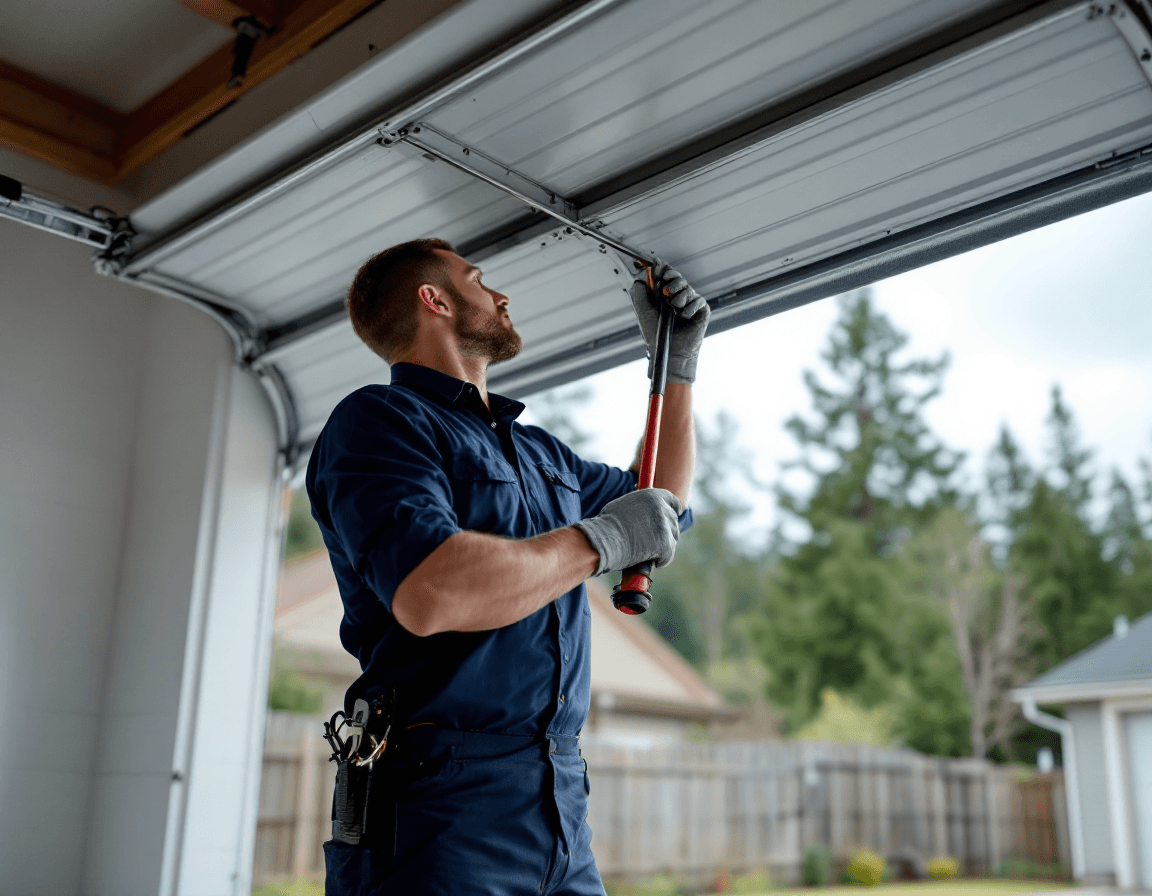
Garage door spring replacement in Edgewood, WA is one of the most common repairs we handle for homeowners in the Edgewood Meadows area and across the wider Pierce County corridor. The springs carry most of your door's weight, so when one fails, the door usually stops working right away. Many Edgewood households first notice the problem when the door refuses to rise, when the opener groans without moving the door, or when a sharp crack comes from the garage without warning. A failed spring is not a minor inconvenience, because the tension stored in it can release suddenly and cause injury or damage if someone is nearby.
This page explains what a broken spring looks like, why it happens so often in our region, and how we approach replacement. We cover the difference between torsion and extension springs, the symptoms that point to a spring problem instead of an opener problem, and what affects the price. We also explain why high-cycle springs and careful door balancing matter for heavier doors, and what you can safely check on your own before calling for service. Most spring replacements we handle fall within a range of $180 to $450, though the final figure depends on your door and the components involved.
Whether your door has just come off its track after a break or you are noticing early warning signs, the right next step is the same: keep people and pets away from the door, avoid using the opener, and have a licensed technician inspect the system. You can reach our team at (888) 799-3819 to talk through what you are seeing. The sections below walk through each step in detail.
Reading the Bang: What a Snapped Spring Sounds and Looks Like
A spring that breaks often announces itself with a loud bang that sounds like a gunshot or a heavy metal pipe dropping inside the garage. Some Edgewood homeowners hear it while they are inside the house and assume a vehicle has struck the door or a tool has fallen off a shelf. The noise is the sound of the coiled steel releasing its stored energy all at once, and it can be startling even when you know what it is. Many people describe it as the loudest thing that has happened in their home all year.
After the bang, look at the spring from a safe distance, without touching it or standing beneath it. On a torsion system, the spring is mounted on a steel shaft above the door opening, and a break usually shows up as a visible gap in the coil or a spring that looks stretched and loose. On an extension system, the spring runs along the side of the track, and a break may leave one spring hanging slack or pulled away from its anchor point. Either way, the door will typically be stuck partway down, or it may feel suddenly very heavy to lift by hand.
Do not attempt to lift the door by hand, pull on the cables, or try to hold it up with a ladder or a stack of boxes. A door that appears stable can drop without warning once it is disturbed, and a broken spring can leave the door unbalanced in ways that are hard to predict. If the bang came with a visible gap in the torsion coil, treat the entire system as unsafe until a licensed technician has checked it. Keep children and pets out of the garage and disconnect the opener at the wall if you can reach it safely.
Torsion Versus Extension: Which Spring Your Edgewood Door Is Carrying
Before any repair begins, a technician needs to know which type of spring system your door uses, because the replacement procedure and the parts differ substantially. Torsion springs are mounted horizontally on a shaft above the door and twist to store energy as the door closes. They are the more common setup on newer garage doors in the Edgewood area, and they generally produce smoother, quieter operation when they are properly balanced. Extension springs sit along the horizontal tracks on each side of the door and stretch as the door opens.
Extension springs are often found on older homes and on lighter doors, and they usually come with a safety cable running through the center of each spring. That cable is designed to keep the spring from whipping across the garage if it breaks, and it must be correctly installed and undamaged during any replacement. A common mistake we see is a homeowner who replaces only the visible spring and leaves a frayed or improperly anchored safety cable in place. Our technicians check every anchor point, pulley, and cable run before they consider the job complete.
Torsion systems carry their own hazards, mostly because the winding process stores a great deal of energy. Winding cones, winding bars, and the shaft itself can cause serious injury if they slip, which is why these repairs belong to trained professionals who use the right tools and follow a set procedure. If you own a door with a torsion system, please do not attempt to wind or adjust the spring on your own, even if you have watched a video or helped a neighbor before. Identifying your system is useful for understanding your repair, but the actual work should always be handled by a licensed technician.
Why Pierce County Winters and Damp Air Wear Springs Down
Western Washington is known for its long, damp winters and its steady, fine rain, and those conditions affect garage door hardware in ways that homeowners do not always expect. Moisture that settles on the springs, shaft, and bearings encourages surface rust, and rust weakens the steel over time. When a spring is already close to the end of its rated life, a damp season or a sudden cold snap can be the final push that causes it to fail. Garages in the Edgewood area that sit near the Puyallup River valley or in lower, wetter spots may see this effect more often.
Temperature swings also play a role. Steel expands and contracts as temperatures change, and a spring that is under heavy tension may fail during a cold morning more readily than during a mild afternoon. Many Pierce County homeowners notice their door struggling on the first freezing mornings of the year, and that is often when a weakened spring finally gives way. Garages that are not insulated or that share a wall with an unheated space tend to experience larger swings in temperature than the rest of the house.
Good maintenance can reduce this wear, but it cannot stop it entirely. Keeping the springs clean, applying a light lubricant designed for garage door parts, and checking for early rust spots each season can help extend their life. Tightening loose hardware and keeping the door balanced also reduce the strain on each spring. A service visit every year or two gives a technician the chance to spot wear before it leads to an unexpected break on a cold weekday morning.
Door Stuck a Few Inches Up: Diagnosing Partial Lifts Safely
One of the most frustrating symptoms is a door that opens a few inches and then stops, sometimes with the opener straining or clicking as if it is trying to keep going. This pattern often signals a spring problem, especially when the door was working normally the day before. A broken spring removes the counterbalance the door depends on, so the opener must lift the full weight on its own, and many openers will shut off or stall when they cannot manage the load. Partial lifts can also come from track obstructions, damaged rollers, or a misaligned sensor, so the cause is not always obvious.
Homeowners can safely perform a few basic checks without touching any spring or cable. Start by looking at the tracks from the side of the door, away from the path of the panels, to see whether anything is blocking the rollers. Check the weather seal and bottom edge for debris that might be caught in the track, and make sure the opener's emergency release is in its normal position. If the door sits level and nothing appears out of place, a broken spring becomes the more likely culprit.
Here is a short list of signs that point toward a spring issue rather than a simple obstruction:
- The door stops at the same height every time, often a few inches to a foot off the ground.
- A visible gap appears in the torsion coil, or an extension spring hangs slack along the track.
- The door feels much heavier by hand when the opener is disconnected and the door is lifted carefully from its lowest safe position.
- The opener runs for several seconds, strains, and then reverses or stops entirely.
If several of these signs are present, stop using the door and call a licensed technician. Attempting to force the door higher can damage the opener, the tracks, and the remaining spring. A proper inspection will confirm the cause and let us recommend the right replacement before the situation gets worse.
Cables Off the Drum: The Hidden Damage After a Break
A spring break frequently does more than just cut the spring in half. When the tension releases, the lift cables can slip off the cable drums, jump their channels, or fray where they wrap around the drum. Once a cable is off the drum, the door may look like it is still hanging normally, but it is no longer properly anchored, and any attempt to operate it can make the damage worse. Cables that have been stretched or kinked during a break should be replaced rather than reused, because a cable that has lost its integrity can snap under load later.
Inspect the cable drums from a safe distance if you can see them clearly. Look for a cable that appears loose, twisted, or pulled out of its groove, and note whether the drum itself looks cracked or deformed. Do not try to rewrap a cable or pull it back onto the drum, since the cable is under tension even when the spring is broken, and it can whip if released suddenly. Our technicians release and secure the tension in a controlled manner before inspecting the drums, cables, and anchor brackets.
Replacing cables along with the spring is usually the most reliable approach, especially on older doors where the cables have been in service for many years. Many Edgewood homeowners ask whether they can save money by reusing the cables, and the honest answer is that a damaged cable is a real safety concern. A new spring paired with worn cables may fail again sooner than expected, and the door will not balance correctly. Our technicians will tell you plainly what they find and explain which components are worth replacing.
What a Typical Spring Swap Costs Around Edgewood
Most spring replacements in and around Edgewood fall between $180 and $450, depending on the type and size of the spring, the door's weight, and the amount of related work required. The lower end of that range often applies to a straightforward extension spring replacement on a lighter single-car door. The higher end usually reflects a torsion system, a heavier double-car door, or a job that includes cable replacement, drum repair, and full rebalancing. Every door is different, so we give you a clear quote after inspecting the system rather than guessing from a phone call alone.
Several factors influence the final figure. The spring's cycle rating and whether you choose a higher-cycle option will change the price, as will the need for new bearings, brackets, or a safety cable. Door weight matters because heavier doors require springs with more lifting force, and some insulated or wood-paneled doors fall into that category. Accessibility also plays a role, especially if the garage has low ceilings, a tight workspace, or a stored vehicle that must be moved.
Keep in mind that the cheapest quote is not always the best value for your household. A spring installed without a complete balance check may wear quickly, strain the opener, and lead to a second service call. When you compare estimates, ask whether the price includes inspection of the cables, drums, bearings, and opener connection, and whether a balance test is included after installation. A thorough repair often saves money over the life of the door.
High-Cycle Springs and Balance Tuning for Heavier Doors
Springs are rated by the number of open-and-close cycles they are designed to handle, and standard springs commonly carry ratings that suit typical household use. Homes with heavy doors, frequent daily use, or multiple family members coming and going may benefit from higher-cycle springs, which are manufactured to tolerate more repetitions before fatigue sets in. Higher-cycle options cost more up front but can reduce the frequency of replacement for busy households. We discuss this choice with every customer based on how often the door is used and how much it weighs.
Balance is just as important as the spring itself. A correctly balanced door should stay in place when you lift it partway by hand, with the opener disconnected, and it should not drift up or down on its own. If the spring tension is too strong or too weak for the door, the opener will work harder than it should, the panels may bind in the track, and the door may close too fast or land unevenly. Our technicians test and adjust the balance after installation so the door moves smoothly and the opener is not overloaded.
Heavier doors in Edgewood, especially insulated models or doors with glass inserts and heavier hardware, deserve particular attention during balance tuning. A door that was balanced for a lighter panel setup may not perform well after an upgrade or a panel replacement. When the springs are matched to the door's actual weight and the balance is verified, the door tends to last longer, the opener runs quieter, and the risk of a sudden failure drops considerably.
Opener Hum, Door Barely Moves: Telling a Spring Problem From an Opener Problem
When a garage door opener hums loudly but the door barely moves, many homeowners assume the motor is failing. In reality, the opener is often working as designed, but it is trying to lift a door that has lost most of its counterbalance. A motor that is pushed past its limits can overheat, trip its internal protection, or wear out prematurely, so it is wise not to keep pressing the button. If the opener hums and the door moves only an inch or two, a broken spring is a likely explanation, though a seized trolley or a bent track can produce similar symptoms.
To help separate the causes, watch what happens when you press the button from a safe position, without standing under the door. Note whether the door begins to move at all, whether it rises evenly on both sides, and whether the opener's light flickers or its motor cuts out. If the door lifts smoothly with the opener disconnected but refuses to rise when connected, the opener may be the issue. If the door resists lifting by hand, the spring system is more likely at fault.
Our technicians test both the spring system and the opener before recommending a repair, because replacing the wrong component costs you time and money. In some cases the opener needs adjustment, a new limit setting, or a new drive belt or chain. In others, the spring has to be replaced before the opener can operate properly. A clear diagnosis lets you avoid unnecessary parts and keeps the repair focused on what actually failed.
Closing Too Fast or Crooked: Balance Clues Homeowners Often Miss
A door that slams shut or closes faster than it should is not just noisy. It can damage the bottom seal, stress the tracks and rollers, and create a pinch hazard for anyone standing nearby. A door that closes crooked, with one side reaching the floor before the other, points to an imbalance in the spring tension or a cable that is not seated evenly on its drum. Both problems deserve prompt attention, because they tend to worsen as parts wear unevenly over time.
Some of these clues are easy to spot. Look at the bottom seal to see whether one end is compressed more than the other, and check the tracks for scraping or uneven gaps at the top. Pay attention to whether the door appears to drop quickly once it passes a certain height, which can indicate that the spring tension is no longer matched to the door's weight. Listening for a grinding or popping sound during closing is also useful, since it often signals a roller or hinge problem that accompanies a balance issue.
Unbalanced doors should be checked by a licensed professional rather than adjusted with trial and error. Turning a winding bar or changing cable tension without proper training can lead to serious injury, and it can also worsen the imbalance. Our technicians will measure the door, check the cables and drums, verify the spring tension, and test the balance so the door closes smoothly and evenly. This process is the only reliable way to correct a door that is closing too fast or crooked.
Keeping Your Replacement Springs Healthy Between Service Visits
After a new spring is installed, a few simple habits can help it last as long as possible. Keep the garage clean and free of standing water, especially during the wet months when runoff and humidity are common across Pierce County. Wipe down the springs and shaft periodically with a dry cloth to remove grime and early rust, and apply a light coat of garage door lubricant to moving parts as recommended for your system. Avoid spraying lubricant directly onto the springs in a way that attracts dust, and never lubricate the cables with products that can damage them.
Watch for early warning signs that often appear before a spring fails. Pay attention to new noises during operation, uneven movement, or a door that seems slightly harder to lift in the morning compared with the evening. Look at the spring for any new rust, flaking, or discoloration, and note whether the door's balance has changed since the last service visit. Catching these signs early gives you time to schedule a visit rather than dealing with a sudden break.
Here is a practical maintenance checklist for Edgewood homeowners:
- Test the door balance twice a year by lifting it partway by hand with the opener disconnected.
- Inspect the springs, cables, and drums for rust, fraying, or looseness every season.
- Keep the tracks, rollers, and hinges clean and lightly lubricated.
- Schedule a professional inspection every year or two, especially before the cold months.
- Never wind, adjust, or remove a spring yourself, regardless of how simple the task looks.
A professional inspection every year or two gives you the best protection against an unexpected failure. Our team can check your springs, cables, balance, and opener in one visit and tell you honestly what is working well and what will need attention soon. If your door is showing any of the symptoms described on this page, or if you simply want a clear picture of its condition before winter arrives, call Seattle Garage Door Fix at (888) 799-3819 to schedule a licensed technician for your Edgewood home.