
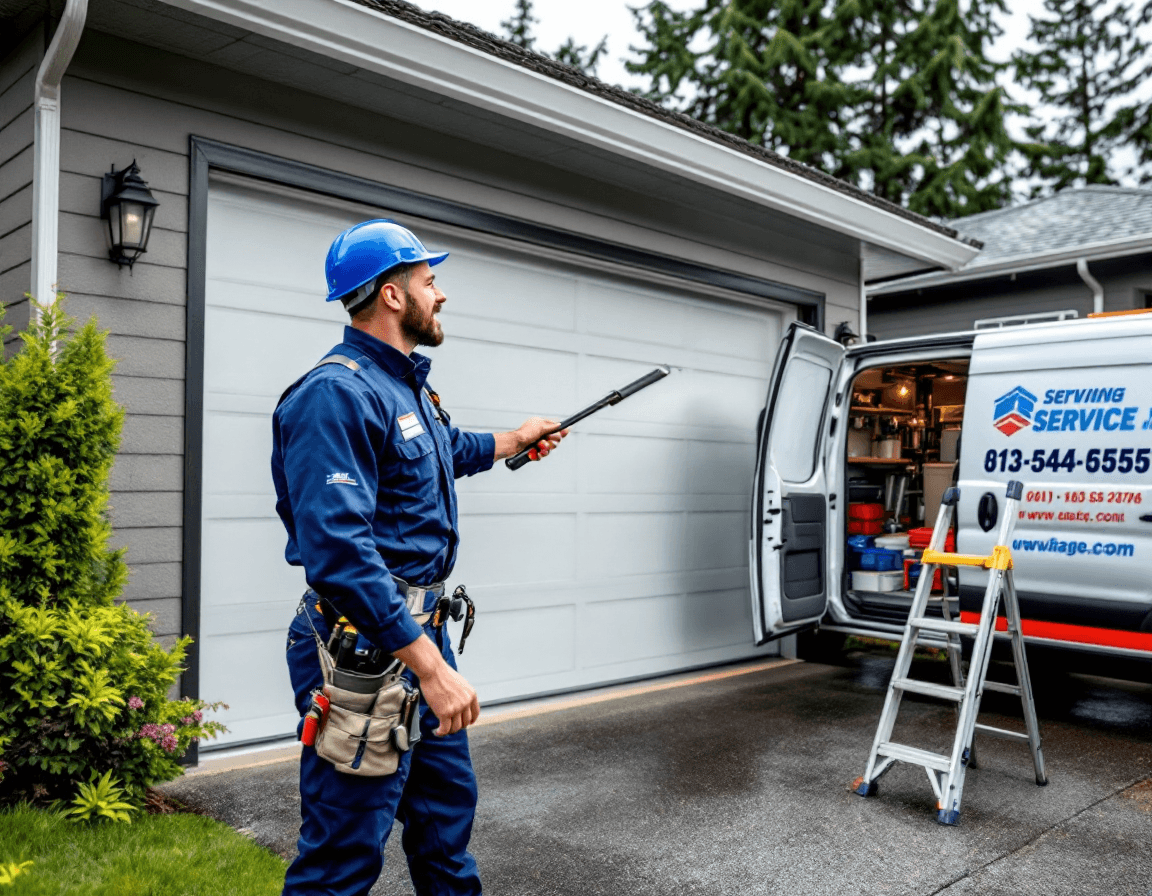
Garage door repair in Edgewood, WA is one of those home services people put off until a Tuesday morning when the car is trapped inside and the coffee is getting cold. Our technicians serve Edgewood homes from the quiet cul-de-sacs near Edgewood Meadows to the newer blocks off the main arterials, and the problems we see are remarkably consistent. A door that won't respond, a panel that grinds on the way up, or a section that looks slightly out of level usually has a clear cause and a practical fix. Most residential repairs fall in the $95 to $450 range, depending on the parts involved and how much diagnostic time the problem requires.
This page explains what tends to go wrong with garage doors in our part of Pierce County, what the common symptoms are telling you, and what you can reasonably check before a technician arrives. Edgewood sits in the greater Puyallup area, so the local climate, the age of the housing stock, and the way families use their garages all shape the repairs we see. We have written this the way we would explain it to a neighbor standing in the driveway, with enough detail to help you make a sound decision without turning your weekend into a home-engineering project.
Whether your door has stopped completely or is simply behaving strangely, the sooner you understand the symptom, the easier it is to prevent a small adjustment from becoming a larger repair. Call us at (888) 799-3819 and we will talk through what you are seeing before we ever roll a truck out.
Why Edgewood Garage Doors Live a Harder Life Than You Expect
Western Washington weather is gentle in the sense that we rarely see brutal heat or deep freezes, but it is persistently damp, and that dampness does real work on a garage door over the years. Long stretches of wet, grey winter months keep moisture in the air and in the tracks, and that moisture encourages surface rust on hinges, rollers, and the steel tracks that guide each panel. A door that moves freely in August can feel noticeably heavier in January, simply because cold, damp metal and dried lubricant behave differently than they did during the drier summer months. Homeowners in Edgewood often describe the door as being "slower lately," and that observation is frequently the first clue that lubrication or track alignment needs attention.
Temperature swings also matter more than people realize. A cold snap followed by a mild afternoon causes metal components to contract and expand, which can loosen fasteners, shift brackets, and change how the door sits in its tracks. Garage doors are heavy assemblies that depend on balanced tension, and small changes in that balance show up as uneven lifting, a door that stops partway, or a sudden jolt when the opener engages. Because our winters bring frequent damp days rather than dramatic freezes, the wear tends to be gradual and easy to miss until something finally sticks.
Many of the homes in and around Edgewood have attached two-car garages where the door sees daily use, often multiple times a day as families come and go with school runs, errands, and weekend projects. That repetition is hard on rollers, cables, and the opener's drive system, and it means small issues compound quickly. A roller that was merely noisy in the spring can seize by the time autumn leaves start collecting in the track, and a door that developed a slight imbalance can strain the opener until the motor overheats or the gears strip. Understanding that your door is a working mechanical system exposed to a damp, variable climate helps explain why routine attention matters so much here.
When the Remote or Wall Button Does Absolutely Nothing
There is a particular kind of frustration that comes from pressing the remote in the driveway and getting no response at all. The first step is always to separate the problem into its parts: the remote, the wall control, the opener, and the power supply. Before assuming the worst, check whether the remote's battery is weak, whether the wall button is wired correctly, and whether the opener's lights come on when you press the control. If the opener shows no sign of life, the problem might be as simple as a tripped outlet, a disconnected power cord on the ceiling unit, or a breaker that has been switched off during a storm.
Radio frequency interference and programming issues are also common. If you recently replaced a remote, changed your internet router, or added other wireless devices, the opener may have lost its synchronization or be receiving competing signals. Some Edgewood homeowners discover that a neighbor's device on a similar frequency is causing intermittent failures, which is why a remote can work one day and fail the next. A technician can check the receiver, reprogram the codes, and confirm that the safety sensors are not interrupting the signal, which is a surprisingly frequent cause of a door that refuses to close even when the remote seems to be working.
Safety sensors deserve particular attention because they are designed to stop the door from closing when something is in the way. These photo-eye sensors sit near the floor on either side of the opening, and if one is misaligned, dirty, or damaged, the opener will refuse to close and may flash a light to signal the fault. Spider webs, dust, and the occasional misdirected broom can all block the beam, and a bump during a move-in or a bicycle leaning against the wall can knock the bracket out of alignment. Cleaning the lenses and making sure the two sensors face each other is a simple check, but if the problem persists, the sensor wiring or the logic board may need professional testing.
- Replace the remote battery and test the wall button before anything else.
- Confirm the opener's power cord is seated and the outlet or breaker is active.
- Look for a blinking light on the sensors and wipe both lenses clean.
- Make sure nothing is blocking the path of the door, including stored items near the track.
- If the opener still does not respond, call for diagnostics rather than repeatedly pressing the control.
The Door That Reverses Just Before It Reaches the Floor
A door that starts down, then suddenly lifts back up a few inches before touching the ground, is one of the most common symptoms we hear about. This behavior is almost always a safety feature doing its job. Modern openers are designed to reverse when they detect resistance, and in many cases the trigger is a sensor problem, a floor obstruction, or a force setting that has drifted out of calibration. Leaves, gravel from a driveway that has shifted, a small toy, or even a pooled bit of water can create just enough resistance to cause a reversal, so it is worth looking at the threshold before assuming the opener itself has failed.
Force settings are adjusted through the opener's limit and force controls, and over time those settings can shift, especially after the door has been adjusted or the opener has been reprogrammed. If the door reverses only at the very end of its travel, the down-force may be set too low for the door's weight, or the balance may have changed. A door that is out of balance requires more effort to lower smoothly, and the opener may interpret that extra effort as an obstacle. This is where the difference between a simple adjustment and a more involved repair becomes clear, and it is also where an experienced technician earns their keep by testing the door's balance before changing any settings.
Another frequent cause is a worn or misaligned bottom seal, or a bottom panel that has shifted slightly relative to the track. When the door is not sitting square, one edge can contact the floor before the other, triggering the reversal on one side. Edgewood homes are often built with concrete slabs that settle slightly over the years, and an uneven floor can create the same effect even when the door itself is perfectly healthy. Diagnosing this correctly saves money, because adjusting the force settings on a door that has a floor-level problem will only mask the symptom until it returns.
Grinding, Squealing, and Banging: Listening to Your Door
Noise is a garage door's way of talking, and learning to translate it can save you from a much larger repair. A high-pitched squeal usually points to dry or dirty rollers, hinges, or bearings that need lubrication. A grinding sound often means metal is rubbing against metal somewhere, perhaps a roller that has worn flat, a track that has bent slightly, or an opener gear that has lost some of its teeth. A sharp bang at the top or bottom of the travel typically indicates that the door is hitting a stop too hard, that a spring has lost tension, or that a bracket has come loose.
Edgewood's damp climate tends to make squealing more common in the cooler months, when moisture collects on metal and lubricant thickens or washes away. Rollers with nylon or steel wheels should be inspected for cracks, flat spots, and wobble, and the bearings inside them should spin freely without grit. Lubricating the moving parts with a silicone-based or garage-door-specific lubricant is a reasonable step for a homeowner, but it should be done on the track rollers and hinges only, never on the springs or cables. Greasing the wrong component can attract dirt and make the noise worse over time.
Banging and clunking deserve a faster response because they can signal a loose or failing component under load. If the noise occurs when the door reaches the top or bottom, the limit settings may need adjustment, but if it occurs in the middle of the travel, a worn track section, a loose bracket, or a broken roller may be to blame. Ignoring a loud bang can turn a single broken roller into a panel that jumps its track, which is a far more involved and costly repair. When in doubt, shut the door off from the opener and call a technician rather than continuing to operate it.
Uneven Travel, Crooked Panels, and a Door That Looks Off-Level
A garage door that rises unevenly, with one side noticeably higher than the other, is a symptom that should never be dismissed. The door is designed to move as a single balanced unit, and when one side lags behind, it puts twisting stress on the panels, hinges, and tracks. Over time that stress can bend the top section, pull fasteners loose, or cause the door to jump off its track entirely. Homeowners often notice the problem first when the gap at the top of the door looks wider on one side, or when the bottom seal no longer lies flat against the floor.
Common causes include a broken or stretched cable on one side, a roller that has become misaligned in its track, a track that has been bumped and pulled slightly out of square, or a loosened mounting bracket on the wall or ceiling. In many Edgewood garages, the tracks are mounted to drywall or older framing, and those mounting points can gradually loosen as the door cycles thousands of times over the years. A simple visual inspection can reveal a lot, but any repair involving cables, springs, or the tension system should be handled by a licensed professional rather than attempted by a homeowner.
Off-track doors are the most urgent version of this problem. If a roller has popped out of the track, the door may hang at an angle, refuse to close, or rest partially in the opening. Do not attempt to force the door back into place, and do not try to lift it manually while the opener is still connected. Disconnect the opener's power and emergency release if necessary, keep people and pets clear of the door, and call for service right away. Getting the door back on track and checking the entire system for hidden damage is a job that calls for proper tools and training.
Stuck Halfway, Sagging Sections, and Visible Gaps
A door that stops partway up or down and refuses to move is frustrating, but it also tells you something useful about where to look. A door that stalls at roughly the same height every time often has a problem in one specific area of the track or a binding roller at that point in its travel. A door that stops at random positions may indicate a sensor issue, an opener problem, or a sudden change in balance. Taking note of exactly where the door stops, and whether it stops in both directions, gives a technician a much clearer starting point.
Sagging is another signal worth respecting. If the middle section of the door bows outward or the bottom edge dips in the center, the panels may be fatigued, the hinges may be loose, or the tension in the system may have dropped. Visible gaps between the door and the header, between sections, or along the sides also suggest that the door is no longer sitting square in its opening. Gaps let in cold air, moisture, pests, and dust, and they can affect insulation performance, especially in garages that are attached to heated living spaces.
Many homeowners try to fix sagging or gaps by tightening random bolts, and that approach can actually make things worse. Hinges and brackets are designed to work together, and over-tightening can strip threads or crack the panel edges. A better approach is to note which areas look different, take a few clear photos, and then schedule an inspection. A technician will check hinges, rollers, tracks, springs, and cables as a system, because a problem in one component almost always has ripple effects elsewhere.
Slamming Shut Too Fast: Understanding Speed, Dampening, and Safety
A door that drops quickly and slams at the bottom is more than an annoyance. It places sudden stress on the panels, the bottom seal, and the opener, and it can create a real safety concern for anyone standing near the opening. Many modern openers include a close-speed setting or a soft-start feature, and if those settings have changed or the door's balance has shifted, the door may descend faster than intended. In some cases the opener itself is functioning normally, but the door is heavier on one side, pulling down more quickly than the system expects.
Dampening components, where equipped, also play a role in controlling the speed of the door. Worn dampeners or misaligned brackets can allow the door to fall with less resistance than it should have. Additionally, if the door's springs are weakened, the door may feel light and then drop abruptly when the opener releases its hold. Diagnosing the cause requires checking the balance of the door, the condition of the opener's drive, and the integrity of the tension system, and that diagnosis should be handled carefully because springs carry significant stored energy.
It is worth remembering that a door closing too quickly is a sign the system is out of balance, not simply a setting that needs changing. Adjusting speed without addressing the underlying cause can leave the door vulnerable to damage and create an unpredictable operating experience. A thorough inspection includes testing the door's balance, reviewing the opener's programming, and confirming that the safety reversal system responds correctly when the door meets an obstruction. This layered check protects both the equipment and the people who use the garage every day.
What a Typical Garage Door Repair Costs in Edgewood
Pricing for residential garage door repair depends on what has failed, how accessible the components are, and whether the job requires specialized parts. For most residential repairs, our pricing falls in the range of $95 to $450. Smaller jobs, such as replacing a sensor, realigning a track section, or swapping out a worn roller, tend to land near the lower end of that range. Larger repairs involving multiple components, opener diagnostics, or more involved hardware typically sit higher in the range, and we give you a clear explanation before any work begins so that you can make an informed decision.
Several factors influence the final number. The age and style of the door matter, because older or custom doors may require parts that are less common and need to be sourced separately. The type of opener also affects cost, since some models have proprietary components or electronic boards that need specialized testing. Access and layout play a role too, especially in garages where the tracks or opener mount are hard to reach. We aim to be transparent about these variables and to explain what each option will accomplish, rather than surprising you with unexpected charges.
It is also worth thinking about the cost of delay. A small roller problem can grow into a damaged track, a bent section, or a strained opener if it is left unattended. A sensor issue that is ignored may lead to repeated failed attempts to close the door, which wears the opener's motor. Addressing a symptom early often keeps the final bill lower, and it reduces the risk of a door failing when you need it most, such as during an early morning commute or when you are loading a car for an out-of-town trip.
- Sensor cleaning, alignment, or replacement for a door that will not close.
- Roller, hinge, or track adjustments for noise, sticking, or uneven movement.
- Opener reprogramming, remote synchronization, or limit and force settings.
- Bottom seal or minor panel-level repairs for gaps and floor contact issues.
Why Spring and Cable Work Belongs in Licensed Hands
Garage door springs and cables are among the most dangerous components in any home. Torsion springs and extension springs store enormous amounts of energy, and when they are released improperly they can cause serious injury. Cables carry the load of the door and can snap under tension, whipping through the air with force. For these reasons, any work involving springs, cables, or the tension system should be performed only by a licensed, bonded, and insured professional who has the proper tools and training.
We want to be clear on this point because some homeowners are tempted to try a spring replacement after watching a video or reading a forum post. Even experienced DIYers can misjudge the stored energy in a spring, and the consequences of a mistake can be permanent. If you notice a broken spring, a frayed cable, or a door that seems to hang unevenly because of a tension problem, keep the door closed, avoid trying to lift it manually, and schedule service. In the meantime, keep children and pets away from the door and disconnect the opener if it is safe to do so.
Our technicians are licensed and bonded, and they carry insurance, which protects you and your property during the work. When spring or cable replacement is needed, the technician will explain the scope of the job, the parts involved, and the safety steps taken to complete it. That kind of professional oversight is the best way to ensure that the repair restores your door's balance and that the system operates safely for years to come.
Simple Checks You Can Safely Do Before We Arrive
There are several reasonable checks a homeowner can perform before calling for service, and they can help the technician diagnose the issue more quickly. Start by observing the door carefully as it operates, noting any noises, pauses, or uneven movement. Take a few photos or short videos if the problem is intermittent, since a clear recording can reveal patterns that are hard to describe. Make a note of when the problem started, whether it follows the weather, and whether anyone has recently bumped the door or changed the opener settings.
Next, perform a few basic visual and operational checks that do not involve tension components. Confirm that the remote batteries are fresh and that the wall button is responding. Look at the safety sensors to make sure both lenses are clean, unobstructed, and aligned with each other. Check the track for visible debris, such as leaves or dirt that may have blown in from the yard, and clear the path under the door so nothing rests against the bottom panel. These steps are safe, quick, and often resolve minor issues on their own.
Finally, avoid the following actions, because they can make the situation worse or create a safety hazard: do not attempt to adjust or remove springs, do not pull or lift the door manually while it is connected to the opener, do not force a stuck door, and do not operate a door that is visibly off its track. If you see any of these conditions, shut down the opener and call for service. A careful homeowner who knows the difference between safe checks and dangerous interventions is a valuable partner in keeping the door in good working order.
Garage doors in Edgewood work hard through damp winters, busy family schedules, and the everyday wear of opening and closing hundreds of times a year. When something feels wrong, the best move is to take it seriously and get it looked at by people who do this work every day. Seattle Garage Door Fix provides fast, reliable residential repairs throughout Edgewood and the surrounding Pierce County communities, with licensed, bonded, and insured technicians who will explain the problem, outline your options, and get your door moving again. Call (888) 799-3819 today to schedule service or to describe what your door is doing, and we will help you get back to normal.