
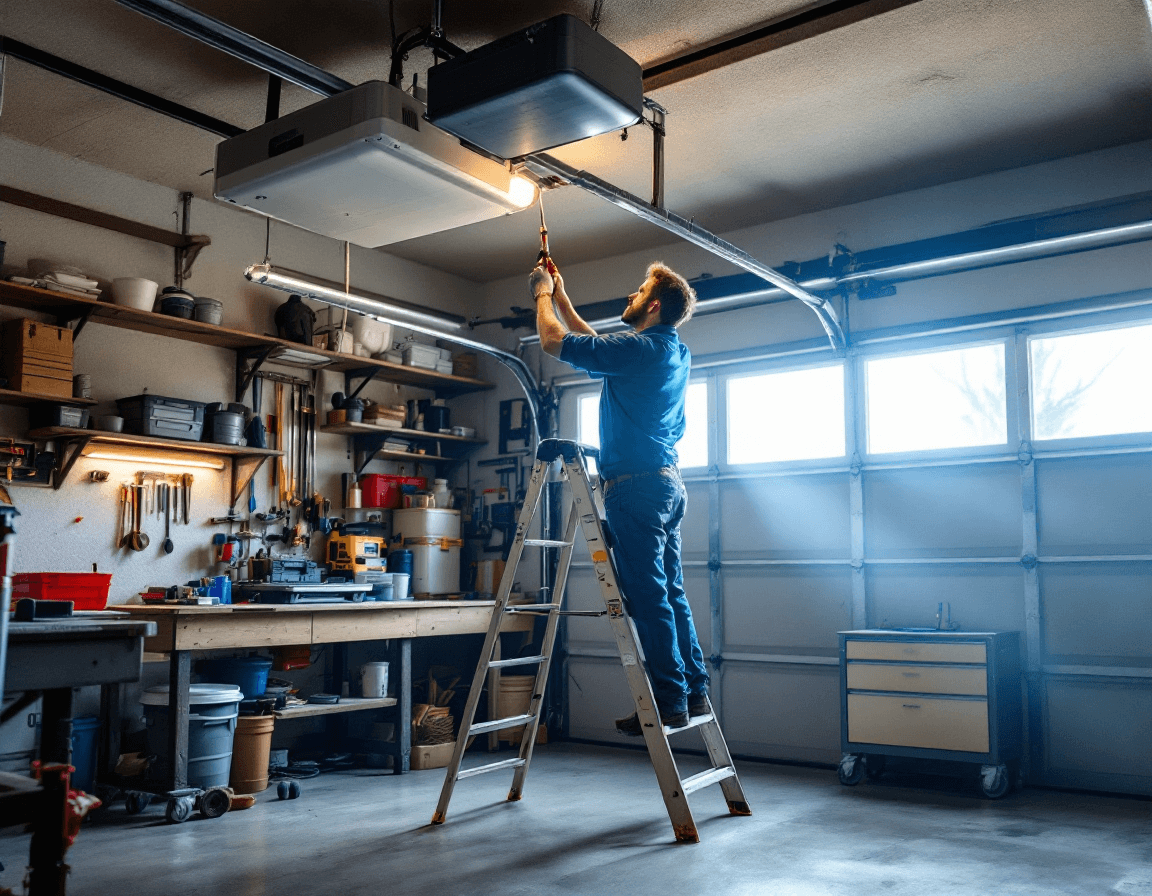
Garage door opener repair in Milton, WA is often the difference between a garage that opens on the first press and one that leaves you sitting in the driveway with the engine running. Milton sits in the southern reaches of Pierce County, tucked among the neighborhoods that border Fife and Edgewood, and many of the homes here have attached or detached garages that see daily use. An opener that worked fine last spring can start acting up after a wet winter, a power flicker, or a remote battery that died quietly months ago. Because the opener is the part of the system that does the lifting, pushing, and stopping, problems with it show up in very particular ways.
This page walks through the troubleshooting path our technicians follow when a Milton homeowner calls about a sluggish, silent, or erratic opener. We cover motors, gear sets, circuit boards, travel limits, safety sensors, and the drive chain or belt that connects everything. Most opener repairs we handle fall within a range of $95 to $375, depending on which component has failed and how much labor the job requires. Our goal here is to help you describe what you are seeing accurately, understand what is likely happening inside the housing, and know when a repair is a reasonable fix versus when it is time to bring in a licensed professional for the heavier parts of the system.
Why Milton Garages Work Their Openers Harder Than They Expect
Pierce County weather is the first factor that shapes how openers behave in Milton. Long stretches of drizzle, damp mornings, and cool nights mean that moisture finds its way into door tracks, hinges, and the wiring that runs up to the opener head. Metal parts that stay humid all winter can develop a film of grime and light corrosion, and that added friction makes the motor work harder every time the door lifts. Many homeowners notice that the door feels fine in August but sluggish in January, and the opener is often blamed when the real issue is a track that needs cleaning or a roller that has lost its smoothness.
Milton also has a mix of housing ages. Older ranch-style homes may still have original openers with worn gear sets and aging logic boards, while newer construction might include a belt-drive unit paired with a smart-home hub that can complicate troubleshooting. A garage that shares a wall with a bedroom or sits at the end of a long driveway may be used several times a day by busy households, which accelerates wear on every moving part. Understanding the age and style of your opener helps us narrow down the likely cause before we ever open the cover.
Power quality matters too. Storms that knock the lights out briefly can cause an opener to lose its memory of travel limits, and some units need to be reset after a surge. If your opener began acting strangely right after a windstorm or a utility outage, that timing is worth mentioning when you call, because it often points toward a control board or limit setting rather than a mechanical failure.
When the Motor Hums but the Door Stays Put
A motor that runs and makes noise while the door refuses to budge is one of the most common calls we take from Milton households. The sound tells you electricity is reaching the unit, but something between the motor and the door is no longer transferring that effort. The problem could be as simple as a disengaged trolley that has slipped off the rail, or as involved as a stripped drive gear or a failing clutch assembly inside the opener head. Because the motor is working, many people assume the motor itself is broken, when in fact it may be doing exactly what it is supposed to do while the drive path is interrupted.
We start by checking whether the emergency release has been pulled, whether the door can be moved by hand when disconnected, and whether the door binds at any point along its travel. A door that is hard to lift manually points toward a spring or track issue, which is outside what a standard opener repair covers and should be handled by a licensed technician who can safely work with tension. If the door moves freely by hand, the issue is almost always in the opener, and we move on to inspecting the carriage, drive mechanism, and limit settings. Clear and specific symptoms help us do this quickly.
Here are the signs that most often accompany a motor-runs-but-door-stays-still problem in Milton homes:
- The motor hums or clicks for a few seconds, then shuts off without moving the door
- The trolley arm detaches from the door bracket or appears loose at the rail
- The emergency release cord has been pulled or hangs at an odd angle
- The door moves a few inches and then stops, often with a clunk
- The opener light blinks or the unit resets itself after the failed attempt
The Remote and Wall Button That Stop Talking to the Opener
When the remote and the wall button both fail to respond, homeowners tend to assume the opener has died. In practice, the cause is often upstream of the motor, in the transmitter batteries, the receiver antenna, the wall control wiring, or the logic board that interprets the signal. A keypad that lights up but does nothing, or a remote whose indicator LED dims significantly when pressed, usually points toward power or battery trouble rather than a full opener failure. Testing the wall button first is a useful diagnostic step, because it tells us whether the problem lives in the transmitter or in the opener itself.
Pacific Northwest humidity can affect these components more than people expect. Moisture inside a wall control or a poorly sealed remote can corrode contacts, and a loose wire at the wall plate may work intermittently depending on temperature and humidity. Milton garages that sit close to the house may see condensation in winter months, so a control that works in the afternoon but fails on a foggy morning may be pointing toward a connection problem rather than a dead board. We check wiring continuity, test the antenna wire routing, and confirm that the receiver is seeing signal from each transmitter in the household.
Reprogramming is another common fix. After a power loss, a battery swap, or a change in a rental or family member's remote, some openers need their codes relearned, and the process varies significantly by brand. We handle programming for the major opener brands we service, and we always confirm that every transmitter in the home works before leaving, so you are not left with a single remote that still functions while the others do not.
Stripped Gears and the Grinding Sound You Should Not Ignore
A grinding or crunching noise from the opener head is one of the more urgent symptoms, and it deserves prompt attention. Most residential openers use a plastic or nylon drive gear meshed with a metal worm gear, and when teeth wear down or strip, the result is a harsh scraping sound that often gets louder with each cycle. Continuing to run a stripped gear can damage the motor shaft or the surrounding housing, which turns a moderate repair into a more expensive one. If you hear grinding, the wisest move is to stop using the opener until a technician has looked at it.
Stripped gears usually develop gradually. Dust, lack of lubrication, and heavy use all contribute to tooth wear, and the Milton climate can accelerate the problem when moisture gets into the gearbox and mixes with old grease. Some owners notice a clicking or chattering during the first few seconds of travel before the grinding becomes constant. Describing that sequence to us helps identify whether the gear is wearing or whether a loose mounting bolt is allowing the assembly to shift under load.
Gear replacement is often one of the more labor-intensive opener repairs, and it can fall near the upper end of our typical pricing range depending on the brand and the parts required. We inspect the gear set, check the shaft and bearings for wear, and confirm that the drive is aligned before reinstalling. Where the housing itself is cracked or the motor shows signs of overheating, we will explain the options clearly so you can decide how to proceed without pressure.
Doors That Close Halfway, Reverse Early, or Refuse to Seal
Travel limits are the settings that tell the opener where the door should stop when opening and closing. When those limits drift, the door may stop a few inches short of fully closed, creep upward after a closing cycle, or reverse the instant it touches the floor. Many of these complaints get blamed on the safety sensors, and while the sensors can cause reversal, a door that reverses without any obstruction usually has a limit-setting problem. Adjusting limits is a common and manageable task, but the exact method depends on the opener brand and model, so following a generic procedure from the internet can leave the system misconfigured.
Auto-reverse is a safety feature, and it should respond to a real obstacle or a sensor misalignment, not to a door that simply touches the floor a bit early. Milton garages often have uneven slabs or slightly sloped drives, and a door that seals snugly on one side may hit the floor differently on the other, which can confuse the force setting. We check the force adjustment, verify that the bottom seal is not caught on debris or a frayed weather strip, and confirm that the opener is not working harder than necessary to lower the door.
Sensors deserve their own inspection. The two photo-eye sensors near the bottom of the door tracks should face each other with a steady indicator light on each side, and a sensor that has been bumped by a bicycle, a shop vacuum, or a rolling trash bin may need realignment. If the indicator lights blink or go dark, the wiring or the sensor itself may need attention. We test each sensor under load so you know the system is protecting people and pets as intended.
Reading the Pattern: What Blinking Opener Lights Are Trying to Tell You
Most opener heads have a light that does more than illuminate the garage. Many units flash in a specific rhythm to signal a fault, and the number of blinks or the spacing between them often corresponds to a particular error. A repeating pattern that starts as soon as you press the button usually means the opener has detected something it does not like, such as a sensor interruption, a limit fault, or an overload. The pattern varies by manufacturer, so the owner's manual or the label inside the cover is the best starting point, but those references do not always explain what to do next.
Our technicians use the flash pattern as one clue among several. We ask whether the light flashed during a single attempt or repeatedly, whether the door moved at all, and whether anything changed right before the problem began, such as a storm, a remote reprogramming, or a new smart device added to the network. A blinking light combined with a door that will not close fully often points toward a sensor or limit issue, while a flash pattern paired with a dead motor can suggest a logic board problem. Matching the light pattern to the symptom on the door is what turns a confusing signal into a plan.
Here are some of the most common light-related situations we see in Milton homes:
- The light flashes rapidly for a few seconds right after the button is pressed, then the door stops
- The light blinks steadily and the door reverses as soon as it begins to close
- The light stays on solid while the motor runs but the door does not move
- The light flashes in a slow repeating cycle after a power outage or storm
- The light turns off intermittently, suggesting a loose connection or failing board
Chains, Belts, and the Slack That Quietly Causes Trouble
The drive chain or belt is what carries the motor's energy to the trolley and, from there, to the door. Chain-drive openers are common in older Milton homes and are known for durability and noise, while belt-drive units are quieter and popular in newer installations. Either type can develop slack, wear, or complete separation, and each problem produces slightly different symptoms. A loose chain may rattle or slap against the rail as the door moves, while a belt that has slipped off its pulley may cause the motor to spin without any real movement on the door.
Slack often develops over time as the chain stretches and the tension adjustment loosens. Milton's damp conditions can contribute to rust on chain links and rail components, which increases friction and makes the chain more prone to jumping off its sprocket. Belts can crack or fray, particularly if the garage gets very cold and then warms up, creating stress cycles in the material. Checking for visible wear, unusual sag, or debris caught in the drive path is a good early step that can prevent a sudden failure.
Adjusting chain or belt tension is generally within the scope of an opener repair, but it requires care. Overtightening can strain the motor and gearbox, while undertightening can cause the chain to jump the sprocket. We check alignment, confirm the rail is secure, and set tension to the manufacturer's specification. If the chain or belt is broken or the rail is bent, we will explain what is needed and provide a clear estimate before proceeding.
Intermittent Trouble That Comes and Goes With the Weather
One of the most frustrating problems for homeowners is an opener that works perfectly most days and then fails at random. Intermittent operation often traces back to a loose wire, a failing connector, a sensor that is shifting slightly with temperature, or a board that is starting to degrade. Because the symptom disappears before the technician arrives, these problems can take patience to diagnose. Keeping a short log of when the opener fails, including the weather, the time of day, and whether the door was used repeatedly, gives us valuable information.
Milton's climate plays a role here as well. Temperature swings between cool mornings and mild afternoons can cause metal and plastic components to expand and contract, which may loosen connections or shift sensor alignment just enough to cause a fault. Humidity can introduce a thin layer of moisture on circuit boards or wire terminals, and that moisture can interrupt signals until it evaporates. An opener that acts up only on foggy or rainy days should be checked for water intrusion, sealed wiring entries, and proper ventilation around the head unit.
We approach intermittent problems methodically. We inspect wiring harnesses, check the power supply, test each sensor and control, and look for signs of heat damage or corrosion on the board. Many intermittent faults are resolved by securing a connection or replacing a worn component, but we will not guess. If the symptoms point toward a board that needs replacement, we will walk you through the reasoning so the repair is based on evidence rather than assumptions.
What a Milton Opener Repair Visit Typically Covers
When you schedule an opener repair with us, the visit usually begins with a conversation about what you have been seeing. We ask about the sounds, the lights, the timing, and any recent changes to the system, because those details narrow the diagnosis before anyone touches a tool. The technician then inspects the opener head, the trolley and rail, the travel limits, the safety sensors, the wall control, and the connections between them. From there, we explain what we found in plain language and outline the options.
Pricing for most opener repairs falls between $95 and $375, depending on the component involved and the labor it requires. A simple adjustment, sensor realignment, or remote programming may sit near the lower end, while gear replacement, board replacement, or a motor repair typically falls higher in that range. We provide the estimate before work begins so there are no surprises, and we will tell you if a repair is not worth pursuing compared with replacing the opener. Clear communication about cost is part of how we earn the trust of Milton homeowners who depend on their garage every day.
Some visits uncover issues outside the opener itself, such as worn rollers, a bent track, or a spring that is near the end of its service life. Those items may be related to the opener's performance, but they fall under different safety considerations and should be handled by a licensed professional. We will document what we see and recommend next steps, so you understand exactly what is happening with the full door system rather than only the opener.
Brand Differences and Why the Right Approach Matters
Garage door openers come from many manufacturers, and each has its own wiring layout, programming method, limit-setting procedure, and error code system. A repair approach that works on one brand may be inappropriate for another, and mixing methods can leave the opener misconfigured or the safety features compromised. Because we troubleshoot every major opener brand, our technicians are used to adjusting for these differences, but we still confirm model details before starting so the repair follows the correct specifications.
Brand matters for parts availability as well. Some common components are widely stocked, while others may require ordering, which can extend the time needed to complete a repair. When we identify the opener model, we can often estimate whether the needed part is likely to be a quick fix or a longer wait. That information helps you decide whether to schedule the repair immediately or consider a replacement if the opener is older and the repair would be expensive relative to its remaining life.
Smart openers add another layer. Units with Wi-Fi modules, app connectivity, or third-party hub integration can fail in ways that look like mechanical problems but are actually network or software issues. A door that opens from the app but not from the wall button, or a notification that arrives late, may point toward connectivity rather than the motor. We check the app settings, the home network connection, and the controller firmware where appropriate, so you do not pay for a motor repair when the issue is in the signal path.
Safety Lines We Hold Even When a Repair Looks Simple
Safety is the foundation of every garage door job we do. An opener repair is generally manageable, but certain parts of the system carry significant stored energy, and mishandling them can cause serious injury. Torsion springs and extension springs hold enormous tension, and cable drums and lift cables can snap with force if they are damaged or improperly handled. For that reason, we always recommend that spring and cable work be performed by a licensed, bonded, and insured professional, and we will never encourage a homeowner to attempt it without proper training and equipment.
Homeowners sometimes try to save money by fixing a spring themselves or by removing the opener to reach a difficult component. Both approaches can lead to injury or additional damage. If your opener repair reveals a spring problem, a cable issue, or a drum that needs replacing, we will explain why that work must be handled by a qualified technician and help you schedule it. Keeping the work in the hands of trained professionals protects your household and your investment.
There are also simple safety habits that help in the meantime. Keep the emergency release cord out of reach of children and pets, do not walk under a door that is moving or appears unbalanced, and test the auto-reverse feature periodically by placing a flat object in the door's path. If the door behaves unexpectedly, stop using it and call for help rather than forcing the opener to finish the cycle. These precautions cost nothing and can prevent injuries that no repair bill could undo.
Milton homeowners who notice any of the symptoms described on this page, from a silent motor to a grinding gear or a blinking light that will not clear, can reach out for a diagnosis and a clear estimate. Our technicians will listen to what you are experiencing, inspect the opener and related components, and explain your options in plain terms before any work begins. Call Seattle Garage Door Fix at (888) 799-3819 to schedule your opener repair in Milton, WA, and let us help get your garage door moving safely again.