
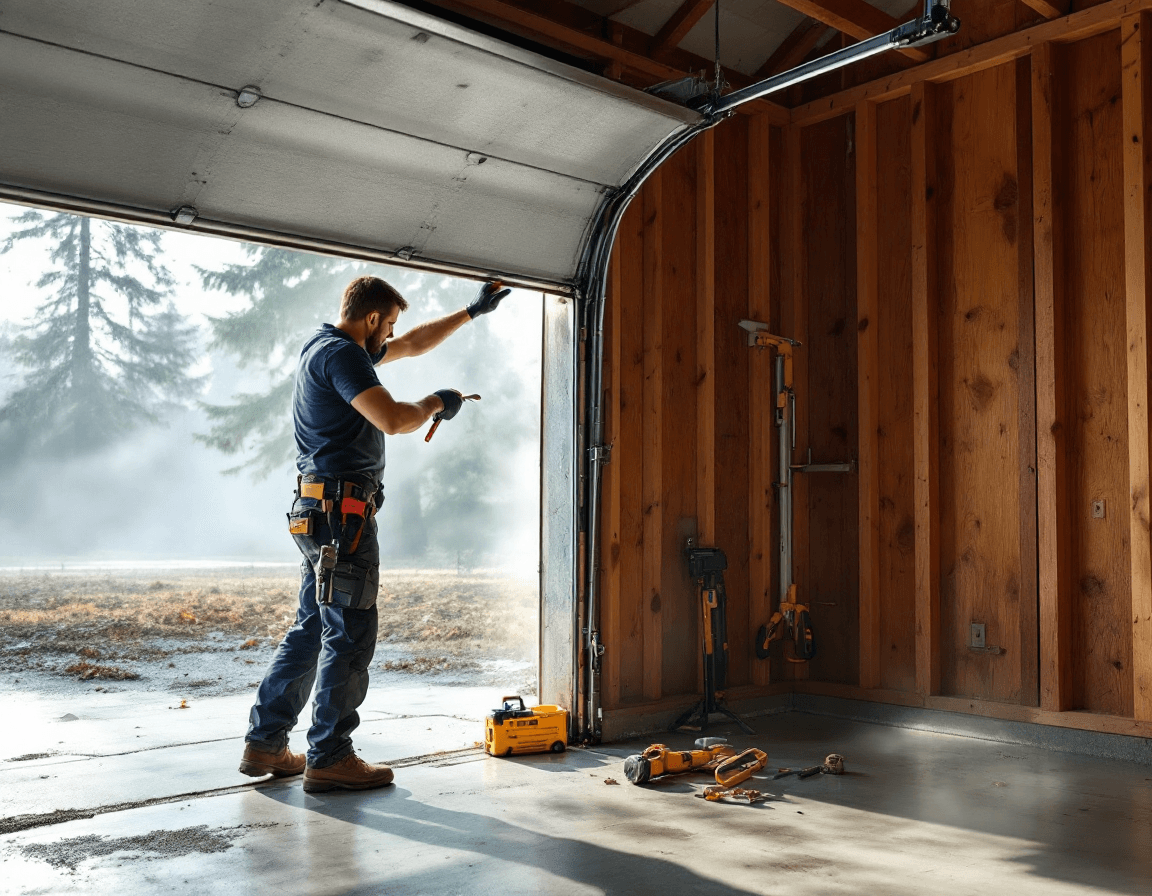
Off-track garage door repair in Algona, WA is one of the more common calls we get from homeowners along the Pacific Algona corridor, and it is rarely the kind of problem that fixes itself. When a door slips out of its tracks, the panels can stop moving smoothly, and the door may sit crooked, jam halfway up, or refuse to close at all. Some of these failures start small, with a single roller hopping out of its channel, while others come from a hard impact that bends steel. Knowing what happened and what to avoid doing next can save you money and keep people in the household safe.
Algona homes sit in a part of King County where wet winters, moist air off the Green River valley, and frequent temperature swings all work against garage hardware. Metal track sections and steel rollers expand and contract through the year, and a door that has been slightly out of square for months may finally give way after a cold snap or a heavy rain. This guide walks through what causes off-track failures, how to recognize the early warning signs, what a proper realignment involves, and what homeowners can reasonably expect to pay. It is written by technicians who work these doors every week, so the advice reflects what we see in real driveways rather than textbook scenarios.
If your door is off its track right now, the most important step is to stop using it. Do not pull on the door, push it up by hand while the springs are under tension, or try to hammer a track back into shape. The sections below explain why those shortcuts are dangerous and what a licensed technician will do instead. Our phone line is (888) 799-3819, and we answer calls from homeowners across Algona and neighboring communities.
Why Doors Keep Leaving the Track Around Algona
Most off-track events have a traceable chain of causes, and in our area the chain often starts with the weather. Persistent rain soaks into the soil around slab edges and migrates into the framing of older garages, which can shift the header and the mounting points that hold the track brackets. Once a bracket moves even a fraction of an inch, the rollers begin riding at a slight angle, and that angle places extra load on one side of the door every time it opens. Over several seasons, that uneven load wears the roller stems and bends the track flange until the roller finally escapes.
Loose hardware is the second major cause we encounter. Lag bolts pulled out of wood framing, track bolts that backed out because nobody tightened them after installation, and hinges that loosened from years of vibration all allow the door to drift sideways. Homes built in the decades before modern door standards often have tracks fastened to thin trim or old sheathing, so a door that operates well for years can suddenly start to walk out of its channel. Mismatched parts, such as a replacement roller with a different stem length or a track section from another manufacturer, cause the same problem.
The third cause is impact. Vehicles backing into a driveway, a delivery truck clipping the corner of the garage, or a lawn tractor striking the lower panels can all push a section of track out of alignment in a single moment. Impact damage is not always visible from the driveway, so a door that seems fine on the outside may still have a track that is bent just enough to cause binding. For that reason, we always inspect the full track path after any collision, rather than assuming the damage stops at the dent you can see.
Warning Signs Before a Door Fully Derails
Off-track failures usually announce themselves before the door actually comes loose. Homeowners often notice a faint scraping or squeaking sound during the first few feet of travel, and that noise is frequently the first sign that a roller is rubbing against the track lip instead of rolling freely. Another early signal is a door that closes unevenly, with one side hitting the floor a second before the other. These symptoms are easy to dismiss during a busy week, but they point to an alignment problem that will only get worse with each cycle.
Visual clues matter too. Look along the vertical tracks from the inside of the garage and check whether the gap between the top roller and the track looks the same on both sides. A gap that narrows on one side, or a door panel that sits visibly closer to the wall on one end, usually means the track has shifted or the bracket has pulled away from the framing. Also watch for shiny scuffs on the track, which indicate metal-on-metal contact, and for rollers that appear tilted in their brackets.
Pay attention to the opener as well. Many openers will automatically reverse or stop when the door encounters extra resistance, so a door that suddenly reverses partway through its path may be binding on a track that has begun to misalign. If the opener strains, hums without moving the door, or runs longer than usual, shut the system off at the wall switch and call for service. Catching the problem at this stage often means a repair that is quicker and less expensive than waiting until a roller pops out completely.
Inside the Track: How Rollers Pop Out and Why It Happens
Each roller in a standard steel garage door rides inside a track channel and is held in place by a short stem attached to the door's hinge or panel. When the track is properly aligned, the roller follows a smooth path and never touches the outer lip of the channel. When the track bends or the roller wears, the stem can lift and the roller can slip past the lip, which is why the door suddenly sits off its track even though nothing appears broken. Once a roller is out, the panel it supports tends to tilt, and the adjacent rollers take on loads they were not designed to carry.
Worn rollers are a frequent contributor. Nylon rollers can flatten or crack after years of use, and steel rollers can develop grooves where the bearing has worn through the surface. A flat or cracked nylon roller may still look intact from a distance, yet it will no longer track straight and will eventually escape the channel. We often replace worn rollers during an off-track visit because reseating an old roller without replacing it just sets up the next failure.
Re-seating a roller is only part of the job. The technician must confirm that the track is straight in the area where the roller sits, check that the bracket holding the track is secure, and verify that the door's panel hinges are not bent or loose. If the roller popped out because the track was pulled away from the wall, simply pushing the roller back into the channel will not hold for long. Proper reseating means restoring the entire geometry the roller depends on.
Bent, Dented, and Separated Track Sections
Track damage ranges from a slight bow in an otherwise usable section to a fully separated joint where two pieces no longer meet. Light bends can often be straightened in place with careful hand adjustment and the right tools, but deep kinks or cracked seams usually require replacing the affected section. A track with a sharp dent will catch rollers at the same spot every cycle, and that repeated catch is what causes the scraping and eventual derailment we described earlier. Leaving a dented track in service tends to damage new rollers and even the door panels themselves.
Separated sections are a particular concern on doors that have been hit by a vehicle. When the force of an impact pulls a horizontal section away from the vertical run, the door can drop unevenly and the springs may shift their load in unexpected ways. A technician needs to inspect the connection points, the mounting brackets, and the header angle before deciding whether the track can be realigned or should be replaced. Rushing this assessment can leave a hidden weakness that fails under the next load.
Do not attempt to straighten a bent track with a hammer or a pry bar while the door is still under tension. Metal that looks simply bent can be under stress that releases violently when disturbed, and a section that appears to spring back into shape can slip and pinch fingers or hands. A licensed technician will release the appropriate tension safely, measure the track against the door's path, and correct the geometry with controlled pressure rather than brute force.
A Quick Homeowner Checklist (Look, Don't Adjust)
There are a few checks that are safe for homeowners to perform, as long as the goal is observation rather than repair. Start with the door in the closed position and the opener disconnected or the power shut off at the breaker. Stand inside the garage and look at each vertical track from top to bottom. The tracks should appear parallel to the door edges and should sit at the same distance from the frame along their entire length.
Next, check the following items and write down anything that looks unusual, so you can describe it clearly when you call:
- Gaps between the door edge and the track that are noticeably wider on one side than the other
- Rollers that appear tilted, cracked, or sitting outside the track channel
- Track bolts or lag screws that look loose, backed out, or pulled away from the wood framing
- Dents, kinks, or shiny scrape marks along the track lip or the horizontal section
- Hinges with visible gaps, bent brackets, or panels that seem to sit at different heights
Once you have completed the inspection, do not attempt to force the door or adjust the springs. Keep children and pets away from the door, and avoid standing directly beneath it. Reporting what you observed gives the technician a head start and helps determine whether a simple alignment will suffice or whether the job will require parts.
Why Spring Tension Is Strictly a Licensed Technician Job
Garage door springs store a large amount of energy, and that energy is exactly what makes an off-track door dangerous to handle. Torsion and extension springs are under constant tension, and even a door that looks motionless may be holding a load that can release suddenly. Cable drums and lift cables are also under stress, and a cable that has slipped from its drum can snap or whip when the door is disturbed. For these reasons, our standard procedure treats any door with a broken spring, a slipped cable, or an unknown tension condition as a job for trained technicians with proper equipment.
We are a licensed, bonded, and insured company, and we do not recommend that homeowners attempt spring or cable work themselves. Improvised methods, such as clamping a door in place with ratchet straps or propping a panel up with a ladder, have caused serious injuries across the region. If the door is off its track and you are unsure whether the springs are involved, treat the situation as if they are. The safest decision is always to keep everyone clear and call a professional.
Even when the springs appear intact, a technician will evaluate the balance of the door before reseating any rollers. A door that is out of balance will drift or slam, and attempting alignment without addressing balance can lead to the same derailment within days. The right approach combines track correction, roller replacement where needed, and a check of the spring system so the door moves evenly from the first inch to the last.
Moisture, Rust, and the Western Washington Factor
Western Washington's climate is kind to lawns and hard on steel. The region's long wet seasons keep garage floors damp, and humidity can linger in attached garages long after the rain stops. Track brackets, hinges, and roller bearings are all vulnerable to surface rust, and that rust can build up in the roller channels and slow their movement. A door that is sluggish in the fall may be signaling corrosion that has been developing through the winter.
Mud, grit, and road debris also contribute. Vehicles tracking in wet soil and gravel from driveways deposit fine particles along the bottom of the door and in the track channels. When those particles are not cleared, they act like sandpaper against the rollers and wear them down faster than normal. Splashback from heavy storms can carry the same debris into the lower tracks, especially on garages with shallow driveway grades.
Simple seasonal habits can make a noticeable difference. Keep tracks free of debris with a dry cloth or soft brush, avoid spraying heavy solvents that can strip factory lubricant, and use a light lubricant recommended for garage door components on the hinges and rollers rather than the track surfaces themselves. Check the hardware twice a year and tighten any bolts that have loosened. These steps will not replace a professional inspection, but they reduce the chance of a surprise derailment on a cold morning.
What Happens During a Typical Off-Track Service Visit
When you call us about an off-track door, the first conversation focuses on what you have observed and whether anyone has been hurt or whether the door is still partially supported. Our dispatch team will ask about the symptoms, any recent impacts or weather events, and whether the door is currently stuck open, closed, or halfway up. This information helps us prepare the right tools and parts before the technician arrives at your Algona home.
On site, the technician begins with a safety assessment. They will identify the status of the springs and cables, confirm the door is secure, and decide whether the door can be moved safely at all. Once the door is stabilized, the technician measures the track path, checks the bracket attachments, and inspects each roller and hinge. Any damaged components are documented so you understand exactly what was found.
Repairs proceed in a logical order. Track sections that are bent but usable are carefully realigned, worn or cracked rollers are replaced, and loose brackets are reattached to solid framing with appropriate fasteners. The technician then tests the door through several full cycles, checking for smooth movement, even gaps, and proper closure. Before leaving, we review what was done, what to monitor, and whether any follow-up work is recommended.
Typical Pricing for Off-Track Repairs in Algona
Most off-track repairs in our service area fall between $125 and $400, depending on the nature of the damage and the parts involved. A straightforward reseating of one or two rollers with a track adjustment usually sits at the lower end of that range, while jobs that involve replacing multiple rollers, straightening a bent section, or repairing bracket damage tend to land higher. Doors that were struck by a vehicle can cost more when the impact has also affected the panels, hinges, or springs.
Several factors shape the final number. The door's size and weight matter, as do the type of track system and whether the track is standard or a specialty configuration. Access can also affect the time required, particularly in garages where clutter or a tight layout makes working around the door more difficult. Parts availability determines whether a repair can be finished in one visit or requires a follow-up appointment.
We provide clear explanations before starting work, so you know what the repair includes and what it does not. If the technician discovers a problem that goes beyond the original scope, such as a cracked spring or a damaged header, they will explain the findings and the options before proceeding. There is no obligation to approve additional work on the spot, and you are welcome to think it over before making a decision.
Serving Algona and the Pacific Algona Corridor
Algona sits in a compact footprint along the Pacific Algona corridor, where residential streets connect to busy commercial routes and the broader Auburn and Pacific roadway network. Homes in the area range from older single-family houses with detached garages to newer builds with attached double-bay doors, and each style presents its own track and framing challenges. Our technicians are familiar with the layouts common in this part of King County, including the narrow driveways and sloped approaches that can contribute to impact damage.
We also serve nearby ZIP codes, including 98001 and 98047, and the wider network of communities across the Green River valley and greater Seattle area. Whether your door sits along Algona Blvd, a side street off the main corridor, or a cul-de-sac in a newer neighborhood, the same diagnostic approach applies. Local knowledge helps us anticipate common issues, from moisture-related hardware corrosion to the vehicle traffic patterns that lead to collision damage.
If you are not sure whether your door qualifies for an off-track visit or a different type of service, call our team and describe what you are seeing. We will help you determine the next step and schedule a technician who can assess the situation safely. Our contact line is (888) 799-3819.
If your garage door has come off its track in Algona, WA, do not try to force it back, and keep everyone clear of the opening. Call Seattle Garage Door Fix at (888) 799-3819 and a licensed, bonded, and insured technician will assess the door, realign the track, and get it moving safely again.