
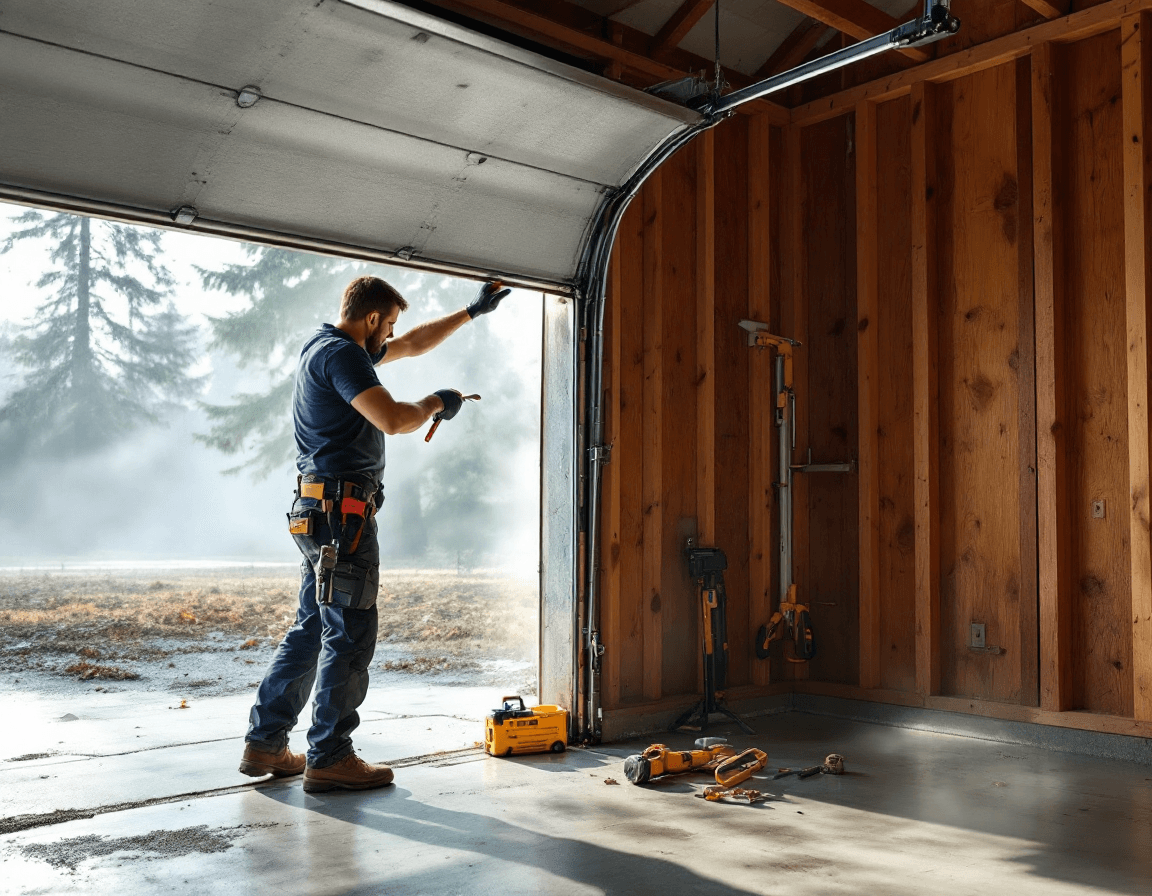
Off-track garage door repair in Federal Way, WA is one of the most common calls we run into across the 98003 and 98023 ZIP codes, and it is also one of the easiest to make worse. A door that has jumped its track is usually still in one piece, but the rollers, track sections, and sometimes the cables are under stress. Pushing, yanking, or running the opener repeatedly can bend a track that would have been a simple realignment or turn a minor roller problem into a damaged panel. Knowing what happened and what to avoid gives you the best chance of a quick, inexpensive fix.
Federal Way homeowners deal with a particular mix of conditions that wear on garage doors. Long, damp winters off Puget Sound, humid spring mornings, and occasional hard freezes all affect the steel tracks, nylon or steel rollers, and the hardware that holds everything in line. A door that tracked perfectly through a dry August can start binding in November after weeks of rain, and a door that worked fine in the morning can seize by evening once temperatures drop. This page explains how off-track problems develop, what the warning signs look like, what a professional visit involves, and what a typical repair costs, so you can make a clear decision when your door stops cooperating.
If your door is off the track right now, the most important step is to keep everyone clear of it. Do not stand beneath the door, do not try to lift it by hand while it is partly off the track, and do not keep pressing the opener button to see whether it will "pop back in." Call us at (888) 799-3819 and we will talk through the situation before you touch anything else. The rest of this guide is here to help you understand what you are dealing with.
Why Doors Leave the Track in Federal Way Homes
Most off-track events have a short list of causes, and in our experience around Federal Way they usually trace back to wear that has been building for months. Rollers are the most frequent culprit. Older rollers with worn bearings or cracked nylon wheels can wobble, flatten on one side, or slip free of the track's channel when the door passes a joint or a slight dip in the track. Loose mounting brackets are another common cause, because the track bolts can work loose as the door cycles thousands of times a year.
Homes in the Twin Lakes and Dash Point areas often have older garage doors installed before modern track designs became standard, and some of those systems were never fully squared up during installation. A track that sits even a fraction of an inch out of plumb or level will push rollers against one edge of the channel, and eventually one roller will ride up and over. Settling foundations, which are common on sloped lots in the region, can also shift the header or side jambs enough to throw the track out of alignment without anyone noticing at first.
Finally, a door can leave its track after an unbalanced spring or cable condition. When one side of the door carries more load than the other, it can lift unevenly and tilt the panels out of the track. We will always check the springs and cables during an off-track visit, but this is also where safety matters most, which we cover in a later section.
Reading the Warning Signs Before the Door Lets Go
Garage doors rarely jump off the track without giving you a few hints first. The earliest sign is usually a new noise. A rhythmic scraping, a grinding that changes as the door climbs, or a sharp pop at one particular spot in the travel can mean a roller is rubbing the track lip or starting to slip. Many homeowners in Federal Way describe a door that "sounds different in the rain," which often points to moisture swelling a wood frame or causing a roller to stick.
Visual clues matter too. Look at the gap between the top panel and the header, and the space between the door edges and the vertical tracks on both sides. If the gap on one side is noticeably wider than the other, the door may be riding crooked. Check the rollers as well. Rollers that look flattened, chipped, cracked, or sitting at an angle deserve attention before they fail completely. A roller that has partly come out of its track is a warning that the next cycle may take it fully out.
Pay attention to how the door behaves when you run it manually from inside the closed position with the opener disconnected. A door that feels heavy on one side, catches at a specific height, or drifts sideways while moving should be inspected soon. Waiting until the door is fully off the track is a much more expensive way to learn the same lesson.
What Stops a Door Cold: Jams, Binding, and Gaps
A door that jams and refuses to move in either direction is often the most alarming symptom, and it is important to approach it carefully. When a door jams, the cause is usually one of three things: a roller has come partly out of the track and is wedged against the lip, a track section has been bent or pushed out of position, or a panel has separated slightly and caught on the frame. Forcing the opener to keep running can snap a cable, strip a gear, or spread a track section further, so the safest response is to stop.
Binding is a milder version of the same problem. The door moves, but it grinds, tilts, or stops and starts. In Federal Way's damp climate, binding frequently comes from rollers that have seized inside worn bearings or from moisture-related swelling in wood doors and seals. Lubricating the wrong parts, however, can make binding worse. Grease belongs on hinges and bearings, not on the track itself, because greasy track surfaces attract grit that accelerates wear.
A gap between the door and the track, especially at the top corners or along the sides, signals that the door is no longer seated where it was designed to run. Some gap is normal for weatherstripping, but a visible opening that lets daylight through or allows wind and water to blow into the garage is a sign that the alignment has shifted. We check these gaps against the track geometry and the door's own tolerances before deciding whether a simple reseating will solve the issue.
Rollers That Pop Free and Why They Keep Doing It
Rollers are small parts that carry an enormous load, so their failure is disproportionately disruptive. A standard steel-stem roller may carry hundreds of pounds of door weight through its bearing each time the door moves. When the bearing wears, the roller stops turning smoothly, and the door begins to drag or hop. Nylon-tired rollers offer quieter operation but can crack or flatten after years of heat, cold, and friction, particularly in garages where temperature swings are common during the transitional seasons.
Many off-track repairs we handle involve rollers that have popped out repeatedly. Replacing only the roller that came out of the track often works for a while, but the other rollers may be just as worn and will eventually fail too. A good technician checks every roller, every hinge, and every track bracket, then recommends replacing the components that show measurable wear rather than changing parts piecemeal. In many cases, a full roller set costs far less than the cascade of damage that follows when one worn roller keeps forcing the door out of line.
Upgrading to sealed bearing rollers is often worth discussing, particularly for doors that see daily use in wet months. Sealed bearings resist moisture and grit better than open designs, which helps keep the door tracking straight through long Pacific Northwest winters. The right choice depends on the door's weight, the track type, and how the door is used, so it is worth having that conversation with a technician rather than guessing from a parts catalog.
Bent Track Sections and the Trouble with Straightening Steel
Garage door tracks are made from thin-gauge steel formed into precise channels, and even a modest bend can throw the whole system out of alignment. Bent or dented track sections often result from a door that has come off the track and slammed into the track lip, from a child or pet catching the track during operation, or from a vehicle backing into the lower track with enough force to deform it. Track sections can also separate at their joints when the bolts loosen or when the vertical track tears away from its mounting bracket.
Straightening a track is not simply a matter of bending it back by hand. A track that has been kinked, flattened, or stretched may need careful adjustment at several points along its length, and each adjustment must keep the roller path smooth and consistent. If a section is cracked or torn at a seam, or if the metal has been fatigued by repeated stress, straightening may only be a temporary fix. In those cases, replacing the affected section is the more reliable option, and it is usually more affordable than many homeowners expect.
We always check the track's mounting points, the header angle, and the spacing between the two vertical tracks. A track can look straight while being mounted at a slight angle to the door opening, which will eventually cause the same problem all over again. Taking the time to measure and reseat the entire assembly is what turns a quick fix into a lasting repair.
When a Car Clips the Door: Impact Damage on Driveways
Vehicle impact is an unfortunately common cause of off-track doors in Federal Way, particularly on narrower driveways and in older neighborhoods where garages sit close to the street or where vehicles are parked tightly. A bumper that clips the lower panel can push the bottom corner out of its track, bend the vertical rail, or crack a roller bracket. Even a slow, low-speed tap can shift a door that was already slightly out of alignment, so it is worth checking the door after any contact, even if the damage is not immediately visible.
After an impact, the first priority is safety. Keep vehicles and people away from the door, and avoid operating it until it has been inspected. Take photographs of the damage for insurance purposes if the impact was accidental, and note the time and approximate position of the door so the technician can match the damage to the event. Some homeowners also find it helpful to check whether the opener's safety reversal is working correctly after any impact, since a misaligned door can affect the sensors and the travel limits.
Impact damage can be deceptive. A panel may look intact while the internal section joint has separated, or a track may appear only slightly bent when the roller path is actually compromised. A thorough inspection looks at the panels, hinges, rollers, track, springs, and cables together, because force from an impact travels through the whole door. Repairs after a collision often involve several small components, and it is more efficient to address them all in one visit.
Spring and Cable Tension: The Part Not to Touch
Springs and cables are what hold a garage door's weight and make it manageable, and they are also the most dangerous parts of the system. Torsion springs and extension springs store enormous amounts of energy, and a spring that breaks or releases unexpectedly can cause serious injury. Cables that fray, unwind, or come off their drums can also cause sudden, uncontrolled movement. For this reason, any spring or cable work should be left to a licensed, bonded, and insured professional who has the correct tools and training.
If your door is off track, a cable may have come off its drum or a spring may have lost tension. Do not attempt to adjust spring tension, wind springs, or pull cables back onto drums yourself. Do not stand under a door that is partly off its track, and do not try to lift it while the springs may be unbalanced. Keeping the door closed and the opener disconnected until a technician arrives is the safest course of action.
We will always inspect the springs and cables during an off-track visit, because they often need attention when the door has been out of line. Sometimes the springs are sound and only the rollers and tracks need work. Other times a cable has stretched, a drum has slipped, or a spring has reached the end of its cycle life and must be replaced. Our recommendation will always be based on what we find, and we will explain the reasons clearly before doing any work on tensioned components.
Wet Winters, Salt Air, and Corrosion Near the Sound
The Pacific Northwest climate is a major factor in how garage doors age, and Federal Way's position near the Puget Sound means homes often experience more moisture and salt-laden air than homes farther inland. Steel tracks and bracket hardware can develop surface rust over time, which roughens the roller path and increases friction. Surface rust can also hide deeper corrosion at mounting points, where a bolt may look fine while its threads have weakened. Wood doors swell during wet months and shrink during dry spells, which can change the door's fit in its opening and push panels against the track in ways that were not present during installation.
Winter temperature swings add another layer of stress. A door that tracks smoothly at 50 degrees may bind when the garage temperature drops near freezing, because lubricants thicken and materials contract. Conversely, a warm spring afternoon can cause panels to expand slightly and rub against frames. These seasonal shifts are why some off-track problems seem to appear and disappear, and why a technician who understands local conditions can often pinpoint the cause faster.
Protecting the door from moisture helps. Keep the track clean and free of debris, wipe off surface rust before it spreads, and use a lubricant made for garage door components on the rollers and hinges rather than on the track. Check the weatherstripping along the bottom of the door, since water intrusion can encourage corrosion at the lower track brackets. Routine inspection before the rainy season is often the simplest way to avoid a mid-winter off-track call.
What a Typical Off-Track Visit Covers
When you call us about an off-track door, the technician's goal is to get the door safely back on track and identify the underlying cause so the problem does not return in a few weeks. A typical visit follows a clear sequence, and understanding it can help you know what to expect. Each step matters because the door is a system, and a fix that ignores one component often fails quickly.
- Confirm the door is secured and the opener is disconnected before any hands-on work begins.
- Inspect both vertical tracks, the horizontal track, and all mounting brackets for bends, gaps, or loose bolts.
- Check every roller for wear, cracking, flat spots, and bearing condition, and note which rollers are involved.
- Examine the springs, cables, and drums for tension, fraying, and proper seating, and perform any spring work only with appropriate tools and safety procedures.
- Measure the door opening and track alignment to confirm the door is square, level, and plumb.
- Reseat the door into the tracks, straighten or replace damaged sections, and adjust the hardware so the door travels evenly.
- Test the door through its full range of motion, both manually and with the opener, and verify the safety reversal system is working.
- Review the findings with you, including any parts recommended and whether the issue is likely to recur without further work.
In many Federal Way homes, this process takes a single visit when the damage is limited to rollers and a few track brackets. More involved situations, such as a bent multi-section track or a cable that needs replacement, may require parts ordered for a second appointment. Either way, you should receive a clear explanation of what was done and what, if anything, still needs attention.
Typical Pricing and What Shapes the Final Bill
Most off-track repairs we perform fall within a range of $125 to $400, depending on what is damaged and how much work is needed to restore smooth operation. Simple reseating of a roller or two and minor track adjustment usually sits at the lower end of that range. Repairs involving multiple rollers, a straightened track section, or bracket replacement typically land in the middle. Larger jobs, such as replacing a bent track assembly or addressing spring or cable work along with track repair, can reach the upper end. These are typical ranges, and your final cost will depend on the specifics of your door.
Several factors influence the price. The door's size and weight affect how much hardware is involved. The track type matters, since standard lift tracks, high-lift, and low-headroom configurations each have different components. The age and condition of the other parts also play a role, because a door that has been running on worn rollers for years may need more attention during a single visit than a door that has been in good shape until a recent impact. The time of day and whether parts must be ordered can also affect scheduling.
We believe homeowners should understand what they are paying for. A good estimate explains which parts are necessary now, which are recommended for the near future, and which are optional. If a repair is only a temporary measure, we will say so. The goal is a door that tracks reliably, not a quick patch that brings you back in a month.
Keeping the Door Tracked Through Federal Way Seasons
Once your door is back on its track, a little attention each season can prevent the next off-track event. In the early fall, before heavy rain sets in, clean the tracks of leaves, grit, and debris that collect along the lower edge. Check that the track bolts are snug and that the brackets have not shifted, since a small loosening can become a big problem under daily use. Watch the door's movement, listening for new sounds and noticing any hesitation or drift.
During the wet months, keep an eye on the weatherstripping and bottom seal, and make sure water is not pooling near the track or running down into the bottom bracket area. In the colder months, a light application of the right lubricant on rollers and hinges helps the door move freely, but avoid over-lubricating, since excess grease attracts dust. If you notice a roller that looks worn or a track that has developed a slight bow, schedule an inspection before it becomes an emergency.
Finally, make sure everyone in the household knows the safe way to respond to a door problem. Keep children and pets away from the door when it is moving, and teach family members never to crawl under a partly open door or try to free a jammed door by hand. A few simple habits, combined with regular professional checks, go a long way toward keeping your garage door running smoothly through the Federal Way seasons.
If your door has come off its track, is binding, or has a gap that wasn't there last month, don't wait for the next cycle to make it worse. Call Seattle Garage Door Fix at (888) 799-3819 to schedule a licensed technician who serves Federal Way and nearby communities, and we'll get your door safely back where it belongs.