
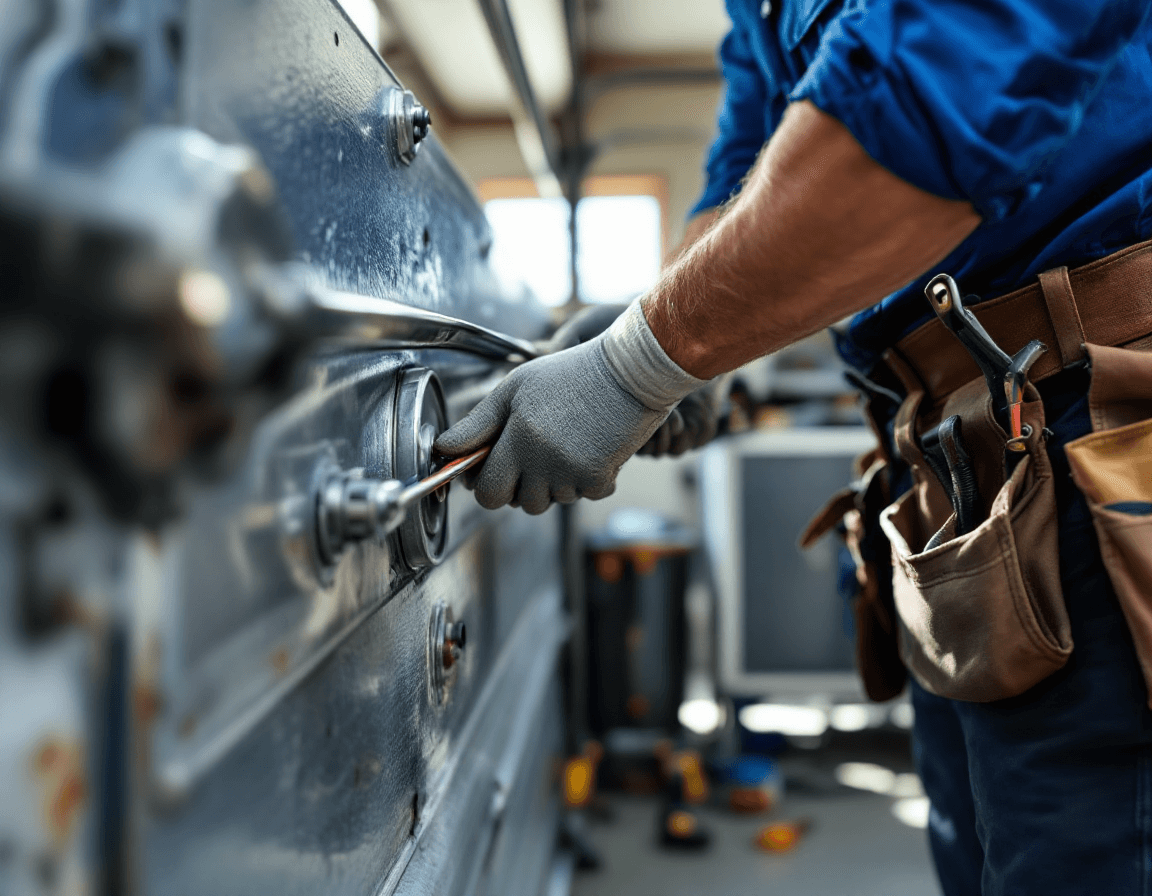
Garage door cable replacement in Federal Way, WA is one of the most common repairs we see on residential doors across South King County, and it is also one of the easiest to put off until it becomes urgent. The lift cables on a sectional garage door carry the full weight of the door as it rises and falls, so when one fails, the door can drop, twist, or stop in a dangerous position. This page explains how cables wear out, what the warning signs look like, and what a proper repair involves. It is written for homeowners in neighborhoods from the Twin Lakes area to the blocks near Dash Point and the Wild Waves corridor, under ZIP codes 98003 and 98023.
Federal Way homes have a particular set of conditions that shape how garage doors age. Long, damp winters, a steady drizzle that can last for weeks, and summers that are mild but sometimes humid all work on steel in a slow, persistent way. Many of the houses in the area were built during decades when builders used standard builder-grade door hardware, and those doors have now been running through thousands of open-and-close cycles. Understanding those local factors helps explain why a cable that looked fine during a dry August can start fraying by the following February.
If you are reading this because a cable has already snapped or come off the drum, the most important point is simple: do not attempt to fix it yourself, and keep people and vehicles away from the door. The rest of this page will walk you through the warning signs, the safety considerations, the repair process, and the factors that influence cost, so you can make informed decisions and know what to expect when a licensed technician arrives.
Why Federal Way Garage Doors Wear Their Cables Faster
Lift cables are made from steel wire, typically galvanized, and they run from the bottom bracket of the lowest door panel up over pulleys and into the drum mounted on the torsion shaft above the door opening. Every time the door moves, the cable bends around the drum and flexes through the pulleys. Over years of cycling, the outer strands of the cable fatigue, and any moisture or corrosion accelerates that fatigue. In a region where the air can stay damp for long stretches, cables are exposed to exactly the conditions that encourage surface rust to creep into the wire.
Federal Way sits in a climate that rarely produces dramatic temperature swings, but it does produce constant moisture. A garage that is attached to the house may feel dry inside, yet the door panels, hinges, and cables still pick up condensation during cold, humid nights. Doors that face north or sit under heavy tree cover in older neighborhoods often stay damp longer after rain, which means rust has more time to form on the cable's outer wire. We also see detached garages and shop buildings with open soffits or less insulation, where moisture swings are even more pronounced.
Another factor is use. Many households in Federal Way run two vehicles in and out of the garage each day, sometimes more during school runs or commutes toward the Puget Sound employment centers. Each cycle adds wear to the cable, pulleys, and drum. A door that opens dozens of times a day will reach the end of its cable life far sooner than one used only a few times a week. When a homeowner describes a cable that failed "out of nowhere," it is usually the result of many small stresses adding up quietly over a few seasons.
Reading the Warning Signs Before the Cable Lets Go
Cable problems rarely appear without notice, though the warning signs are easy to overlook if you are only glancing at the door as you pull out of the driveway. Paying attention to how the door moves, sounds, and looks at the bottom and sides of the track gives you a head start on a repair that can be scheduled calmly instead of done in an emergency. Some signs are subtle, such as a slight tilt that appears only when the door is halfway open, while others are obvious, such as a visible kink or a loose strand.
Here are the signs Federal Way homeowners most often notice before a cable fails completely:
- A door that hangs lower on one side than the other when it is closed or partly open
- A visible fray, bird's-nest bulge, or rust-colored residue on the cable, especially near the bottom bracket or where it wraps the drum
- A door that closes unevenly, jerks, or binds on one track while moving freely on the other
- A cable that looks slack on one side, or a sag in the cable when the door is fully closed
- A grinding, popping, or ticking noise that repeats during each opening and closing cycle
Any of these signs deserves a professional look, even if the door still works. A door that is hanging crooked is putting uneven stress on the other cable, the rollers, and the track, so one problem can create several. Catching the issue early often means replacing only one cable instead of two, and it reduces the chance of a sudden drop when the weak cable finally gives way.
What Happens When a Cable Jumps the Drum
Not every cable problem involves a broken strand. Sometimes the cable slips off the drum entirely, usually because the door was forced, the cable loosened, or the drum groove wore unevenly over time. When this happens, the door may still open partway, then stop with a lurch or a grinding sound. The cable may appear to be wrapped loosely around the shaft or tangled in a way that looks alarming but is actually a sign the drum needs attention rather than a sign that the entire system has failed.
Cable jumping off the drum is also dangerous in a different way. The drum and shaft are under significant tension from the springs, and the cable can snap back or whip when it is released from its normal path. If a homeowner tries to pull the cable back onto the drum by hand, the door can shift, and the spring energy can release unexpectedly. This is why we tell homeowners to keep hands and tools clear of the drum area and to avoid trying to force anything back into place.
A cable that has come off the drum needs to be inspected for kinks, flattened sections, or broken strands before it is reseated. In many cases the cable is still usable but the drum groove or the cable's end fitting has been damaged. A licensed technician will check whether the drum needs cleaning, whether the cable is the correct length and gauge, and whether the door balance has shifted. Reseating a cable without checking these details can lead to repeated failures within days.
The Snap That Sounds Like a Gunshot: Handling a Broken Cable Safely
A broken lift cable often announces itself with a sharp crack or bang, sometimes loud enough to make a homeowner jump from the kitchen or the living room. Many people assume the spring has broken, or that something inside the wall has failed. In reality, the sound is usually the cable parting under load, and the door will often drop or tilt quickly afterward. The safe response is to stop, step away from the door, and keep everyone else out of the garage until the door is secured.
If the door has dropped partway and is resting on the floor or sitting crooked in the opening, do not try to lift it manually or push it back up. A door that appears stable can still shift weight unexpectedly, especially if the other cable is also weakened. If your garage has an automatic opener, unplug it or switch off the breaker so the opener does not try to run the door while the cables are compromised. Then use the manual release only if it is safe to do so, and keep your hands and body clear of the panels and tracks.
Once the immediate danger is controlled, call a licensed technician and describe what you heard and what you see. A technician can determine whether one or both cables need replacement, whether the drum or pulleys were damaged, and whether the springs need to be evaluated. Cable replacement is a job that involves tension, and mistakes can cause injuries that are far more serious than the cost of the repair. For that reason, every cable replacement should be performed by a qualified professional rather than a do-it-yourself project.
How a Technician Replaces a Lift Cable Step by Step
Professional cable replacement follows a sequence that protects both the homeowner and the equipment. The technician begins by securing the door in a stable position, usually with clamps or locking pliers on the track, and by checking the spring tension to confirm the door is safe to work on. Only after the door is secured does the technician release the old cable, noting its routing and the position of the end fittings so the new cable is installed exactly the same way. Taking shortcuts at this stage is one of the most common reasons repairs fail early.
Next, the technician inspects the drum, pulleys, bracket, and shaft for wear, looseness, or damage. The new cable is measured and fitted to the correct length, with attention to the bottom bracket and the drum groove. The cable is then routed through the pulley, wrapped onto the drum in the correct direction, and secured with the appropriate fittings. Each step matters: a cable wrapped the wrong way on the drum or seated in a worn groove can produce crooked travel and rapid fraying.
After installation, the technician tests the door through several complete cycles, watching for level travel, smooth movement along both tracks, and proper cable tension. Balance is checked by raising the door partway and noting whether it stays in place or drifts. If the door behaves correctly, the work is complete. If it does not, the technician adjusts the setup until the door moves evenly. Homeowners should expect the process to take a focused visit, and they should ask questions about any part of the work they do not understand.
Drum Service: Cleaning, Seating, and Checking the Shaft
Cable drums are often overlooked in routine maintenance, yet they play a central role in how smoothly the door moves. The drum is a grooved cylinder that guides the cable as it winds and unwinds, and over time the grooves can collect grit, rust flakes, and old lubricant that cause the cable to bind or ride unevenly. A drum that has worn grooves may also wear a new cable prematurely, which is why drum service is commonly included with a cable replacement.
Drum service typically involves removing debris from the grooves, checking that the drum is firmly fixed to the shaft, and inspecting the set screws or fasteners that hold it in place. The shaft itself should be straight and free of rust pitting that could cause uneven rotation. If the drum shows cracks, deep grooves, or signs that the set screws have stripped, replacement may be the better choice. Technicians also check that the cable enters and exits the drum at the correct angle, since misalignment is a frequent cause of rapid wear.
Homeowners sometimes ask whether they should lubricate the drum themselves. The answer is that lubrication should be done with light, appropriate products and only after a technician confirms the system is safe to touch. Heavy grease can attract dust and debris, which then builds up in the grooves. A proper drum service includes cleaning and light lubrication, applied in the right places and no more than needed, so the cable can glide without picking up grit.
Cost Factors Behind the $110 to $300 Range
Most cable replacements in Federal Way fall within a range of about $110 to $300, but the final cost depends on several specifics of the door and the job. A single cable on a standard residential door with easy access costs less than a pair of cables on a larger, heavier door where the drum and pulleys also need attention. The table below is not a price list; it simply shows the kinds of details that move a quote toward one end of the range or the other.
- Whether one cable or both need replacement, since replacing both is usually more efficient and balances the door
- The size and weight of the door, including insulated double-wide and triple-car doors that carry more load
- Condition of the drum, pulleys, and shaft, and whether drum service is needed alongside the cable
- Accessibility of the garage, including high ceilings, tight workspaces, or extra clearance needed for the work
- Whether the spring system or other hardware also requires attention once the door is open for inspection
A good technician will explain the reason behind any additional recommendations rather than presenting them as a sales pitch. If a cable is the only failed component, the quote should reflect that. If the drum, pulley, or bracket is also worn, the technician should show you the wear and explain why replacing it now prevents a second failure soon after. Asking for a written breakdown is reasonable, and any professional should be comfortable providing one.
Choosing Between Galvanized and Coated Replacement Cables
When a cable is replaced, the homeowner often has a choice between standard galvanized steel and cables with additional protective coatings. Galvanized cable is a common, reliable option that resists rust through a zinc layer applied to the wire. Coated cables, often vinyl-covered, add a barrier that can help in damp conditions, though the coating can also hide early signs of wear. Neither option is automatically better for every garage, so the right choice depends on your door, your use, and the environment.
In Federal Way, moisture is the main concern. A galvanized cable installed correctly will perform well for many years, particularly on an attached garage that is somewhat protected from weather. For detached garages, unheated shops, or doors that see heavy condensation, a coated cable may offer extra protection against corrosion. The important point is that the cable must match the door's specifications, including diameter and length, because an oversized or undersized cable can cause uneven tension and rapid failure.
Homeowners should also consider how often they inspect the cable after installation. A coated cable can look clean even when the strands underneath are beginning to fatigue, so it still benefits from periodic visual checks. Galvanized cable shows rust more openly, which can be an advantage for spotting problems. Your technician can recommend the option that fits your door and explain how to monitor it between service visits.
Keeping Cables Healthy Through Puget Sound Winters
Routine care will not prevent every cable failure, but it can extend the life of your cables and catch problems before they become emergencies. The most useful habit is a quick monthly look at the door: check the cables for visible fraying, rust, or looseness, watch the door for crooked travel, and listen for new noises. A flashlight is helpful for seeing the bottom brackets and drum area. If you notice any change, schedule a service visit rather than waiting for the next season.
Moisture management also makes a difference. Keep the garage as dry as practical by ventilating the space, avoiding wet items stored against the door, and making sure the door seals and weatherstripping are in reasonable condition. Standing water on the floor or leaks around the door can speed corrosion on cables and hardware. In winter, avoid forcing a frozen door open, because the sudden strain can damage cables that are already stressed.
Finally, keep a simple record of service visits and repairs. Note the date, the work performed, and any recommendations the technician made. A written history helps the next technician understand what has been done and how the door has performed over time. It also helps you plan ahead for parts that are approaching the end of their useful life, which is often the most cost-effective way to manage a garage door.
Questions Federal Way Homeowners Ask About Cable Repairs
Can I replace one cable and leave the other one? Sometimes a single cable is replaced when only one has failed and the other is in good condition with similar wear. However, cables on the same door often age at similar rates, and replacing both can keep the door balanced and reduce the chance of an early second failure. A technician can compare the two cables and recommend the approach that makes sense for your door.
Will the door be safe to use after a cable snaps? A door with a broken cable should not be operated until it has been inspected and repaired. Even if the door appears to close, the remaining cable may be under unusual load, and the door may drop without warning. Keep the opener disconnected, keep the area clear, and arrange a service visit as soon as you can.
Why does my door look crooked after a repair? A door that is hanging crooked after a repair usually needs adjustment of the cable tension or drum alignment. This should be corrected by the technician who performed the work, and you should not attempt to adjust the cables yourself. Ask the technician to recheck the door before they leave, and make sure the door moves level through several full cycles.
Cable replacement is a job where expert hands matter, and no homeowner should attempt it with tools borrowed from a hardware store. If your garage door shows any sign of cable trouble, whether it is a snapped strand, a door that hangs crooked, or a cable that has jumped off the drum, call Seattle Garage Door Fix at (888) 799-3819. Our licensed, bonded, and insured technicians serve Federal Way and neighborhoods across King County, and we will inspect the door, explain what needs attention, and handle the repair with the safety and care your home deserves.