
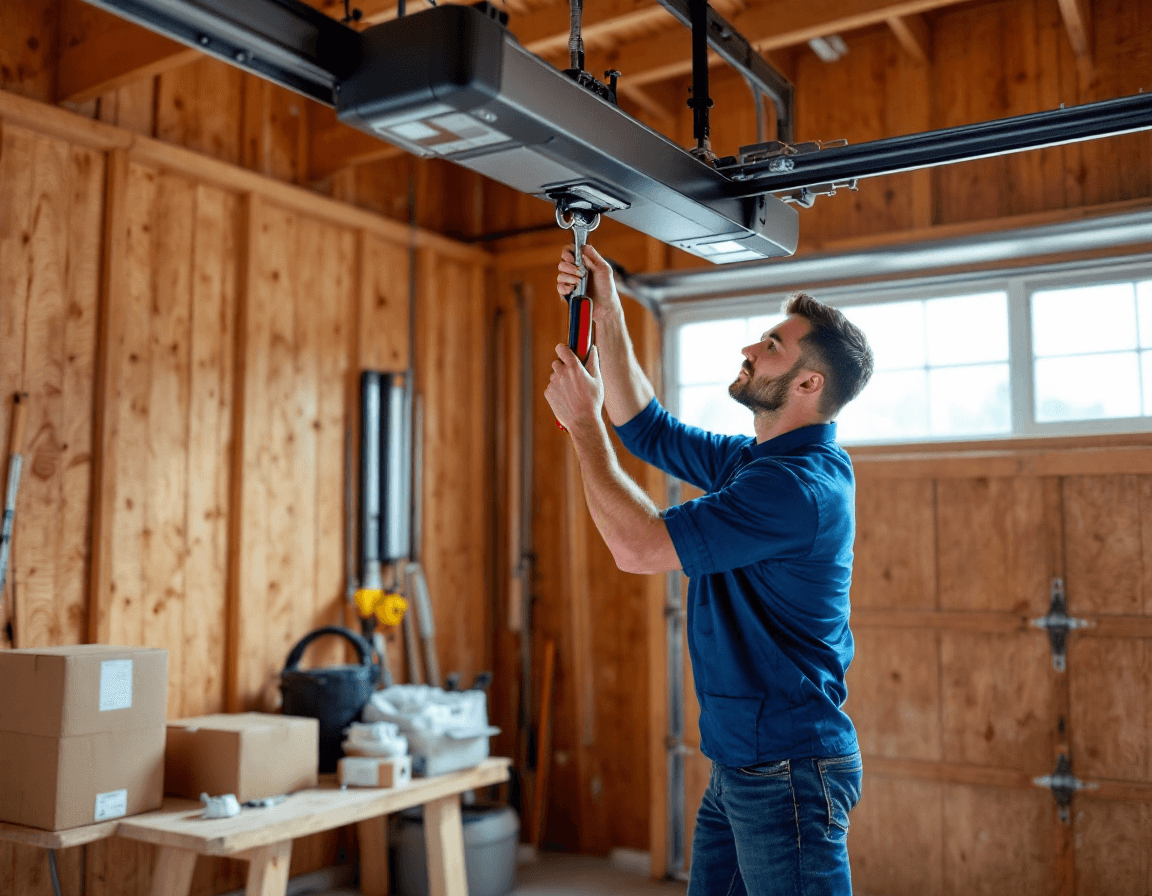
Garage door opener installation and replacement in Federal Way, WA is one of the most practical upgrades a household can make, and it's often one of the most overlooked until something goes wrong at 6:40 on a rainy morning. Homes across the 98003 and 98023 ZIP codes tend to have attached garages that get used as a second entry, a workshop, and a storage room all at once, so the opener is working far more than most owners realize. When it starts grinding, hesitating, or simply refusing to respond, the inconvenience spreads quickly into the rest of the day.
Our team works across the greater Federal Way area, from neighborhoods near Twin Lakes to homes in the Dash Point direction and streets within a short drive of the Wild Waves area. We see the same patterns repeatedly: a unit that has run for fifteen or twenty years on a single-button remote, a belt that has stretched, a logic board that has quietly given up after a winter of moisture. Some owners want the quietest possible ride for a bedroom above the garage, others want to open the door from a phone while they're still on the Interstate, and many simply want a backup plan for the next power outage. This page explains how we think through those decisions so you can make a confident choice.
Whether you are replacing a failing unit or adding a modern opener to a garage that never had one, the goal is the same: a reliable, secure, properly installed system that fits your door, your wiring, and your daily routine. Installed pricing for our opener work generally falls between $275 and $650, depending on the model and the features you choose. The sections below walk through the decisions that drive that range, the local conditions that affect performance, and the signs that tell you it may be time to stop repairing and start replacing.
Why Federal Way Garages Push Openers Harder Than You'd Think
Federal Way has a mix of older ranch-style homes and newer subdivisions, and both types bring their own garage quirks. Many older attached garages were built with modest door tracks and older header framing, while newer construction often includes heavier insulated doors that place more load on the opener. A door that was light enough for a 1990s opener can be considerably heavier once it has insulation, a reinforced bottom panel, or upgraded windows, and the motor has to work harder every time it lifts. Over years of daily cycles, that extra effort shows up as heat, slower travel, and early wear on gears and belts.
The Pacific Northwest climate adds its own pressure. Our winters are mild compared with the Midwest, but they are long, wet, and humid, and that moisture gets into everything. Condensation settles on metal rails and springs, moisture finds its way into wiring junctions and the safety sensor connections at the floor, and damp air slowly degrades the contacts inside older control boards. Garage doors in shaded areas under evergreen trees can also collect moss, fir needles, and debris along the bottom seal and tracks, which forces the opener to pull harder through the same travel path.
Wind is another factor that homeowners in the area notice. Winter storms that roll through western King County can bring gusts strong enough to knock out power for a period of time, and the same storms can shake a poorly secured door or misalign a track. Your opener is the component that has to hold, lift, and lower the door reliably under those conditions, which is why choosing the right drive style and installing it with proper hardware matters more here than the simple brand name on the box.
Reading the Warning Signs Your Current Opener Has Given Up
Most opener failures do not arrive without notice. They usually build over several months, and the early symptoms are easy to dismiss as normal aging. The most common warning is noise: a rattling, humming, or grinding sound that gets louder each season often points to worn gears, a loose mounting bracket, or a trolley that needs replacement. Another sign is speed, where the door begins to open or close noticeably slower than it used to, or it pauses partway through its travel and then continues. Both issues can indicate that the motor is struggling against the door's weight or against friction in the track system.
Reliability problems are the next category. If your remote works only some of the time, if the wall button responds on the second press, or if the light on the opener flickers without a clear cause, the control board or receiver may be failing. Doors that reverse for no visible reason are also worth taking seriously, because the safety system is meant to protect people and pets. A reversing door can indicate sensor misalignment, but it can also reflect a motor or force setting that has drifted, and those issues should be checked by a technician rather than ignored.
- Loud grinding, banging, or a rattle that is worse than it was last year
- The door travels noticeably slower or stops and restarts partway through
- The remote works only intermittently or requires multiple presses
- The door reverses or stops without an obvious obstruction
- The opener has been repaired several times, and the repair bills keep climbing
- The unit is more than about fifteen years old and lacks modern safety features
If several of these apply, it is worth having the system evaluated. An older opener that has already been repaired multiple times may be a poor candidate for another round of parts, especially when a new unit adds security, quieter operation, and better safety functions for a similar overall investment.
Belt, Chain, or Wall-Mount: Matching a Drive to Your Garage
Choosing the right drive type is one of the most important decisions in any opener project. Chain-drive openers are the traditional, budget-friendly option. They are strong, reliable, and well suited to garages where noise is not a major concern, such as a detached workshop or a garage with no living space above it. Their drawback is audible operation: the metal chain running over the rail produces a distinctive clatter that many homeowners find disruptive, especially on quiet mornings or late evenings.
Belt-drive openers use a reinforced rubber belt instead of a metal chain, and the difference in sound is substantial. For homes with a bedroom or office above the garage, or for any household that values quiet, belt drive is usually the better fit. Belts also run smoothly without the metallic vibration of chains, which many owners appreciate over time. Belts do require a sound, properly tensioned rail system and occasional inspection, but they are typically the best balance of comfort and durability for the attached garages common in Federal Way neighborhoods.
Wall-mount openers attach to the wall beside the door rather than to the ceiling. They are a good solution when ceiling space is limited, such as in a garage with a low overhead beam, a storage platform, or a ceiling-mounted heater. Wall-mount units also keep the motor away from the door track and can be easier to service in some layouts. Each style has its tradeoffs, and the right answer depends on your ceiling clearance, your door's weight, and how the garage is used day to day.
Rolling Code Security and Why Older Remotes Are a Liability
Older openers, particularly those produced before rolling-code technology became standard, often use fixed codes. A fixed code means the remote sends the same signal every time, and that signal can be captured and replayed by someone with the right inexpensive equipment. For a home where the garage door is the most convenient way into the house, that is a meaningful vulnerability. Rolling-code systems change the transmitted code each time the remote is used, so a captured signal cannot simply be reused to open the door.
Replacing an older unit gives you rolling-code protection along with updated remotes and keypads. We recommend reviewing every remote and keypad that has access to the garage, including the ones left in vehicles or given to family members, and removing any that you no longer need. A new opener also gives you an opportunity to reset access codes, change keypad PINs, and verify that the safety reversal system is working correctly as installed. These are small steps, but they close gaps that many households never think about until they are reminded.
Security also depends on what happens after the opener is installed. Keep the door's manual release in good working order, avoid leaving remotes in plain view in a parked car, and consider whether your garage-to-house door is locked and sturdy. A modern opener is one layer of a broader home security approach, and it works best when the rest of the entry system is maintained as well.
Wi-Fi and myQ Control Without the Gadget Overload
Smart control has become one of the most requested upgrades, and for good reason. Wi-Fi-enabled openers let you check whether the door is closed from anywhere, open or close it from a phone, and receive alerts when the door has been left open. Compatible systems such as myQ-enabled openers can also work with some smart home platforms, so you can integrate garage control into routines and voice assistants. For busy households in Federal Way, that flexibility is often the difference between wondering and knowing.
That said, smart features should serve your routine rather than complicate it. Before choosing a model, think about who in the household needs access, whether you want guest or temporary access for a service provider, and whether you want notifications for every movement or only when the door has been left open. Some owners prefer a simple setup with a phone app and a wall keypad, while others want full integration. We help you choose a configuration that matches your comfort level so the technology does not become a chore.
Wi-Fi performance matters too. A garage often sits at the far edge of a home's network, and a weak signal can make a smart opener unreliable. During installation, we check the signal strength at the opener location and can recommend a simple range extender or a relocation of the opener's network connection if needed. A smart opener that drops offline is frustrating, so verifying connectivity before we leave is part of the job.
Battery Backup for Windstorms and Dark Winter Evenings
Power outages are a real consideration for homeowners in western Washington, particularly during winter storms when wind can bring down lines or trigger brief interruptions. When the power goes out, a standard opener cannot lift the door, and the manual release becomes the only way in or out unless you have a backup. Battery backup systems keep the opener functional for a limited number of cycles during an outage, which can be the difference between being stuck in the driveway and getting the car in the garage.
Battery backup kits are available for many opener models, and they are often a worthwhile addition for households that rely on the garage for daily access. They are especially useful if you have a teenager driving in and out at irregular hours, a home office that needs quick access, or a family member who depends on the garage entry for mobility reasons. Keep in mind that a battery backup is a convenience measure rather than a permanent power source, and the number of cycles it provides depends on the battery and the door's weight.
Our technicians can add or upgrade battery backup during an opener installation, and we will explain what the expected cycle count looks like for your specific setup. We also recommend checking the battery periodically and replacing it according to the manufacturer's schedule, since a backup that has quietly aged out will not help when you need it. A short test once or twice a year is a simple habit that pays off.
What Installation Day Looks Like on a Typical Federal Way Street
A professional opener installation follows a clear sequence, and understanding it helps you plan your day. We begin by inspecting the existing door, tracks, springs, hinges, and wiring to confirm that the door is balanced and moves freely. This matters because an opener can only be as good as the door it moves, and a binding track or worn roller will shorten the life of even a premium unit. If we find issues in the door hardware, we will explain them before we proceed.
Next, we remove the old opener and prepare the mounting location. For ceiling-mounted units, we verify that the ceiling structure can support the motor and that the rail and bracket layout is correct for your door height. For wall-mount units, we confirm the wall framing and the position relative to the door. We then install the new opener, connect the safety sensors, set the travel limits, and program the force settings. The safety sensors are a critical step, and we test their operation by reversing the door with an obstruction placed in the path, as required for safe operation.
Finally, we program your remotes and keypads, connect Wi-Fi if you have chosen a smart model, and walk you through the controls. Before we leave, we confirm that the door opens and closes smoothly, that the manual release works, and that the safety reversal functions correctly. Most standard installations are completed in a single visit, though complex door repairs or wiring work can extend the timeline. We always aim to leave the garage cleaner and the homeowner fully informed.
Pricing From $275 to $650: What Shapes the Final Number
Installed opener pricing in our service area generally falls between $275 and $650, and the spread reflects real differences in equipment and labor. A basic chain-drive replacement with standard remotes will typically sit at the lower end of that range, while a belt-drive or wall-mount smart opener with battery backup will move toward the upper end. The model you choose, the features you need, and the condition of the existing hardware all influence the final figure. We provide clear pricing once we have looked at your specific setup.
Several factors can shift the total. A heavier insulated door may call for a more powerful motor, and that can change the model recommendation. Old wiring, a missing or misaligned safety sensor, or a track that needs adjustment may require additional labor. Adding battery backup, Wi-Fi control, or extra keypads and remotes also affects the final invoice. We believe in explaining these choices openly so you can decide what fits your budget and daily needs.
- Drive type: chain, belt, or wall-mount, each with different hardware costs
- Motor strength: matched to your door's weight and size
- Smart features: Wi-Fi control, app integration, and compatibility with home platforms
- Battery backup: a kit that keeps the door usable during outages
- Accessories: additional remotes, keypads, and safety sensor upgrades
- Existing conditions: track alignment, wiring, and any repairs needed before installation
Keeping the New Opener Quiet and Reliable Through Our Wet Winters
A new opener performs best when it is maintained through the seasons, and western Washington's damp winters are a good reason to build a simple routine. Every few months, check that the door moves smoothly by hand when the opener is disengaged, look for loose bolts on the rail and brackets, and wipe down the tracks to remove grit and debris. Keeping the door's rollers and hinges lubricated with a silicone-based product rather than heavy grease helps prevent the sticky buildup that moisture and dust can create. These small tasks protect both the opener and the door.
Watch the bottom seal and the area under the door, since tree debris, moss, and standing moisture can all affect how the door travels. Clear fir needles and leaves from the threshold and check that the door seal is intact so water does not pool along the bottom edge. Also verify that the safety sensors remain clean and aligned, because a sensor coated in dust or pushed out of position can cause repeated reversals. A few minutes of attention each season prevents many of the problems that lead homeowners to call for service.
Finally, if you notice any new noise, slowdown, or erratic behavior after installation, do not wait for it to become serious. Early adjustment is simpler and less expensive than repairing a part that has been strained for months. A licensed technician can check the force settings, belt tension, and sensor alignment in a single visit.
When Replacement Beats Repair (and What We Won't Touch)
Deciding whether to repair or replace an opener usually comes down to age, parts availability, and how often the unit has needed attention. If your opener is relatively recent and the problem is isolated, such as a failed remote or a worn sensor, a repair may be the most economical choice. But if the unit is older, has already required multiple repairs, lacks rolling-code security, or no longer meets current safety expectations, replacement often provides better value. A new opener also gives you quieter operation, smart features, and a fresh warranty period on the equipment.
We are equally clear about the work that requires a different level of expertise. Garage door springs and cables carry significant stored energy, and adjusting or replacing them is dangerous without the right tools and training. If your door needs spring or cable work, that should be performed by a licensed, trained professional, and we will refer you appropriately if it falls outside the scope of an opener replacement. Our focus is on the opener itself, its wiring, its controls, and its safety system, and we approach every job with that boundary in mind.
If you are weighing whether to repair or replace your opener, we are happy to take a look and give you an honest recommendation. Sometimes the answer is a quick fix that saves you money, and sometimes it is a new unit that will serve your household well for years. Either way, you should understand the reasons behind the decision before any work begins.
Ready to get your garage working the way it should? Call Seattle Garage Door Fix at (888) 799-3819 to schedule an opener evaluation, compare drive styles and smart features, and get clear installed pricing for your Federal Way home.