
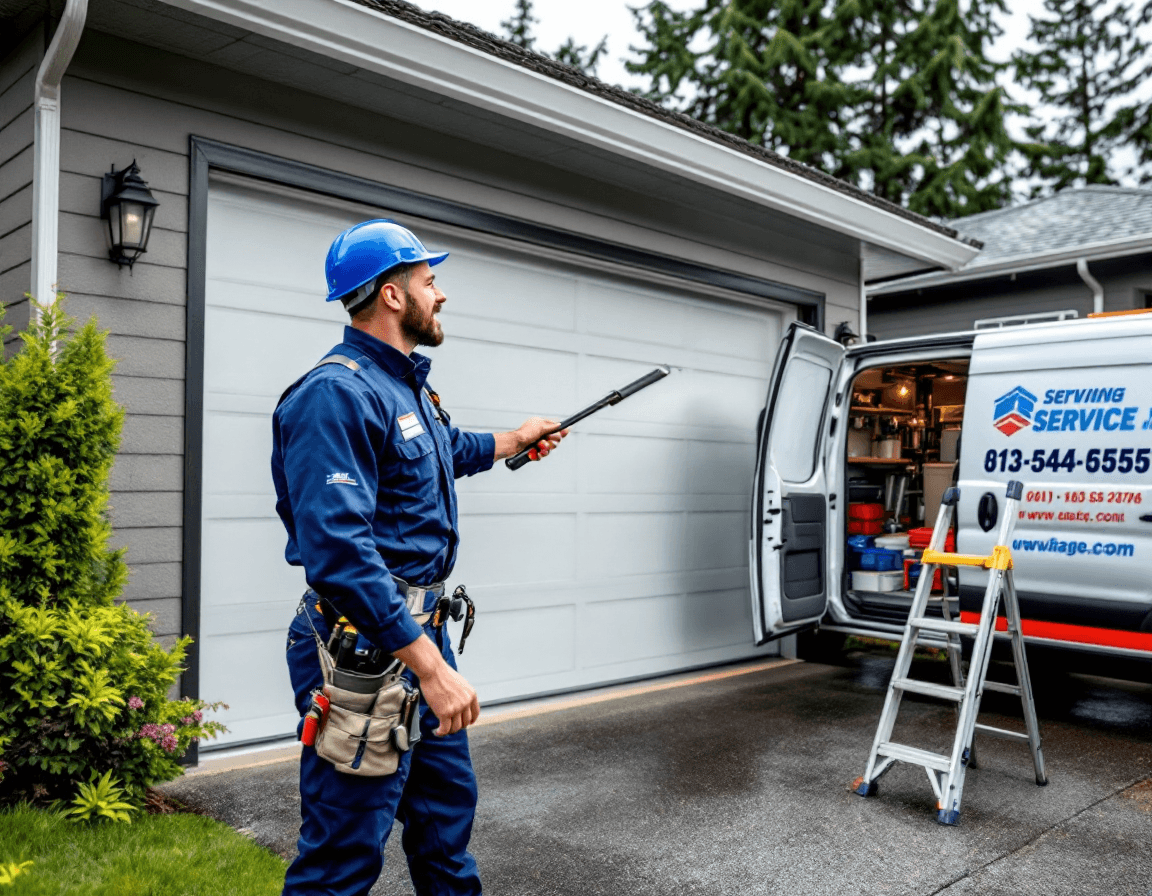
Garage door repair in Federal Way, WA is one of the most common calls we take, and it makes sense once you look at how the region treats hardware. Our winters bring long stretches of drizzle, cold mornings that hover near freezing, and humidity that rarely drops far enough to let metal fully dry. A door that opened smoothly last summer can start grinding or hesitating by the first hard rain of November. Most of the problems we see are not sudden failures. They are small issues that built up over months until the door finally refused to cooperate.
If your door won't open, won't close, or moves in a way that makes you uneasy, you are not alone, and it is usually fixable without replacing the whole unit. Fast, reliable residential repair is our focus, and most standard service calls fall in the range of $95 to $450, depending on the parts involved and how much diagnosis the problem requires. This guide walks through the symptoms we hear about most often from homeowners across the south King County area, including neighborhoods around Twin Lakes, Dash Point, and the stretch near Wild Waves. It also explains what happens during a visit so you know what to expect before the technician arrives.
Read through the sections that match what your door is doing right now. You do not need to be a mechanic to spot the difference between a noise that signals worn rollers and one that signals a serious spring problem. Where a repair involves high-tension springs or cables, we will tell you plainly that the work belongs to a licensed professional, and we will never ask you to attempt it yourself. Use the information here to describe the problem accurately when you call, which often speeds up scheduling and helps the technician arrive with the right parts.
Why Damp Winters in Federal Way Wear Down Garage Doors
Federal Way sits in a part of King County where moisture is a constant presence for much of the year. Rain tends to come in long, steady spells rather than brief storms, and garages in older homes often trap that dampness near the floor and along the lower panels. Steel components, including springs, hinges, and bearing plates, begin to show surface rust long before they lose strength, and that rust increases friction every time the door moves. Left alone, friction becomes resistance, and resistance becomes a door that strains against its opener.
Temperature swings add another layer of stress. A cold morning can stiffen lubricant that was working fine the night before, and the door may move slowly or unevenly until the garage warms up a little. Wood frames and weatherstripping also expand and contract with the seasons, which can shift the tracks by fractions of an inch. Those small shifts are enough to make a roller catch on a seam or a panel rub against the header.
Many homes in the area have doors that have been running for a decade or more, so the components are working harder than they did when new. Regular cleaning and a light lubricant on the right parts help considerably, but the most useful habit is simply paying attention when the door sounds or behaves differently than it used to. Catching a small change early almost always costs less than waiting until the door is stuck open or closed.
Early Warning Signs Your Door Is Giving Up
Garage doors rarely fail without warning. Most homeowners notice a sequence of small changes before the door stops working entirely, and recognizing that sequence can save you a stressful morning when you need to leave for work. The signs below are the ones our technicians hear about most often from Federal Way households, and each one is worth taking seriously even if the door still opens.
- The door takes noticeably longer to open or close than it did a few months ago.
- You see a faint line of rust on springs, hinges, or the track near the rollers.
- The door pauses briefly at the same point in its travel every time it moves.
- One side of the door lifts faster or sits lower than the other when you watch it.
- The remote needs several presses before it responds, especially in wet weather.
None of these symptoms alone guarantees a major failure, but together they usually point to wear that is developing into something more serious. A door that hesitates at one spot may have a roller beginning to flatten or a track section that has shifted slightly. A remote that works only on the third try may need a battery change, or it may signal a receiver issue in the opener. Writing down what you notice, along with the date and weather, gives a technician useful clues during the visit.
When the Door Reverses Before It Reaches the Floor
A door that starts to close and then bounces back up before reaching the ground is one of the most common safety-related complaints we handle. Modern openers are designed to reverse when they encounter resistance, which is a deliberate protection against pinching hands, pets, or vehicles. The same protection can trigger falsely if the door is misaligned, if the photo-eye sensors are blocked or out of alignment, or if the travel limits have drifted over time. In the damp months, a sensor lens coated with road grime or spider webs can cause the same symptom even when the mechanical parts are fine.
Start by checking the photo-eyes mounted near the floor on either side of the door. Each sensor has a small indicator light, and both should be steady when the door is clear. If the lights are blinking or off, wipe the lenses with a dry cloth and make sure nothing is blocking the beam, including a bicycle leaning against the wall or a cardboard box near the track. Also confirm that the sensors are aligned by eye so they face each other across the opening.
If the sensors are clean and aligned and the door still reverses, the problem may lie in the door's balance or the opener's force settings. A door that is out of balance will feel heavy when you lift it manually from the middle, and the opener will struggle to close it smoothly. Adjusting the balance involves spring tension, which is high-risk work that should be left to a licensed technician. We recommend calling us rather than changing the force settings yourself, because incorrect adjustments can make the reversal feature unreliable.
Noises That Point to Specific Problems
Garage doors are noisy by nature, but certain sounds are clearer signals than others. A low, steady rumble often comes from the opener motor or the drive chain or belt. A sharp squeal usually indicates dry metal rubbing against metal, most often at the rollers or hinges. A deep bang or thud, particularly at the top or bottom of travel, can mean loose hardware or a track that has shifted out of its channel. Learning to distinguish these sounds helps you describe the problem clearly and prioritize what needs attention first.
- Squealing during travel usually points to dry or worn rollers, hinges, or bearing plates.
- Grinding that repeats in a rhythm often comes from a damaged roller or debris caught in the track.
- A banging sound at the end of travel may mean the door is hitting its stops too hard or the track is loose.
- A rattle from the top of the door can indicate loose brackets or worn center-bearing hardware.
- A clicking or chattering sound at the opener itself often involves the drive mechanism or a loose mounting bolt.
Some noises need prompt attention. If you hear a loud snap or see a spring that looks stretched, coiled unevenly, or separated, stop using the door and keep people and vehicles away from it. A broken spring can release stored energy suddenly, and the door may drop unexpectedly. Do not try to wind, unwind, or replace springs yourself. Call a licensed technician, and keep the opener disconnected if the manufacturer's manual says it is safe to do so.
Crooked Doors, Off-Track Panels, and Sagging Sections
A door that looks crooked, rides higher on one side, or shows a gap along the bottom edge is telling you that the two sides of the mechanism are no longer working together. This is common after a bumped car, a loose bracket, or a worn cable on one side, but it can also develop slowly as rollers wear unevenly. When the door sits off-level, the panels can bind against the track, the weatherstripping can tear, and the opener can wear out faster than it should. Federal Way homes with older wood or composite frames sometimes show gradual sagging as the structure shifts with the seasons.
Visible gaps between panels, a door that looks bowed in the middle, or a panel that has popped partly out of its track channel all deserve attention. Do not try to force a panel back into place while the door is under tension or while the opener is connected, because a sudden movement can injure fingers or damage the panel further. Instead, keep the door closed and call for service so the technician can inspect the tracks, rollers, and hinges in a controlled way. Photos taken from the inside and outside of the garage often help us plan the visit.
Sagging sections are sometimes mistaken for a bigger structural issue, but they usually come from loose hardware, worn hinges, or a broken section of track that can be repaired or replaced. A good technician will check whether the bottom seal is compressed unevenly, whether the track is level and square to the opening, and whether the bracing has pulled away from the wall. Catching this early keeps a simple repair from becoming a panel replacement.
Remote or Wall Button Doesn't Respond
When the remote or wall button does nothing, the first instinct is often to assume the opener has failed. In practice, the cause is frequently simpler. Remote batteries lose charge gradually, and cold weather can make a weak battery fail completely even when it seemed fine a week earlier. Antennas can become bent or corroded, and the wall button wiring can loosen where it enters the control box. Power interruptions during storms can also reset the opener's logic board, which sometimes requires a fresh learn cycle to restore remote communication.
Start with the easy checks. Replace the remote battery, then test the remote from close range and from the driveway. Make sure the opener's light and motor respond when you press the wall button, and confirm that the breaker or outlet powering the opener is still on. If the opener has a learn button on its motor housing, the manufacturer's instructions will explain how to reprogram the remote, though you may need the model number to find the correct steps.
If the wall button works but the remote does not, the receiver or antenna may be the problem. If neither works, look for a tripped safety circuit, a failed control board, or a wiring issue at the wall station. Opener diagnostics are a good match for a technician with the right test equipment, and most of these repairs fall well within our standard service range. We will test the entire control path and tell you what we found before recommending any parts.
Doors That Slam Shut or Stall Halfway
A door that slams down too fast is more than an annoyance. It can damage the floor, strain the opener, and create a real hazard if someone is standing near the threshold. Most of the time, a door closes too quickly because the opener's close-force or speed setting has changed, the door has lost balance, or a component inside the mechanism is no longer slowing the descent as designed. Older openers with worn gear assemblies are especially prone to this.
A door that stops halfway and sits there, neither fully open nor closed, is typically showing one of three things. The safety reversal may be sensing an obstruction that is not visible, the door may be out of balance so the opener cannot hold its position, or a track section may be bent in a way that creates a hard stop. Sometimes the cause is as small as a roller wedged against a track seam or a bit of debris lodged in the channel. Never reach under a door that is stuck partway, and never try to lift it by hand while the opener is still connected.
If the door is stuck, disconnect the opener using the emergency release cord only if the door is fully closed, and then call a technician. If the door is partly open and cannot be safely secured, keep people and vehicles clear and wait for help. We work with stuck and jammed doors regularly, and most can be restored with roller replacement, track alignment, or a balance correction handled by a licensed professional.
What Happens During a Federal Way Repair Visit
Knowing the sequence of a service call can take some pressure off the day. Our technicians begin by asking what the door is doing, when the problem started, and whether any noises, gaps, or safety reversals have been noticed. We then inspect the door in both the closed and open positions, checking the rollers, hinges, track alignment, weatherstripping, springs, cables, and opener components. Photo-eyes, wall controls, and remote operation are tested as part of the same visit.
Once the cause is identified, the technician will explain the repair in plain language and provide a clear quote before work begins. Common fixes such as roller replacement, lubrication, sensor realignment, track adjustment, or opener reprogramming are often completed in a single visit, provided the needed parts are on the truck or can be sourced quickly. If a more involved repair is needed, such as spring replacement, we will discuss options and timing with you so the decision is yours to make. Our licensed and insured technicians handle spring and cable work only, because those components store enough energy to cause serious injury.
Homeowners in Federal Way often ask whether it is worth fixing an older door rather than replacing it. The honest answer depends on the age and condition of the panels, the opener, and the structure around the opening. In many cases, a repair restores reliable operation for a fraction of the cost of a new door, and we will tell you when we think replacement makes more sense. Our goal is to recommend the least expensive repair that solves the real problem safely.
Understanding the $95 to $450 Repair Range
Many homeowners want to know what a repair will cost before they call, and the honest answer is that prices depend on what is actually wrong. Our typical residential repair range runs from $95 to $450, and most standard service calls fall within that window. Simple jobs such as sensor realignment, remote programming, or lubrication and adjustment tend to sit near the lower end, while roller replacement, track repairs, or opener component work usually land in the middle. Larger repairs involving high-tension springs, cables, or multiple parts may fall toward the upper end of the range.
Several factors influence the final figure. The door's size and weight matter, as do the brand and model of the opener and the availability of replacement parts. Access to the garage, the condition of the tracks, and whether the problem is isolated or connected to several worn components can also change the scope of work. We provide a quote before any work begins so you know the expected cost and can decide how to proceed.
Most homeowners appreciate knowing that a diagnostic visit often reveals whether a quick fix will hold or whether the door needs a more complete repair. We would rather explain the situation clearly and let you choose than push unnecessary work. If a repair falls outside the typical range because of an unusual problem or a damaged structure, the technician will talk through that with you before proceeding.
Keeping Springs, Rollers, and Tracks Healthy Through Wet Seasons
Routine care cannot replace professional repair, but it does reduce the number of emergency calls a household makes during a long Pacific Northwest winter. Wipe the tracks clear of dirt and debris a few times a year, and keep the area beneath the door free of leaves and standing water. Check the weatherstripping along the sides and bottom for cracks or flattening, since damaged seals let moisture and cold air into the garage and can speed up corrosion on nearby hardware.
Lubrication matters, but it is easy to overdo. Use a silicone-based or manufacturer-recommended lubricant on hinges, rollers, and the opener's rail chain or screw, applying it sparingly and wiping away excess. Avoid spraying lubricant directly onto the springs or onto the photo-eye lenses, since residue can attract grime and interfere with sensors. A lightly oiled roller that moves freely is far less likely to flatten or chew up a track than one that is dry and gritty.
Look at the door each season and note anything that has changed, even if it seems minor. A new squeak, a slight tilt, or a longer travel time can be the first sign of a component that needs replacement. If you ever see rust flaking from a spring, a frayed cable, or a gap that appears suddenly, stop using the door and schedule service promptly. Preventive attention is the cheapest protection a garage door can get.
Choosing a Technician for Your Federal Way Home
Garage door work involves real safety risks, so choosing the right technician matters. Look for a company that is licensed, bonded, and insured, and ask to see proof of coverage before work begins. A good technician will explain the problem in terms you understand, provide a written estimate, and avoid pressuring you into unnecessary replacement. They should also be clear about which parts of the job they will perform and which, if any, require a separate specialist.
Local familiarity helps too. Technicians who regularly work in Federal Way and the surrounding south King County communities understand how the damp climate affects older homes, how driveway slopes and garage layouts vary from one neighborhood to the next, and how quickly parts can be sourced for common opener brands in this market. Whether your home is near Twin Lakes, out toward Dash Point, or close to the Wild Waves area, a technician who knows the region can plan the visit with fewer surprises.
Our team at Seattle Garage Door Fix serves Federal Way homeowners across ZIP codes 98003 and 98023 and more than 60 cities throughout the greater Seattle area and Western Washington. We are licensed, bonded, and insured, and we treat every door as a safety-critical system. If your garage door is refusing to open or close, grinding, reversing, sagging, or simply not responding to your remote, we are ready to help with fast, reliable residential repair.
Call Seattle Garage Door Fix today at (888) 799-3819 to schedule your Federal Way garage door repair. Describe what your door is doing, including any noises, gaps, or safety reversals, and our team will help you get it working safely again.