
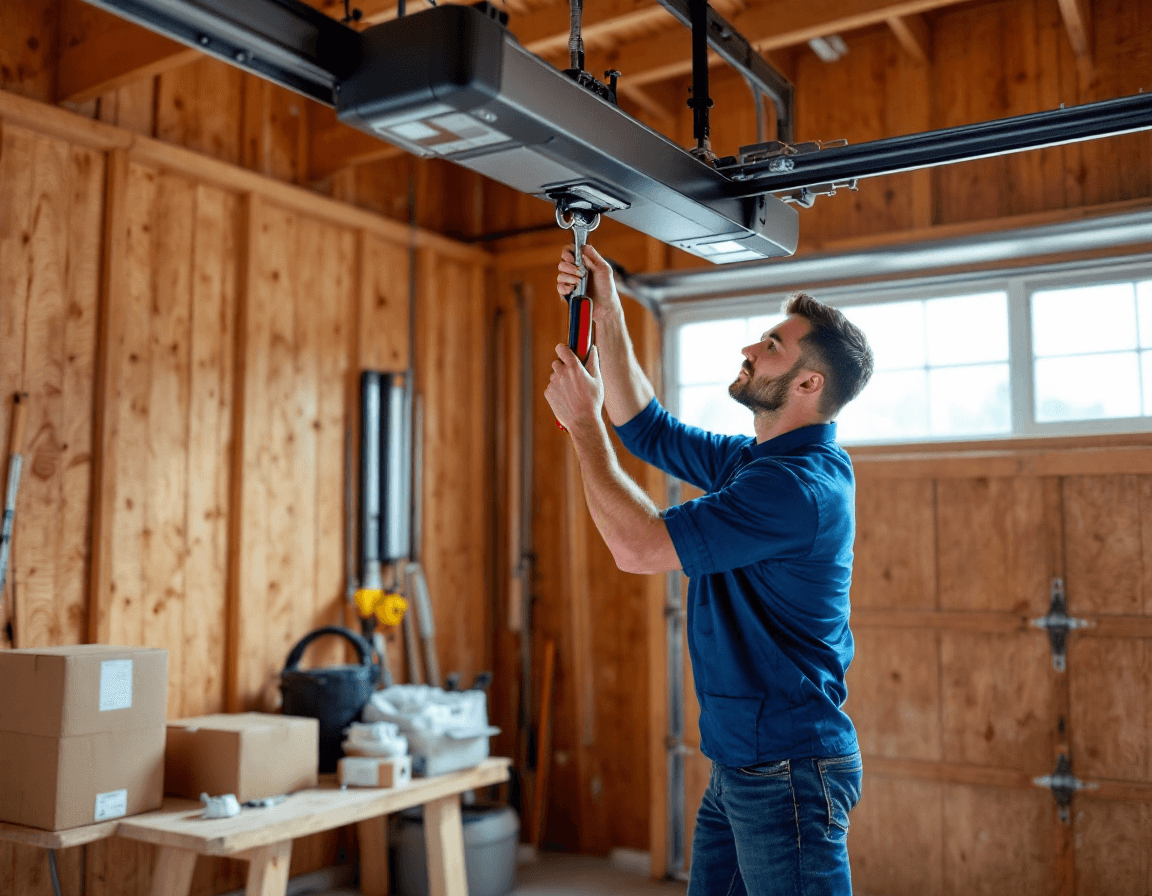
Garage Door Opener Installation & Replacement in Auburn, WA is one of the most practical upgrades a homeowner can make, because the opener does far more work than most people realize. It lifts and lowers a heavy door hundreds of times a year, reverses the door when something gets in the way, and in many homes serves as the main entry point between the car and the kitchen. When that unit starts grinding, stalling, or failing to respond to the remote, the whole household feels it. Our technicians install and replace openers across Auburn every week, from older attached garages near Auburn Downtown to newer homes on the hillsides of Lea Hill and in the master-planned neighborhoods of Lakeland Hills.
Auburn sits in the White River valley at the southern edge of King County, and the local weather shapes how garage equipment ages. Winters are long and damp, with steady rain that can stretch for weeks, and the cold snaps that come through the valley bring frost and the occasional icy morning. Those conditions keep door tracks, weatherstripping, and electrical connections wet for much of the year. An opener that has been quietly struggling through a few damp seasons often shows its wear the first time the temperature drops hard in January. Choosing a replacement now, instead of waiting for a complete failure, gives you control over the timing, the price, and the features you actually want.
This page explains when an opener should be replaced rather than repaired, how the main drive types differ, what rolling-code security means for your home, and how battery backup and smart controls fit into daily life. It also outlines what a professional installation involves and what the price range of $275 to $650 installed typically reflects. Read through the sections that match your situation, and call us at (888) 799-3819 if you would like a technician to look at your specific door and opener.
Reading the Warning Signs Before Your Opener Quits
Most openers do not fail without warning. The earliest signs are often small: a door that pauses halfway up, a motor that hums for a second before the door moves, or a remote that works only when you stand in a particular spot in the driveway. Over time these symptoms tend to multiply, and the opener begins to sound louder and rougher during each cycle. Homeowners often assume the door itself is the problem, when the opener has simply lost the consistency it once had.
Noise is one of the clearest indicators. A worn gear set, a loose trolley, or a motor bearing that is beginning to fail will each produce a distinctive grinding, clacking, or whining sound. If the opener rattles the ceiling bracket or shakes the wall it is mounted to, the mounting hardware and the drive assembly are working harder than they were designed to. Slow travel is another common complaint, especially when the door stops and starts as it moves. That pattern usually points to a motor that is struggling to maintain its speed under load.
Reliability problems deserve attention even when the noise seems manageable. If the opener reverses without an obvious obstacle, loses its memory of the door limits, or needs repeated button presses before it responds, the control board or logic components may be aging. Some of these issues can be corrected with adjustments, but when the same problem returns every few weeks, replacement is usually the more dependable choice. A new unit also gives you updated safety sensors and current safety standards, which matter when children or pets are around the door.
How Auburn's Wet Winters Affect Garage Openers
Rain and humidity do more than soak the driveway. Water migrates into the garage through the bottom seal, pools near the track, and works its way into the ceiling where the opener is typically mounted. Over several seasons, that moisture can corrode the mounting brackets, speed up rust on the rail, and create conditions where electrical connections degrade. Homes with older or thinner weatherstripping, which is common in many established neighborhoods around downtown Auburn, often see this damage sooner than newer construction does.
Cold mornings add a different kind of stress. When temperatures drop into the low thirties and below, lubricants thicken, and the opener has to work harder to start the door moving. A motor that was adequate in summer may bog down on a frosty morning, leaving the door partway open or causing the auto-reverse to trigger. Those short-cycle reversals are frustrating, and they also put repeated strain on the gears and the door itself. A properly sized opener, matched to the weight of your door, handles these conditions far more smoothly.
Auburn's seasonal patterns also shape when homeowners call. Replacement requests tend to rise in late fall and early winter, when a failing opener becomes an everyday annoyance, and again in early spring, after a long wet season has taken its toll. If you notice moisture on the opener housing, rust spots on the rail, or a damp smell in the garage after storms, it is a good time to schedule an inspection. Addressing the environment alongside the equipment helps the new opener last longer.
Choosing Between Belt-Drive, Chain-Drive, and Wall-Mount Designs
The drive style of your opener determines how it sounds, how it is mounted, and how it fits your garage. Chain-drive openers use a metal chain that runs along the rail and are generally the most affordable and the most durable under heavy use. They are also the loudest option, and the vibration they produce can be noticeable in rooms that share a wall with the garage. For detached garages or homes where noise is not a concern, a chain drive remains a sensible choice.
Belt-drive openers use a reinforced rubber belt instead of a chain, which makes them noticeably quieter during operation. Many Auburn homeowners choose belt drive when the garage is attached to a bedroom, a home office, or a living area, because the difference in sound is substantial. Belt systems also run more smoothly, which can make the door feel more controlled as it travels. They typically cost more than basic chain-drive units, so the decision often comes down to how much you value a quiet home.
Wall-mount openers attach to the side wall of the garage instead of the ceiling, which frees up overhead space for storage, bikes, or ladders. This design is especially useful in garages with low ceilings, unusual door heights, or a ceiling track that does not allow for a standard ceiling bracket. Wall-mount units can be paired with either belt or chain mechanisms, so you may still choose between quiet and economical operation. A technician can measure your door height, track configuration, and ceiling clearance before recommending a model.
- Chain-drive: strong, economical, and well suited to detached garages or noise-tolerant households
- Belt-drive: quieter operation that works well for attached garages and living spaces above or beside the garage
- Wall-mount: frees ceiling space and solves clearance problems in low or unusually shaped garages
Rolling-Code Security and Why Older Remotes Are a Risk
Older openers often used fixed-code remotes, meaning the signal sent from the transmitter never changed. Anyone with a basic signal capture device could record that code and replay it later to open the door. Rolling-code technology solves this problem by generating a new code each time the remote is pressed, so a captured signal cannot be reused. If your opener is an older fixed-code model, upgrading is one of the most meaningful security improvements you can make for the garage.
Security is not the only reason to consider a rolling-code system. Modern units typically support multiple remotes, keypad entry, and programmable access for family members or service providers, which makes it easier to manage who can enter. Many also include built-in lighting, interior wall controls with clear status indicators, and safety features that alert you when a sensor is misaligned. These details seem minor until you need them, and then they make daily use considerably easier.
When we replace an older unit, we also check for other security gaps. A garage door that is left in an unlocked state, a keypad with a factory default code, or an exterior sensor that has been bypassed can each undermine the new system. Changing default codes, reviewing who holds remotes, and confirming the manual release mechanism is working are simple steps that make a real difference. Ask your technician to walk through these settings with you before you leave.
Smart Wi-Fi and myQ Control in Everyday Use
Smart openers connect to your home network so you can open, close, and monitor the door from a phone. Many systems work with myQ and similar apps, which can send alerts when the door has been left open, show the current door position, and let you grant temporary access to a delivery driver or a neighbor watching the house. For households where people come and go on unpredictable schedules, these features bring real peace of mind.
Connecting a smart opener does require some planning. Most garage door openers that support Wi-Fi operate on the 2.4 GHz band, so the garage needs to be within reliable range of your router. In larger Auburn homes, especially those with the garage at the far end of the property, a signal extender or mesh node may be necessary. Your technician can check signal strength during the visit and suggest placement that keeps the connection stable through the wet months when metal framing and damp walls can weaken signals.
It is also worth thinking about how smart features fit your habits. Some homeowners enjoy receiving a notification every time the door moves, while others find it distracting and prefer alerts only when the door stays open for a set period. Shared family accounts, guest access, and two-factor sign-in settings should be reviewed carefully so that access remains limited to the people you trust. A smart opener delivers the most value when the settings match how your household actually lives.
Battery Backup for Power Outages and Long Nights
Power outages in Western Washington usually arrive with wind, saturated ground, and falling branches, and they can last long enough to matter. Without battery backup, a standard opener cannot lift the door during an outage, leaving you dependent on the manual release cord and a lot of effort. Battery backup units keep the opener working for a limited number of cycles, which is often enough to get the car out or back in during the hours when the grid is down. For homes that rely on the garage as a main entrance, this feature is worth serious consideration.
Backup systems vary in how long they hold a charge and how many door cycles they support, so it is important to match the battery to your household routine. Some units recharge automatically when power returns, while others need periodic maintenance to keep the battery healthy. A battery that has been sitting unused for years may not deliver the performance you expect, which is why we recommend testing the backup during every installation. Battery options can be added to many new openers at the time of replacement.
Backup power also deserves a place in your broader emergency plan. Keep the manual release cord accessible, make sure everyone in the household knows how to use it safely, and avoid hanging anything from it that could cause the door to drop unexpectedly. Test the release once a season, ideally when the door is closed and the car is not directly beneath it. A simple, regular check takes only a minute and can save a frustrating situation later.
What a Professional Installation Visit Involves
A proper installation begins before the old opener is removed. The technician checks the door's height, weight, and balance, confirms the track is aligned, and evaluates the condition of the springs, cables, and rollers. This inspection matters because an opener can only perform as well as the door it moves. If the door is binding or unbalanced, installing a new opener will not solve the underlying problem, and the new unit may be strained from the start.
Once the door is ready, the technician selects the correct horsepower and drive type for your setup, mounts the rail and motor, and connects the safety sensors and control wiring. Auto-reverse force settings and travel limits are adjusted and tested under real conditions. The technician also confirms that the manual release works, that the photo-eye sensors are aligned and clear, and that the opener responds correctly to remotes, keypads, and any smart controls you have chosen. Programming the new system takes care and patience, and it is not something to rush.
Installation in older Auburn neighborhoods sometimes reveals hidden issues, such as outdated wiring, damaged header brackets, or ceiling joists that need additional support. In newer developments in Lakeland Hills and Lea Hill, the layout is often more uniform, but door sizes and track configurations can still vary by builder. Whatever the home, the goal is the same: a secure, quiet, and dependable opener that matches your door and your daily routine. Ask for a walkthrough at the end of the visit so you know how to operate every feature.
Understanding the $275 to $650 Installed Price Range
Installed pricing for garage door openers in our service area generally falls between $275 and $650, and the spread reflects real differences in equipment and work. Entry-level chain-drive units sit at the lower end of that range, while belt-drive models, wall-mount systems, smart Wi-Fi capability, and battery backup options move the price upward. The final figure depends on the specific opener model you select, because each model carries its own motor, warranty, and feature set.
Labor is part of the total as well. A straightforward ceiling-mount replacement on a standard door with an existing circuit will usually be simpler than a wall-mount installation that requires new bracketing or added wiring. Older garages may need electrical updates to meet current requirements for outlet placement, so it is wise to confirm these details during the estimate rather than discovering them mid-job. Accurate pricing depends on an on-site look at your door and garage.
When comparing quotes, look beyond the sticker price. Ask what is included in the installation, whether the old unit is removed and disposed of, what warranty covers the motor and parts, and whether the technician will program your remotes and test the safety reversal. A lower quote that leaves out these steps can cost more in the long run. A transparent estimate that explains each line item is a good sign of a company you can trust.
Repair or Replace: Knowing When an Opener Is Beyond Saving
Not every problem calls for a new opener. A worn remote battery, a misaligned sensor, or a loose hardware bolt can often be corrected in a single visit at modest cost. The question becomes harder when multiple components are failing at once, or when a repair would cost a substantial portion of the price of a new unit. In those cases, replacement usually gives you more reliable performance for the money.
A useful rule of thumb is to consider the age of the opener, the number of repairs in the past few years, and the availability of replacement parts. If the motor has already been replaced once and the logic board is now showing problems, the unit is likely to fail again soon. Openers that are no longer supported by the manufacturer can be difficult to repair, and their fixed-code systems leave you exposed to the security concerns discussed earlier. Replacing these units restores both function and peace of mind.
A technician should explain your options honestly, including what each repair would accomplish and how long the result is likely to last. We will not recommend a replacement when a simple repair will do, and we will not recommend a repair when the opener has reached the end of its useful life. Clear information lets you decide what makes sense for your budget and your home.
Safety Checks, Springs, and Why Cable Work Belongs With Licensed Professionals
Safety is the foundation of any garage door project, and it is important to separate what a homeowner can handle from what requires a licensed professional. Testing the auto-reverse, checking that the photo eyes are clean and aligned, and confirming that the manual release works are reasonable tasks for an informed homeowner. Keep children and pets clear of the door while testing, and never stand under the door when it is moving.
Springs, cables, and drums are a different matter entirely. Torsion and extension springs store enormous amounts of energy, and an improper adjustment or a sudden release can cause serious injury. Cable repair, spring replacement, and any work that involves tensioning must be left to trained, licensed technicians with the right tools and experience. Even when an opener installation seems simple, a technician will inspect these components because they affect how the new opener performs and how safely the door operates.
Our technicians follow established safety procedures during every installation and will not attempt spring or cable work without the proper equipment. If the inspection reveals a spring that is near the end of its life or a cable that is fraying, we will explain the risk and recommend the appropriate repair. Your safety and your household's safety come first, and we are glad to answer any questions about how these components work before any work begins.
Garage Door Opener Installation & Replacement in Auburn, WA is a job best handled by people who understand both the mechanics and the local conditions that shape them. If your opener is loud, unreliable, lacking modern security, or unable to handle another wet winter, our team can help you choose the right drive type, smart features, and battery backup for your home. Call Seattle Garage Door Fix today at (888) 799-3819 to schedule an inspection, get a clear installed estimate, and find out which opener fits your Auburn home.