
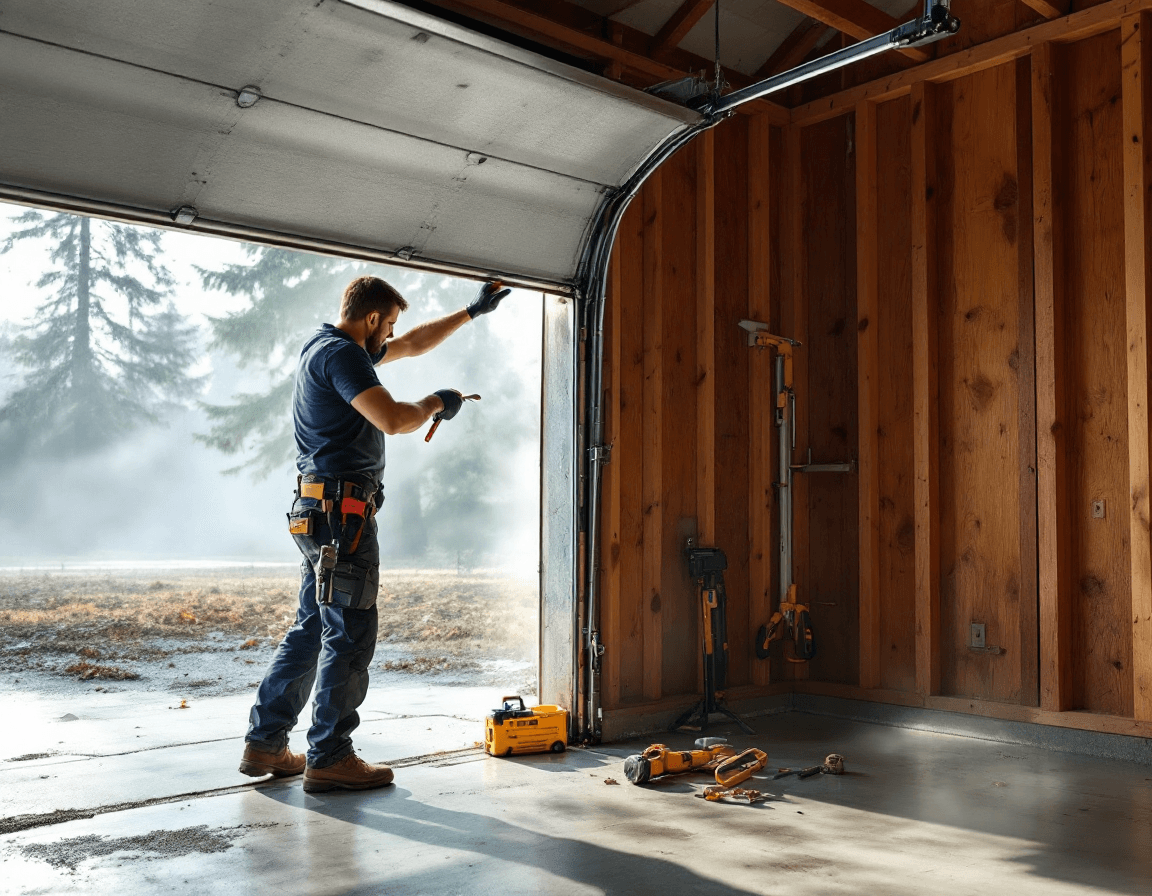
Off-track garage door repair in Auburn, WA is one of the more common calls we handle, and it is usually more fixable than homeowners expect. When a door jumps a track, binds halfway up, or sits at a visible angle, the cause is almost always a short list of familiar culprits: a roller that has popped out, a track section that has shifted, or a panel that has been knocked out of square. Auburn's mix of older neighborhoods, newer subdivisions, and wet winters means we see the full range of these problems, from a single worn roller in a 1990s tract home to a bent track after a delivery truck clipped a door in a downtown alley. Our technicians handle them the same way every time: confirm the cause, correct it, and check the whole system before we leave.
Most off-track repairs for homes across Auburn fall in the range of $125 to $400, depending on what has actually failed and how much time the realignment takes. A door that needs a few rollers reseated and a loose bracket tightened sits at the low end, while a door with a bent track section or a panel that needs to come out and be squared up costs more. We walk you through the findings before any work starts, so you know exactly what is being done and why. If you are dealing with a door that is stuck or leaning right now, call us at (888) 799-3819 and we will tell you what we can likely fix on the first visit.
This page explains what causes a door to leave its track, how we diagnose the problem, what a typical realignment involves, and where safety limits should stop a homeowner from working on the door alone. It also covers the particular conditions that affect Auburn homes, including the damp air that swells wood and the hillside driveways and settling slabs found in some parts of the city. Our goal is to help you make a clear decision about whether to call a technician now, schedule a visit soon, or keep an eye on a minor issue that can wait a few weeks.
Reading the Warning Signs Before a Door Leaves Its Track
A door rarely jumps its track without warning. Most homeowners notice a small change first, such as a faint squeal at the top of the travel, a slight pause before the door starts moving, or a gap that wasn't there last month between the bottom seal and the floor. These early signs usually mean one roller is starting to wear or has begun to walk out of its channel. If you catch the problem at this stage, the repair is typically quick and inexpensive, because nothing has been bent or damaged yet.
Pay attention to how the door behaves at different points in its travel. If it runs smoothly when closing but hesitates when opening, or if it moves fine until it reaches a certain height, the trouble is often located at one specific track section or roller set. A door that sits visibly lower on one side than the other, or that shows a wedge-shaped gap along the top edge, is telling you the two sides are no longer tracking together. Ignoring that imbalance puts extra strain on the opener, the cables, and the remaining rollers.
Sounds deserve attention too. Grinding, scraping, or a sharp clack during operation usually means metal is contacting metal somewhere along the track. A door that stops and reverses on its own may be detecting resistance caused by a binding roller. If you notice any of these symptoms, stop using the automatic opener and call a technician instead of forcing the door to finish its cycle. Pushing an off-track door with the opener can bend the track further and turn a simple reseating job into a larger repair.
Why Auburn Doors Tend to Wander Off Course
The Pacific Northwest climate has a real effect on garage doors. Long, wet winters push moisture into wood doors, causing panels to swell and sometimes warp slightly at the edges. Steel doors are less affected by moisture itself, but they still suffer when rust forms around hinges and roller stems or when the galvanized finish breaks down from years of damp air. Swelling and warping change the door's weight distribution and its fit inside the tracks, which can push a roller slightly out of its groove.
Ground movement is another factor. Auburn's soils hold water through the rainy months and can shift slightly as they dry out in summer. When a slab moves even a fraction of an inch, the vertical tracks that are anchored to the framing can drift out of plumb. We often find a door that appears to be misaligned only because the track has changed position, not because the door itself has failed. Correcting the track is the real fix, and simply adjusting the door will not hold for long.
Wind storms that sweep through the region can also play a role. Strong gusts push against large, lightweight doors, especially on wider two-car openings, and can nudge a roller out of its channel. Combined with the day-to-day stress of opening and closing the door, that small shift can become a full derailment. Keep this in mind when you see a door that came off track right after a windy night, because the cause may be external rather than a worn part.
What a Technician Actually Checks on an Off-Track Door
When we arrive at a home with an off-track door, the first step is always safety. We confirm the opener is disconnected, check that the door is held in place, and look for any sign that the springs or cables have been damaged. If the spring system appears compromised, we stop and explain the options before going further, because spring tension is one of the most dangerous elements of a garage door. Our technicians are licensed, bonded, and insured, and we follow strict procedures whenever a spring or cable is involved.
Next we inspect the track itself. We look for dents, kinks, separated joints, loose bolts at the mounting brackets, and any section that has been pulled away from the wall or ceiling. A track that looks straight at first glance may have a slight twist that only shows up when you sight down its length. We also check the vertical and horizontal runs for alignment, since a door cannot track properly if the tracks themselves are out of square.
Finally we examine the rollers, hinges, and panels. We test each roller by spinning it by hand and checking for flat spots, cracks, or excessive play in the stem. We look at the hinges for stretched holes or missing fasteners, and we check whether any panel has been bent or pushed out of its normal shape. Only after this complete review do we decide on the repair plan, because fixing the most visible symptom without checking the rest of the system often leads to a second call a few weeks later.
Rollers, Hinges, and the Small Parts That Pop Loose
Rollers are the components most often responsible for an off-track door, and they fail in a few predictable ways. The wheel itself can crack or flatten after years of use, and the stem can wear until the roller wobbles inside its bracket. Nylon rollers become brittle with age and temperature changes, while steel rollers can seize when lubrication runs dry. Once a roller loses its smooth motion, it can climb out of the track during a single cycle, and the door follows it off the rail.
Hinges and brackets are the next most common culprits. Hinge holes can elongate from repeated stress, and the screws holding the hinge to the panel can loosen over time. A hinge that has pulled free changes how the door flexes at that joint, and the adjacent roller may drift out of position as a result. Track mounting brackets work the same way, so loose bolts at the wall or ceiling should be part of every inspection.
Here are the small parts we most often replace or tighten during an off-track repair:
- Worn or cracked rollers, especially those showing flat spots or noise
- Stretched or elongated hinge holes that no longer hold the panel square
- Loose track bolts at wall brackets and ceiling supports
- Bent or missing track brackets that let the rail drift out of plumb
- Damaged roller stems or bearings that wobble inside the track
Replacing these parts is usually straightforward, but using the correct size and type matters. A roller of the wrong diameter or stem length may fit initially and then fail within weeks, so we match the components to your door's make and track size before installing anything.
Straightening Bent Track Sections Without Making Things Worse
Track damage is often the most serious part of an off-track repair. Tracks are made from thin steel, and a sharp impact can kink them in a way that is not immediately obvious. A section that appears only slightly dented may still be enough to pinch a roller and push the door out of its groove. Our approach is to identify the exact location of the bend, measure how far the track has moved, and determine whether the section can be carefully straightened or needs to be replaced.
Straightening a track requires patience and the right tools. We loosen the mounting brackets just enough to allow movement, gently work the bend back toward true alignment, and then recheck the line from end to end. Forcing a track with a hammer or pry bar can crack the steel or create a new kink, which is why we avoid shortcuts. If the track has separated at a joint, we inspect the connection and replace the hardware as needed so the sections stay locked together under load.
Some tracks cannot be restored to their original shape. When the steel has been stretched beyond its elastic limit or when cracks have formed at the seams, replacement is the only safe option. We will tell you clearly if that is the case, and we will explain what a new section involves before ordering parts. Honest diagnosis at this stage protects your door, your opener, and the people who use the garage every day.
When a Car Bump Turns Into a Track Problem
Vehicle impacts are a common cause of sudden derailments, particularly in driveways where the parking space is tight or the garage opening is close to a wall. A car that rolls forward a few inches can push the lower panels inward and force the bottom roller out of its track. Even a light tap can bend the lowest track section, and the damage may not show until the door begins to operate again. Many homeowners assume a bump that didn't break anything is harmless, but a bent track can cause problems days or weeks later.
If your door was hit by a vehicle, do not run the opener until the track has been inspected. Running the door through a bent section can tear rollers apart, strip the opener's drive mechanism, or stress the springs in ways that create a more serious hazard. Look at the door from both inside and outside the garage, check the track for visible dents, and note any panels that appear pushed out of their normal line. Taking photos before the repair can also help with insurance documentation if you choose to file a claim.
Our technicians can assess impact damage on the same visit as the derailment. We will check the panels for structural damage, examine the track and brackets for bends, and confirm that the springs and cables were not affected. If a panel needs to be replaced, we can discuss the options and the expected timeline. Because impacts can involve more than one component, a thorough inspection is always the best starting point.
Lakeland Hills and Lea Hill: Driveway Slope, Settling Slabs, and Door Alignment
Homes in neighborhoods like Lakeland Hills and on the slopes of Lea Hill often sit on lots with varied grading, and that can affect how a garage door performs. Sloped driveways may cause the garage floor to sit at a slight angle, which can change how the door hangs and how the bottom seal meets the threshold. When a door is installed on a floor that is not level, one side may track differently from the other, especially if the vertical tracks were set to the wrong plumb at installation.
Newer construction can also settle over the first several years. As the foundation adjusts, the header above the door may shift a small amount, and the tracks anchored to it can move with it. We often see off-track problems appear a few years after a home is built, once the framing and slab have finished their initial movement. A technician who understands this pattern will check the framing, the header, and the track anchors rather than only resetting the door.
Lea Hill homes frequently have wooded surroundings, which means moss, needles, and moisture can collect on the door's exterior and around the tracks. Debris that builds up in the track channel can slow a roller and eventually cause it to jump. Keeping the track clear is a simple maintenance step, but it becomes more important on properties where trees shed heavily or where wet conditions linger. We can point out debris buildup during a service visit and recommend a cleaning schedule that suits your property.
Downtown Auburn Garages: Older Doors, Tight Spaces, and Shared Walls
Many garages in and around Downtown Auburn were built decades ago, and their doors and tracks reflect the construction methods of that era. Older tracks may use different gauges of steel, and some installations have hardware that is no longer manufactured in its original form. When a door in one of these garages comes off track, we often need to source compatible parts or make careful adjustments to keep the new components working with the existing system. Taking time to match the original design protects the door's long-term performance.
Tight spaces are another challenge in older homes. Narrow driveways, close neighboring structures, and limited headroom can make it difficult to access the track or to lift the door safely during repair. Our technicians plan each visit around these constraints, bringing the right tools and working methodically so the door is not left in an unsafe position. Where space is limited, we may recommend temporary bracing or a different sequence of steps to keep the job safe for everyone involved.
Some downtown properties have garages that share walls with neighboring structures or sit close to walkways. Track damage in these settings should be repaired promptly, because a door that binds or drops unexpectedly can create a hazard for pedestrians and vehicles nearby. If your garage is in a shared or tightly packed setting, let the scheduler know when you call so the technician can plan accordingly.
Price Ranges, What Affects the Bill, and What Is Included
Most off-track repairs we perform in Auburn fall between $125 and $400. The final amount depends on several factors, and it helps to understand them before the technician arrives. A door that needs only a roller reseated and a bracket tightened will land near the lower end of that range. A door with multiple damaged rollers, a bent track section, or a panel that must be removed and squared up will move toward the higher end. We provide an itemized explanation before any work begins so you can approve each step.
The main variables that influence the cost include the number of rollers involved, whether the track needs straightening or replacement, the condition of the hinges and brackets, and how many sections of the door are affected. Access also plays a role, since tight spaces or very high openings take more time. We do not add surprise charges for work you have not approved, and if we find a problem that requires a larger repair, we will explain the options and let you decide how to proceed.
Here is what a typical off-track service visit usually includes:
- A safety check of the door, springs, cables, and opener before any movement
- Inspection of the tracks, brackets, rollers, hinges, and panels
- Reseating or replacement of rollers that have left the track
- Straightening or replacement of bent track sections where needed
- Tightening or replacing loose hardware and verifying alignment
- A test cycle of the door to confirm smooth operation before we leave
Specific pricing can change depending on the exact parts involved, so the range above is a guide rather than a guarantee. The technician will confirm the cost on site and explain any differences from the typical range.
DIY Limits: What You Should Never Attempt Yourself
Some homeowners are comfortable with basic garage door tasks, such as tightening a loose bolt or cleaning the track, and those simple steps can help prevent future problems. However, an off-track door involves forces that can cause serious injury, so there are clear limits to what should be attempted without training. The most important rule is that spring and cable work must be left to a licensed professional. Garage door springs carry enormous tension even when they look relaxed, and a mistake can cause the spring to release with force.
Never try to unwind, adjust, or remove a torsion spring, and do not attempt to tension or detach extension springs. Cables under tension can snap and cause injury, so they should not be handled while the door is loaded. If a door has come off its track and the cable has slipped, do not try to lift or drop the door to get it back in position. The door's weight can shift suddenly, and a free-falling panel can crush hands, fingers, or feet.
Keep the opener disconnected whenever you are inspecting an off-track door, and keep children and pets well away from the work area. If you are unsure whether a component is under tension, assume it is and call a technician. Treating the door with caution is far less costly than dealing with an injury, and a licensed professional can usually restore the door safely in a single visit.
Keeping a Door on Track Through Auburn's Seasons
Preventing derailments is easier than fixing them, and a few routine habits go a long way in the Pacific Northwest climate. Moisture is the biggest enemy, so keeping the track, rollers, and hinges clean and lightly lubricated helps them move smoothly despite damp weather. Wipe away debris from the track channel, and use a lubricant made for garage door components rather than a heavy grease that attracts dirt. Avoid spraying lubricant onto the opener's motor or onto the springs.
Check the door's balance periodically. A simple test is to disconnect the opener, lift the door by hand to about waist height, and see whether it stays in place. If it drifts up or down, the springs may need adjustment, which is a job for a licensed technician. Also look over the track bolts and roller hardware every few months, tightening anything that has backed out. Small loose parts are often the first sign that a bigger problem is developing.
Seasonal changes call for extra attention. Before the wet season arrives, inspect the bottom seal and make sure water is not pooling against the threshold, since standing moisture can accelerate rust on the lower brackets. After windy weather, take a quick look at the tracks and panels for any shift. Scheduling a professional tune-up once a year can catch small wear before it becomes a derailment, and it gives you a clear record of the door's condition over time.
If your garage door has come off track, is binding, or shows any of the warning signs described above, call Seattle Garage Door Fix at (888) 799-3819. Our licensed, bonded, and insured technicians serve Auburn and more than 60 cities across the greater Seattle and Western Washington area, including homes near Auburn Downtown, Lakeland Hills, and Lea Hill across ZIP codes 98001, 98002, and 98092. We will diagnose the problem, explain the repair in plain terms, and get your door moving safely again.