
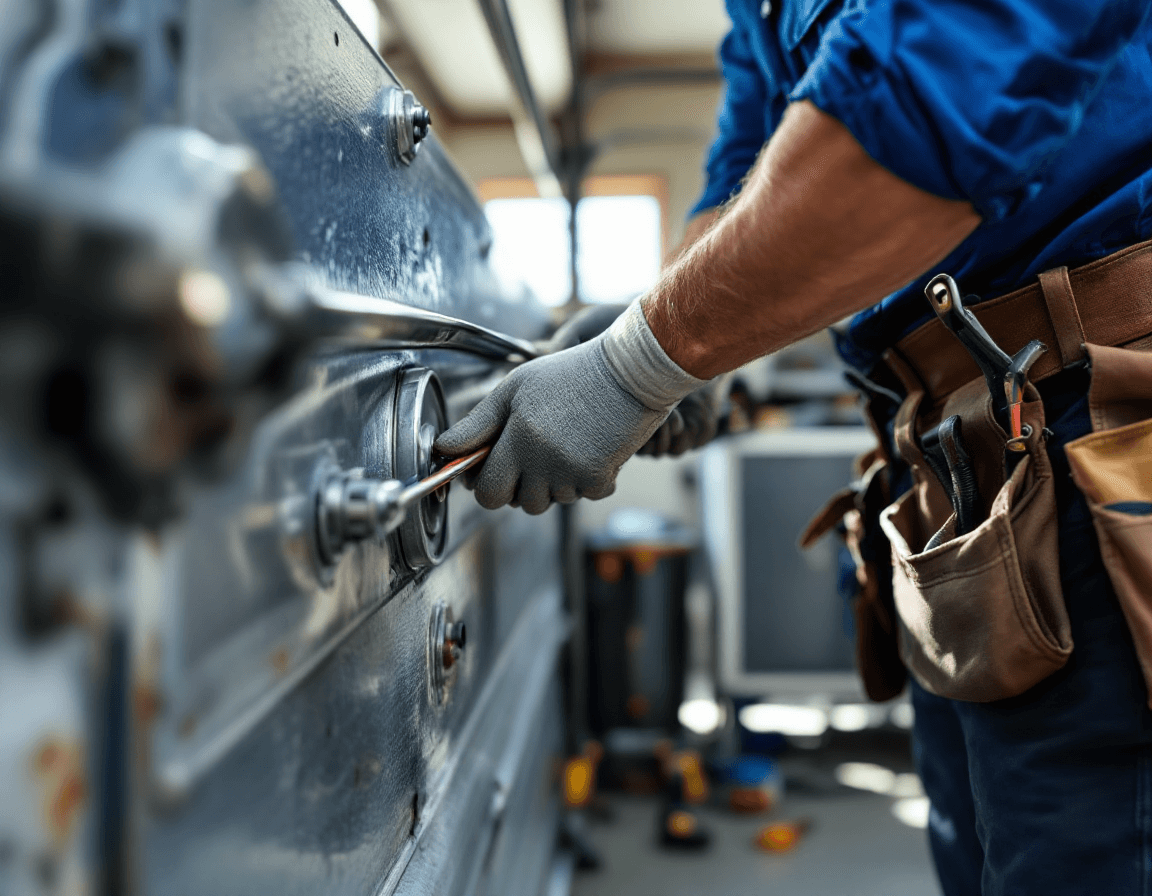
Garage door cable replacement in Des Moines, WA is one of the most common repairs we handle for homeowners across the south King County shoreline, and it is also one of the most time-sensitive. A lift cable that frays or snaps can drop a 150-pound door, or leave it hanging crooked on its tracks, with very little warning. Homes near Des Moines Marina, in the Woodmont area, and out toward Redondo see these failures often because of the damp, salty air that drifts in off Puget Sound. If your door has started behaving strangely, this guide explains what is likely happening and what a proper repair involves.
Most cable problems do not appear overnight. They build up through repeated cycles of lifting and lowering, slow corrosion, and the constant strain of holding a heavy door in balance. By the time a cable finally lets go, the warning signs have usually been visible for weeks or months, such as a door that sits slightly off level or a faint popping sound during operation. Knowing those signs lets you schedule a repair on your terms instead of discovering the problem at six in the morning with the car stuck inside. The sections below walk through the signs, the causes, the repair steps, and the price range you can reasonably expect in Des Moines and nearby neighborhoods.
Why Cables Wear Faster in the Des Moines Coastal Air
The Des Moines shoreline sits in a microclimate that is kinder to views than to steel. Salt-laden moisture settles on exposed metal, and the long, drizzly stretches that characterize Western Washington winters keep that moisture in contact with the cable for days at a time. Galvanized steel resists this for a while, but once the protective zinc coating is scratched or thinned, rust begins working into the individual strands. Corroded strands lose strength quietly, which is why a cable can look acceptable from a distance and still fail under load.
Temperature swings add another layer of stress. Cold mornings make metal contract and can stiffen the lubrication on the drum and pulleys, while warm afternoons in late spring and summer expand components that were previously sized for a different temperature. Over many seasons, this pattern works fine parts loose and encourages small kinks in the cable where it wraps the drum. Homes with north-facing garages, or those tucked behind trees that keep the driveway damp longer, often show the effects sooner than homes with more sun exposure.
Garages in older Des Moines homes can also be less insulated and less ventilated than newer construction. Trapped humidity condenses on cold surfaces, and that moisture sits on hardware for hours each day. Simply wiping down exposed hardware a few times a year and keeping the door closed during heavy rain can slow corrosion, though it will not stop it. Regular inspection is the most reliable way to catch a worn cable before it fails.
Recognizing the Early Warning Signs Before a Cable Gives Way
The first sign is often visual. Look at the lift cables, which run vertically on each side of the door near the tracks. A healthy cable is smooth, evenly coated, and consistent in thickness along its length. A worn one may show bright patches where the coating has rubbed off, a dull brown film that signals surface rust, or small broken wire ends poking out like tiny whiskers. Any of these deserves attention, even if the door still works.
Sound and movement are the next clues. A cable that is starting to fray may produce a faint scraping or ticking as it runs over the drum, while a door that stutters or jerks partway through its travel can indicate uneven tension between the two sides. Many homeowners describe the door as seeming to "catch" on one side before it finishes opening. That catch usually means one cable is carrying more load than the other, and the stronger side is working harder to compensate.
Finally, pay attention to how the door sits when closed and when it is partially raised. A door that hangs lower on one side, leaves a visible gap at the bottom corner, or seems to rest unevenly against the weatherstripping is telling you something about tension and alignment. Do not wait for a snap to act on these observations. Calling a licensed technician at the first sign of imbalance is almost always less expensive than dealing with the damage a failed cable can cause to the door panels, tracks, and opener.
What a Snapped or Dropped Cable Actually Looks Like
When a lift cable breaks, the result is usually dramatic. You may hear a sharp crack or a loud twang, followed by the door sagging or dropping on one side. The door often stops with a jolt, and the opposite side may remain under tension while the broken side drops freely. In many cases the cable end whips loose from the drum or bottom bracket, which is why this kind of failure should never be handled by hand.
Some cable failures do not break completely at first. Instead, a strand or two may fail, and the cable slowly loses load capacity over several days. The door might open with more effort, sit a little crooked, or bind in the track on one side. A fully snapped cable is an emergency because the door is no longer balanced and can move unpredictably. A partially damaged cable is urgent but usually not a same-minute emergency, provided the door is kept closed and no one tries to force it.
Here is what a homeowner should notice on a failed or near-failed cable:
- A sudden loud snap, bang, or metallic crack during operation
- A door that sits noticeably lower on one side than the other
- Visible broken wire strands, loose cable ends, or a cable hanging slack
- A door that opens crooked, stops partway, or refuses to close evenly
- A cable that has jumped off the drum or is wrapped unevenly around it
If you see any of these, keep people and pets clear of the door, avoid using the opener, and call for service.
How Cables Come Off the Drum and Tangle
The drum is the grooved cylinder at the top of the door that the lift cable winds around as the door rises. Cables are designed to stack neatly in a spiral, with each wrap sitting beside the last. When something disrupts that pattern, the cable can slip off the drum edge, overlap itself, or bunch up in a tangle. This often happens after the cable has stretched, after a drum has worn unevenly, or after a door has been forced open when one side was stuck.
Cable drums can also suffer from worn grooves, loose set screws, or a bearing that has seized. Each of these problems changes how the cable feeds onto the drum, and over time that alteration can damage the cable, creating kinks, flat spots, or broken strands. A cable that has come off the drum once is often weakened at the point where it kinked, so it should be inspected closely even after it has been reseated.
This is one of the clearest examples of why cable work belongs in professional hands. The door is held in balance by tension in the springs and cables, and releasing or reseating a cable without relieving that tension can lead to serious injury. A trained technician knows how to secure the door, measure the cable, and check the drum and bearing condition before reinstalling anything.
Why a Lopsided Door Usually Points to the Cables
Many homeowners assume a crooked door means a bad track or an opener problem, but the cables are a frequent culprit. Because the two lift cables share the load, a difference in their length, stretch, or condition will pull one side of the door higher or lower than the other. You may see the bottom panel sitting at an angle, a gap at one corner of the weatherstripping, or the door rubbing against one track.
Tracks and rollers certainly can cause misalignment, and a thorough inspection should check them as well. Still, if the door is hanging lopsided and the tracks look straight and clear, the cables and the drum assemblies deserve a close look. A technician will typically compare cable tension and drum position on each side, then check the springs, since spring tension and cable condition work together to keep the door balanced.
Balance matters for more than appearance. An unbalanced door places uneven strain on the opener, the rollers, and the hinges, which can shorten the life of every component. Correcting the imbalance early often prevents a chain reaction of smaller repairs that would otherwise add up over time.
Choosing the Right Replacement Cable for Your Door
Replacement cables are not one-size-fits-all. The correct cable depends on the door's weight, height, spring system, and drum design. A cable that is too thin will not carry the load safely, and one that is too long or too short will prevent the door from balancing correctly. This is why a technician should identify the door's specifications and match the cable to them rather than relying on a generic part from a shelf.
Here are the main factors a technician considers when selecting a replacement cable:
- The door's overall weight, including insulated panels and hardware
- The door height and track configuration
- The drum size, groove profile, and attachment style
- The spring system the cable works with, including whether the door uses standard or high-lift tracks
- The existing cable diameter and the condition of the mounting hardware
Matching all of these details ensures the new cable will seat properly on the drum, carry the rated load, and keep the door level through its full travel. Installing the wrong size is one of the most common mistakes in DIY attempts, and it can lead to repeated failures.
Our Typical Cable Replacement Process
A professional cable repair begins with safety. The technician secures the door so it cannot move, relieves spring tension using proper procedures, and confirms the opener is disconnected. Only then does the old cable come off. Each step is carried out in a set order so that the door stays controlled from start to finish.
Once the damaged cable is removed, the technician inspects the drum, bearing, and bracket. Worn grooves, cracked drums, seized bearings, or loose mounting hardware are addressed at the same visit when possible, because a new cable on a damaged drum will not last. The replacement cable is then routed through the drum and secured to the bottom bracket, and tension is restored carefully so the door rises and falls evenly.
The final stage is testing. The technician runs the door through several full cycles, checks the level of the bottom panel, confirms that both cables are seated and wrapping correctly, and verifies that the opener's safety reversal functions as designed. Homeowners are usually walked through what was replaced, what was checked, and any maintenance steps that will extend the life of the new components.
What Affects Cable Replacement Pricing in Des Moines
Most cable replacements we perform fall within a $110 to $300 range. The final price depends on several things, including whether one or both cables need replacement, whether the drum or bearing also requires service, the door's size and spring system, and whether the job takes place during regular or after-hours scheduling. A single cable on a standard residential door will generally cost less than a two-cable job on a heavier, custom, or insulated door.
Accessibility also plays a role. A garage with plenty of working room and a straightforward door configuration is faster to service than one with stored items crowding the space or an unusual track layout. If additional repairs such as roller replacement or track alignment are needed, the technician will explain those options separately so you can decide what to address now and what to schedule later.
We recommend asking for a clear explanation of the repair and its cost before work begins. A reputable technician should be able to describe the parts being installed, the reason each one is needed, and what the total will be. Transparency at the estimate stage is one of the best indicators of a trustworthy service provider.
Safety Limits Every Des Moines Homeowner Should Respect
Garage door springs and cables store enormous amounts of energy, and that energy is the reason this work should be left to licensed professionals. Attempting to release tension, reseat a cable under load, or wind a spring can cause serious injury, and these incidents happen to experienced amateurs as well as beginners. There is no safe shortcut for a door that is hanging off its drum or sitting crooked on one side.
Homeowners can take several precautions while waiting for service. Keep the opener disconnected, keep children and pets away from the door, and avoid standing beneath it. Do not attempt to lift or force the door by hand, and do not pull on the cables. If the door must be used before repair, operate it slowly and only if it moves freely without catching or jerking.
Use this quick reference while you wait for a technician:
- Do not stand under or near a door that is sagging, catching, or hanging unevenly
- Do not try to rewrap, reseat, or tension a cable yourself
- Do not adjust or remove any spring components
- Disconnect the opener if the door is unbalanced, and call for service right away
- Keep the area clear of vehicles and stored items until the door is secure
Protecting Your Cables Through Each Western Washington Season
Good maintenance can extend cable life considerably, even in a damp coastal environment. Inspect the cables at least twice a year, ideally in spring and fall, looking for bright wear spots, rust, and broken strands. Wipe away salt residue and moisture when you notice it, and keep the garage ventilated so humidity does not condense on hardware for long stretches.
Lubrication matters too, but it must be applied correctly. Use a lubricant recommended for garage door hardware on the rollers, hinges, and bearings, and follow the manufacturer's guidance. Do not spray lubricant directly onto the cable in a way that attracts dirt or grit, and never use a lubricant that could damage the cable's coating or the opener's components. If you are unsure, ask your technician during a routine visit.
Finally, schedule professional inspections periodically rather than waiting for a failure. A licensed technician can measure cable tension, check drum wear, confirm balance, and spot early signs of corrosion that are easy to miss. Catching a problem at the fraying stage almost always costs less and disrupts your household far less than responding to a snapped cable in the middle of a rainy week.
If your Des Moines garage door is hanging crooked, making a snapping sound, or showing a cable that has come off the drum, do not wait for it to fail completely. Call Seattle Garage Door Fix at (888) 799-3819 to schedule a licensed, insured technician who can inspect the door, explain your options clearly, and restore safe, balanced operation.