
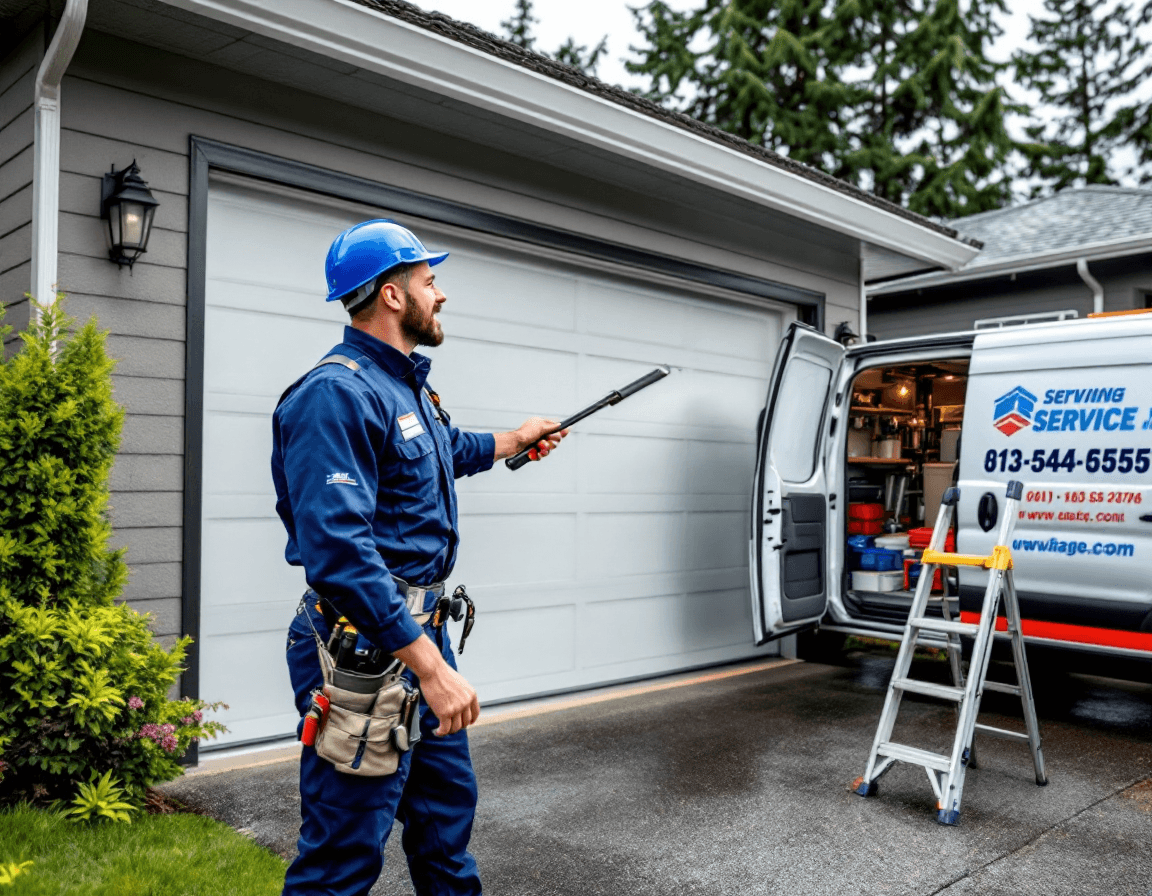
Garage door repair in Pacific, WA is one of those jobs homeowners tend to put off until the door makes the decision for them. A door that hesitates, grinds, or stops halfway usually gives some warning first, but in a busy household it is easy to dismiss a slight stutter as normal wear. Our technicians serve Pacific and the surrounding King County communities, and we see the same pattern repeatedly: a small problem that was ignored turns into a stuck door at 6:45 on a weekday morning. This page explains what tends to go wrong with residential garage doors in and around Pacific, how to recognize the early signs, and what to expect when you call us.
Pacific sits in the White River valley, where the weather shapes how garage doors age. Long, wet winters, frequent drizzle, and damp mornings that linger well into the day all put steady pressure on the hardware that keeps a door moving. Repairs that seem simple, such as replacing a roller or realigning a track, deserve a closer look here because moisture is working on metal and wood around the clock. Whether your door is a steel sectional unit or an older wood model, the goal is the same: a door that opens and closes predictably, every time, with no surprises. The rest of this page is written to help you make sense of what you are seeing and hearing.
Fast, reliable service matters, but so does an honest diagnosis. Some symptoms have a simple cause that costs little to correct, while others point to a worn component that should be replaced before it fails completely. We aim to explain the difference in plain language so you can decide what makes sense for your home and budget. For most residential repairs, our pricing falls between $95 and $450, depending on the parts involved and the complexity of the work. Read on for the details that matter most to Pacific homeowners.
Why Western Washington Humidity Wears Down Garage Door Hardware
Humidity is one of the less obvious enemies of a garage door, and it is especially relevant in the Pacific area. Moisture settles into the galvanized and painted steel of sections, the hinges, and the roller bearings, and over time it encourages surface rust and corrosion. Rollers that once glided quietly can begin to bind, and the tracks themselves may collect grit that the damp mud from driveways tracks in. A door that spent a wet winter closed in an attached garage often shows the effects by early spring.
Wood doors face a different set of problems. Panels can swell during the rainy months and shrink during drier stretches, which changes how the door sits in its opening and how it meets the weatherstripping along the bottom. A wood door that once cleared the floor evenly may start to rub or drag on one side after a few seasons of this movement. Paint and sealant help, but they need periodic attention to hold up under constant moisture.
Cold mornings add another layer. When temperatures drop overnight, lubricants thicken and metal contracts slightly, which can make an opener strain or a door hesitate on its first cycle of the day. Many homeowners notice the problem only in the cold months and assume the door is failing, when a fresh lubrication and a check of the balance may restore smooth operation. A regular seasonal inspection is one of the most cost-effective habits a Pacific homeowner can adopt.
Reading the Early Warning Signs Before a Door Fails Outright
Garage doors rarely stop working without warning. Most failures are preceded by a series of small changes that are easy to overlook if you are not paying attention. Learning to notice these early signals lets you schedule a repair on your terms instead of during an emergency. Some of the most common early indicators include:
- The door pauses or jerks for a moment at the start or end of its travel.
- One side of the door lags behind the other when it opens or closes.
- The opener runs longer than usual before the door finally moves.
- Fresh rust, flaking paint, or a dark stain appears on the track or at roller contact points.
- The door seems slightly out of level when it is fully closed, with a gap showing at one corner.
Any one of these signs can have an ordinary explanation, such as a dirty track or a loose bolt. However, when two or more appear together, the odds favor a component that is wearing out or out of adjustment. Catching it early often means a simpler and less expensive fix, because a single roller or a track bracket is far cheaper to replace than an entire section or a damaged spring system.
Keep a short note of what you observe, including the time of day and the weather. A door that sticks only on the first cold morning points to different causes than one that struggles after a week of heavy rain. When you call, that information helps our technician narrow down the likely source of the problem before arriving at your home. It also helps us avoid unnecessary parts and time spent on the wrong diagnosis.
When the Door Reverses Before It Reaches the Floor
A door that starts to close and then immediately lifts back up is doing exactly what it was designed to do, which is protect people and objects in its path. Modern openers are equipped with a safety reversal system, typically either an infrared photo-eye pair mounted near the floor on each side of the opening or a pressure-sensitive mechanism built into the opener's logic. When that system detects an obstruction or a misaligned sensor, the door reverses. The frustrating part is that the reversal often happens even when nothing is actually in the way.
In Pacific, the most frequent culprit is a photo-eye that has been knocked out of alignment or whose lens has accumulated dust, cobwebs, or road grime. Sunlight streaming through a side window can also confuse the sensors at certain times of day. Check the two small sensor units first: the indicator lights should be steady rather than blinking, and the sensors should point directly at each other across the opening. A gentle nudge to re-aim them and a wipe of the lenses with a dry cloth solves many of these calls.
If the sensors look correct and the door still reverses, the issue may lie in the closing force settings or in a track that has shifted slightly out of plumb. Adjusting the force settings can be done by a careful homeowner, but it is important not to override the safety system to make the door close. A door that closes with excessive force is a genuine hazard, and any adjustment should be checked to confirm the door reverses properly when it contacts a test object on the floor.
Grinding, Squealing, and Banging: Sorting Out the Sounds
Noise is the most common complaint we hear from homeowners, and different sounds usually point to different parts of the system. A high-pitched squeal often comes from dry or worn rollers, particularly nylon rollers that have lost their lubrication, or from hinges rubbing against each other. A low, rough grinding sound is more likely to indicate a worn bearing inside a roller, a gearbox issue in the opener, or grit trapped in the track. A sharp bang or thump usually means a loose hardware connection or a panel that is no longer seated squarely in its track.
Pacific's damp conditions make the squeal-versus-grind question especially important. Rust that forms on the steel track can create a rough surface that makes ordinary rollers sound louder and harsher than they should. Cleaning the track thoroughly and applying the correct lubricant can quiet a door considerably, but the lubricant should be a silicone or lithium-based product designed for garage door components. Avoid heavy grease or household oils, which attract dirt and can gum up the rollers over time.
Banging deserves prompt attention because it can signal that a track bracket has loosened or a panel has come partly out of its channel. A door that bangs loudly on every cycle should be inspected before it is used again, especially if you notice the door sitting unevenly. If the noise is accompanied by visible gaps, sagging, or a door that appears to have left its track, stop using the door and call a technician. Continuing to run a damaged door can turn a modest repair into a much larger one.
Crooked Travel, Sagging Panels, and Doors Knocked Off Track
A door that moves unevenly or looks crooked is telling you that the two sides are not carrying their share of the load equally. This can happen when a roller fails on one side, when a track has been bent or loosened, or when one of the cables or springs has lost tension. Homeowners often notice the problem first as a visible gap at the top or bottom corner, or as a door that stops with one side higher than the other. Because the door is under significant tension, this is a situation where caution is essential.
Our technicians check several items during this kind of call: the track alignment from top to bottom, the condition of each roller and hinge, the tightness of the mounting brackets, and the overall balance of the door. Sagging panels can sometimes be traced to a worn hinge or a flexed section, while a door that has come partly off its track usually needs the track re-seated and the rollers inspected. In many cases, the repair involves straightening or re-securing the track and replacing a damaged roller, both of which are relatively modest jobs.
Any repair involving the spring system or the lifting cables requires a licensed professional. Springs store a large amount of energy, and cables carry significant load even when the door appears to be at rest. Attempting to adjust, release, or replace these components without proper training and equipment can cause serious injury. If you see a broken spring or a cable that has come loose from its drum, keep the door closed, keep people and pets away from the area, and schedule a professional visit.
Remotes, Wall Buttons, and Openers That Seem Dead
When the remote and the wall button both do nothing, the first step is to determine whether the opener itself has power. Check that the unit is plugged into a working outlet, that any GFCI reset has not tripped, and that the circuit breaker serving the garage is still in the on position. Many Pacific homes have garage outlets that share circuits with other appliances, and a surge or a tripped breaker can leave an opener unresponsive without any mechanical fault. Replacing the remote batteries is a quick check that costs almost nothing.
If the opener has power but still refuses to respond, the wall button wiring or the receiver board in the opener may be the issue. Wall buttons can fail after years of exposure to humidity, and a corroded contact can interrupt the signal entirely. The opener's receiver may also lose its programmed codes after a power outage or a firmware change, which means the remotes need to be relearned. A technician can test each part separately to determine whether the fault lies in the remote, the wiring, or the logic board.
Many of these problems are inexpensive to fix, but they are also easy to misdiagnose from the outside. A dead remote can be mistaken for a failed opener, and a failed opener can be mistaken for a stuck door. Calling a technician early for a no-response situation helps rule out the simple causes and prevents you from paying for parts you do not need. It also keeps you from being stranded outside the garage on a rainy evening.
Doors That Slam Down Too Fast
A door that drops quickly and hits the floor with force is more than an annoyance. It can damage the door, the track, and anything underneath it, and it places stress on the opener and the springs that was never intended. The most common cause is a spring system that has weakened and no longer balances the weight of the door properly. When the door is not properly balanced, the opener must work harder in one direction and the door may accelerate uncontrollably in the other.
Balance problems are one of the areas where homeowners should step back and call a professional. Testing balance involves disconnecting the opener and lifting the door partway by hand, then checking whether it stays in place. Doing this incorrectly, or on a door with a damaged spring, carries real risk. A licensed technician has the training and equipment to assess the spring tension safely and recommend a repair or replacement that restores smooth, controlled movement.
Closing speed can also be affected by the opener's settings and the condition of the door's rollers. Worn rollers can make the door move unpredictably, and an opener set to an aggressive close speed can make a minor issue feel dramatic. A technician can review the opener settings and confirm that the door's safety features are working as designed. In most cases, restoring proper balance and smooth travel returns the door to a controlled, quiet operation that feels solid and secure.
What a Typical Repair Visit Covers in Our Pacific Service Area
When you schedule a visit with Seattle Garage Door Fix, the technician begins by asking about the symptoms and observing how the door behaves during a full cycle. This initial conversation often reveals useful details that save time on site, such as whether the problem appears only in cold weather or only when the door is partly open. The technician then inspects the key components, which typically include the tracks, rollers, hinges, sensors, cables, springs, and opener. Each part is checked for wear, alignment, and secure fastening.
A typical residential visit in our area might address some of the following: re-aligning or re-securing a track, replacing one or more rollers or hinges, cleaning and lubricating moving parts, adjusting or replacing photo-eye sensors, restoring opener programming, or addressing a worn bearing. Larger jobs, such as replacing a section or addressing the spring system, are discussed with you before any work begins so you understand the scope and cost. We believe you should know exactly what is being done and why before any part is installed.
Our standard repair pricing for most residential work falls between $95 and $450. The final figure depends on the parts required, the time involved, and whether any additional components are discovered during the inspection. We explain the findings on site and give you the choice of moving forward or waiting, so there are no surprises. We are licensed, bonded, and insured, and we stand behind the quality of the work performed.
Safety Limits: Where Homeowners Should Stop and Call a Professional
Garage doors are heavier and more powerful than most homeowners realize, and certain repairs carry risks that no amount of online instruction can fully offset. Spring work, cable work, and any task that involves releasing tension should be left to a licensed professional. A torsion spring can hold enough energy to cause serious injury, and a cable under tension can snap with force. These are not tasks that become safe simply because a video made them look easy.
Homeowners can safely handle several basic tasks, provided they use common sense and the door is fully closed and disconnected from the opener. Cleaning the tracks, wiping the photo-eye lenses, replacing remote batteries, and applying lubricant to hinges and rollers are all reasonable steps. Tightening visible bolts on the outside of the door can also be done carefully, as long as you do not attempt to adjust anything under spring tension. When in doubt, stop and call.
Some warning signs should prompt you to keep the door shut and avoid using it until a technician has inspected it. These include a visibly broken spring, a cable hanging loose, a door that has come off its track, a door that sags heavily on one side, and a door that falls rather than lowers under its own control. Keep children and pets away from the door in these situations, and do not attempt to force it open or closed. A short wait for a professional visit is far safer than attempting a repair that could result in an injury.
Booking a Visit and What Pacific Homeowners Can Expect
Scheduling a repair with us starts with a simple phone call. Describe the symptoms you have noticed, including when they occur, whether the door makes any noise, and whether you have checked the sensors or the remote. This information helps us prepare the right tools and parts and estimate how long the visit will take. If the door is currently stuck or unsafe, let us know so we can prioritize your appointment appropriately.
Our technicians work throughout the Pacific area and the surrounding King County communities, and we aim to make each visit as efficient as possible. We arrive ready to diagnose the problem, we explain our findings clearly, and we confirm the repair with you before proceeding. Many residential repairs in our range are completed in a single visit, though more involved work may require a second appointment if parts need to be ordered. You will always know the expected scope and cost before work begins.
Pacific City Park and the surrounding neighborhoods are well known to our crew, and we are used to working in the variety of home styles you will find around town. Whether your garage is attached or detached, your door is wood or steel, or your opener is several years old, we can assess the situation and recommend a practical path forward. Quick, honest service is the goal on every call.
Call Seattle Garage Door Fix at (888) 799-3819 to schedule garage door repair in Pacific, WA. Tell us what your door is doing, and we will help you get it moving safely and smoothly again.