
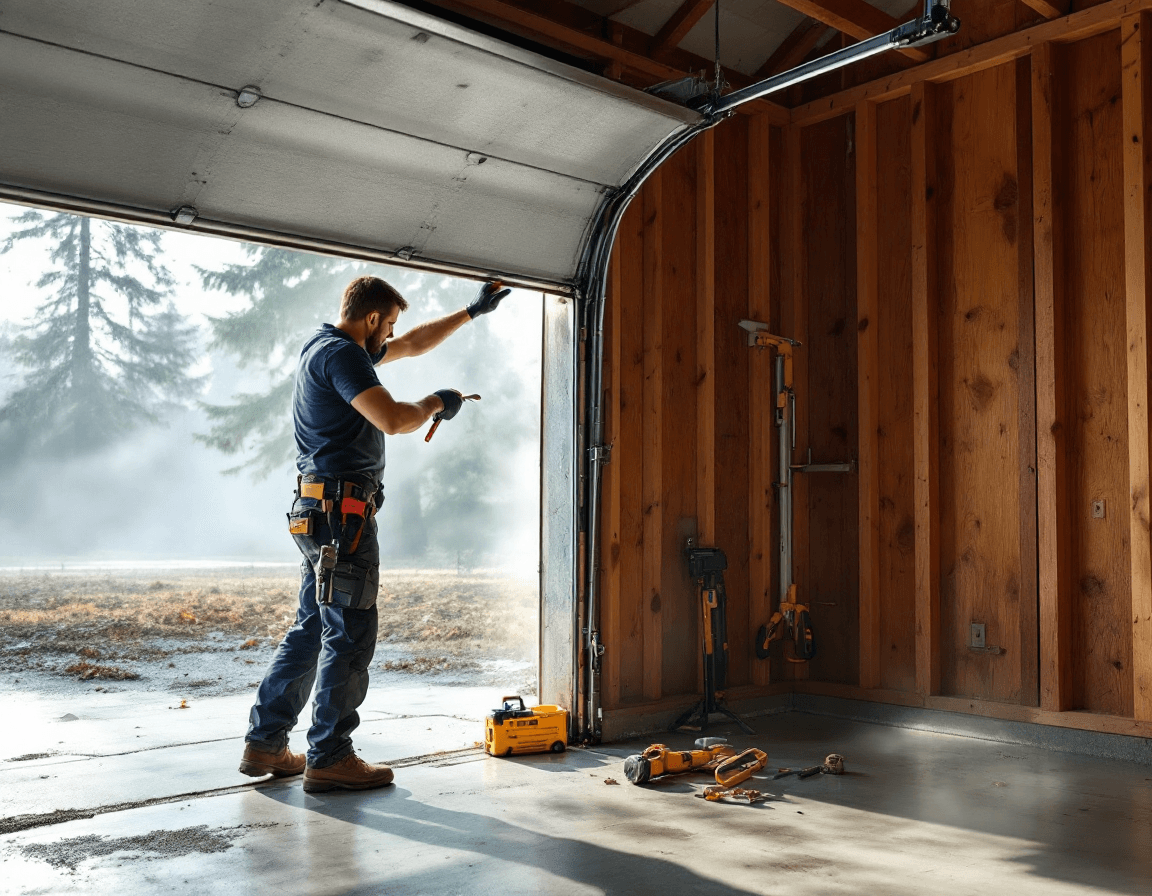
Off-track garage door repair in Fircrest, WA is one of the more urgent calls we take, because a door that has left its track can't be safely opened, closed, or secured until a technician gets it back where it belongs. Homeowners in this part of Pierce County usually notice the problem when the door stops halfway, sits crooked, or makes a grinding noise that wasn't there the day before. A door that is partly off its rails can look stuck but still be under tension, so the safest first move is to stop trying to force it. This page explains how off-track problems develop in our area, what the warning signs look like, what a technician does to fix them, and what a typical job costs.
Most of the calls we hear about start the same way: someone pulls into the driveway, presses the remote, and the door shudders, lurches, or stops with a visible gap along one side. Sometimes the trouble is obvious, such as a roller hanging out of the track or a dent in a section. Other times the door seems fine until the next morning, when one corner has dropped slightly and the opener strains to move it. Whatever the sequence, the goal is the same: get the door realigned, rollers seated, and track straightened before the hardware takes more damage. Our technicians are licensed, bonded, and insured, and they treat every off-track job as a safety call first and a repair second.
If you are reading this because your door is off track right now, call (888) 799-3819 and describe what you see. We can often tell you over the phone whether the situation calls for a same-day visit or whether the door can safely wait a day while you keep people away from it.
When a Door Jumps the Rails on a Fircrest Driveway
Many homes in Fircrest have driveways that run close to the garage opening, and families here tend to use the garage as their main entry. That daily traffic means doors get opened and closed dozens of times a week, and small misalignments can build up without anyone noticing. A door that has been slightly out of square for months may finally jump a track after a particularly windy evening or a sudden temperature change. Once one roller pops, the rest of the door is pulled off line, and the panels can rack sideways within seconds.
Derailments tend to happen at the moment the door is moving, not when it is sitting still. Watch for a loud bang, a rattling sound along one side, or the opener motor running longer than usual. Some homeowners describe the door "walking" out of the track as it rises, with one edge climbing faster than the other. If you hear these sounds, shut the opener off at the wall switch and stop operating the door until someone has looked at it.
Because the door is often still attached to the opener, it can be tempting to keep pushing the remote to see whether it will settle back into place. That habit is the main reason a simple off-track job turns into a bent-track replacement. Each attempt drives the rollers harder against the track and can twist the panels. A technician can usually assess the situation in a few minutes once the door is stopped, and an early call keeps the repair within the lower end of our typical range.
Reading the Warning Signs Before a Full Derailment
Off-track problems almost never arrive without notice. In the days or weeks before a door fully leaves its track, homeowners often notice small changes that are easy to dismiss. A gap may appear between the top section and the header, or the bottom seal may look uneven when the door is closed. The door might feel heavier on one side, or it may stop partway up and require a second push on the remote.
Our technicians look for these early signals during routine visits because they point to a track or roller problem that has not yet become a derailment. Catching them early is much cheaper than waiting for a section to split or a panel to crack. Pay attention if any of the following show up in your household:
- A visible gap between the door edge and the track along one side
- A door that looks crooked or sits lower on one end when closed
- Rollers that appear to ride up on the track or make a squealing or clicking noise
- A door that binds, stalls, or reverses on its own during travel
- A dented, bent, or pulled-apart track section, especially near the floor or at the curves
- Scrape marks on the wall, weatherstripping, or floor near the track
If you notice two or more of these at once, it is worth scheduling a visit before the door goes off track entirely. Do not wait for a holiday weekend or a rainy stretch to find out whether the problem is serious.
Why Wet Winters and Salt Air Loosen Tracks Around Pierce County
The Pacific Northwest climate does real work on garage door hardware. Long, wet winters keep the bottom of the door damp for weeks at a time, and moisture seeps into wood stiles, weakens fasteners, and encourages rust on steel track brackets. In the Fircrest area, where many homes sit on lots with limited drainage, water can pool near the garage threshold and migrate up into the lower track mounting points. Over several seasons, those mounting bolts can loosen, and the track can shift just enough to let a roller slip free.
Temperature swings matter too. A cold morning can stiffen lubricant on the rollers and hinges, causing the door to resist movement and put uneven strain on one side. When the same door warms up later in the day, the stress shifts, and a roller that was barely seated may now jump the track. Homeowners often report that their door "works fine in the afternoon but jams at 7 a.m.," and temperature-related friction is a frequent reason why.
Pierce County also gets its share of wind, and gusts can push against large panels, especially on tall or wide doors. A door that is already slightly out of square can be pushed farther off line by a strong gust while it is partially open. Coastal-influenced humidity and the mineral residue that sometimes collects on hardware can speed corrosion, which is why we recommend checking track bolts and brackets at least once a year rather than waiting for something to fail.
What Happens Inside the Track When a Roller Pops Out
To understand an off-track repair, it helps to picture how the door is supposed to travel. Each side of the door has a track made of steel, usually with a vertical section along the jamb, a curve at the top, and a horizontal section running back over the ceiling on residential sectional doors. Rollers attached to the door panels ride inside the track, guiding the door up, around the curve, and back. The rollers are designed to stay captured by the track's lip at all times.
When a roller pops out, it typically jumps over the lip because the track has been pushed slightly open, or because the roller has been pulled sideways by an uneven door. Once the roller is out, the panel it supports loses its guidance, and the neighboring panels are forced to carry extra load. That is why one popped roller can cause the entire door to tilt or rack. The panels also pull against the hinges, which can crease or deform the hinge plates if the door is moved in this condition.
Re-seating a roller sounds simple, but it requires care. The door must be fully supported and the opener disengaged before anyone touches the rollers. Our technicians check the roller stem, the wheel, and the bearing for damage, then inspect the track lip to confirm it is not bent inward. If the roller or track has been deformed, re-seating alone will not hold, and the damaged piece needs to be replaced or straightened as part of the same visit.
Straightening Bent Track Sections Without Replacing Everything
Bent track is one of the most common reasons an off-track door keeps coming off, even after the roller is reinstalled. A vehicle bump, a moving-day mishap, or years of stress can bend the vertical or horizontal section just enough that the roller no longer tracks cleanly. Sometimes the damage is visible as a dent in the steel. Other times it is only detectable when the door is run slowly and the technician watches where the roller binds.
In many cases, a section can be carefully straightened and re-secured without replacing the full track. The technician loosens the mounting hardware, realigns the section against a reference line, and then tightens the brackets to hold it in place. The door is run through several cycles to confirm that the rollers track smoothly around the curves. If the steel has creased or cracked, or if the track has separated at a joint, the affected section must be replaced rather than straightened, because a weakened piece can fail again under load.
We are careful about promising a specific outcome before we see the track in person. A light bend near the floor is usually a straightforward fix. A badly kinked curve, a twisted horizontal run, or a track that has pulled away from the wall anchors may take longer and cost more. We will explain what we find and what it would take to fix before we start any work that changes the parts.
Vehicle Strikes and Backing-Into Damage on Tight Lots
Many Fircrest homes sit on lots where the driveway is not especially wide, and a car backing out or pulling in can easily catch the lower corner of a garage door. A bumper strike is one of the fastest ways to bend a track, dent a panel, or knock a roller clean out of the lip. The damage is often worst at the bottom corner, where the vehicle makes contact, and the door may look only slightly crooked at first glance.
After any impact, we recommend stopping the opener and keeping the door closed if it is still in position. Do not attempt to run the door to see whether it still works, because the track may be deformed in a way that causes the door to bind or drop unexpectedly. Take photos of the damage, note which side was hit, and call for service. Those details help the technician arrive prepared and can make a difference if you need to speak with an insurance adjuster or a homeowner's association.
Vehicle damage also raises a question about hidden stress. A strike that looks minor can twist the torsion or extension hardware, and that is not work for a homeowner to attempt. If the door has been hit hard enough to bend track, the springs and cables should be inspected by a licensed technician at the same visit. Spring and cable work carries serious risk, and a licensed professional should handle any repair involving tension.
Realignment, Re-Seating, and Track Work: What a Technician Actually Does
When a technician arrives for an off-track call, the first step is always safety. The door is secured, the opener is disconnected if needed, and the work area is cleared so nobody is standing under the door or near the springs. The technician then takes a look at the whole system rather than only the roller that popped out, because an off-track door is usually the visible symptom of a larger alignment issue.
Next comes the diagnosis. The technician checks both tracks for level, plumb, and parallel alignment, measures the gap at the top and bottom of the door, and inspects the rollers, hinges, and brackets for wear or deformation. Where the door has racked, the panels may need to be squared, and any hinge plate that has been pulled or bent is replaced. The technician also looks at the springs and cables to confirm that they are balanced and undamaged, but adjusting or replacing those components is performed only by licensed professionals under proper safety procedures.
Once the diagnosis is clear, the repair follows a logical order. Rollers are re-seated, track sections are straightened or replaced, mounting bolts are tightened to the correct torque, and the door is run through several full cycles while the technician watches for binding, rubbing, or uneven movement. A final check confirms that the opener's safety reversal works correctly, because that feature protects people and pets if the door encounters an obstruction during closing.
Pricing Expectations for Off-Track Work in the $125 to $400 Range
Homeowners often want a straight answer about cost before they schedule anything, so here is how we describe it. Most off-track repairs, including re-seating rollers, realigning the door, and straightening or replacing a modest track section, fall in the range of $125 to $400. That range reflects the labor and parts for typical residential doors, and it is the figure we give most callers for this kind of service.
Several factors move a job toward the higher or lower end. A single popped roller on a door that is otherwise square will usually cost less than a job where the track is bent in two places and the panels have racked. Doors that need several hinge replacements, a damaged header bracket, or a full section of new track will also cost more than a simple realignment. The door's size, weight, and style matter as well, because heavier or insulated panels take more time to handle safely.
We prefer to explain pricing before any parts are replaced, so you know what the repair involves. If the technician finds that the spring system or cables also need attention, we will describe that separately and give you the choice of scheduling it now or later. Our goal is to keep the visit focused on the off-track problem you called about, and to avoid surprises when the invoice arrives.
Staying Safe While a Door Sits Off Track
A garage door that has come off its track is a serious hazard, and the safest way to handle it is to keep people and vehicles well clear until a technician arrives. Springs and cables are under very high tension, and a door that appears stable can shift without warning. Even a door that seems to be resting securely may release if someone bumps it, leans on it, or tries to lift it by hand.
Here are the precautions we recommend while you wait for service:
- Keep children, pets, and visitors out of the garage and away from the door
- Do not stand under the door or try to lift, push, or pry it back onto the track
- Do not operate the opener, even if the door seems to move a little
- Use the interior entrance to the house instead of the garage door until the repair is complete
- Do not attempt to adjust, loosen, or remove springs, cables, or brackets yourself
If the door is partly open, do not try to close it by hand. A technician will assess whether it can be lowered safely or needs to be supported before anyone works on it. Please also avoid parking a vehicle in the garage until the door is repaired, since a shifting door can cause additional damage.
Preventing the Next Derailment Through Simple Seasonal Habits
Once a door is back on track, a few simple habits can reduce the chance of another derailment. Many of them take only a few minutes and can be done without any tools beyond a rag and a little lubricant. The key is consistency, especially in the damp months when Pacific Northwest weather is hardest on metal and wood.
Start by watching the door move through a full cycle every month or two. Listen for grinding, squealing, or banging, and look for any change in how evenly the door rises and lowers. Wipe the tracks clear of dirt, leaves, and grit, which can build up in the lower sections and cause rollers to bind. Use a garage door lubricant recommended for rollers and hinges, applied sparingly, rather than heavy grease that attracts debris.
Schedule a professional inspection at least once a year, ideally before the wet season arrives. A technician can check track bolts, brackets, and hinge fasteners, confirm the door is balanced, and catch small misalignments before they turn into an off-track emergency. Mentioning any recent bumps, unusual noises, or changes in how the door sits will help the technician focus on the areas most likely to need attention.
Scheduling Service Across Fircrest and the Surrounding Neighborhoods
We serve Fircrest and dozens of nearby communities across the greater Seattle and Western Washington area, and our technicians are familiar with the kinds of homes and driveways found throughout Pierce County. Fircrest's mix of residential streets, mature landscaping, and nearby parks such as Fircrest Park means many of our calls come from families who are close to the garage and use it every day. When you call, let us know your street or the nearest landmark so we can plan the visit efficiently.
Calls about off-track doors are often time-sensitive, especially when a vehicle needs to get out or a household depends on the garage for daily access. We will ask a few quick questions about what the door is doing, whether anyone has been hurt, and whether the opener is still attached, so we can advise you on immediate steps before the technician arrives. If the situation is urgent, tell us so we can prioritize your request.
Whenever you call, have your garage door's make and approximate size handy if you know it, along with a brief description of the damage and any recent events such as a storm or vehicle contact. That information helps us bring the right parts and gives you a clearer estimate. You do not need to diagnose the problem yourself; describing what you see and hear is enough for us to plan the visit.
Off-track garage door repair is not a job to attempt yourself, and a door sitting crooked in the driveway only gets more expensive the longer it waits. Our licensed, bonded, and insured technicians can realign the door, re-seat the rollers, straighten or replace damaged track, and make sure the system is safe before you use it again. Most off-track repairs fall in the $125 to $400 range, and we will explain the cost before any parts are installed. For same-day guidance or to schedule service in Fircrest, call Seattle Garage Door Fix at (888) 799-3819 today.