
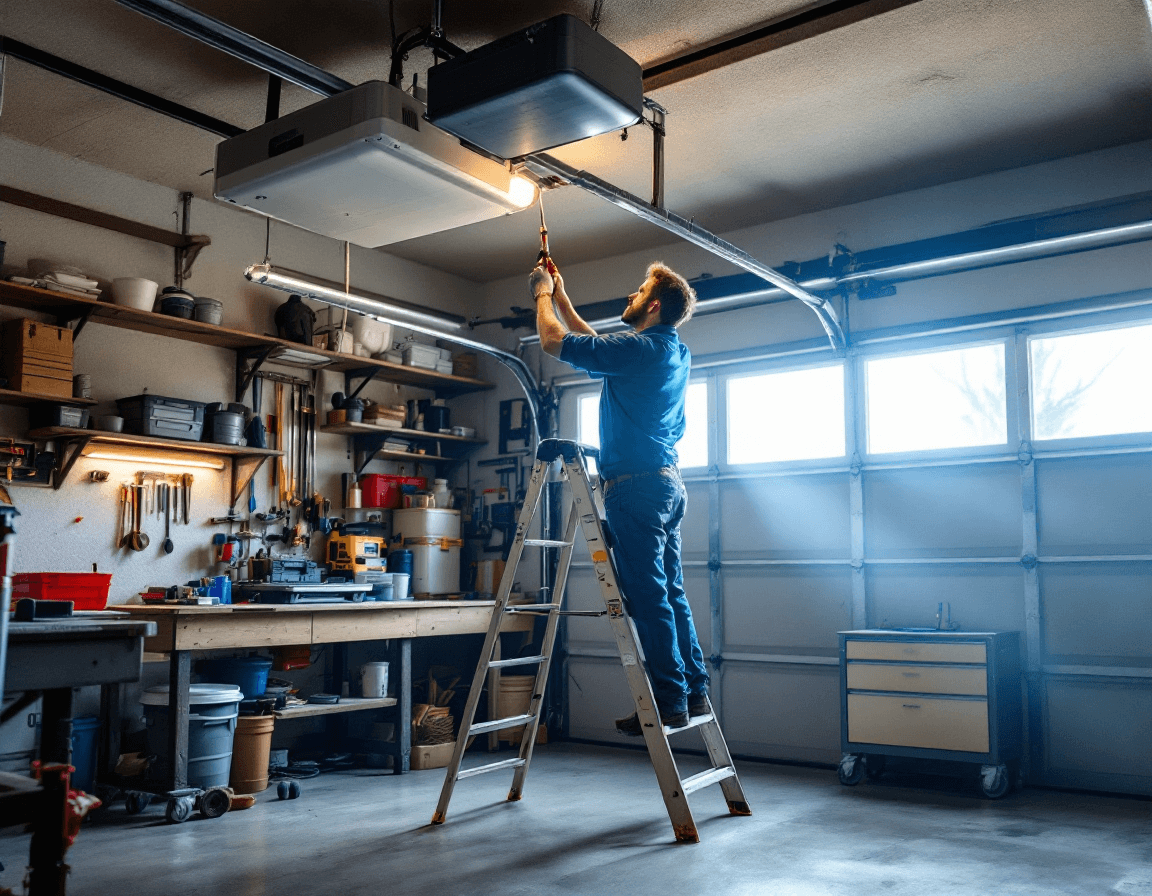
Garage door opener repair in Fircrest, WA is one of the most common calls we take from homeowners in this part of Pierce County, and it is often a problem that shows up on a busy weekday morning when the car is already running. Many Fircrest households use the garage as the main entrance, so a silent opener or a door that stalls halfway can disrupt everything from school drop-offs to grocery runs. Our technicians troubleshoot motors, gears, circuit boards, and travel limits on every major opener brand, and most repairs we complete fall within a range of $95 to $375. The final figure depends on what the diagnosis actually reveals, which is why we start with a careful look rather than guessing from a phone description.
Fircrest is a compact community with a mix of older ranch homes and mid-century houses that were built long before smart openers and rolling-code remotes became standard. Those homes often have garages that were designed for a single-car door and a basic belt or chain drive, and many have been upgraded at least once without anyone revisiting the wiring or mounting hardware. When an opener starts acting strangely, the cause is frequently a combination of age, previous modifications, and the wet Pacific Northwest weather that works its way into every part of a home. If you live near Fircrest Park or anywhere else within ZIP 98466, the information below will help you understand what your opener is trying to tell you before you call for service.
Because a garage door is one of the heaviest moving objects in your home, we want you to approach these problems with both curiosity and caution. Some symptoms have simple explanations you can check safely, while others point to components that only a trained technician should handle. The sections that follow walk through the most common issues we see in the area, explain what typically causes them, and describe where the line sits between homeowner observation and professional repair. Our goal is to give you enough context to make a clear decision and to call (888) 799-3819 with a good description of what you are seeing.
Mid-Century Homes, Modern Openers: What Fircrest Garages Often Face
Many houses in Fircrest were built during decades when garage doors were heavier, manually operated, or fitted with first-generation openers that used simple wall switches and basic safety features. Over time, homeowners have replaced those openers with newer models that include wireless keypads, battery backups, and smartphone integration. The result is a patchwork of old door hardware carrying newer electronics, and that mismatch can create problems that do not appear in any single manual. Track alignment, header bracket condition, and the age of the door springs all influence how the opener behaves, even when the motor itself is healthy.
The Pacific Northwest climate adds another layer of strain. Winters bring long stretches of moisture, cool temperatures, and occasional damp air that settles into garages with limited ventilation. Metal parts can develop surface corrosion, lubricants can thicken or wash away, and wiring connections exposed to humidity may become less reliable over time. Garages that sit against a shaded yard or a north-facing wall often stay damp longer than homeowners expect, which accelerates wear on rollers, hinges, and the electrical boxes mounted near the ceiling.
When we inspect an older Fircrest garage, we pay close attention to these environmental clues as well as the opener itself. A technician who understands how local moisture behaves can often spot loose hardware, sagging brackets, or corroded terminals that would otherwise appear only as an intermittent fault. Addressing those underlying conditions alongside the opener repair helps prevent the same problem from returning a few months later. It also gives you a clearer picture of whether the current setup is worth repairing or whether an upgrade would serve your household better.
When the Motor Hums but the Door Stays Put
One of the most puzzling symptoms is an opener that clearly powers up, lights its bulb, and may even emit a steady hum, yet the door does not budge. This usually means the motor is receiving power and sending force toward the drive system, but something between the motor and the door has failed to transfer that motion. The most frequent culprits are a disconnected trolley, a broken drive chain or belt, or a release mechanism that has been pulled or left in the disengaged position. Each of these failures produces the same outward symptom, which is why a methodical check is so valuable.
Sometimes the cause is much simpler than a broken part. A release cord that has been tugged during a storage cleanup, a child playing with the handle, or a bicycle hung too close to the track can all leave the trolley disconnected from the carriage. Homeowners can often confirm this by looking at the red emergency release handle and noticing whether it hangs loose from the trolley. Reengaging the trolley is a reasonable thing to check only after you have confirmed the door is fully closed and the opener is unplugged or otherwise de-energized.
If the trolley is engaged and the door still does not move, the drive gear, the sprocket, or the rail itself may be damaged. A technician will test motor torque, inspect the travel carriage for binding, and check whether the opener is receiving a steady supply of power. Persistent humming with no movement is a signal to stop running the opener repeatedly, since continued attempts can worsen a stripped gear or overheat the motor windings. We recommend scheduling a diagnostic visit rather than repeatedly pressing the wall button.
Remote Silence and Dead Wall Buttons: Working Through the Signal Chain
When the remote fails but the wall button still works, the problem is almost always located in the transmitter or the receiver side of the wireless system. Remote batteries are the first thing to check, and a weak coin cell can cause sporadic response long before it dies completely. If the remote works at one spot in the driveway but not another, the receiver antenna wire may be damaged, disconnected, or positioned poorly, which is a surprisingly common issue in garages where the wire was tucked behind a shelf or stapled too tightly to the ceiling.
Wall buttons fail for different reasons. A pushbutton that sticks, a loose low-voltage connection at the wall plate, or a damaged wire running through an older attic can prevent the signal from reaching the logic board even though the opener itself is working perfectly. Homes that have been remodeled or rewired over the years sometimes contain previously abandoned runs that were never disconnected, which can confuse a diagnosis. We trace each conductor and confirm the signal at the control board before concluding that a button or wire is faulty.
Wireless interference can also cause frustration, particularly in neighborhoods where many households use garage remotes, keypads, and wireless security sensors. Nearby devices operating on similar frequencies can occasionally block a signal, and a remote that was reprogrammed years ago may no longer match the receiver after a board replacement. Relearning codes is usually straightforward, but it must be done according to your opener brand's procedure. If you are unsure which steps apply to your model, a technician can reprogram the system and confirm that every transmitter responds reliably before leaving the property.
Grinding Heads and Stripped Gears
A grinding, clicking, or whining noise from the opener head is one of the clearest signs that a gear assembly needs attention. Most residential openers use a metal or nylon gear that meshes with a worm drive or chain sprocket, and over time the teeth can wear, chip, or strip completely. Stripped gears often begin with a subtle change in sound, such as a rhythmic click at the start of travel, and then progress to louder grinding that signals metal-on-metal contact. Ignoring those early warnings can turn a modest gear replacement into a larger repair involving the motor housing.
Lubrication plays a role here too. Many openers are factory-lubricated for the life of the unit, but in damp garages the lubricant can break down, collect grit, or wash away from the drive components. A technician will inspect the gear train, check for debris, and determine whether the gear damage is limited to normal wear or whether an underlying issue, such as an unbalanced door or binding track, is forcing the opener to work too hard. Correcting the root cause is essential, because a replacement gear will not last long if the door continues to fight the opener.
Homeowners should avoid forcing a door that is making grinding noises. Pushing or lifting the door by hand while the opener is still engaged can damage the gear further and may create a safety hazard. If the opener is making harsh noises, unplug it if you can safely reach the power source, keep people and pets clear of the door path, and call for service. We schedule gear repairs promptly because delays tend to increase the total cost.
Doors That Reverse Before They Reach the Floor
A door that starts closing and then immediately reverses is designed to protect people and objects, but it can be frustrating when there is no visible obstruction. The most common causes are misaligned safety sensors, a sensor lens coated with dust or spider webs, or a wire that has been bumped out of position. Garage sensors are mounted low on each side of the door opening, and even a small shift can break the beam path. Morning sun, reflective floor surfaces, or a bright flashlight pointed at the sensors can also interfere with proper operation on some models.
Force and travel settings are another frequent factor. Over time, a door can become slightly heavier or less balanced, and an opener programmed with tight force limits may interpret normal resistance as an obstruction. The close limit may also be set too aggressively if the door was adjusted after a spring change or track repair. A qualified technician will check whether the door moves freely through its full range, confirm that the sensors are aligned and clean, and then adjust the travel limits and force settings to match the current condition of the door.
It is important to remember that a door reversing due to an obstruction is working as intended. We never recommend disabling safety sensors or bypassing the reversal feature to make a problem go away. Instead, we look for the reason the system detected resistance, whether that is a damaged cable, a warped section, or a worn roller that is catching on the track. Proper diagnosis keeps your household safe and restores reliable operation.
Blinking Lights as a Diagnostic Language
Modern openers often communicate problems through a pattern of blinking lights on the motor head or control panel. A light that flashes a specific number of times can indicate a sensor issue, a motor fault, a travel-limit problem, or a wireless communication error, though the exact meaning varies by brand and model. Because each manufacturer uses its own code, the first step is to identify the make and model and consult the correct reference. Guessing based on a generic chart can lead you toward the wrong fix.
Repeating light patterns are especially useful when they occur right after a power interruption or a storm. A brief outage can reset some control boards, and the opener may flash a code until it completes its startup routine or until the travel limits are confirmed. If the pattern continues, it may signal a damaged sensor wire, a failing circuit board, or a motor that is not receiving consistent voltage. Writing down the pattern, the number of blinks, and when it occurs will help a technician narrow the diagnosis quickly.
We encourage Fircrest homeowners to photograph or note the light sequence before calling. This small step can save time during the visit and help us bring the correct parts on the first trip whenever possible. Blinking lights are not always a sign of a major failure, but they are always worth taking seriously. Treating them as early warnings can prevent a minor fault from becoming an unexpected shutdown.
Loose Chains, Slipping Belts, and Trolleys That Let Go
Chain-drive and belt-drive openers depend on proper tension to move the door smoothly and safely. A chain that sags can jump off the sprocket, while a belt that stretches can slip, lose grip, or fray at the edges. Loose drive components often produce a clattering sound, an uneven start, or a door that stops partway through its travel. Because the drive system carries significant force, tension problems should be handled by someone who understands the proper adjustment specifications for the specific opener.
Homeowners sometimes notice slack in the chain or belt after a long period of use, particularly in homes where the door has been opened and closed many times each day. A careful technician will check whether the tension is uniform, whether the rail is straight, and whether the carriage is sliding freely. If a chain has come off the sprocket, the repair should include inspecting the sprocket teeth and the chain links for damage before the system is returned to service. Reinstalling a chain without addressing the underlying cause can lead to repeated derailment.
We do not recommend that homeowners attempt chain or belt tensioning without training, because improper adjustment can overstress the motor and create dangerous conditions. The drive system is part of the opener's engineered balance, and small errors can have large effects. Our technicians use manufacturer-specified methods and confirm that the opener reverses correctly after every adjustment.
Intermittent Failures That Come and Go with the Weather
Some of the most challenging calls involve an opener that works perfectly for days and then fails without warning. These intermittent problems are often connected to moisture, temperature swings, loose wiring, or a component that is beginning to fail. A cold morning may cause a marginal connection to lose contact, while a damp afternoon may introduce corrosion at a terminal. Because the symptom disappears before a technician arrives, diagnosis requires patience, testing, and a clear history of when the problem occurs.
Power quality can also contribute. Brief voltage dips, aging outlets, or a garage circuit that shares load with other equipment can make an opener behave unpredictably. Some openers are sensitive to these fluctuations, especially when the motor starts under load. A technician may measure voltage during operation, inspect the outlet and wiring, and check whether the opener is properly grounded. Addressing power issues often stabilizes the system without replacing major parts.
If your opener is intermittent, keep a simple log of the dates, times, and weather conditions when it fails. Note whether the remote, wall button, or automatic close is the trigger, and whether the door was in motion or stationary. This information gives a technician a far better starting point than a general complaint. We would rather diagnose a pattern on the first visit than replace parts on guesswork.
Travel Limits, Force Settings, and the Logic Board
The opener's logic board coordinates the motor, sensors, wireless receiver, and travel limits, so when its settings drift, the whole system can behave unpredictably. Travel limits tell the opener where the door should stop when opening and closing, while force settings determine how much resistance the system tolerates before reversing. If a door is adjusted, replaced, or re-balanced, these settings may no longer match the physical door, and the result can be a door that stops short, overshoots, or refuses to close fully.
Circuit boards themselves can fail, especially after power surges or prolonged exposure to humidity. A failing board may cause erratic lights, inconsistent remote response, or random reversals that do not match any obvious mechanical problem. Before replacing a board, a technician should rule out sensor faults, wiring issues, and mechanical binding, because replacing the board will not solve those root causes. When a board does need replacement, we use compatible components and reprogram the travel limits and force settings to match your door.
Many homeowners are surprised to learn how much calibration happens after a repair. Even a simple motor or board replacement may require resetting limits, confirming the safety reversal, and testing the door through several complete cycles. We perform this full verification before we leave, because a repair is only complete when the door operates smoothly, reverses correctly, and responds reliably to every control.
What a Fircrest Repair Visit Typically Covers
A typical opener repair visit begins with a conversation about the symptoms, the age of the door, and any recent changes such as a power outage, a new remote, or a recent door adjustment. Our technician then inspects the opener, the rail, the trolley, the sensors, the wall control, and the door's movement through its full range. The goal is to separate the opener's problem from problems in the door hardware, wiring, or environment so that the repair addresses the true cause.
Once the diagnosis is clear, the technician explains the options in plain language and provides a price for the recommended work. For most opener repairs, the total falls between $95 and $375, though the specific part, labor, and any additional safety corrections will shape the final figure. Here is what homeowners in Fircrest can typically expect from a diagnostic and repair visit:
- A visual and functional inspection of the opener, rail, trolley, and drive components
- Testing of the remote, wall control, safety sensors, and wireless receiver
- Review of travel-limit and force settings, with adjustments made as needed
- Evaluation of gear wear, drive tension, and signs of moisture or corrosion
- Verification that the door reverses correctly and completes full open and close cycles
Our work is performed by licensed, bonded, and insured professionals, and we explain each step before proceeding. If a repair reveals a larger concern, such as a door that requires spring replacement, we will describe that separately so you can decide how to move forward. You are never obligated to approve work you do not understand.
Homeowner Safety Boundaries Around Springs and Cables
Garage doors contain springs and cables that store enormous amounts of energy, and that energy is the reason these components must never be adjusted, removed, or replaced without professional training. Torsion springs can carry tension strong enough to cause serious injury, and cables under load can snap with dangerous force. Even an experienced homeowner should not attempt to wind springs, remove cable drums, or loosen spring hardware. Please leave all spring and cable work to a licensed professional.
There are still several safe steps you can take while waiting for a technician. Keep children, pets, and vehicles clear of the door path, and do not stand under a door that is moving or appears unbalanced. If you need to use the emergency release, pull the cord only when the door is fully closed, because releasing a door that is raised can allow it to drop suddenly. Avoid lifting the door by hand while the opener is still connected, and never try to force a stuck door open.
Good household habits also reduce risk. Keep the tracks clean, avoid hanging heavy items from the door or opener, and check that the sensors remain aligned after storage cleanups or holiday decorating. If you notice fraying cables, gaps in the springs, a door that drops quickly, or a door that sits crooked on the track, stop using it and call for service. Your safety is always more important than a quick fix.
Pricing Context and Choosing Between Repair and Replacement
Deciding whether to repair or replace an opener depends on the age of the unit, the nature of the failure, and how well the rest of the door system is working. A relatively new opener with a failed circuit board, a damaged sensor, or a worn gear may be an excellent candidate for repair, particularly if the door is balanced and the mechanical parts are in good condition. An older opener with multiple recurring faults, outdated safety features, or limited parts availability may be more cost-effective to replace.
Our technicians will explain both options honestly. If repair is the sensible choice, we will provide a clear quote and a realistic timeline. If replacement makes more sense, we will describe the difference in features, reliability, and warranty coverage, and we will make sure any new unit is properly installed and calibrated for your door. We believe homeowners should understand the reasoning behind every recommendation before making a decision.
Whatever you decide, scheduling a diagnostic visit early often keeps costs manageable. A small sensor misalignment or a loose connection is far easier to correct than a stripped gear that has been grinding for weeks. If your Fircrest garage door opener is showing any of the symptoms described here, call Seattle Garage Door Fix at (888) 799-3819 to speak with our team and arrange a visit that fits your schedule.