
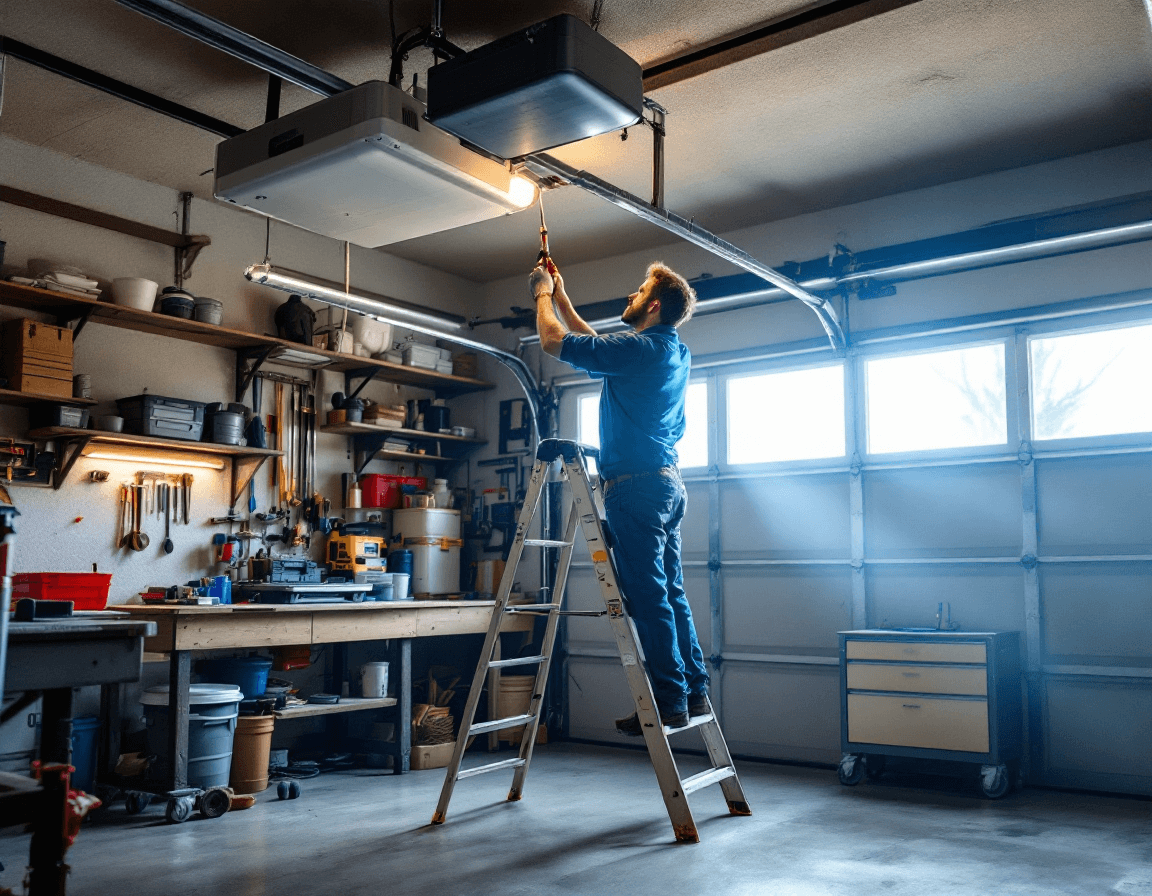
Garage door opener repair in University Place, WA is a common need for homeowners across the peninsula, from the older ranch houses near the Chambers Bay shoreline to newer subdivisions tucked behind the commercial corridors. Openers in this part of Pierce County work hard. They face damp winters, salty air drifting in from Puget Sound on certain days, and the constant cycling that comes with busy family schedules. When one starts behaving badly, the symptoms can look similar even when the causes are very different, which is why a careful diagnosis matters before anyone replaces parts.
This page explains what typically goes wrong with openers in University Place and how a licensed technician works through the problem. We cover motor and gear faults, circuit board and remote issues, travel-limit settings, belt and chain trouble, and the blinking-light codes that confuse many owners. We also explain what affects the cost of a repair, which is often between $95 and $375 for most opener work, depending on the brand, the part involved, and how much time the diagnosis takes. Our goal is to help you understand what you are seeing at your door so you can make a confident decision.
Whether you live near Bridgeport Village, closer to the 98466 or 98467 neighborhoods, or in one of the surrounding pockets of the area, the principles are the same. A good repair starts with observation, moves to testing, and only then calls for replacement. Keep reading for a detailed walkthrough, and call (888) 799-3819 whenever you would rather have someone on site look at the equipment directly.
Why Openers in University Place Struggle With Moisture and Mild Winters
The Pacific Northwest climate does not produce brutal cold like the interior states, but it creates a different kind of stress on garage door equipment. Long stretches of drizzle and high humidity keep the air moist for months, and that moisture finds its way into wiring connectors, control boards, and the sensor housings near the floor. Many University Place garages are attached to homes with modest ventilation, so condensation can linger on metal surfaces long after the rain stops. Over several seasons, that steady dampness can corrode terminals and cause intermittent contact problems that come and go with the weather.
Homes closer to the water can see an added layer of wear. Salt carried by onshore breezes settles on exterior surfaces, and it can creep into garages through gaps around doors and vents. Metal hardware, including the rail brackets and the bolts that hold the opener to the ceiling, is more prone to rust in these conditions. A technician working in this area pays attention to corrosion on connectors and fasteners, because a weak ground or a loose mounting bolt can produce symptoms that look like a failing motor.
Mild temperatures also mean that many homeowners rarely notice their garage door until something stops working. An opener that runs fine in summer may struggle on a cold, wet December morning when the door's lubricants have thickened slightly and the tracks are sluggish. Understanding these seasonal patterns helps explain why a problem might appear suddenly even though the equipment has been slowly degrading for a long time.
Reading the Warning Signs When the Motor Runs but the Door Stays Put
One of the most common complaints we hear is that the opener motor starts, hums, and even seems to strain, yet the door does not move. This symptom can point to several causes, and it is worth describing exactly what you hear and see before the technician arrives. A steady hum followed by a click suggests the motor is receiving power but the drive mechanism is not engaging. A sharp buzz that stops quickly often indicates the motor is trying to turn against resistance, which can come from a binding door, a frozen roller, or a disconnected trolley.
Many openers include a release handle that disconnects the carriage from the door, usually for power outages or manual operation. If that handle has been pulled, or if the trolley has slipped off the rail, the motor will spin but the door will remain still. A technician will check whether the carriage is properly reconnected and whether the release cord has tangled or slipped. This is a simple check, but it is easy to overlook when the garage is dark and the door looks normal from the driveway.
Sometimes the motor itself is the culprit. Worn brushes, a failing capacitor in older units, or overheating from repeated attempts to move a stuck door can all prevent the motor from producing enough torque. A technician will measure current and check for signs of heat damage before recommending a motor replacement, since in many cases the mechanical side of the system has been placing an unnecessary load on the motor. Replacing the motor without addressing the underlying binding would simply shorten the life of the new part.
When the Remote and Wall Button Stop Talking to the Opener
Few things are more frustrating than pressing the remote and getting no response, especially when the rest of the household is waiting in the car. Remote and wall button failures usually fall into a few categories: dead batteries, lost programming, interference, or a fault in the receiver on the opener's logic board. Before calling for service, it is reasonable to check the simplest possibilities, but avoid spending too long on guesses, because repeated button presses can sometimes trigger safety lockouts on certain models.
A useful first step is to test the wall control and the remote separately. If the wall button works but the remote does not, the problem is likely in the remote's battery, its programming, or the receiver's ability to read the signal. If neither works, the fault may be in the wall button's wiring, the low-voltage control circuit, or the main board. Pay attention to whether the opener's indicator light responds when you press a button, since that light is often the first clue about where the signal is failing.
Radio interference can also affect remotes in busy neighborhoods, though it is less common than people assume. Some remotes lose range when the batteries weaken in cold weather, and a remote that works from the driveway may fail from the back of the house. A technician can test signal strength, reprogram receivers if needed, and check the antenna wire on the opener head. For many brands, reprogramming takes only a few minutes once the correct procedure is confirmed from the owner's manual.
Grinding Sounds, Stripped Gears, and the Price of Ignoring a Noisy Head
A grinding noise from the opener head is one of the more serious warning signs, and it should not be ignored for long. Most residential openers use a drive gear, often made of nylon or a composite material on the inside of a metal housing, that meshes with a worm gear or a drive shaft. Over time, teeth can wear, chip, or strip, especially if the door has been forced or if the opener has been running through repeated start-stop cycles. The sound often starts as a faint scrape and grows louder until the door begins to slip or stop.
Stripped gears can also cause the door to move erratically. You might notice the door rising a few inches, pausing, and then continuing, or stopping completely at a random point in its travel. The problem is that continued operation can damage the motor shaft, the sprocket, or the rail, turning a moderate repair into a larger job. A technician will inspect the gear train, check for debris or metal shavings, and confirm whether the drive assembly can be replaced on its own or whether the entire head needs attention.
Lubrication is part of the picture too. Many owners assume that more grease will fix a grinding opener, but the wrong lubricant or excessive grease can attract grit and accelerate wear. The correct approach depends on the opener's design, and a technician will use the manufacturer's recommended product in the right quantities. Keeping the gear train clean and properly lubricated is far cheaper than replacing a stripped assembly.
Doors That Stop Short, Reverse Immediately, or Refuse to Close Fully
Few symptoms are as unsettling as a door that begins to close and then reverses before reaching the floor. This behavior is often intentional, because modern openers are designed to reverse when they detect an obstruction. That safety feature is important, but when it activates without a clear reason, the cause is usually a misaligned sensor, a dirty lens, a damaged sensor wire, or a travel-limit setting that has drifted out of range. A door that will not close fully may simply be reaching a limit that the opener believes is the bottom, even though the door has not finished its travel.
Travel-limit adjustment is one of the most misunderstood parts of opener service. The opener needs to know where the door is fully open and fully closed, and it stores those positions in memory. If the door's weight has changed, if the springs have been adjusted, or if the limit screws have been turned, the opener may stop too early or too late. A technician will adjust the limits carefully, testing the door's movement at each stage and confirming that the auto-reverse force setting is correct for the door's weight and size.
Safety sensors deserve special attention. The photo-eye sensors near the floor should be aligned so that their beams cross directly, and their wiring should be intact and free of pinched or damaged insulation. Spider webs, dust, and road grime are common culprits, especially in garages that open onto a driveway during wet weather. Keep the lenses clean, but do not rely solely on cleaning if the problem persists, since misalignment or wiring faults are frequent causes that cleaning will not solve.
Here is a short list of things homeowners can check safely before calling for service:
- Look for obstructions on the track, such as a toy, a bicycle pedal, or a stack of boxes near the door path.
- Wipe the sensor lenses with a dry cloth and confirm that both indicator lights are steady.
- Check that the sensors are mounted at a similar height and pointed at each other.
- Observe whether the door reverses at the same spot each time or at random points.
If these checks do not resolve the issue, stop testing and call a professional. Continued cycling of a door that is reversing unexpectedly can strain the springs and the opener.
Chains, Belts, and the Slack That Creeps In Over Time
Chain-drive and belt-drive openers are common throughout University Place, and both can develop problems from normal use. A chain or belt that becomes loose may skip on the drive sprocket, producing a clicking or slapping sound and a door that moves unevenly. In severe cases, the chain can come off the track entirely, leaving the opener turning without any effect on the door. Belts are generally quieter and require less maintenance, but they can stretch, fray, or slip off their pulleys if the tension is wrong.
Tension adjustment on a chain or belt is a task that a homeowner can sometimes perform, but it is not a casual job. Excessive tension can damage the motor and the bearings, while too little tension allows the drive to slip and wear unevenly. A technician will check whether the chain or belt is seated correctly, measure the slack against the manufacturer's specification, and inspect the sprocket and idler for wear. If the chain has jumped the track repeatedly, the rail itself may be bent or the alignment may be off.
It is important to note that spring and cable work is a different category entirely. The torsion or extension springs that counterbalance the door carry significant stored energy, and cables can snap under tension. Those components should be handled only by a licensed, trained professional. If you see a broken spring, a frayed cable, or a door that feels extremely heavy when lifted by hand, keep everyone away from the door and call for service rather than attempting a repair yourself.
Blinking Lights, Repeating Patterns, and What the Opener Is Trying to Say
Many modern openers use a status light to communicate faults, and the light often blinks in a repeating pattern. The number of blinks, the pauses between them, and the color of the light can all carry meaning. A pattern that repeats steadily may indicate a sensor fault, an obstruction, a travel-limit problem, or a communication error between the wall control and the logic board. Because each brand uses its own system, the first step is always to consult the owner's manual or the label inside the opener cover.
While the exact code meanings vary, a technician generally follows the same logic. They note the pattern, check the most likely causes first, and rule out the simplest explanations before moving to the board. A flashing light that appears only when the door is closing points toward the sensors or the force settings. A light that flashes continuously even when the door is at rest may suggest a board fault or a stuck button. Recording the pattern on your phone, if you can do so safely, gives the technician useful information.
Some blinking patterns are triggered by a safety lockout. If a sensor is blocked or a button is held down, the opener may stop responding until the condition clears. In those cases, resetting the opener by disconnecting its power for a short time can help, but the underlying cause still needs to be found. Repeatedly resetting an opener without fixing the fault can mask a developing problem that will eventually leave the door stuck in an inconvenient position.
Intermittent Failures That Appear on Damp Mornings and Cold Nights
Intermittent operation is among the most difficult complaints to diagnose, because the opener may work perfectly during a service call and fail the next morning. In University Place, intermittent faults often correlate with weather. A connector that is slightly corroded may make contact when dry and lose it when humidity rises. A sensor wire that has been nicked by a shelf edge may short only when it moves a certain way. A battery backup, if installed, may be aging and lose capacity during cold nights.
Diagnosing intermittent problems requires patience and good records. A technician may ask when the failures happen, how often they occur, and whether anything else changes at the same time, such as the weather, the time of day, or the use of other appliances on the same circuit. They may also inspect wiring runs, check for loose terminals, and look for signs of rodent damage, which can be surprisingly common in garages that border wooded lots. Each finding is documented so the repair addresses the real cause rather than replacing parts that were never faulty.
If your opener works fine most of the time but fails occasionally, avoid assuming the problem will fix itself. Intermittent faults usually get worse as moisture and wear accumulate. Calling for service early often means a smaller repair, and it prevents the frustration of being stranded outside on a rainy evening.
Brand Coverage and Choosing Parts Without Guesswork
Homeowners in University Place own openers from a wide range of manufacturers, and many of those openers have been installed over different decades. A technician working in this area needs to recognize the major brands, understand their control systems, and know which components are interchangeable. Our service covers motor, gear, circuit board, and travel-limit troubleshooting across the major opener brands, so the approach is tailored to the specific hardware rather than applying a single generic method to every unit.
Parts sourcing is where a lot of repairs succeed or fail. Using the wrong motor, control board, or gear assembly can leave the opener running poorly or create safety issues. A knowledgeable technician confirms the model number, the serial number, and the revision of the logic board before ordering anything. When a discontinued model is involved, they can sometimes recommend a compatible upgrade, which may offer better features and more reliable operation than the original unit.
It is worth asking questions about parts before a repair begins. A reputable technician should be able to explain why a component is needed, what symptom it addresses, and whether a less expensive fix might work first. That conversation helps you make an informed choice about how much to spend, and it keeps the repair focused on the problem you are actually having.
What a Typical Repair Visit Covers and How Pricing Works
Most opener repairs in University Place fall between $95 and $375, though the final cost depends on several factors. A simple fix, such as recalibrating travel limits, replacing a remote, or reconnecting a loose carriage, will generally land at the lower end of that range. Replacing a motor, a control board, or a gear assembly typically costs more because of the parts involved and the time needed for proper installation and testing. Pricing can also reflect the opener's age and availability of parts.
A standard visit usually begins with a conversation about the symptoms and the history of the opener. The technician then inspects the door, the tracks, the sensors, the opener head, and the wiring, and tests the operation through a full cycle. Safety features are verified before the door is returned to service, including auto-reverse and the force settings. Once the diagnosis is complete, the technician explains the findings and offers options, so you can decide how to proceed.
Transparency matters throughout the process. If a repair reveals that the springs, cables, or other high-tension components are worn, those items require a licensed professional and should be addressed as part of a clear, documented plan. You should never feel pressured into work you do not understand or need. A good visit leaves you with a working opener and a clear picture of its condition.
Simple Habits That Keep an Opener Dependable Between Service Calls
Routine care can extend the life of an opener and reduce the likelihood of emergency calls. Because University Place garages deal with moisture and occasional salt exposure, a few habits matter more here than in drier regions. Keeping the garage ventilated, wiping down exposed metal, and checking connections periodically can prevent many of the problems described above. None of these tasks requires specialized tools, and most can be completed in a few minutes each season.
Here are practical maintenance habits that homeowners can handle safely:
- Test the auto-reverse feature once a month by placing a flat object, such as a piece of wood, in the door's path and confirming that the door reverses.
- Wipe the sensor lenses and check their alignment at least twice a year, especially after heavy rain or dusty periods.
- Inspect the chain or belt for visible wear and listen for unusual noises during operation.
- Keep the remote batteries fresh and store remotes away from direct moisture.
- Look for signs of corrosion on the opener's mounting brackets and exposed wiring, and report anything unusual.
Avoid lubricating the opener's internal gears or applying grease to the track unless the manufacturer specifically recommends it. Spring and cable inspections should be left to licensed professionals, even if the door appears to be moving normally. Regular professional checkups, scheduled around seasonal changes, can catch developing faults before they interrupt your daily routine.
If your opener is showing any of the symptoms described on this page, a licensed technician can diagnose the cause and recommend the right repair. Call Seattle Garage Door Fix at (888) 799-3819 to schedule service for your University Place home, and let us help you get your garage door moving safely and reliably again.