
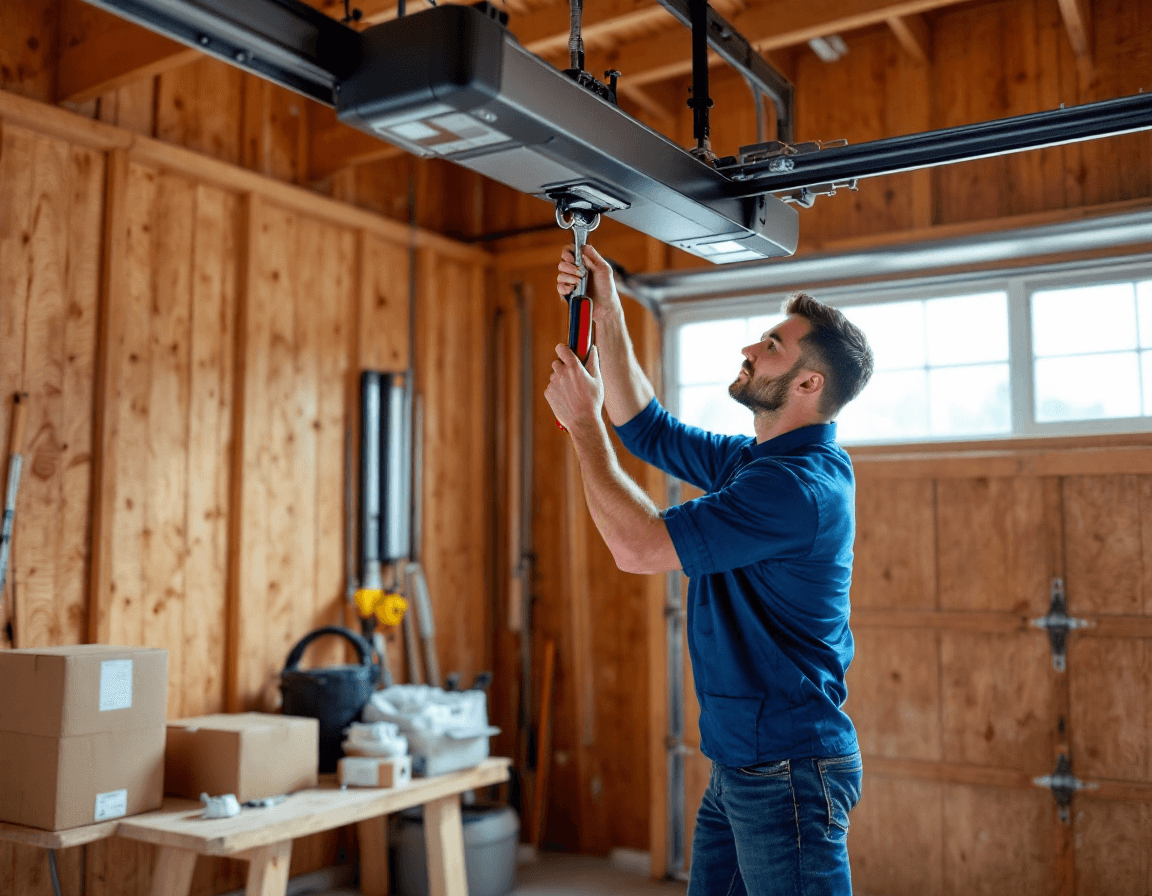
Garage Door Opener Installation & Replacement in Port Orchard, WA is one of the most practical upgrades a homeowner can make to an aging garage, and it is often overlooked until the old unit stops working on a wet November morning. Port Orchard sits on the western shore of Sinclair Inlet across from Bremerton, and the damp, salt-tinged air that drifts in from Puget Sound works its way into every piece of hardware on a garage door system. Many of the openers we see in Downtown Port Orchard, Manchester, and the neighborhoods around McCormick Woods were installed fifteen or twenty years ago, and they are doing their best under conditions that were never kind to them.
If your opener has become loud, slow, or unpredictable, you are not imagining it, and you are not alone. A replacement opener can change how your garage functions day to day, from the way the door moves to how you control it from the driveway and what happens when the power goes out. This page explains what to expect from a professional installation, how we think about matching a drive system to your specific garage, and how the $275 to $650 installed price range breaks down. We also explain why the security and convenience features of a newer unit matter more on the Kitsap Peninsula than many homeowners expect.
Why Port Orchard Garages Age Faster Than the Manual Suggests
Garage door openers are built to run for many years, but the manufacturer's expectations assume a relatively dry, moderate environment. In Port Orchard, the combination of long wet seasons, high humidity, and salt-laden breezes off the inlet speeds up corrosion on mounting brackets, rail fasteners, and the electrical contacts inside the motor housing. Moss and mildew also find their way onto garage roofs and exterior trim, and the water they hold can drip onto the operator's cover over time. None of this means your opener is defective; it simply means the local climate asks more of it than a drier town would.
Homes in older parts of Downtown Port Orchard often have detached or converted garages where the door opener was retrofitted onto a structure that was not originally designed for it. Those installations can have uneven ceiling joists, undersized mounting hardware, or wiring that was run in a hurry. When an opener starts to strain, those hidden weaknesses can show up as vibration and noise that the homeowner assumes is normal wear. A technician who looks at the full system, including the rails, the trolley, and the door's balance, can usually tell whether the opener is simply worn out or whether something else is pushing it past its limits.
Newer homes in the McCormick Woods area and in the broader Manchester corridor tend to have stronger framing and cleaner electrical runs, but they still face the same damp conditions. Even a relatively new opener benefits from an inspection of its mounting points and its safety sensors after several wet winters. Preventive attention costs far less than an emergency call when a spring snaps or the opener refuses to lift the door on a cold morning.
Recognizing When Your Opener Has Reached the End of Its Useful Life
Most homeowners do not replace an opener in one dramatic moment. Instead, they notice a series of small changes that gradually become impossible to ignore. The door starts taking longer to open, the motor sounds strained or hums without moving the door fully, and the remote begins working only when you stand in the exact right spot. Those signs are worth taking seriously, because they often point to a motor, gear, or logic board that is failing rather than a simple adjustment that needs to be made.
Below are the most common signals we hear from Port Orchard homeowners when they ask whether a replacement makes more sense than another repair:
- The opener is noticeably louder than it used to be, with grinding, rattling, or a whine that seems to come from the drive gears
- The door moves slowly, stops partway, or reverses without any obvious obstruction
- Remote controls or keypads work intermittently, even after new batteries
- The opener has lost its ability to hold a consistent travel limit, so the door closes too hard or stops short
- Repair parts for the unit are no longer available, or a single repair would cost a large share of a new installation
- The unit has no rolling-code security, which leaves the door more vulnerable to older signal-capture tools
Any one of these symptoms might be fixed with a targeted repair. When several appear together, especially on an opener that is more than a decade old, replacement is usually the more economical choice. We will always walk through the numbers honestly with you before recommending a new unit, and we will tell you if a repair is the smarter move.
Choosing Between Belt-Drive, Chain-Drive, and Wall-Mount Openers
The drive system determines how the opener moves the door, how quiet it runs, and how much maintenance it needs. A chain-drive opener uses a steel chain running along a rail. It is sturdy and cost-effective, and it handles heavy doors well, but it is also the loudest option, which makes it a poor fit for garages that share a wall with a bedroom, a home office, or a kitchen. Chain drives remain a sensible choice for detached garages or for homeowners who mainly want reliable lifting power at a modest price.
A belt-drive opener replaces the metal chain with a reinforced rubber belt. The result is noticeably quieter operation, smoother starts and stops, and less vibration transmitted into the ceiling. Belt drives are a strong match for attached garages in Port Orchard neighborhoods where the family spends evenings close to the garage. The belt does need the same attention to tension and alignment as any other moving part, and it performs best when the rail and trolley are kept clean and free of corrosion from the damp air.
A wall-mount opener is mounted to the side wall of the garage rather than to the ceiling. This design frees up overhead space, which helps when a garage is used for storage or when the ceiling has limited clearance. Wall-mount units are particularly useful when the header or the joists above the door are not strong enough to support a ceiling bracket. They are also a good option for homeowners who want to keep the ceiling clear for shelving or for an overhead storage rack.
Our technicians consider several factors before recommending a drive type, including the door's weight, the garage's ceiling height, whether the garage is attached, and how the household plans to use the space. We never recommend a drive simply because it is the most expensive option. A well-matched chain drive can outperform a poorly fitted belt drive, and the right answer depends on the garage itself.
Why Rolling-Code Security Matters More Than Most Owners Realize
Older garage door openers often use fixed-code signaling, meaning the remote sends the same signal every time it is pressed. That consistency is convenient, but it also means a determined person with a simple capture device can record the signal and replay it later. Rolling-code technology changes the transmitted code with every press, so a recorded signal cannot be reused to open the door. For a home in a quiet Port Orchard neighborhood, where families often leave for work or travel on the weekend, this added protection is a meaningful upgrade.
Many homeowners assume that a garage door's security depends only on the lock. In practice, the opener's signal is often the easiest entry point, especially if the remote was kept in a vehicle that was parked on the street. Replacing an older opener with a unit that uses modern rolling-code encryption closes that gap. We also recommend reviewing the remote buttons, keypads, and any programmed vehicle visors to make sure old devices are removed from the system rather than left active.
Security upgrades pair well with other practical improvements. When we install a new opener, we check the status of the safety sensors, confirm that the door locks engage correctly, and make sure the emergency release cord is accessible and easy to use. A new opener with strong encryption will not protect a door whose manual release has been left in an unsafe state, so we treat the whole system as a unit.
Adding Smart Wi-Fi and App-Based Control to Your Garage
Smart openers allow you to check the door's status and open or close it from a phone, which can be surprisingly useful in everyday Port Orchard life. You might be heading home from Bremerton on the ferry route or driving back from a late shift in Manchester and want to confirm that the garage is closed. A smart unit can send an alert if the door has been left open, and some models let you grant temporary access to a family member, dog walker, or contractor without handing over a physical remote.
Many of the newer units we install work with myQ and similar app ecosystems, but the specific features depend on the model you choose and on the reliability of your home's Wi-Fi signal. Garages are often at the far edge of a home's network, and a weak signal can make a smart opener frustrating to use. Our technicians check signal strength during the visit and can recommend a simple extender or a relocated access point if the connection is marginal. We will always explain what the app can and cannot do before you commit to a particular model.
Smart features should complement the opener's core job rather than complicate it. We set up notification preferences, walk you through the app's sharing controls, and review how to remove access for anyone who no longer needs it. A smart opener that is configured thoughtfully can make your daily routine smoother without introducing new points of failure, and that balance is what we aim for on every installation.
Battery Backup for Storms, Outages, and Long Winter Nights
Power outages are a reality on the Kitsap Peninsula, especially when winter windstorms bring down branches and lines across roads and yards. When the power goes out, a standard opener cannot lift or lower the door, and the household is left relying on the manual release cord. That can be inconvenient in the dark, and it becomes a real problem if you need to get a vehicle out during an emergency or if you are trying to reach a generator or supplies stored inside the garage.
A battery backup kit provides a limited number of door operations during an outage. The exact number depends on the battery, the door's weight, and how often the door is cycled, so we set realistic expectations during the visit rather than promising a fixed count. The battery typically keeps the opener's logic and lighting working as well, which helps you find your way in and out of the garage at night. Backup batteries also need periodic replacement, and we recommend noting the install date so you remember to check them every few years.
Battery backup is a sensible addition for households with medical equipment that needs access to a vehicle, for families with young children, and for anyone who regularly relies on the garage as a secondary entrance. It is also worth considering if you live in an area where outages tend to last longer than a few hours. We will talk through your household's needs and recommend a backup option that fits your situation without adding unnecessary cost.
What Happens During a Professional Installation Visit
A typical replacement begins with a careful inspection of the existing door and opener. Our technician confirms the door's weight, checks the condition of the tracks and rollers, and looks for signs of wear or corrosion on the mounting points. We also test the door's balance by disconnecting the opener and lifting the door manually, since a door that is out of balance will strain even the best replacement motor. If the door itself has problems, we will explain them before proceeding with the opener work.
Once the inspection is complete, we remove the old unit, prepare the mounting location, and install the new drive system according to the manufacturer's instructions and local requirements. We connect the wiring, install the safety reversing sensors at the proper height, program the remote controls and any keypads, and set the travel limits so the door opens and closes smoothly. The technician then tests the auto-reverse function, confirms that the emergency release works, and verifies that the door responds correctly to every control point in the system.
Before we leave, we walk through the new system with you. You will learn how to use the remote, how to program additional devices, how to operate the manual release safely, and how to recognize warning signs that the system needs attention. We also review the battery backup and smart features if your unit includes them. Our goal is for you to feel confident operating the new opener from the first day, not to leave you with a manual and a set of unanswered questions.
Understanding the $275 to $650 Installed Price Range
Installed prices for garage door openers in our service area generally fall between $275 and $650, depending on the model you select and the features it includes. A basic belt-drive or chain-drive unit with standard remotes sits at the lower end of that range, while a quieter belt-drive or wall-mount model with smart Wi-Fi control and battery backup will typically land toward the upper end. Those figures include professional installation, but the exact total depends on what the technician finds when the old unit is removed.
Several factors can influence the final cost. The garage's ceiling height and the presence of an existing bracket can affect how much preparation is needed. A door that requires minor balancing or hardware replacement may add to the job, and we always explain those items before doing the work. If your garage has an unusual layout, such as a long run of wiring or a wall-mount location that needs reinforcement, the technician will outline the expected impact on the total before proceeding.
We believe homeowners deserve a clear explanation of what they are paying for. Every estimate should identify the opener model, the drive type, the included features, and any additional work that might be required. If you are comparing quotes from different providers, ask whether the price includes professional installation, safety sensor setup, remote programming, and a walkthrough of the system. Transparent pricing is part of earning trust, and we are happy to provide a detailed breakdown before any work begins.
Quieter Operation for Attached Garages and Living Spaces
For many Port Orchard families, the garage is not a separate building but a room that connects directly to the kitchen, laundry, or a bedroom. In those homes, the opener's noise travels through the ceiling and walls, and a chain-drive unit can make early morning departures or late evening returns feel disruptive. A belt-drive or a well-isolated wall-mount opener reduces that impact considerably, and it can make the garage feel like a more comfortable part of the house.
Noise reduction depends on more than the drive type alone. The mounting bracket, the rail alignment, and the condition of the rollers all contribute to how loud the door sounds. We check each of these elements during installation and make adjustments to reduce vibration. We also recommend lubricating the rollers and hinges with a suitable product on a regular schedule, since a dry or misaligned door can produce noise even when the opener itself is quiet.
If you are sensitive to noise or share a wall with a living space, mention it when you request your estimate. We can recommend models and installation approaches that prioritize quiet operation, and we will explain the tradeoffs between noise level, speed, and cost. Quieter does not always mean slower or more expensive, and a thoughtful match between the opener and the household's needs usually delivers the best result.
Safety Checks We Complete and When to Call a Licensed Specialist
Garage doors are heavy, and the forces involved in lifting and lowering them are significant enough to cause serious injury if something goes wrong. Every opener installation includes a check of the auto-reverse function, which must stop and reverse the door if it contacts an obstruction. We test the photo-eye safety sensors, confirm that they are mounted at the correct height and aligned properly, and verify that the door reverses when a beam is interrupted. These checks are not optional, and they are part of every job we perform.
Opener installation itself does not normally require adjusting the torsion springs or the lift cables. Those components store enormous tension, and they should only be serviced by a licensed, trained professional using the proper tools. If the inspection reveals a broken spring, a frayed cable, or a door that is severely out of balance, we will stop the opener work and recommend spring or cable repair by a licensed specialist before proceeding. Please do not attempt to adjust, wind, or replace springs yourself, even if you have experience with other home repairs.
Our technicians are licensed, bonded, and insured, and we carry that responsibility into every installation. We will explain any safety concern clearly, show you the issue if it is safe to do so, and give you options for addressing it. A new opener is only as safe as the door it moves, so we treat the entire system with the same care whether we are installing a basic chain drive or a fully connected smart unit with battery backup.
Schedule Your Port Orchard Opener Installation Today
If your garage opener is loud, slow, unreliable, or lacking modern security, a professional replacement can restore smooth, safe operation for many years to come. Whether you live near Downtown Port Orchard, in Manchester, or within the McCormick Woods community, our team understands how Kitsap County's damp climate and changing seasons affect garage hardware. Call (888) 799-3819 to discuss your options, request a clear estimate, and find out which drive type, security features, and battery backup make the most sense for your home.