
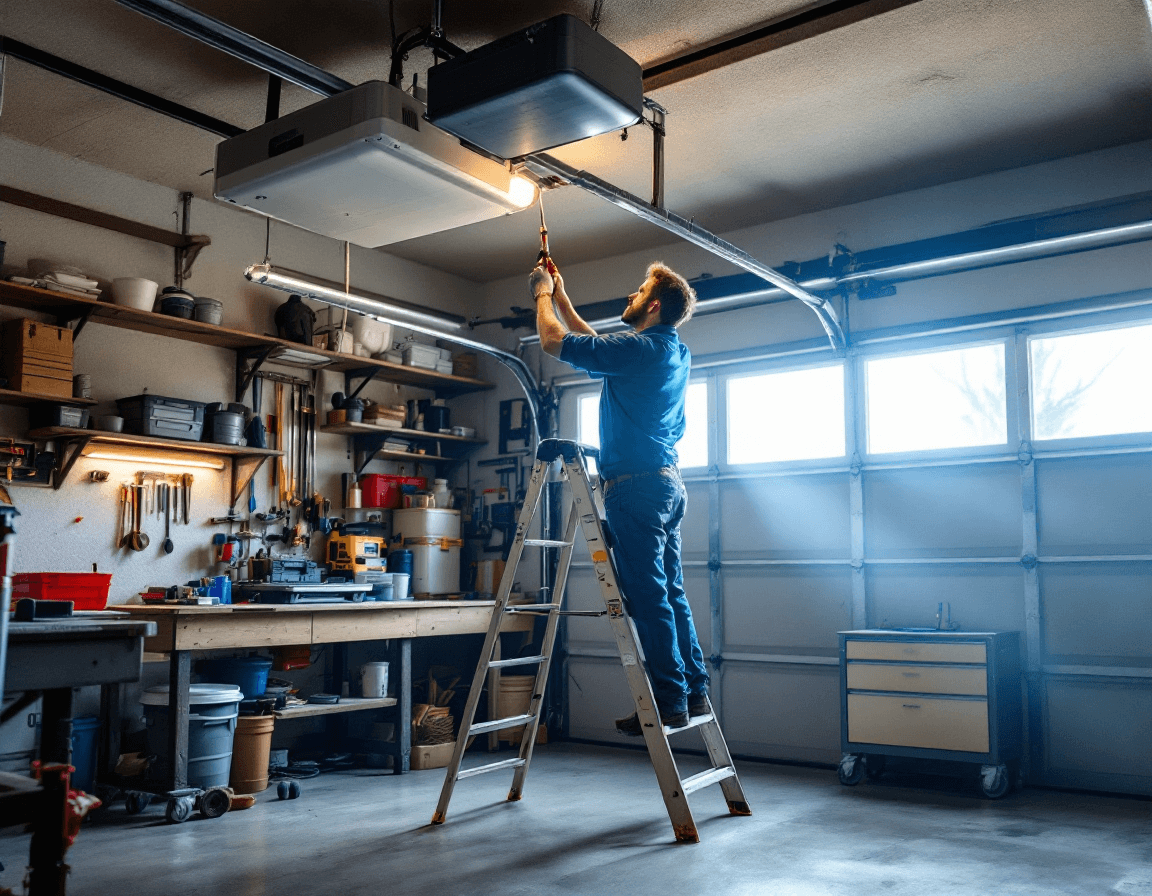
Garage Door Opener Repair in Bellevue, WA is one of the most common calls we handle, and it usually starts with something small: a remote that stops working, a door that stalls halfway, or a motor that hums without lifting anything. Bellevue's mix of older split-level homes in Lake Hills, newer townhomes near Downtown, and larger custom houses in the hillsides means openers here range from decades-old belt drives to recent Wi-Fi-enabled units. Each one fails in its own way, and the fix depends on whether the problem is electrical, mechanical, or simply a setting that drifted out of calibration.
Our technicians work on every major opener brand, and we approach each call the same way: confirm the symptom, rule out the easy causes, then test the motor, gear train, control board, and travel limits in order. Most opener repairs we complete fall in the $95 to $375 range, depending on whether the job is a sensor adjustment, a logic board replacement, or a gear assembly. We are licensed, bonded, and insured, and we will tell you plainly whether a repair makes sense or whether replacement is the smarter spend. This guide walks through the most common opener problems we see across Bellevue and the surrounding neighborhoods, so you can understand what is happening before the technician arrives.
How Pacific Northwest Weather Shapes Opener Trouble in Bellevue
Western Washington winters bring long stretches of rain, high humidity, and damp air that settles into garages even when the outside temperature stays mild. Moisture is hard on electronics, and it works its way into wall control boxes, safety sensor wiring, and the circuit board housed inside the opener head. Many of the "random" failures we hear about in Bellevue during November through February trace back to corroded terminals or a board that has absorbed enough moisture to misbehave when the weather shifts.
Summers are milder than in many parts of the country, but a garage with a closed door can still heat up during the few warm stretches we get. Repeated heat cycling loosens connections, dries out lubricants, and can cause plastic gear teeth to wear faster than expected. Homes with north-facing garages or ones shaded by mature trees often hold moisture longer, which means metal rails and hardware show surface rust sooner than owners anticipate.
If you have noticed your opener acting up only during rainy weeks or after a cold snap, mention that pattern to the technician. It is a useful clue, and it helps us decide whether to focus on sealing, grounding, or replacing a component that has already taken on moisture damage.
When the Motor Hums but the Door Refuses to Move
A motor that runs with no door movement is one of the most frustrating symptoms, and it almost always points to a disconnect somewhere between the motor and the door itself. The first thing we check is the release mechanism, usually a red cord hanging from the trolley. If that cord has been pulled, or if the door was manually lifted and not re-engaged, the trolley will spin without carrying the door.
Beyond the trolley, a humming motor can indicate a stripped drive gear, a worn coupler, or a broken drive sprocket that no longer grips the chain or belt. In some cases the motor is working correctly but the reduction gears inside the head have lost enough teeth that the output shaft spins freely. We test this by disconnecting the door from the opener and checking whether the motor shaft turns smoothly on its own.
Motor problems can also trace to a failing capacitor or a board that is not delivering proper power. A motor that buzzes faintly, runs briefly, or struggles to start is worth taking seriously, because continued operation can burn out windings. If the motor is hot to the touch or smells of overheating, switch off the breaker and call for service before trying again.
Remote Silence: Separating Radio Problems From Wall Button Failures
When the door will not respond to the remote or the wall button, the first step is figuring out which device is failing. Test both. If the wall button works but the remote does not, the issue is almost always in the transmitter or the receiver's learned codes. If neither works, the problem is more likely in the power supply, the control board, or the wiring running to the wall unit.
Remote batteries are the obvious first check, and they are often the answer. Beyond batteries, we look for interference from new LED fixtures, Wi-Fi routers placed too close to the opener, or a neighboring garage door on the same frequency. Newer openers use rolling-code technology, so a remote programmed to an old unit will simply fail to communicate, and reprogramming may be the right fix.
Wall control wiring deserves special attention in Bellevue homes where the garage was added or remodeled over the years. Low-voltage runs can be pinched behind drywall, damaged by staples, or corroded at the terminal screws, especially after a damp winter. A technician with a multimeter can usually isolate the fault in a single visit, which keeps the cost of the repair from climbing unnecessarily.
The Grinding Head: Stripped Gears and Worn Drive Components
A grinding, clicking, or whining sound from the opener head is usually a warning that the gear train is failing. Most residential openers use a nylon or composite gear that meshes with a worm gear on the motor shaft. Over thousands of cycles those teeth wear down, and once they strip, the opener can still turn but no longer moves the door reliably.
Grinding that starts gradually and gets louder over several weeks is typical of gear wear. Sudden grinding accompanied by the door stopping mid-travel suggests a tooth has broken off and jammed the assembly. Either way, continued operation can damage the motor or the output shaft, so it is best to stop using the opener and schedule a repair before the damage spreads.
Gear replacement is often one of the more substantial repairs on the list, but it is still usually more economical than replacing the entire opener, provided the motor and board are in good condition. We inspect the motor for scoring on the shaft, check the sprocket for wear, and confirm that the drive assembly is properly lubricated with the manufacturer-specified grease before we close the cover.
Doors That Stop Short or Reverse Without Warning
A door that closes most of the way and then springs back up is one of the more alarming symptoms, and it is often a safety feature doing exactly what it was designed to do. Modern openers reverse when they detect resistance, and the force settings or the photo-eye sensors may be detecting something the homeowner cannot see. Sensors mounted at knee height are especially sensitive to misalignment after a bump from a bicycle, a vacuum, or a shifting track.
Travel limits are the other common cause. Openers store the fully open and fully closed positions in memory, and if those limits drift, the door may stop short of the floor or reverse before it seats. Limit adjustment is usually straightforward on most brands, but it requires patience and the right sequence of button presses, which is why many owners end up calling us after failed attempts at home.
Sensor wiring is worth inspecting closely in Bellevue, where damp garages can corrode the small connectors at the bottom of the door track. Check that both sensors show steady indicator lights and that nothing blocks the beam. If the door reverses only when the garage is damp, moisture in the sensor housing is a likely suspect.
Decoding Flashing Lights and Repeating Blink Patterns
Opener lights that flash in a repeating pattern are the unit's way of reporting a fault, and every manufacturer uses its own code. Some openers blink a set number of times and then pause, while others flash continuously when a sensor is blocked or a limit is not set. Knowing how many blinks your opener performs is the first step toward a useful diagnosis.
Here are patterns our technicians commonly check first:
- Continuous rapid flashing, often pointing to a sensor obstruction or misalignment
- A set number of blinks followed by a pause, typically matching a specific fault code in the owner's manual
- Light flashing only during movement, suggesting a travel-limit or force-setting issue
- No light at all with the motor silent, which usually means a power supply or fuse problem
Look up your opener's model number and check the manual's troubleshooting table before calling. Writing down the pattern, how many times it blinks, and what the door was doing at the time gives the technician a head start. That information often shortens the visit and keeps the repair in the lower part of our price range.
Loose Chains, Belts, and Off-Track Trolleys
A chain or belt that has come off the track, or that sags visibly, can prevent the opener from moving the door at all. Chain drives are common on older and budget openers, and they can stretch over time, especially when the door is heavy or when the opener has been run hard. Belt drives, which are quieter and common in newer Bellevue installations, can slip off their pulleys if the tension is wrong or if a bracket has shifted.
A loose chain is not just a nuisance. When a chain slackens enough to jump the sprocket, it can bind, strip teeth, or whip against the rail. If you notice slack, a rattle at the start of each cycle, or the door pausing before it moves, stop using the opener until it has been inspected. Reattaching or tensioning a chain is a repair we can handle safely, but it should not be attempted by someone who does not understand how the opener is loaded.
Torsion and extension springs are a different matter entirely, and they are not part of an opener repair for good reason. Springs store enormous energy and can cause serious injury if mishandled. If the door is off track, sagging unevenly, or sitting crooked, have a licensed professional inspect the springs and cables before anyone attempts to re-engage the opener. We always recommend licensed technicians for spring and cable work, and we follow that rule on every call.
Intermittent Operation: The Problem That Comes and Goes
Some of the most maddening calls involve an opener that works perfectly for a week and then refuses to cooperate for a day. Intermittent failures are often tied to loose wiring, marginal power supplies, or boards that are beginning to fail under heat or moisture. They can also come from a remote with a weak battery that only fails on cold mornings, or a sensor that gets bumped only when the garage is busy.
Our approach to intermittent problems is methodical. We record the conditions when the failure occurs, check voltage at the outlet and the board, inspect every connector for corrosion or looseness, and test the sensors and wall control under load. Many intermittent faults turn out to be a single compromised connection that expands and contracts with temperature, which is why a careful visit matters more than a quick reset.
If your opener is unreliable, try to note what was happening at the time of failure. Was it raining? Did the door run during the coldest part of the morning? Had the garage been used heavily that day? These details help us connect the symptom to its cause and avoid replacing parts that were not actually at fault.
Brand-Specific Quirks Across Common Opener Models
Every major opener brand has its own design habits, and knowing them helps a technician work faster. Chamberlain and LiftMaster units share many components and their limit and force adjustments follow a similar logic, though the button sequences differ by model year. Genie openers use their own control architecture and often require specific procedures to reset memory or relearn remote codes. Craftsman, Ryobi, and other retail-branded openers often share internal hardware with larger manufacturers, which can make parts sourcing more straightforward than owners expect.
Newer units with smartphone integration add another layer. Wi-Fi bridges, app-based controls, and cloud accounts can fail independently of the motor and board, so a door that opens from the wall button but not from the app may simply have a connectivity issue. We check the network connection, confirm that the opener firmware is current where applicable, and make sure the account settings match the hardware before assuming a deeper fault.
Older openers present their own challenges. Units more than fifteen years old may no longer have replacement boards available for the original model, and in those cases a retrofit or full replacement can be the practical answer. We are upfront about these situations so you can decide whether to invest in repair or move toward a newer unit with better safety features and warranty coverage.
What a Bellevue Opener Repair Visit Involves and Typical Costs
A typical opener repair visit begins with a conversation about the symptoms, the model number, and any recent changes such as a power outage, a storm, or a new remote. The technician then performs a visual inspection of the head, rail, sensors, wall control, and wiring, followed by functional tests of the motor, limits, and force settings. Once the cause is confirmed, we explain the repair options, including what the part costs and whether a replacement would make more sense.
Most opener repairs we complete fall between $95 and $375. Simpler jobs such as sensor realignment, remote reprogramming, or limit adjustment tend to sit at the lower end, while logic board replacement, gear assembly repair, or motor replacement typically land higher in the range. Final pricing depends on the brand, the part availability, and the complexity of the diagnosis, and we will confirm the estimate before any work begins.
Because we serve homeowners across Bellevue, including neighborhoods around Downtown Bellevue, Crossroads, Factoria, Somerset, and Lake Hills, scheduling is generally flexible. Service is available across ZIP codes 98004, 98005, 98006, 98007, and 98008, and we can often coordinate visits around work or school schedules. Ask about availability when you call so we can plan the appointment around your household.
Keeping Your Opener Dependable Through Every Bellevue Season
Preventive care is the most effective way to avoid an unexpected failure. Twice a year, check that the door balances properly by disconnecting the opener and lifting the door partway; it should stay roughly in place without drifting. Test the auto-reverse feature by placing a board in the door's path, and confirm that the photo-eye sensors are clean and aligned. Replace remote batteries before they fail, and keep the wall control clear of dust and moisture.
Lubrication matters too, but it should be done with the right product. Apply a silicone-based lubricant to the rollers, hinges, and track as directed, and avoid heavy grease on the chain or belt unless the manufacturer specifies it. Wipe down rails in the rainy months to limit corrosion, and check the garage door weatherstripping so that water and cold air stay out.
Finally, keep an eye on the parts that should only be handled by professionals. Springs, cables, and drums carry serious tension, and any sign of fraying, gaps, or uneven door movement means it is time for a licensed technician. Regular opener checks paired with timely professional service will keep your door safe, quiet, and reliable through Bellevue's wet winters and mild summers.
If your Bellevue garage door opener is running, stalling, grinding, or flashing a warning light, do not wait for the problem to worsen. Call Seattle Garage Door Fix at (888) 799-3819 to schedule a licensed, insured technician who can diagnose the issue, explain your options clearly, and get your door moving safely again.