
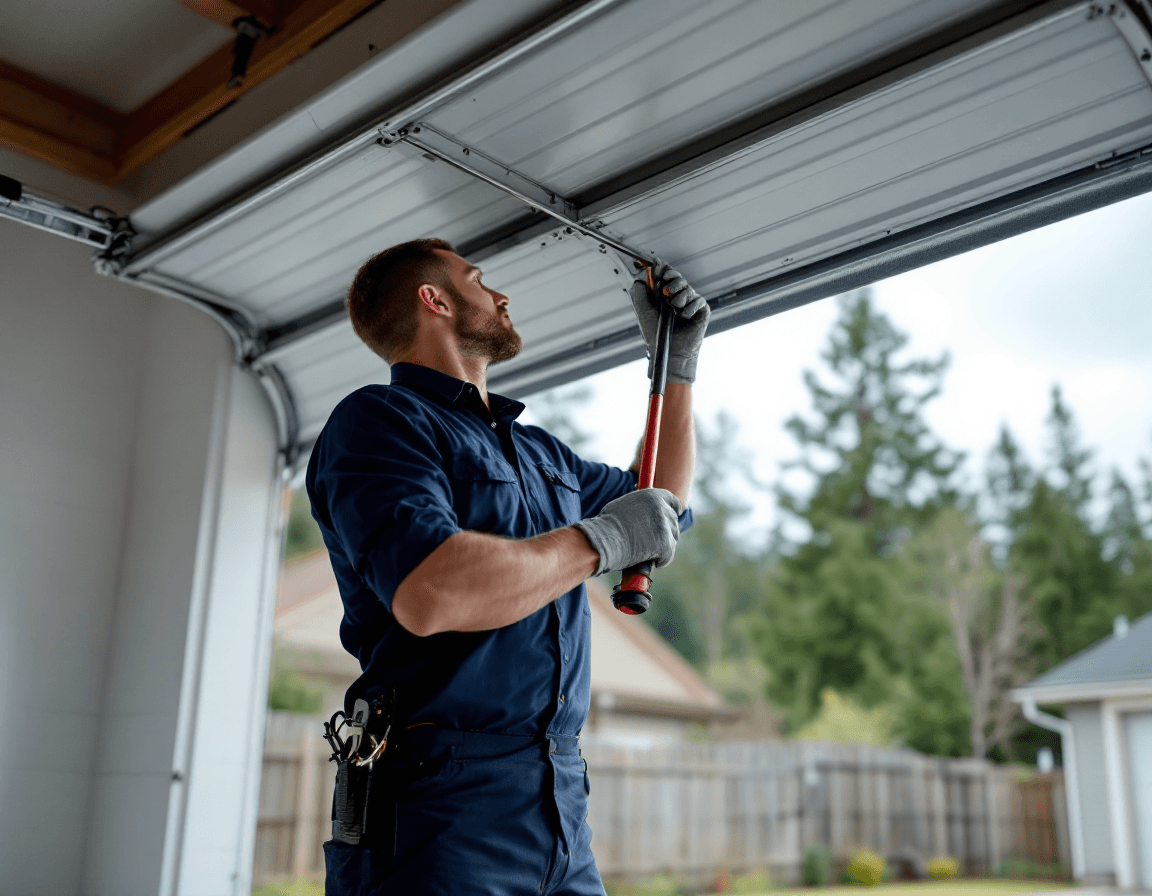
Garage Door Spring Replacement in Bellevue, WA is one of the most common repairs we handle across the Eastside, and it's also one of the most urgent when the spring has already failed. A broken spring can leave a 150-pound or heavier door unable to lift safely, and it can turn a routine morning into a stuck car in the driveway. Homeowners in Bellevue often notice the problem first as a sharp bang from the garage or a door that suddenly feels like it weighs a ton.
This page explains what a failed spring looks like, why our damp Western Washington climate wears springs down faster than many people expect, how torsion and extension springs differ, and what a proper replacement involves. We serve homes across Downtown Bellevue, Crossroads, Factoria, Somerset, Lake Hills, and the surrounding neighborhoods in ZIP codes 98004, 98005, 98006, 98007, and 98008. Our goal is to give you enough practical information to make a good decision, whether you're deciding to call a technician today or just trying to understand what happened in your garage.
Spring work carries real risk because the springs store a large amount of tension, so this is a job for a licensed, bonded, and insured professional. Please read the sections below with that in mind, and don't attempt to remove or adjust a spring yourself, even if you've watched a video about it.
What a Snapped Spring Sounds Like and Looks Like
Most homeowners remember the sound of a broken spring more clearly than anything else about the event. It usually arrives as a single loud bang, similar to a gunshot or a heavy metal pipe dropping on concrete, and it often happens while the door is closed or sitting still. Some people describe it as the garage "jumping," and others only realize something went wrong when they try to open the door and it refuses to budge.
After a break, a few visual clues tend to confirm the diagnosis. On a torsion system, look along the horizontal steel shaft above the door opening for a coil that has a visible gap, a wide space between two sections, or coils that appear to have pulled apart. On an extension system, look for a spring that has separated, a cable that has slackened, or a spring that is no longer tight against its mounting bracket. Many people also notice that the door sits lower than normal or that one side is noticeably heavier to lift than the other.
- A single loud bang from the garage, often at the start of a day or during a temperature drop
- A visible gap or missing sections in a torsion spring coil above the door
- A door that will not lift at all, or that rises only partway and then stops
- Cables that have gone slack, jumped off their drums, or hang loosely at the sides of the door
If you hear a bang and see any of these signs, keep people and pets away from the door, do not try to lift it by hand, and do not run the opener to force the door open. Forcing a door with a broken spring can strain the opener, bend tracks, and damage the cables further. It's safer to disconnect the opener by pulling the emergency release cord, then leave the door closed until a technician can inspect it.
Why Bellevue Garages Wear Springs Out Faster Than You'd Expect
Springs fail because they wear out through repeated cycles, and metal fatigue doesn't pause for the weather. Still, the Pacific Northwest climate can accelerate the process in ways that aren't obvious from the driveway. Our region is known for long stretches of damp, overcast weather, and a garage that is attached to a home can hold moisture from laundry, cars coming in wet from rain, and poor ventilation.
Moisture is a steady enemy of steel. Over several seasons of humidity, surface rust can form on torsion shafts, spring coils, bearing plates, and hardware, and rust makes the metal more brittle and less uniform. We also see plenty of springs in Bellevue homes that have been exposed to cold snaps, which occasionally bring hard freezes to the Eastside. Metal under tension can behave less predictably in cold, and a spring that was already close to the end of its life may give out during the first real frost of the year.
Garage use plays a role as well. A household that leaves the door open for long stretches, or that uses the garage as the primary entry for a busy family, will cycle the door far more than a home that uses the front door for most trips. That extra use adds up quickly, and it's one reason we recommend checking your springs during routine maintenance rather than waiting for a failure.
Torsion or Extension: Matching the Spring to Your Door
Before any replacement, a technician needs to identify which type of spring system you have, because the two designs are not interchangeable. A torsion system mounts a long spring on a horizontal shaft above the door opening. As the door lifts, the spring winds and stores energy, and cables wrapped around drums at each end of the shaft lift the door. Torsion systems are common in newer residential garages and are often preferred for their smoother operation and balanced lift.
An extension system uses one or two springs that run along the horizontal tracks on each side of the door, usually near the ceiling. These springs stretch as the door lowers and pull it back up as it opens, and they tend to be found in older homes and in many detached or budget installations. Extension springs are generally simpler in design but carry their own safety considerations, since they can release energy in a dangerous way if a cable or safety cable is not properly installed.
When we arrive at a home, we confirm the system type, measure the door's weight and height, check the existing spring's wire size and inside diameter, and read the cycle rating stamped or printed on the spring if it's still legible. A correct replacement must match the door's weight, track configuration, and drum or cable setup. Installing a spring that's rated for a different load is one of the most common causes of premature failure, and it's a major reason we discourage homeowners from buying springs online and trying to fit them without training.
What a Spring Replacement Costs Around Bellevue
For most spring replacements, pricing falls in the range of $180 to $450. The final figure depends on the type of spring, the door's size and weight, whether one or both springs need replacement, the condition of the cables and drums, and whether the job involves a torsion shaft or extension hardware. A single extension spring on a lightweight door will generally cost less than a pair of torsion springs on a heavy two-car door.
It's worth asking what's included before you agree to any quote. A complete replacement should cover the springs themselves, safe removal of the damaged parts, inspection of cables, drums, and bearing plates, and a full balance test once the new springs are installed. If a cable has frayed or a drum has cracked, those parts may need replacement as well, and a good technician will explain that before doing the work rather than adding charges afterward.
Homeowners sometimes wonder whether it makes sense to replace only one spring when a torsion pair is involved. In many cases, when one spring has failed, the other has been under the same load for the same number of cycles and is nearing the end of its life. Replacing both at the same time often costs less than paying for a second service call later, and it keeps the door balanced on both sides.
High-Cycle Springs for Busy Eastside Households
Standard residential torsion springs are commonly rated for roughly 10,000 cycles, which is one full open and close. For many households, that rating lasts several years, but a family that uses the garage daily, runs a home business from the garage, or has multiple drivers may reach that number sooner than expected. High-cycle springs are engineered with a heavier wire gauge or a different alloy and are often rated for considerably more cycles, commonly in the range of 25,000 to 50,000 depending on the manufacturer and the door.
High-cycle options cost more up front, but they can be a practical choice when the household's usage justifies it. We discuss the tradeoffs openly with every customer. A high-cycle spring is not automatically the right answer for every home, because a lightly used door with a standard spring may serve well for years, while a heavy-use door may benefit from the extra durability. The right choice depends on how often the door moves, how heavy it is, and how long you expect to keep the home.
Regardless of the cycle rating, a high-cycle spring still needs correct sizing and balancing. A stronger spring installed on a poorly balanced door can put extra stress on the opener, the cables, and the bearings. That's why we treat high-cycle upgrades as part of a complete system review rather than a simple part swap.
Balancing the Door So It Behaves Properly
Once new springs are in place, the door needs to be balanced. A balanced door should stay in place when lifted partway, roughly at the midpoint of its travel, without drifting up or down on its own. If you open the door by hand and it rises quickly, sags, or seems to fight you, the spring tension is off, and the opener is probably working harder than it should.
Balancing is one of the most overlooked parts of a spring repair. Adjusting the spring tension, checking the cable alignment on the drums, and confirming that the lift is even on both sides all contribute to safe, smooth operation. An unbalanced door can close too fast, close crookedly, or put uneven stress on the tracks and rollers. Over time, that imbalance can damage the opener and shorten the life of nearby parts.
A proper balance test is something you can observe yourself after the job is complete. Ask the technician to demonstrate the test, and watch whether the door stays put when you release it at different heights. If the door drifts, your technician should make the adjustment before leaving, not after you've already discovered the problem the following week.
Cables, Drums, and Other Damage a Spring Break Leaves Behind
A broken spring rarely fails alone. When a torsion or extension spring lets go, the sudden release of energy can strain the cables, the drums, the bearing plates, the center bracket, and the track alignment. Cables may fray, kink, or come loose from the drum. A drum may crack or slip on the shaft. Bearings may be bent or damaged, and the shaft itself may twist if the tension was released unevenly.
This is why a full inspection is important after any spring break. We check the cables for fraying and proper seating, examine the drums for cracks or wear, confirm that the shaft is straight, and look at the bearings and hangers for damage. We also inspect the track to make sure the door rollers are still engaged and the track is aligned. Catching these secondary problems during the same visit can prevent a second failure a few weeks later.
Cables deserve special attention. If a cable has jumped off its drum or stretched unevenly, it can cause a door to tilt or stop mid-travel. Homeowners sometimes try to rewrap a cable themselves, but this is risky because the cable carries tension from the spring. A licensed technician has the tools and training to re-seat cables safely and replace them if necessary.
Hillside Driveways, Split-Levels, and Shared Garages in Bellevue
Bellevue's housing mix creates a range of garage configurations, and each one can influence how a spring problem shows up. Many homes in Somerset and other hillside areas have sloped driveways and garages set into grade, which can affect door alignment and cable wear over time. Split-level homes, which are common in several older Eastside neighborhoods, sometimes have tighter clearances above the door, making extension springs and headroom a more delicate matter during replacement.
In Downtown Bellevue and parts of Factoria, many residents live in condominiums, townhomes, or apartment-style buildings with shared or individually assigned garages. Those garages may have unique door sizes, older hardware, or access rules that affect scheduling and parts access. Crossroads and Lake Hills include a mix of older single-family homes and newer builds, which means a technician may encounter everything from decades-old torsion systems to recent installations with high-cycle springs already in place.
Whatever your home looks like, a good technician takes the time to measure the space, check the headroom and sideroom, and confirm that the replacement will fit the existing opener and track layout. Those details are easy to overlook, but they can determine whether a repair goes smoothly or stalls halfway through.
Why Springs Are Not a Do-It-Yourself Project
It can be tempting to search online, buy a spring, and try to replace it with basic hand tools. We understand the appeal, especially when a broken spring feels like a simple part swap. However, spring work is among the most dangerous tasks in residential garage maintenance. Torsion springs store large amounts of energy, and mishandling a winding bar or releasing tension incorrectly can cause serious injury.
Extension springs carry their own risks, particularly when safety cables are missing or improperly installed. A spring that releases unexpectedly can strike the person working on it or anyone standing nearby. Even experienced DIYers can misjudge the tension, install the wrong spring, or miss damage to the shaft, drums, or cables that makes the replacement unsafe.
Licensed, bonded, and insured professionals carry the training, equipment, and accountability that spring work requires. If something goes wrong during a repair performed by a qualified technician, the company is responsible for the work and for its insurance coverage. That's a meaningful difference when the job involves high-tension hardware above your head.
Keeping Springs Healthy Through a Pacific Northwest Year
Good maintenance can extend the life of your springs and reduce the chance of a sudden break. The most useful habits are simple and inexpensive. Visual inspections, periodic lubrication with the right product, and attention to moisture and cold weather can prevent many failures before they start. Remember that lubrication should go on moving parts such as hinges, rollers, and bearings, but not on the springs themselves in a way that hides corrosion, and never on the cables.
- Look at the torsion spring coils every few months for rust, gaps, or uneven spacing
- Keep the garage ventilated to reduce humidity from laundry, wet vehicles, and rain tracked in on tires
- Watch for signs of imbalance, such as the door drifting or closing unevenly, and schedule service early
- Schedule a professional inspection every year or two, especially for doors that see heavy daily use
Keep in mind that a routine inspection is a good time to ask about high-cycle upgrades if your household's usage has increased since the last service. Changes in family size, a new home business, or a change in commuting habits can all affect how hard your garage door works. A technician who knows your home and your door can help you plan ahead instead of reacting to the next break.
If your garage has just made a loud bang, won't lift, or sits partially open, the safest next step is to stop using the opener, keep the area clear, and call a licensed professional to inspect the springs and cables. Our team serves Bellevue and the surrounding Eastside communities, and we'll explain the options clearly before any work begins. Call (888) 799-3819 to schedule your spring replacement today.