
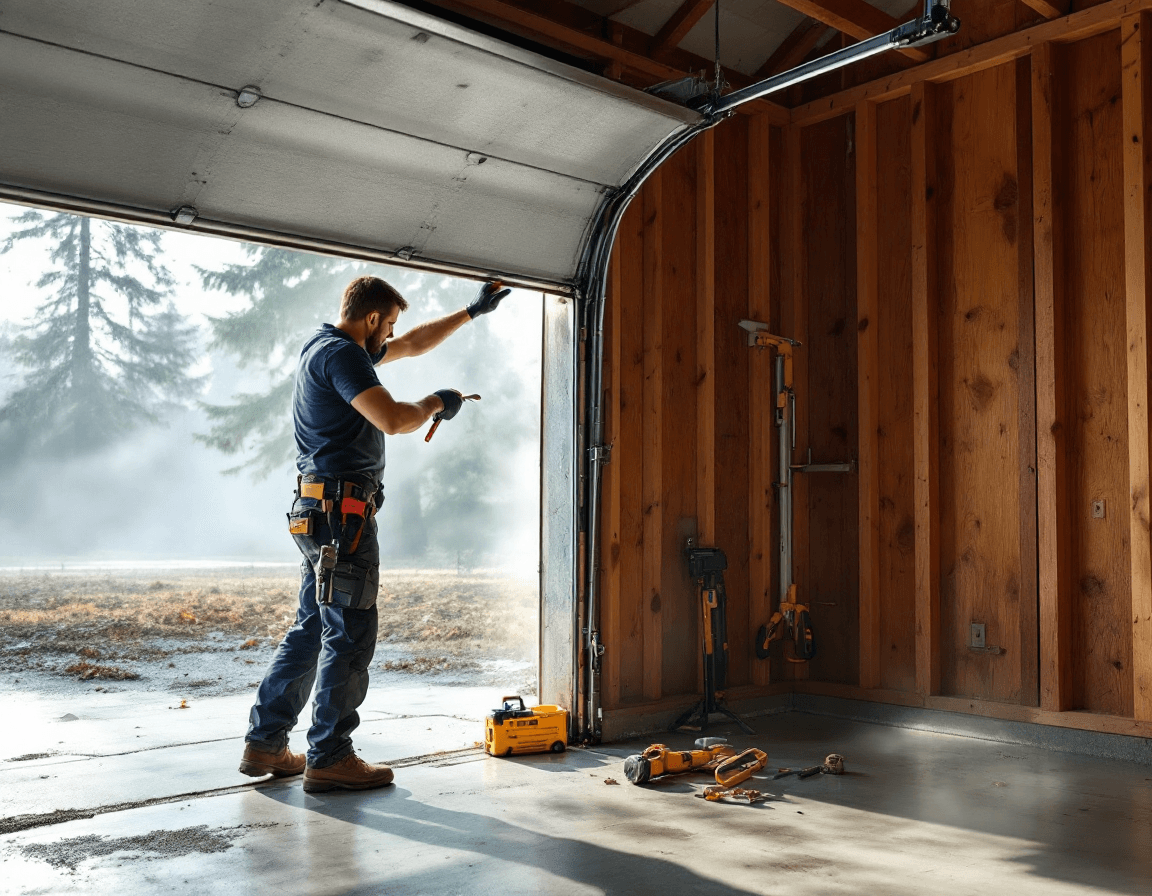
Off-track garage door repair in Bellevue, WA is one of the most common calls we take, and it usually starts with a sound that's hard to ignore: a sharp bang, a grinding noise, or a door that stops halfway up and refuses to budge. Bellevue's mix of older split-level homes, newer townhome garages, and sloped driveways puts a lot of stress on the track system that guides your door. When a roller pops out or a track section shifts, the door can end up crooked, jammed, or hanging partly off its rails. Most of these problems can be corrected in a single visit, and the typical off-track realignment falls in the $125 to $400 range depending on what's damaged.
Homeowners across Bellevue, from the high-rise edges of Downtown to the quiet cul-de-sacs of Lake Hills, often wait a few days before calling because the door still "mostly works." That delay is risky. A door that is partly off its track is carrying its weight on the wrong points, which can bend the track further, strip rollers, and strain the opener. If you're reading this because your door looks wrong right now, you're in the right place. Below, we walk through how to recognize the problem, why it happens so often in our area, what a proper repair involves, and where the safety lines are drawn.
Recognizing a Door That Has Left Its Track
The clearest sign is visible from the driveway: the door no longer sits evenly inside the opening. One side may look lower than the other, or the top edge may lean away from the header. Sometimes you'll see a noticeable gap between the door panels and the vertical track, especially along the side where the roller came out. Stand back and look at the seams between panels; if they no longer line up in a straight horizontal line, the door is out of square.
Sound is the second clue. Off-track doors often make a scraping or rattling noise as the rollers drag along the wrong surface instead of rolling smoothly in the channel. You may also hear a popping or thumping at the start or end of travel. Watch for a door that moves a few feet and then stops, or one that seems to catch and bind even though the opener is still running. The opener motor may hum or strain in these moments, and the auto-reverse feature might trigger because the door has nowhere clean to travel.
Finally, check the rollers if it is safe to look without touching any springs. A roller sitting outside the track, a roller stuck at an angle, or a roller that has jumped the lip of the track is a strong indicator of an off-track condition. Do not try to force the door up or down to see better, and never stand in the path of a door that is moving or is suspended unevenly. If the door is stuck, the safest step is to disconnect the opener by pulling the emergency release cord and then keep everyone clear while you call a technician.
Why Bellevue Doors Jump Their Tracks More Than You'd Expect
Bellevue's climate is a major factor. Our winters bring long stretches of rain, damp air, and temperature swings that cause wood, steel, and vinyl to expand and contract. Wooden doors can swell and sag, changing their weight distribution, while metal tracks can loosen their mounting bolts over time. Moisture also promotes corrosion on the hinges and roller stems, which makes the rollers less willing to turn smoothly and more likely to bind and jump.
The terrain matters too. Many neighborhoods across the city sit on hillsides, and driveways that slope toward the garage can put uneven pressure on a door as it moves. Homes in areas like Lake Hills and parts of Somerset were built decades ago, and house framing settles unevenly over time. When the header above a garage door shifts even slightly, the top track can drift out of plumb, and the door no longer tracks cleanly. Newer construction in Factoria and near Downtown can have its own challenges, such as tight garage footprints that leave little margin for error when a track is bumped during a move or a delivery.
Finally, daily life in a busy city adds wear. Garages in Bellevue see frequent use: school runs, weekend trips to the mountains, and contractors coming and going. Each cycle of the door puts load on the rollers and hinges. Over thousands of cycles, a roller that was slightly loose can work its way free, and a track bracket that was a little under-tightened can gradually spread. Understanding these local pressures explains why a door that worked perfectly for years can suddenly come off its track after a wet February.
Rollers That Have Popped Free and What Comes Next
Rollers are the small wheels that ride inside the vertical and horizontal tracks, and they are the most frequent culprits in off-track situations. A roller can pop out for several reasons: a worn or cracked roller tire, a bent roller stem, a loose hinge that allows the panel to shift sideways, or a sudden jolt from a strong gust or an impact. Nylon rollers, which are common on residential doors, tend to crack or flatten after years of use, and steel rollers can lose their shape if they are pushed hard against a damaged track.
When a roller has popped out, the door's weight shifts onto the remaining rollers on that side. This is why you may see one corner of the door sitting lower than the other. Repeated attempts to lift or push the door can damage the remaining rollers, bend the track, or pull a hinge loose. A technician will usually inspect every roller, not just the one that failed, because a worn roller often signals that its neighbors are close behind.
Common roller-related items a technician typically checks include:
- Whether each roller tire is cracked, flattened, or missing sections
- Whether roller stems are bent or have pulled out of the door's hinge
- Whether the hinges that connect the door panels are loose or misaligned
- Whether the roller lift brackets and track bolts are tight and secure
- Whether any rollers show scoring or flat spots that suggest they were dragging
Replacing a worn roller is usually straightforward, and many of these repairs are completed without replacing the entire track or the springs. Keep in mind that when a technician works on rollers near the top of a door, the door may need to be supported safely while the work is done. This is one reason we recommend calling a professional instead of tackling a stuck door alone.
Bent, Dented, and Separated Track Sections After an Impact
Track damage is more serious than a popped roller, and it often comes from a collision. Vehicles backing out of a driveway, a delivery truck clipping the garage opening, or a child's bicycle hitting the door at speed can all bend a track section. Even a small dent in the vertical track can cause a roller to catch on the edge of the dent, and the door will bind or jump each time it passes that point. In some cases, the track may separate from its mounting brackets or from the horizontal section, leaving a visible gap.
Bent track is not always obvious from the outside. You may need to look at the track from the side and sight along its length to see whether it bows inward or outward. Look for shiny scrape marks on the track surface, which indicate where a roller has been dragging. If the door has been hit by a vehicle, check the door panels, the bottom seal, and the opener mounting for related damage, because a collision that bends the track can also stress the rest of the system.
Repairing track typically involves carefully straightening the metal, re-tightening or replacing brackets, and making sure the track is parallel and plumb. In many cases a technician can straighten and re-secure the track in place, though severely crushed or torn sections may need replacement. Because the track is under tension from the door's weight, a technician should always manage the door carefully during this work. If you are dealing with track damage after a crash, document the damage with photos for your insurance claim before any repairs are made.
Reading Crooked Doors, Gaps, and Binding Movement
Not every alignment problem is a full derailment. Sometimes the door is still on its tracks but sits crooked, or it moves unevenly and binds partway through the cycle. A gap that appears between the door's edge and the vertical track, especially at the top or bottom, is a signal that the door is leaning or that the track has shifted. Binding often shows up as the door catching or jerking at a particular height, which can indicate a worn roller, a dented track section, or a hinge that has loosened.
Start by checking whether the door looks level when closed. Measure the gap between the bottom of the door and the floor at both ends. A significant difference may mean one side's rollers have slipped or that the track on that side has moved. Next, observe the door as it opens slowly by hand (only after you have disconnected the opener and only if the door is balanced and you can do so safely). If one side lifts before the other, the rollers or track on that side likely need attention.
Be cautious with this kind of inspection. Pushing or pulling a door that is out of alignment can cause a sudden shift, especially if the springs are under high tension. A door that is binding is also a sign that stress is building in the system, so minor adjustments are best left to a licensed technician who can read the full picture. Our technicians look at track plumb, roller condition, hinge alignment, and spring tension together, because fixing one piece without checking the others often leads to a second visit.
What Happens During a Professional Off-Track Visit
A typical off-track service visit begins with a safety assessment. The technician will confirm whether the door is stable, whether the opener is disconnected, and whether the spring system is intact. From there, the door is supported as needed while the crew inspects the tracks, rollers, hinges, brackets, and cables. Anything that involves high-tension springs or cables is handled by trained professionals, since those components store large amounts of energy.
Next, the technician returns the roller to the track or replaces it, adjusts the track to be straight and secure, and checks each roller for smooth travel. The door is then cycled slowly through its full range of motion to confirm that it tracks evenly, that the gap at the sides is consistent, and that there is no binding at any height. The opener is reconnected only after the door moves freely by hand and under the opener's power. Finally, the technician reviews what was found and what was fixed, and explains any parts that show wear and may need attention later.
Many off-track repairs in Bellevue are finished in a single visit. If the track is severely damaged or the springs need replacement, the technician will give you a clear explanation of the options and the expected cost before proceeding. You should never feel pressured to approve work you do not understand, and you should always know which parts are being replaced.
Typical Pricing and What Shapes the Final Bill
For most off-track repairs, our pricing falls between $125 and $400. The final amount depends on the extent of the problem, the number of rollers and track sections involved, and whether any components need replacement. A single roller reseated in an otherwise healthy track sits at the lower end of that range, while a door with multiple damaged rollers, a bent track section, and loosened brackets will land higher. Access can also affect cost, especially on doors that are heavy, unusually sized, or mounted in tight garage spaces.
Several factors influence how the job is scoped. Door type and material matter: insulated steel doors, wood doors, and custom-built doors each have different hardware and handling requirements. The age of the track and the condition of the brackets matter too, because old, corroded hardware may need to be replaced rather than reused. If a track has been struck hard, the time required to straighten it safely can be greater than a simple reseating job.
Every estimate should be explained before work begins. Ask for a clear breakdown of what is included, which parts are optional, and what might be needed later. A reputable crew will not hide additional charges behind vague language. If the damage is more than the original scope covered, the technician should stop, explain the situation, and wait for your approval before continuing.
Neighborhood Notes Across Bellevue and Nearby ZIP Codes
Bellevue is not one uniform landscape, and the service needs vary by area. In the Downtown core, covering ZIP codes 98004 and 98005, many homes and multi-unit buildings have compact garages with tight clearances, and doors sometimes get bumped by vehicles or deliveries. Technicians working here often need to plan around limited parking and narrow access, so scheduling and staging matter. Doors in these areas tend to be newer, but track alignment is still critical because a small shift can cause a noticeable binding problem.
Moving east and south, the Crossroads area (ZIP 98008) and the Factoria corridor (ZIP 98006) include a mix of older single-family homes and newer developments. Crossroads residents often have heavier daily garage use, which means rollers and hinges see more cycles. In Factoria, garages are frequently attached to homes built at different times, so the age and condition of the track can vary from one block to the next. Somerset, located on the hillside to the east of Downtown and reached through ZIP 98006, features homes with sloped driveways and older framing, where settling can nudge a header or track out of plumb over time. Lake Hills, primarily in ZIP 98007, has many mid-century and later homes, and doors there often show the wear that comes from decades of Pacific Northwest rain and humidity.
Wherever you are in the city, the principle is the same: an off-track door needs prompt attention, and the cause is usually a combination of wear, weather, and structural movement. Local knowledge helps technicians anticipate what they will find, from older hardware that needs replacing to newer doors that were knocked out of alignment during a recent move.
Off-Track Situations That Should Never Be Handled Solo
Some parts of an off-track repair are simply not safe for homeowners to attempt. Garage door springs, whether torsion springs above the door or extension springs along the sides, store enormous amounts of energy. Releasing that energy unexpectedly can cause serious injury, and it is the single most dangerous component in the system. Cables can also snap under tension, and the drum they wrap around can unwind in ways that are hard to control. These parts should only be serviced by a licensed, trained professional.
If you find that the door is off its track, follow these basic safety habits while you wait for help:
- Disconnect the opener using the emergency release cord, then keep everyone away from the door.
- Do not stand under or inside the door opening while it is off track or partly suspended.
- Do not attempt to lift the door by hand to "reset" it, because uneven weight can cause a sudden drop.
- Do not pry at the spring, cable, or drum, even if a component looks loose.
- Keep children and pets clear of the garage until the door has been secured.
Our technicians are licensed, bonded, and insured, and they handle spring and cable work as a matter of routine. If you are unsure whether a component is safe to touch, the answer is always to call a professional. Taking a few extra minutes to protect yourself is far less costly than an injury or a damaged door.
Keeping Your Door Aligned Through Puget Sound Winters
Preventing off-track problems is easier than repairing them. Start with a simple visual check once a month. Look at the tracks for dents, loose bolts, or gaps, and watch the door during a normal open and close cycle. Listen for new noises, such as squeaks or grinding, which can signal roller wear. In a wet Bellevue winter, it is also smart to check for rust or corrosion on hinges and roller stems, since moisture can quietly weaken hardware.
Lubrication helps, but it must be done correctly. Use a silicone-based or manufacturer-recommended lubricant on rollers and hinges, and avoid heavy grease that attracts dust and grit. Do not spray lubricant into the tracks themselves in a way that leaves residue that catches rollers. Keep the garage floor clear of debris that could be pushed into the track, and make sure the weatherstripping along the bottom and sides is in good shape, since damaged seals can let water and debris into the track area.
Finally, schedule periodic professional inspections, especially if your home has settled, if you have a sloped driveway, or if the door has been hit by a vehicle. A technician can spot early roller wear, track drift, or bracket loosening long before the door comes off its track in the middle of a commute. Catching these issues early usually means a smaller repair and a lower bill.
Choosing a Crew for Off-Track Garage Door Repair
When your door is stuck or crooked, it helps to know what a qualified crew looks like. Look for a company that is licensed, bonded, and insured, and that will show proof of those credentials when asked. Ask whether the technicians are trained on the spring and cable systems that are common in residential doors, and whether they explain the work in plain language before starting. A good crew will also be upfront about pricing, giving you a clear range and a written breakdown before any work begins.
Pay attention to how the technician handles the first call and the first visit. They should ask about the door type, when the problem started, whether there were any impacts or noises, and whether the opener is still connected. They should inspect the whole system, not just the roller you can see, and they should be willing to answer your questions about what they found. Avoid any company that pressures you into unnecessary replacements or refuses to explain the parts involved.
Seattle Garage Door Fix serves Bellevue and more than 60 cities across the greater Seattle and Western Washington area. Our technicians understand the local climate, the common door types in our neighborhoods, and the particular challenges of older homes and sloped driveways. Whether your door has popped a roller, a track has been bent, or the door is simply binding, we can give you an honest assessment and a clear plan. Our off-track repairs typically range from $125 to $400, and we are happy to explain what determines the final figure for your specific door.
If your garage door is off its track, crooked, or stuck, don't wait for it to get worse. Call Seattle Garage Door Fix at (888) 799-3819 to schedule a licensed technician for off-track garage door repair in Bellevue, WA. We'll help you get your door moving safely and smoothly again.