
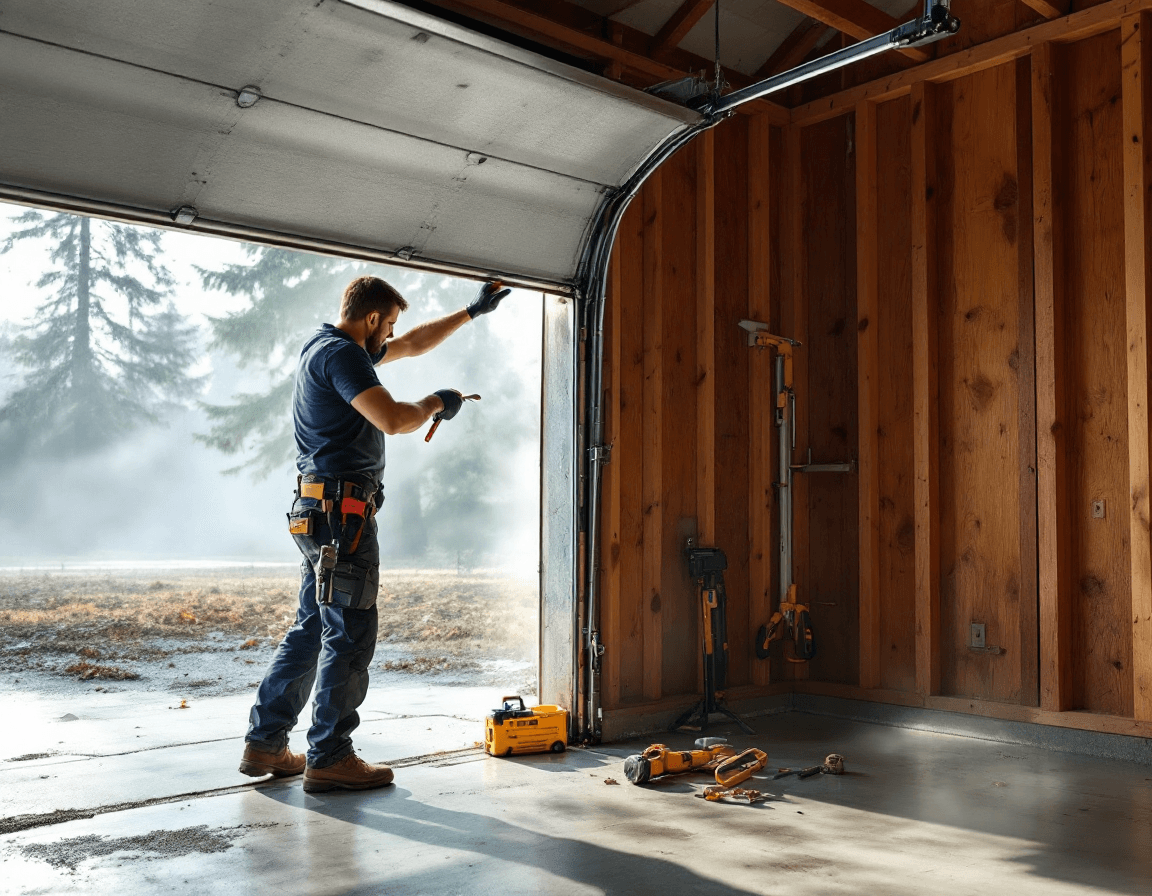
Off-track garage door repair in Redmond, WA is one of the more urgent calls we take, because a door that has jumped its tracks can stop working entirely and become a safety hazard. Homes across Redmond's 98052 and 98053 ZIP codes see this problem regularly, whether the door came loose during a windy winter storm, a rolling bike caught the bottom panel, or a roller simply wore through and popped out of the channel. Realignment, roller replacement, and track straightening are often more affordable than most homeowners expect, and most off-track repairs fall within a range of $125 to $400 depending on how much damage the door and track have taken. The earlier the problem is addressed, the less likely it is to spread into a bent panel, a stripped opener gear, or a cable that needs replacing.
If you are reading this because your door is sitting crooked, jammed halfway up, or showing a gap along one side, you are not alone, and the situation is usually more fixable than it looks. A door that has come off one track is still held in place by its springs, cables, and hardware, which means a trained technician can often guide it back without replacing major components. That said, a door that is off track is also under unusual stress, and continued attempts to force it open or closed can make the damage worse. This guide explains what causes off-track problems in our part of King County, how to recognize early warning signs, what a proper repair involves, and where the safety lines are drawn for homeowners.
Our goal is to give you a clear, practical picture so you can make informed decisions about your door. Nothing here replaces an on-site inspection, since every door has its own mix of hardware, age, and damage history. Where spring and cable work is involved, which it often is in off-track cases, that work belongs in the hands of a licensed, bonded, and insured professional. Read on for the specifics, and call us at (888) 799-3819 if your door is currently off its tracks.
How Redmond's Wet Winters Put Extra Strain on Garage Door Tracks
Redmond sits in one of the wetter corners of Western Washington, and that moisture has a long reach into the mechanics of a garage door. Steel tracks, galvanized rollers, and wooden or composite door panels all respond to humidity and temperature swings in different ways. During the long gray stretches from October through March, the air stays damp for weeks at a time, which encourages surface rust on track edges and can soften the nylon or plastic in older rollers. Once a roller starts to deform, it no longer rides smoothly in the channel, and the door begins to wander sideways.
Temperature cycles add another layer of wear. Redmond can see cold mornings that drop well below freezing followed by milder afternoons, and metal expands and contracts with each shift. Over time, these small movements can loosen the bolts that hold track brackets to the wall or ceiling, leaving the track slightly out of plane. A track that is out of plane by even a fraction of an inch can cause a door to ride up unevenly, and in the worst cases the rollers ride up and out of the channel altogether. Many homeowners notice the problem for the first time on a cold morning when the door refuses to open smoothly.
Wind is the third factor local homeowners ask about. Gusty storm systems that move through the Eastside can push against large door panels, especially on two-car doors facing open exposures or on properties near Marymoor's open fields. A strong gust can flex a door enough to pull one roller free from a track that was already slightly misaligned. If your door has jumped once after a storm, treat that as a warning and have the track and roller alignment checked before the next weather system arrives.
Early Warning Signs Before a Door Fully Leaves Its Track
Most off-track failures do not happen all at once. They build over weeks or months, and the first signs are often easy to dismiss. A door that makes a new scraping or popping noise during its travel is frequently the first clue that a roller is beginning to slip or that a track section has shifted. Homeowners sometimes assume the noise is just the opener working harder, but a sudden change in sound is worth investigating before it becomes a derailment.
Visual clues are equally useful. Walk outside and look at the door with the opener disconnected and the door closed, then compare the gap between the top edge of the panels and the header along both sides. If one side sits noticeably lower or the seal at the bottom no longer meets the floor evenly, the door may be starting to drift out of plane. Check the vertical tracks as well, looking for a gap between the track and the door edge, a track that appears to bow outward, or rollers sitting at an angle instead of flat against the channel.
Here are the warning signs we see most often in Redmond homes before a full off-track event:
- A door that rises unevenly, with one side lagging behind the other
- Rollers that look flattened, cracked, or pulled partly out of their track
- A new rubbing or grinding noise along the vertical or horizontal track
- Gaps larger than a few millimeters between the door and the track on either side
- A door that stops for a moment near the top of its travel before continuing
- Visible rust streaks or bright scrape marks on the inside of the track
If you spot any of these, avoid running the door repeatedly to test it. Each additional cycle can push a loose roller further out of its channel and make the eventual repair more involved.
What Usually Causes a Door to Come Off Its Tracks
Off-track problems almost always trace back to one of a few root causes, and identifying the cause matters because it determines whether the repair will be a simple realignment or a larger job. Worn or failed rollers are the most common culprit, particularly on doors that are fifteen or more years old. Nylon rollers can crack, and steel rollers can lose their bearings, causing them to wobble and eventually jump the track. Broken or stretched cables are another frequent cause, because an uneven cable tension lets one side of the door drop faster than the other.
Track problems form the second major category. Bolts loosened by temperature changes, a track bracket pulled away from a wood frame, or a track section that has been bent by an object all allow the door to drift. Door panels themselves can also contribute, especially if a section has warped from moisture or a hinge has torn out of the panel. Finally, an opener that is forced to lift a misaligned door can pull the door in unexpected directions and accelerate the problem.
Accidents account for a meaningful share of the calls we receive. A car backing out of a driveway, a delivery vehicle, a ladder bumped into the lower panel, or a child's bicycle hitting the track can all knock a door out of alignment in seconds. These impacts often bend the track in a way that is not visible at first glance, so even a door that seems to work after an accident may be hiding damage that will show up later.
The Realignment Process a Licensed Technician Follows
When a technician responds to an off-track call, the first step is always safety assessment. We check whether the door is resting stably, whether the springs and cables are intact, and whether any part of the door is under tension that could release suddenly. The opener is disconnected at the power source, and the technician confirms that the door cannot move on its own before any hands go near the track. This assessment often takes longer than the repair itself, and it is the reason off-track work should never be attempted by an untrained homeowner.
Next, the technician inspects the track system from end to end. This includes checking that vertical tracks are plumb, that horizontal tracks are level and parallel, and that the curve transitions are intact. Brackets and mounting bolts are tested for tightness, and any damaged sections are noted for repair or replacement. Rollers are examined for wear, flat spots, and bearing condition, because a single bad roller can throw off the alignment of the entire door.
Once the track system is sound, the door is guided back into its channels and the rollers are seated fully. The technician then tests the door through a full cycle, checking that it rises and lowers evenly, that the seals meet the floor, and that the opener can move the door without strain. Adjustments are made to tension and to the opener's force settings where needed. Many off-track repairs conclude with a short walk-through so the homeowner understands what was found and what, if anything, should be monitored in the coming months.
Rollers, Hinges, and the Hardware That Fails First
Rollers deserve special attention because they are the parts most often replaced during an off-track repair. Standard steel-ball rollers and nylon rollers each have their place, and the right choice depends on the door's age, weight, and how often it is used. Nylon rollers run quieter and are common on residential doors, but they can deform in hot weather or crack in deep cold, which matters in a region that cycles between damp winters and occasional dry, cold snaps. Steel-ball rollers hold up well under heavier loads and tend to last longer on doors that are opened many times a day.
Hinges are the second area where wear shows up during off-track work. A hinge that has pulled loose from its panel can let a section of the door sag or twist, which pulls the adjacent roller out of the channel. We inspect hinge fasteners, look for elongated screw holes in the wood or steel, and check whether the hinge itself is bent. In many cases a simple re-fastening with appropriately sized hardware solves the problem, but a damaged panel may require more involved repair.
Brackets and mounting hardware round out the list. Lag bolts that have worked loose from wood framing, track brackets that have cracked, and hanger straps that have stretched all contribute to misalignment. Replacing worn hardware is typically inexpensive compared to a full door replacement, and it often delivers the longest-lasting improvement. A technician who checks these small parts during an off-track call is protecting you from a second failure within a few months.
Bent Track Sections and Collision Damage
Bent tracks are among the more stubborn problems in off-track work, because a track that has been deformed by impact does not always return to a straight line when the door is reattached. Sometimes a technician can carefully straighten a lightly bent section by working it back into shape with controlled pressure and then re-securing it to the wall or ceiling. Heavily kinked or split tracks, however, usually need to be replaced, since a compromised section will keep pulling rollers out of alignment.
Collision damage requires a close look at the surrounding structure as well. If a vehicle struck the lower panel or the track, the impact may have transferred force into the header, the jamb, or the opener mounting. Homeowners sometimes notice a small crack in the drywall above the door or a bowed header board after an accident, and those details matter for the repair plan. A good technician will check the framing and mounting points before assuming the track alone is at fault.
Separated track sections are a particular concern on doors with multi-piece tracks. When a joint between sections pulls apart, the rollers can catch on the gap and derail. These joints need to be aligned precisely and secured with the correct hardware, and a gap that has widened over time may indicate that the track has been stressed repeatedly. If you notice a visible seam or a step between track segments, mention it when you call so the technician can plan for the right parts on the first visit.
Safety Rules for the Hours Before a Technician Arrives
A door that has come off its track is an unpredictable piece of equipment, and the time between discovering the problem and getting professional help is when accidents are most likely. The most important rule is to keep everyone, especially children and pets, well clear of the door's path. Do not stand beneath a door that is hanging crooked, and do not allow anyone to lean on it or test it by hand. A door that appears stable can shift suddenly when a roller slips further or a cable gives way.
Homeowners should also avoid the temptation to fix the problem themselves with a pry bar, a ladder, or force. Lifting or shoving a door that is partly off its tracks can bend the track further, strip the opener gear, or release tension from springs in ways that cause injury. Pulling the emergency release cord while a door is off track can cause it to drop unexpectedly, so leave the cord alone unless a technician instructs you otherwise. Keep the opener's power off at the breaker or unplugged if you can do so safely, which prevents the motor from trying to drive a misaligned door.
Here are steps we recommend while you wait for service:
- Keep the area beneath the door clear and mark it off if necessary
- Do not attempt to lift, push, or pull the door by hand
- Do not pull the emergency release cord while the door is off track
- Avoid running the opener repeatedly to test the door
- Park vehicles in an alternate location if the door cannot close fully
- Take photos of the track and door from a safe distance for the technician
These steps are simple, but they prevent most of the secondary damage we see when homeowners try to manage the situation alone.
Why Spring and Cable Work Belongs With a Licensed Pro
Off-track repairs frequently involve the springs and cables that counterbalance the door's weight, and this is where the work becomes genuinely dangerous. Torsion and extension springs store enormous amounts of energy, and a spring that releases unexpectedly can cause serious injury. Cables can snap under tension, and a broken cable can whip through the air or cause the door to drop unevenly. For these reasons, any spring or cable work must be performed by a licensed, bonded, and insured technician who has the training and tools to handle stored tension safely.
We want to be clear about where the line sits for homeowners. Realigning a track that is still attached to the door's counterbalance system, reseating a roller that has come free without involving the springs, or tightening a loose bracket are tasks that a technician will assess carefully before proceeding. But any inspection that reveals a damaged cable, a broken spring, or a drum that has slipped should be handled by a professional without exception. Attempting spring work with improvised tools is one of the most common ways homeowners get hurt during a garage door repair.
If your technician recommends spring or cable replacement after an off-track event, ask them to explain what they found and why it matters. A good technician will show you the damaged component, describe how it failed, and outline the options. Taking that time protects both your door and your household, and it ensures the repair addresses the root cause rather than just the visible symptom.
What Off-Track Repairs Typically Cost in Redmond
Pricing for off-track garage door repair depends on what the technician finds once the door is secured and the track is inspected. For most off-track repairs, our range is $125 to $400, which generally covers realignment, roller replacement, and straightening of modestly damaged track sections. A door that only needs its rollers reseated and its track re-secured will typically fall at the lower end, while a door with multiple worn rollers, a bent track section, and a damaged bracket will land higher in the range.
Several factors push costs up or down. The number of rollers that need replacement, whether the track must be straightened or swapped out, the condition of the hinges and brackets, and the complexity of the door itself all play a role. Doors with specialty hardware or unusual track configurations can require additional parts and time. Repairs that uncover spring or cable problems are priced separately, because those components require licensed work and specific parts.
We believe homeowners should understand what they are paying for before the work begins. Before any repair proceeds, the technician should explain the diagnosis, the recommended fix, and the approximate cost range based on what was observed on site. If additional work is needed, you should have the chance to review it and decide how to proceed. This transparency is part of how we approach every call in the Redmond area.
Neighborhood Notes for Downtown, Overlake, Education Hill, and Marymoor
Redmond's housing stock varies a great deal from one neighborhood to the next, and that variety shapes the kinds of off-track problems we see. Homes near Downtown Redmond include a mix of older single-family properties and newer townhome-style buildings, many with attached garages that share walls or limited headroom. Tight clearances in these garages can make track alignment more demanding, and a door that was installed with minimal headroom may be more prone to binding when a roller slips.
Overlake presents a different picture. Many properties in this part of Redmond are newer construction with taller garage openings and larger two-car doors, which carry more weight and generate more leverage on the track system. Homeowners in Overlake often ask whether their oversized doors are more vulnerable to derailment, and the honest answer is that heavier doors demand properly tensioned springs, quality rollers, and well-anchored tracks. Regular inspection matters more on these larger doors.
Education Hill and the areas surrounding Marymoor Park tend to include a range of home ages and garage layouts. Some properties have doors that have been in service for many years, where worn rollers and tired hardware are the most likely culprits. Others sit in more open terrain where wind exposure can contribute to door flex. Across all these neighborhoods, the same principles apply: inspect regularly, respond to changes early, and let a licensed technician handle anything involving springs or cables.
Keeping a Realigned Door Running Straight Through Redmond's Seasons
A successful off-track repair is only the beginning of keeping your door reliable. Once a technician has realigned the door and secured the track, a few simple habits can help it stay on course through the wet months and the occasional cold snap. Periodic visual checks are the most valuable habit. Once a month, observe the door as it opens and closes, listening for new noises and watching for uneven movement on either side.
Lubrication and cleaning matter too, though the approach should be deliberate. Use a silicone-based or lithium-based lubricant on the rollers, hinges, and bearings as recommended for your door type, and wipe away excess so dirt does not collect in the channels. Avoid heavy grease in tracks, since it can attract grit and debris that accelerates wear. Keeping the tracks free of leaves, mud, and salt-laden grime during the rainy season is one of the easiest ways to extend the life of the entire system.
Finally, schedule a professional inspection at least once a year, ideally before the wettest months arrive. A technician can check track bolts, roller condition, spring tension, and cable integrity during a single visit, catching small issues before they become off-track emergencies. This is especially valuable for Redmond homeowners whose doors have weathered many seasons of moisture and temperature change. Preventive attention costs far less than an emergency call, and it keeps your door opening and closing smoothly for years.
If your garage door has come off its track, is jammed, or shows any of the warning signs described above, do not wait for it to fail completely. Call Seattle Garage Door Fix today at (888) 799-3819 to schedule a licensed technician who can safely assess the door, realign the track, and walk you through the options for a lasting repair across Redmond and the surrounding Eastside communities.