
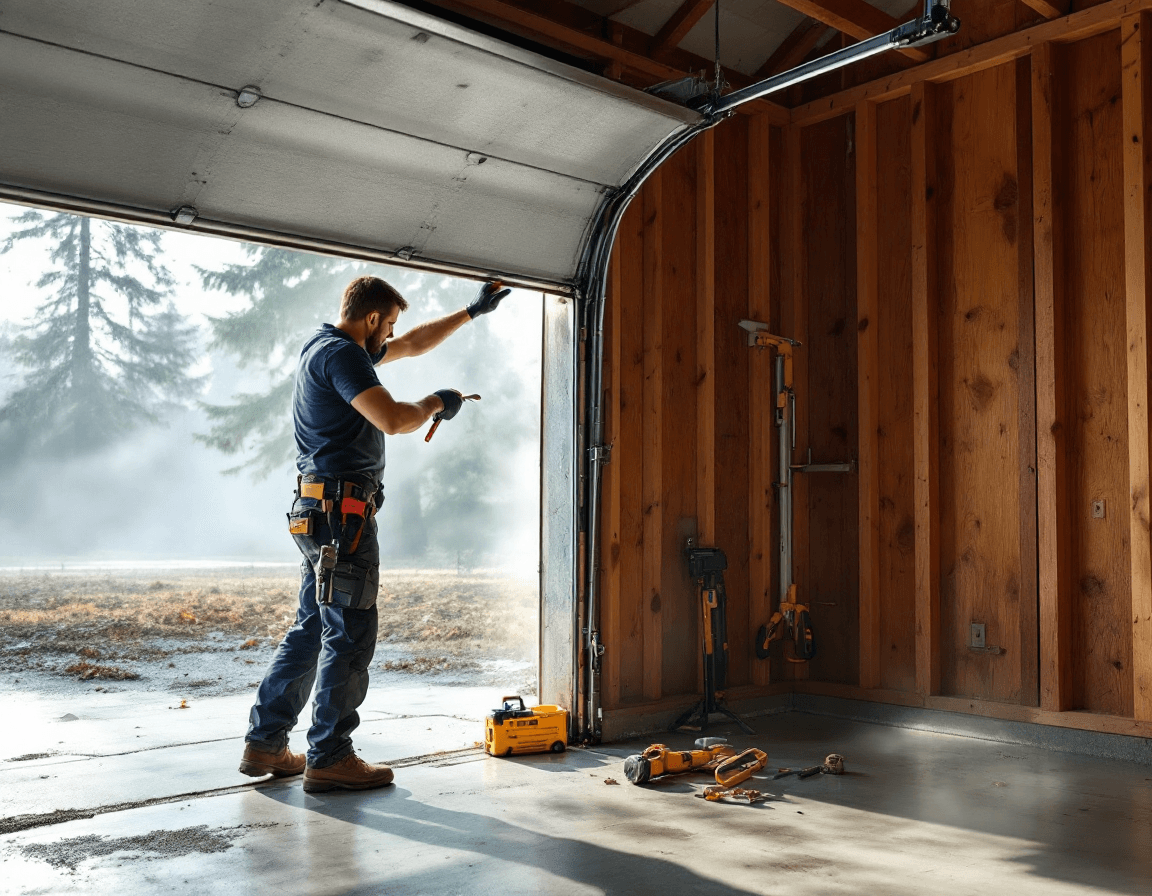
Off-track garage door repair in Duvall, WA is one of the more common calls our technicians take from homeowners along the Main Street corridor and on the quieter roads out toward Cherry Valley. When a door leaves its tracks, the scene can look alarming, with a panel hanging crooked or a gap showing along one side, but the cause is usually something specific, like one roller that jumped, a bent track section, or a bump from a bumper or vehicle. Most of these problems can be corrected in a single visit if they're addressed before the door gets forced open or closed again. This page explains why doors come off track in our part of King County, how to recognize the early warning signs, and what a proper realignment involves.
Duvall sits in the Snoqualmie Valley, where long wet stretches, morning fog, and damp air settle into the same yards and driveways for months at a time. Moisture is hard on garage door hardware. Steel tracks can develop surface rust at the seams and mounting points, and wood framing around a door can swell and shift slightly after a wet winter, which changes how the track sits against the jamb. Those small movements add up, so a door that tracked perfectly in August may start to rub or pull to one side by December. Understanding that seasonal rhythm helps homeowners in Duvall catch problems before they turn into a derailment.
Our crews serve Duvall and the surrounding communities across ZIP code 98019, and we respond to off-track calls with the same tools and checks regardless of whether the house sits in town or on a longer rural driveway. Most off-track repairs we perform fall within a typical range of $125 to $400. The final number depends on what we find when we arrive, including how many rollers need replacing, whether any track sections need straightening or replacement, and whether other components were affected. We always explain the scope before starting work so there are no surprises on the invoice.
Why Doors Jump Their Tracks in a Damp Valley
Garage doors are engineered to ride smoothly in a channel, guided by rollers that travel along the track as the panels fold upward. When something interrupts that path, one roller can slip out of its groove and the door begins to lean. In the Snoqualmie Valley, wet conditions make this more likely over time because lubricants wash away, grit collects in the track, and metal parts begin to corrode. A roller that was seated firmly in a dry summer may ride slightly loose after months of rain and freeze-thaw cycles.
Temperature swings also play a role during the cooler months. Metal contracts in cold mornings and expands again in the afternoon sun, which can cause a track bracket to loosen or a bolt to back out just a fraction of an inch. Over many cycles, that small looseness lets the track drift away from its correct alignment. The door may still seem to work normally, but the rollers begin running at a slight angle, and eventually one of them climbs out of the track entirely. Routine inspection is the best way to catch that drift early.
Older homes in and around Duvall often have original hardware that was installed decades ago, and the wear pattern on those systems can be uneven. Newer homes may use different track profiles or heavier doors, which place different loads on the rollers and brackets. Whatever the age of the system, the underlying principle is the same: the door depends on the track staying straight, the brackets staying tight, and the rollers staying seated. When any of those three slips, the door follows.
Reading the Warning Signs Before a Door Fails Completely
Most homeowners notice something odd before a door fully comes off its track. The first signs are often subtle, such as a slight scraping sound during the middle of the opening cycle or a panel that seems to sit a little lower on one side. Catching these early can save you from a jammed door and reduce the complexity of the repair. The following signs are worth paying attention to:
- The door looks crooked when closed, with one side sitting noticeably lower or with an uneven gap at the bottom seal.
- A roller has visibly popped out of the track, or one side of the door hangs loose at the top corner.
- A gap is visible between the door edge and the track, especially near the top or along the sides.
- The door binds, grinds, or stalls partway through its travel, then moves on its own after a nudge.
- Sections of track look dented, bent outward, or pulled away from the wall brackets.
If you notice any of these, avoid repeatedly operating the opener to see if the door will "work itself out." Running a derailed door through the opener can bend tracks further, damage the opener's trolley, and create a more expensive repair. Stop using the door, keep people and pets clear of the opening, and schedule a technician to inspect the system before the damage spreads.
What Happens Inside the Track When a Roller Pops Out
Each roller on a garage door has a stem that fits into a hinge, and a wheel that rides inside the track channel. When a roller slips out, the wheel may be pinched against the track lip or pressed against the wall, which is why a derailed door often sits at an angle and resists movement in both directions. The panel that lost its roller is no longer supported at the correct height, so its weight shifts onto the neighboring rollers and hinges. That extra load can bend the next section of track or strip a bracket if the door is forced.
In many off-track calls, the roller itself is undamaged. The simple fix is to lift the door carefully, reseat the roller into the track, and confirm that it runs freely through the full range of motion. Technicians check that the roller's wheel is round, that the stem has not cracked, and that the hinge has not elongated around the mounting holes. If the roller is worn flat, cracked, or has a loose bearing, replacing it is usually faster and more reliable than attempting a repair.
Rollers come in several materials, including steel with ball bearings and nylon designs that run more quietly. Nylon rollers are common on many residential doors because they operate with less noise, but they can wear unevenly over time and may need replacement sooner in damp conditions. Choosing the right replacement means matching the track size, stem length, and bearing type, which is why we recommend letting a technician measure and confirm the correct part before installation.
Bent Track Sections and the Trouble With Dents
Tracks are typically made from thin steel, shaped into a channel that the rollers ride through. Because the metal is relatively light, a sharp impact can bend a section outward or inward without tearing it apart. A bent track may look only slightly off from a distance, but even a small deviation can cause rollers to catch at the joint, producing a rough, jerky motion or a complete derailment. Dents near the vertical sections are especially common, since they sit at the height where bumps and bicycles tend to strike.
Straightening a track is a careful process. A technician loosens the mounting brackets, checks the track against a level and a straight edge, and gently works the metal back into alignment using hand tools rather than force. The goal is to restore a consistent gap between the track and the door edge along its full length, and to make sure the joints between track sections line up without a step. Heavily kinked or cracked sections cannot be trusted to hold alignment, so replacement is the safer option in those cases.
Separated track sections are another frequent issue. When the joints between the vertical and horizontal runs pull apart, rollers can drop into the gap and jam. Re-securing the sections with the correct hardware and checking the overhead run for sag is essential, because a horizontal track that sags even slightly will allow the door to drift upward and tilt. We check the entire track path rather than only the spot where the roller came out, because the true cause of a derailment is often somewhere else along the line.
Vehicle Strikes at Driveways Near Main Street and Rural Frontage
Vehicle impacts are one of the most dramatic causes of off-track doors. A backing truck, a delivery van, or a trailer that clips the edge of the door can push the panel sideways and rip rollers out of the track in an instant. In Duvall, where many driveways are wide enough for trucks, boats, and trailers, the margin for error when backing in can be small. Garages near busy stretches or tight turns face the same risk, especially when visitors are unfamiliar with the layout.
If your door has been hit, look first for visible damage to the panels, the bottom seal, and the track. Even if the door still closes, a strike can bend the top brace or twist a section enough to cause rollers to ride unevenly, and the problem often shows up days later. Take photos and note the time and approximate location of the impact, which can be helpful if you need to coordinate with an insurance provider. Do not attempt to pry the door back into the track yourself, since a panel under tension can shift suddenly and cause injury.
Properties with a longer driveway or a detached garage sometimes have less visibility from the house, so an impact may go unnoticed for a while. A door that suddenly looks crooked, makes new noises, or stops closing fully after a delivery or a day of guests should be inspected promptly. Quick attention limits the damage to the track and hinges and often keeps the repair within the lower end of the typical range.
Rollers, Hinges, and the Small Parts That Cause Big Gaps
It is easy to focus on the track when a door looks off, but the rollers and hinges do most of the daily work of keeping the panels aligned. Hinges connect adjacent panels and carry the roller stems, so a cracked or loosened hinge can cause a roller to pull free even if the track is perfectly straight. Over time, the holes in a hinge can stretch from repeated loading, creating a sloppy fit that lets the roller wobble and eventually escape. This is especially common on older residential doors where the hinges were never replaced.
Gaps between panels are another clue. When a hinge fails or a roller wears down, the panel may sit slightly higher or lower than its neighbors, leaving a visible seam or a crooked line along the top section. A technician will inspect each hinge for cracks, check the rollers for flat spots or wobble, and tighten all the fasteners to the manufacturer's specifications. Replacing a single worn hinge or roller is often enough to restore the door's alignment, but ignoring the neighboring parts can lead to another derailment within weeks.
Fasteners deserve attention too. Lag bolts that anchor the tracks to the framing can work loose in wood that has taken on moisture, and machine screws in the hinges can back out with repeated vibration. A complete inspection includes checking that every bolt is snug without being overtightened, since stripped threads or crushed mounting holes create new problems. Good hardware maintenance is one of the most effective ways to prevent off-track events.
Why Binding Doors Need a Hands-Off Approach
When a door jams and refuses to move in either direction, the instinct is often to push, pull, or lean on it to get it moving. That instinct is dangerous. A garage door is heavy, and the springs that counterbalance it store a tremendous amount of energy. Forcing a jammed door can cause a panel to drop, a track to snap free from its brackets, or a spring to release suddenly. For that reason, our technicians never recommend manual force on a binding door.
Spring and cable work is specialized and should always be performed by a licensed professional. Torsion springs, extension springs, and lift cables carry loads that can cause serious injury if mishandled, and adjusting them without the proper tools and training is not a reasonable do-it-yourself project. If a jam is suspected to involve the springs or cables, disconnect the opener, keep everyone clear of the door, and call a licensed technician rather than attempting to free the door by hand. Disconnecting the opener is typically done with the emergency release cord, but that alone does not make the door safe to lift.
Once the spring and cable system is confirmed to be intact, a technician can address the track, rollers, and hinges with far less risk. Realignment often begins by relieving the tension in a controlled way and then guiding the door back into the track one panel at a time. This methodical approach protects both the technician and the homeowner, and it reduces the chance of creating new damage while correcting the original problem.
What a Technician Checks During an Off-Track Visit
A thorough off-track visit follows a consistent checklist so that nothing is missed. The goal is not only to get the door running again but to identify the underlying cause so the repair lasts through Duvall's wet seasons. Homeowners who understand what we examine often find it easier to ask good questions and make informed decisions about the work. The main checks typically include the following:
- Track alignment along the vertical and horizontal runs, including joint connections and bracket tightness.
- Roller condition, including wheel roundness, bearing smoothness, and stem integrity.
- Hinge inspection for cracks, stretched holes, and loose fasteners across all panels.
- Spring and cable condition, checked visually and in coordination with licensed spring work when needed.
- Opener trolley and arm alignment, since a misaligned opener can pull the door out of its channel.
- Bottom seal and weatherstripping, which can reveal whether the door has been struck or has shifted.
After these checks, the technician explains what was found, what was corrected on the spot, and what might need attention later. If a part is worn but still functional, we will say so and note it for future maintenance rather than recommending unnecessary replacement. That transparency helps homeowners in Duvall plan their budgets and avoid repeated calls for the same issue.
Realignment Costs and What Shapes the Final Price
Off-track repairs are priced according to the work required, which is why the typical range of $125 to $400 covers a wide variety of situations. A single roller that popped out and was reseated without damage sits at the lower end, while a door with bent track sections, a replaced roller set, and a re-secured overhead run will land higher in the range. Access also matters, since a tight garage or a door with unusual hardware can add time to the job. We discuss the likely scope on the phone when possible and confirm the final figure after inspection.
Several factors influence the final cost. Track straightening takes more time than simply reseating a roller, and a section that must be replaced requires new hardware and careful alignment. Damage from a vehicle strike may extend to panels, hinges, or the opener, and each additional component adds to the total. Doors that have been forced repeatedly may need a broader set of repairs to restore reliable operation. Understanding these variables helps homeowners weigh their options realistically.
It is also worth asking whether a repair has addressed the root cause. A low-cost fix that reseats a roller without checking the track or hinges may leave the door vulnerable to another derailment. A slightly more thorough visit often costs less over time than repeated emergency calls. We aim to fix what is wrong and to recommend only the work that improves reliability and safety.
Keeping Tracks True Through Rainy Seasons in Duvall
Prevention is the most practical way to avoid off-track problems in the Snoqualmie Valley. Start by keeping the tracks clean, wiping away grit and leaf debris that accumulates along the channel, especially in fall when wind carries needles and foliage into garages and driveways. Use a garage door lubricant recommended for rollers and hinges rather than heavy grease, which can attract dirt and gum up the mechanism. Lubricate moving parts sparingly, and avoid spraying lubricant directly onto the track surface where it can drip and collect dust.
Watch for seasonal changes. After a wet winter, take a few minutes to observe the door through a full cycle, listening for new sounds and checking that the panels rise and fall evenly. Look at the bottom seal and the track brackets for signs of rust, looseness, or moisture damage. In a damp climate, small corrections made early are far less costly than a full realignment after a derailment, so consider scheduling an inspection each year, ideally before the rainiest months arrive.
Finally, be mindful of how the door is used. Teach everyone in the household to park with care, to avoid leaning on the door, and to stop the opener if the door begins to behave strangely. If a door has already come off track, leave it to a professional to restore. Consistent habits, good hardware maintenance, and prompt attention to warning signs will keep your door tracking true for years, even in a valley where the weather never stops testing it.
If your garage door has come off track, is binding, or shows any of the signs described above, call Seattle Garage Door Fix at (888) 799-3819 for prompt service in Duvall and the surrounding communities. Our licensed, bonded, and insured technicians will inspect the system, explain what they find, and recommend the safest path back to smooth, reliable operation.